Archive | April, 2013

Scream (1996)

7 Apr

Drew Barrymore in Wes Craven's "Scream"

Smith’s Verdict: ***1/2

Reviewed by Tanner Smith

When asked why she doesn’t like “scary movies,” teenage Sidney Prescott’s answer is blatant: “What’s the point? They’re all the same—it’s always some stupid killer stalking some big-breasted girl who can’t act, who’s always running up the stairs when she could be going out the front door.” And surely enough, she herself is attacked by a serial killer and does attempt the front door to escape, but whoops! The door chain is difficult to get rid of in a hurry! So what does she do in desperation? Run up the stairs, of course.

That’s only one of many clever moments in “Scream,” a horror movie in which the characters have actually seen other horror movies. It’s a satire of the genre that does what all great satires do to succeed—it contains self-referential humor to gain the comic aspect it’s going for, but it also actually becomes what it’s supposed to be satirizing so that it balances out. As a result, there are as many scares in “Scream” as there are laughs, thanks to a clever, witty screenplay by Kevin Williamson, and nifty direction by Wes Craven who clearly has a true affection for the horror genre.

The film begins with a 12-minute prologue featuring teenage blonde Casey (Drew Barrymore) alone in a big house, preparing to watch a horror movie on TV when her boyfriend arrives. But she gets a mysterious phone call, asking what her favorite scary movie is; Casey plays along, thinking it’s a prank, and they talk for a while. What’s her favorite scary movie? “Halloween—you know, the one with the guy in the white mask who walks around and stalks babysitters.” But then things turn dark when Casey realizes that the person he’s talking to can see her, and as she tries to get him to quit calling her, he realizes that his intentions are deadly. He tells her to play his movie-trivia game in order to live—“Name the killer in ‘Friday the 13th.’” Of course, she gets it wrong (“Jason didn’t show up until the sequel,” the phone voice reminds her), and she and her boyfriend are murdered by someone sporting a Grim Reaper costume (white mask and black rope) and a knife.

Right there, you see how all out “Scream” goes. This prologue is all characterization, dark wit, suspense and ultimately a double-murder, so that we’re on edge for the rest of the film while sticking around to see what else is going to be thrown at us.

It turns out that was just the beginning, as our focus switches to the killer’s real target, a troubled high school girl named Sidney Prescott (Neve Campbell) whose mother was raped and killed exactly one year earlier. Now it seems like the killer is still out there, assuming the accused man was framed in the first place, and is out to kill Sidney just one year since that tragic incident. And if this is sounding at all like the plot for a horror film, it is the plot for a horror film, as the killer who menacingly stalks and calls his victims is seemingly creating a real-life horror movie of his own.

There are many refreshing aspects of “Scream,” and one of them is the whodunit element. The characters are all developed in a way that A) you actually care for who lives and who dies, and B) it really is hard to tell who the killer is. It could be this person; it could be that. The movie keeps you guessing. When the ultimate resolution comes, it’s actually pretty satisfying.

Among these characters are aggressive news reporter Gale Weathers (Courteney Cox) who is covering the story and will do anything to get what she wants; Sidney’s boyfriend Billy (Skeet Ulrich), who is the first person accused of being the killer; police deputy Dewey Riley (David Arquette), who isn’t taken seriously because of his young age; Stu (Matthew Lillard), the high school’s goofball; and Sidney’s friend Tatum (Rose McGowan), the one character you want to see get slaughtered fast (she’s too cold to be likeable; even Gale manages to gain more sympathy than her). My favorite was video-clerk Randy Meeks (Jamie Kennedy), the resident teenage movie buff who describes everything occurring as standard horror-movie stuff. He’s the one who knows the score on this horror film within a horror film (if you will). Some of the best scenes are ones in which he tries to explain the “very simple formula” of it all, and also there’s the scene in which he explains the basic rules of surviving a horror movie—don’t have sex, don’t drink or do drugs, don’t say “who’s there,” don’t investigate a strange noise outside, and never, ever say “I’ll be right back.” One of the most inventive moments of parody comes when Randy, alone in a house watching “Halloween,” is yelling at the screen, “Look behind you!” As he’s saying this, what he doesn’t realize is that the killer is sneaking up on him from behind.

I love the numerous movie references that are scattered throughout; particularly, fans of the horror genre would love to hear these characters talk about their favorite films. We have “Halloween” (of which footage is shown in similarity with what happens in the actual story), “Psycho” (“Did Norman Bates have a motive?”), “Prom Night,” and even director Craven’s own “A Nightmare on Elm Street” (“The first one was scary, but the rest sucked,” one character notes), among many others. Craven even manages to take a shot at his own status, having one of the characters call him “Wes Carpenter” (it’s said that some people confuse him with John Carpenter of “Halloween”).

What makes “Scream” an entertaining horror movie is that the characters themselves have seen horror movies. They know better than to make the same stupid mistakes that the standard stereotypes in the genre make; instead, they make new stupid mistakes so that the plot can keep going, and the killer can be satisfied with the way his sick, demented plan comes into place. Everything comes together in the final act, in which everything is revealed and there is still a good deal of clever moments; I won’t give it away, but the notions the revealed killer bring up are effectively creepy and clever in the way that he knows that they too belong in a horror movie.

“Scream” is a treasure in the horror-film genre. I liked the setup, I liked the self-aware characters, I love the clever wit that is scattered throughout with horror-film in-jokes and self-parody, and while it may be violent, it needed to be in order to make itself known as a legit horror movie and not just a spoof that seems “fake.” Thanks to Craven’s apparent love for the genre, and a crafty script by Kevin Williamson, this is a neat horror movie that even those who aren’t as fond of the genre might have a good time watching.
The Hitcher (1986)

7 Apr

HITCHER1

Smith’s Verdict: ***

Reviewed by Tanner Smith

Usually in horror movies of the 1980s, there is either lack of motivation or too much for the menacing figure that stalked the young hero (or heroes). Arguably, it makes the film more unnerving if there is no motive, but in the case with “The Hitcher,” there may be a motive that hardly anyone could have expected when about to watch it. And it’s a strange, creepily effective motive—to be stopped. The psychopathic title character, the “hitcher,” does his murderous deeds by way of causing misery for a young man’s life, because what he really wants is for this young man to stop him before the situation gets even worse.

I didn’t get this until the second time I watched “The Hitcher.” The first time I watched it, I just thought it was a pointless exercise in violence and gore. There are many gruesome murders and disgusting moments that involve a severed finger in some French fries and a dog licking the dripping blood of his murdered owner. Oh, and there’s also a scene in which the hero’s girlfriend is tied hand and foot between two huge trucks, and the hero has to make sure the hitcher doesn’t take his foot off the clutch of one of them, or the girl will be split in half.

But I digress. The second time I watched “The Hitcher,” my opinion of the film strangely changed. The violence and gore was one thing, but the escalating tension is clearly evident throughout. In that sense, I admired “The Hitcher” more and found it to be an effective thriller.

“The Hitcher” begins as a young man, Jim Halsey (C. Thomas Howell), goes driving at dawn, and picks up a hitchhiker (Rutger Hauer, chillingly charismatic). “My mother told me never to do this,” he tells the hitcher with a grin. Soon enough, he learns he should have taken his mother’s advice, because it turns out this brooding, tranquil stranger is a sick, murderous mind. He tells Jim that he mutilated the previous driver who picked him up and that he’s going to do the same to him. Before he can do anything to him, Jim manages to eject him from the car. But unfortunately, Jim hasn’t seen the last of the hitcher, who keeps appearing and murdering innocent people. And worst of all, Jim himself is framed for the murders as the hitcher continues to make his life a living hell.

One of the most intriguing things about “The Hitcher,” in my opinion, is that we know very little about the hitcher. He has neither a backstory nor a grudge. We just know he’s a sick, murderous mind that is like an ongoing force that seemingly can’t be stopped. And from what we can gather, he doesn’t want to kill Jim; he just wants to ruin his life. But there’s a unique twist here—it’s declared in nonspecific terms that the hitcher is doing this to Jim so that Jim will ultimately stand up and put an end to all of this madness by killing the hitcher. That’s as psychotic a motive as they come, especially considering that the hitcher is doing these terrible things in order for this to happen. And this includes tying a young waitress, Nash (Jennifer Jason Leigh), to two trucks by her hands and feet.

“The Hitcher” may be gory and violent, but it has a great amount of suspense and mounting dread to keep it interesting, effective, and unnerving. The ending of this movie is a final showdown, but it’s more than you’d expect, in an unsettling way. It’s fierce, but it’s also psychological with a certain symbolic final shot that makes you question what really just happened. This is because you realize you never really understood the relationship between Jim and the hitcher, and that climax says a lot by displaying very little.

I’m actually surprised that I like “The Hitcher” more the second viewing. Its central elements are subtler than I originally thought, and the more I thought about it, the more fascinated I was with it. Others can easily dismiss this as just another deplorable slasher-flick. I think it’s better than that.

O Brother, Where Art Thou? (2000)

7 Apr

images

Smith’s Verdict: ***1/2

Reviewed by Tanner Smith

Remember when after “Fargo” was said to be based on a true story; the Coen Brothers revealed that it wasn’t entirely true. Now they say their movie “O Brother, Where Art Thou?” is based on the epic poem “The Odyssey” by Homer. They later revealed that they had never read the story. This movie is not an adaptation to the poem, although there are a few elements taken from the story put into this strange, whimsical Western—there’s a Cyclops, three sirens singing on some rocks near a river, and a journey in which one thing happens after another.

“O Brother, Where Art Thou?” is an active, wonderful piece of work from the Coen Brothers. It’s a fun, strange, whimsical Western story about three members of a chain gang who escape while shackled to each other’s ankles. When unchained, they go on a series of adventures to find a buried treasure that one of them says to have left behind at his home. Oh, and they come across a one-eyed Bible salesman. And three women bathing on rocks that they call sirens.

It’s a road movie, basically, in which these three Southern fugitives seek to find redemption and joy. The self-appointed ringleader Everett McGill (George Clooney) is seeking to settle things with his wife (Holly Hunter); the sour appropriately-named Pete Hogwallop (John Turturro) is hoping to start a new life away from the family name; and the dim-witted Delmar (Tim Blake Nelson) learns along the way that baptism is the best way to go from here. They are chased by the town sheriff, who has a hollow voice, sunglasses, and a big dog.

While on the run, they go through many occurrences, as many people in road movies do. They get baptized in a river, they are briefly accompanied by a black boy named Tommy who sold his soul to the devil at a crossroads, they become a huge hit by singing a bluegrass-themed song “I am a Man of Constant Sorrow,” and they come across a one-eyed Bible salesman (John Goodman). These sequences are handled effectively and to near-brilliance. Some are funny, like the Cyclops; some are just plain fun, I especially love the scenes involving the men singing “I am a Man of Constant Sorrow” while dubbed as the Soggy Bottom Boys; some are dark, the men come across a Ku Klux Klan rally at one point. And then there’s one particular sequence that almost stops the show. It’s an encounter with three sirens that bathe themselves near a riverbank and sing in unison, “Go to Sleep, Little Baby.”

All of these sequences are well-done, and the actors have fun with their roles. Tim Blake Nelson, in particular, seems born to play this role—he has that natural dim-wittedness and his accent helps a lot as well. One criticism I must make is that Everett’s no-nonsense wife is a nagging shrew. I have to wonder why Everett would want to go back to this woman at all. I don’t think I can necessarily hold this against Holly Hunter, although she plays this person all too well. I also didn’t really laugh at the random acts of violence against animals in this movie (cows get shot and a toad is squashed). (I think it’s written in stone that no animal is safe in a Coen Brothers movie.)

“O Brother, Where Art Thou?” does succeed in making us squirm in our seats during a few points and then laugh out loud during a few others. Sometimes, it does both. This is an entertaining road movie with charm, humor, and just plain fun in its Western surroundings.

NOTE: I have absolutely no idea why this film is called “O Brother, Where Art Thou?” If anybody has an idea as to why it is called that, please don’t hesitate to tell me.

Mr. Woodcock (2007)

7 Apr

14wood-600

Smith’s Verdict: *1/2

Reviewed by Tanner Smith

Billy Bob Thornton acts as yet another crude, hateful guy in “Mr. Woodcock”—he played pretty much the same character in “Bad Santa,” “Bad News Bears,” and “School for Scoundrels.” Here, he and other talented actors, including Seann William Scott and Susan Sarandon, are supposed to carry an engaging premise. But the script just kills it dead.

This is the premise—a best-selling author’s mother is about to be married to his old grade school coach who made his life hell growing up. The possibilities within this premise are endless but unfortunately, only a couple of them are added and even THEY aren’t very funny. Think of what the Coen Brothers could have done with this premise and you’d have a much better movie. But with “Mr. Woodcock” as it is, there’s hardly any hope for it at all.

We begin with an opening scene set in the time when the author was just a little fat kid in gym class. Mr. Woodcock pushes these poor kids to the limit—he tells an asthmatic kid, “Take a lap. Lose the asthma.” Then he makes the fat kid strip down to his underwear and attempt to do some pull-ups. What a guy. Cut to about twenty years later, when the fat kid (named John Farley) has definitely slimmed down and grown up to be a best-selling author about “letting go of your past.” He’s played by Seann William Scott, a good comic actor who probably hates being known only for playing Stifler in the “American Pie” movies.

John returns to his childhood home to visit his mother (Susan Sarandon). And boy does she have news for him! She’s engaged to be married to…Mr. Woodcock! Oh no!

This news turns John’s world of fame upside-down and the whole movie is either about him and Mr. Woodcock trying to bond or him trying to break up his mom and Mr. Woodcock. Well, it’s both, but it’s nothing I would really expect from a premise like this. I wish the filmmakers took chances with this instead of giving us what is supposed to be hilarity. There’s one point in the movie where John’s friend (played by Ethan Suplee) visits John, along with his brother who has a swollen eye. The friend tells John he has the solution to the problem—he pops in a videotape and it shows the little brother in a backyard saying unconvincingly, “No, Mr. Woodcock,” and a chair thrown right in the kid’s face. Was that supposed to be funny? Physical abuse to smaller children? There are also plenty of crude, vulgar jokes which are also not funny because the characters know what they’re in for, whereas in “American Pie,” the characters didn’t know what they were in for.

And of course, there are all sorts of slapstick in which a character gets hurt while trying to score a laugh—only one of them worked and it’s in the film’s trailer. It’s the part where John and Woodcock race on treadmills and John slips and falls back into the wall. That was kind of funny.

Billy Bob Thornton does play this role well but then again, we’ve seen him play this guy many times before. He’s the guy who finds your weakness and uses it for nearly sadistic purposes. He’s insulting, hateful, crude, vulgar, violent, and worst of all, uncompromising. (“You must like getting spanked, Farley. I guess it runs in the family.” Ouch.) Seann William Scott, on the other hand, is an annoying whiner and there’s no way I could believe his character could write a best-selling book. Susan Sarandon as the mom is nice, but she’s dumb to fall for Woodcock’s tricks. And then there’s Amy Poehler who plays John’s agent and girlfriend, does the bitch part over-the-top to the point where I wanted her to go away.

“Mr. Woodcock” is a missed opportunity. I would love to give it zero stars, but I’m giving it one-and-a-half instead because of the premise, that one laugh, and Billy Bob Thornton. The rest is just trash.

Halloween II (1981)

7 Apr

stills-halloween-ii-02

Smith’s Verdict: **

Reviewed by Tanner Smith

John Carpenter’s great 1978 chiller “Halloween” did not need a sequel. Sure, it was a box-office success, was the most profitable independent film at the time, and became the phenomenon that would create the “slasher” genre. But it didn’t need a sequel. It was fine on its own.

But with all the trashy, deplorable “slasher” movies (movies in which dumb teenagers are stalked and sliced by some psycho) hoping to cash in on the film’s success, critics and cynics at the time must have hoped that “Halloween II” would at least show copycats of the original how to do this craft properly. But as it turns out, the film is only here as an attempt to cash in, just like the other movies of this sort. It’s a disappointing, repetitive, and (worst of all) boring thriller that lacks the tension and compelling nature of the original film. It’s as if they didn’t want to try so hard with this one because they knew that whatever they would make for a sequel to “Halloween,” it would make money either way.

The eeriness is monotonous and not very tense. The characters are unbelievably dumb. The masked killer, the Shape, has lost his effectiveness as a menacing force, and has instead become a typical slasher-movie villain. Even the gore-level is turned up because apparently, blood and gore sells with audiences (those who are fond of the original remember how bloodless it is, and it had atmosphere and suspense to keep people tense).

“Halloween II” begins just a few minutes after the original film ended. Sick psychotic Michael Myers attempted to kill babysitter Laurie Strode (Jamie Lee Curtis) before Dr. Sam Loomis (Donald Pleasance) shot him seven times (even though he repeatedly, frightfully yells he shot him SIX times, but whatever), and yet his body disappeared without Loomis noticing. Now, Laurie is taken to the nearest hospital, which conveniently (for a horror film) has one doctor on duty and just a few nurses. (I’m not quite sure there are any other patients either—if there were, I’m sure that would explain why there are no complaints about the poor lighting of the building.)

But wouldn’t you know! Michael Myers makes his way to the hospital and kills everyone he comes across!

Wait, how did he know where Laurie was? Why does he still want to kill her? Well, so this sequel can be made, I guess.

Anyway, Michael creeps about the hospital and kills off the people he comes across, while Laurie relies on her wits to fend for herself…Oh wait, I’m sorry; this time around, Laurie is a broken, catatonic fool who is about as complex as Barbra from “Night of the Living Dead.” Scenes that feature her in danger grow really boring as a result.

While all of this is going on, Dr. Loomis is still out to find his patient (Michael) and somehow stop him because he knows for sure that he’s alive because “he’s not a man—he’s evil!” (That’s one of many screaming rants he likes to deliver, including “I shot him six times!”) But soon, he learns of a family connection between Michael and…Laurie? Really? OK, it’s one thing to have a backstory over a character that didn’t need one in “Halloween,” but to have him related to Laurie is to give up hope for this movie.

Halloween (1978)

6 Apr

Halloween 1978 3

Smith’s Verdict: ****

Reviewed by Tanner Smith

John Carpenter’s 1978 thriller “Halloween” sure has spawned more than a dozen ripoffs, most of which deplorable wastes of time. But how does “Halloween” itself hold up? It holds up very well—so well, that I believe it’s one of the best horror films I’ve ever seen. You know the storyline—a masked psychotic killer stalks and kills teenagers. That’s also the storyline for those afore-mentioned deplorable ripoffs like “Prom Night,” “Friday the 13th” (and its sequels), “Terror Train,” and even the lame “Halloween” sequels. But the original “Halloween” is very different from all of those other movies. Why? Read further and I’ll try to explain.

The film opens (on Halloween night 1963) with a wonderful but scary point-of-view shot of someone stalking a teenage girl who apparently had sex with her boyfriend. The person grabs a carving knife, picks up a mask to wear (so we can see through the eye holes of the mask), and stabs the girl repeatedly, killing her. Only when he is discovered do we see who the killer is—it’s a six-year-old boy in a clown costume. That’s the opening scene and it’s an effective chiller. It grabs our attention—especially with the lack of emotion in the little boy’s face as he holds the blood-soaked knife.

The kid is sent away to a mental hospital and is described by his psychiatrist as pure, unadulterated evil. The psychiatrist is named Sam Loomis (Donald Pleasance) and he says he has spent eight years trying to reach through his mind, and the next seven years trying to keep him locked up. But now, fifteen years since the incident, the guy escapes. He returns to the same town and the same street where it happened. And wouldn’t you know it, it happens to be on Halloween. So now, Loomis has to track him down before he finishes what he started all those years ago. But he just might be too late…

Loomis is well-played by Donald Pleasance, but most importantly, the other actors give likable, sympathetic performances. I say “most importantly” because like all thrillers and horror films, they work best if we care about the characters that are in jeopardy. The guy’s primary targets are a trio of teenage girls—Laurie Strode (Jamie Lee Curtis) and her best friends Annie (Nancy Loomis) and Lynda (P.J. Soles). When we first meet them, they seem like realistic teenagers and are likable enough for us to fear for them. That’s either a credit to the writers’ part (the writers are Carpenter and Debra Hill) or the actresses’ part, but it works.

As for the killer—named Michael Myers, or “The Shape,” as he referred to in the end credits—he seems like a demon that stalks before he kills. He kills mercilessly, silently, and remorselessly. Carpenter, as director, is careful about his camera angles for this guy. Until the final act, he isn’t seen entirely. He’s kept obscure to shadows, lighting, or distances.  He’s creepy especially when he is seen from a distance (like when a kid that Laurie is babysitting looks out a window and sees him just standing under the porch light of the house across the street) and still creepy when he gets closer to chase his final victim for the night. He sports a white-painted Captain Kirk mask and black coveralls, and that makes him just as frightening. And we never know what his motivations are. That shows that killers are more terrifying when the motive is unknown. And since he’s possibly mentally-unfit, it would seem like all it would take is teenage sexuality to set him off. All of these make Michael Myers an effective, ominous villain.

John Carpenter’s chilling piano music score for the film may seem simple, but it’s just fantastic. It works well with the tone of the story and it also goes all over the place. Most of the scores will start one theme and lay another theme on top of it, but it will keep the other theme and sometimes start another theme. With this music, added with Carpenter’s clever camerawork in keeping the killer obscure for the most part, it is so hard to feel secure when watching this movie. I remember I had to tell myself, “It’s only a movie, it’s only a movie, it’s only a movie.”

So “Halloween” loves moviemaking, but it also loves its characters. No one in this movie is presented as a stereotype, although that’s how I fear they’ve become after being exploited in the other movies—the Virgin Girl Who Lives to Fight, and the Sex-Crazed Friends Who Die. I don’t know why the ripoffs don’t have the writing talent to create characters as effective as the ones in “Halloween,” but each one has these stereotypes. But here’s something the ripoffs do even worse—they keep the sympathy away from the characters in jeopardy and have the killer be the main focus. That’s a very important difference between “Halloween” and the ripoffs it spawned—we never identify with Michael Myers in “Halloween,” and the movie has us care about what happens to Laurie, Annie, and Lynda.

It’s so hard to make a horror film of this brilliance. “Halloween” is well-crafted, well-acted, thought-provoking, and scary. Since its release and popularity, filmmakers have tried so many times to recreate its terror…but hardly even close to what “Halloween” has created. It’s a classic in the horror-movie genre.

Electric Dreams (1984)

6 Apr

electric-dreams-1984-movie

Smith’s Verdict: ***

Reviewed by Tanner Smith

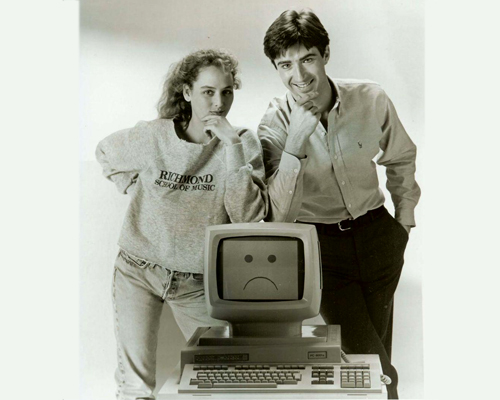
“Electric Dreams” takes a story about as old and as predictable as a romance could get and adds new twists to create a delightful movie. You know that old story of how boy meets girl, boy gets help from his buddy to impress her, and buddy becomes jealous to see how well the boy and girl are getting along? What if the buddy was a computer? Yes, there’s a love triangle in this movie in which the third wheel is a computer.

The computer falls in love. Now, that’s a wonderful idea for a movie. Not only does the computer fall in love, but it also gets jealous—jealous enough to try everything it can to get its owner out of the picture so it can have the girl to itself.

The owner is a shy nerdy guy named Miles, played by Lenny von Dohlen in a likable performance. He buys himself a home computer to get things organized for him, since everyone else has their own pocket organizers. It’s tough trying to get it to work at first, but he soon gets the gist of it…or so he thinks.

Enter the woman who moves into Miles’ apartment building—a fetching cellist, played by Virginia Madsen. Miles feels something for her, and the feeling is mutual. They go out a few times. But what neither of them realize is that the woman thinks that Miles can create great music. You see, earlier in the movie, as the computer gains its “brain” (whatever), it eavesdrops on the woman’s cello practice through a ventilation duct and plays musical notes by itself to follow along, in a duet that is easily the movie’s best scene.

But Miles realizes that the computer talks and has a mind of its own and asks it to create a love song for his new girlfriend. After wrongfully guessing what it sees on TV is appropriate for lyrics and rhythm, Miles helps it out with his own feelings. The result is a beautiful song that Miles takes the credit for, which makes the computer jealous because the computer has fallen in love.

Just thinking about the plotline makes me smile and the movie is just as winning, although maybe a little silly in most eyes, as it goes along. There’s an MTV-style as it goes with its song sequences (particularly with the duet, the love song, and the title song at the end) that gives the movie its energy, but what really makes “Electric Dreams” a nice movie are the central elements, like the actors and the computer. Lenny von Dohlen and Virginia Madsen are great together and separate. Von Dohlen does a good job as this wimpy nerd, and Madsen plays her character as attractive, but not shallow.

But credit should also be given to how well the filmmakers did with the computer. With wonderful voice acting by Bud Cort as the computer’s voice, this is a self-learning computer with a personality of its own. It not only makes for effective comedy, but also for really touching moments, particularly in the final act of the movie.

“Electric Dreams” has an innocence and charm within its characters, the direction, and that wonderful computer that gives me reason to recommend it to those who could use a nice-enough love story. I mean, how often do you come across the rivalry between a man and a machine over the woman they both love?

Field of Dreams (1989)

6 Apr

fieldofdreams

Smith’s Verdict: ****

Reviewed by Tanner Smith

Baseball and the movies usually blend well together. With movies like “The Natural” and “Bull Durham,” among others, the love of the game is evident and well-portrayed. “Field of Dreams” is no exception—in fact, it’s a magical movie. It reminds us of why people love baseball and why it’s America’s pastime.

“Field of Dreams” is a fantasy. It features a man named Ray Kinsella (played by Kevin Costner), who, along with his wife Annie (Amy Madigan), has gone through the fast lane long enough and moved to Iowa to run a family farm. Ray and Annie have a young daughter (Gaby Hoffman) and they all enjoy sitting on the porch and enjoying the relaxation and quiet. But then, Ray begins to hear a mysterious voice in the cornfield. The voice is soft and personal and its instructions aren’t particularly clear—“If you build it, he will come.” Who’s he? What should Ray build?

Then, Ray begins to envision a baseball field in the place of his cornfield. Unsure of whether or not the voice came from his head after stressful work, Ray does the unthinkable and actually plows underneath the corn to build his own baseball diamond.

And what an image it is! To see a baseball diamond right there in your own backyard right next to a cornfield. It’s a wonderful, unforgettable image.

Then suddenly, onto the field walks the ghost of “Shoeless” Joe Jackson (Ray Liotta) of the 1919 Black Sox, who promised until the day he died that he would play the best he could. “Is this heaven,” he asks Ray. “No…it’s Iowa,” Ray responds. And then comes along the rest of the baseball team to come and redeem themselves by playing on the field.

There are problems, to be sure. The decision to keep the field on the farm may put Ray and his family into bankruptcy. And no one else besides Ray, Annie, and their daughter can see the dead baseball players practicing on the field, so a banker (played by Timothy Busfield) believes that they’re all going crazy. But Ray believes a miracle will occur, as the voice is heard again, telling Ray to travel east to meet a famous controversial writer for support, named Terence Mann (James Earl Jones). Terence doesn’t believe Ray’s story about the voice until he has his own experience.

I suppose that’s all I should say about the plot because as the movie progresses, it becomes more imaginative and thus more involving. Just the idea of having these baseball players from the past playing right there in your backyard is intriguing enough, but then the story gets deeper as it goes along with a character who never had a chance to play with the pros and a speech about how much baseball means to people. That speech is so heartwarming and so true, and strongly spoken by James Earl Jones late in the movie, that it exhibits the attitude that the movie is going for with the love of the game—innocence. These ballplayers aren’t merely at the field to impress anyone or prove something to themselves, but merely to continue to play the game they love. They’re stuck in a time when baseball was a game and not just an industry. That makes “Field of Dreams” not merely a great fantasy film, but an effective baseball movie.

The acting in “Field of Dreams” is first-rate. Kevin Costner makes a likable protagonist that you want good things to happen to, and he makes a good couple with Amy Madigan—they’re great together. Ray Liotta does a convincing job playing the legendary Shoeless Joe. James Earl Jones is phenomenally good as the writer who knows a thing or two about the National Pastime. And I can say the same for Burt Lancaster who portrays a character who deserves a second shot at the game as well, after he quit the game early to study medicine.

I won’t give away the ending to “Field of Dreams,” but let me tell you it doesn’t end with a “big game” climax. It’s an ending in which the themes like family values, redemption, reunion, and innocence all come together with the promise of something better to come in the future.

It’s hard to describe how good “Field of Dreams” really is. It’s a wonderful fantasy film about following your dreams and it’s also effective in how it handles baseball and captures the love of the game. It’s a positive movie too—this is not for cynics or disbelievers. The tone and spirit of the movie is modest, but not making the story too sweet that we can’t get invested in it. “Field of Dreams” entertained me, intrigued me, and in the end, it moved me.

Hiding Out (1987)

6 Apr

NQYJUyI2MOn57KiDJGbFeCnky

Smith’s Verdict: **

Reviewed by Tanner Smith

“Hiding Out” is a confused movie. It’s unsure of where it wants to go with its premise. What is its premise? A 20something-year-old stockbroker masquerades as a high school student. OK, but why the masquerade? Oh, so he’ll hide out from mobsters setting out to kill him. Is this a crime thriller or a teenage comedy? Or is it a mixture of both? Does it work? Well, not really. The crime thriller elements are too broad and with the teenage comedy elements (that is, an adult is posing as a teenager in high school), we have the 20something main character developing (or trying to, anyway) a relationship with a high school girl. Sometimes, this is charming. But other times, it’s confused.

Jon Cryer plays Andrew Morenski, the 20something-year-old stockbroker (he has a beard so he’ll look younger later without it). He and his co-workers have been laundering money for a local crime boss, who sends a few men out to kill him. They kill one of his co-workers, who was already freaking out about this deal to begin with, and Andrew runs away and hides in his teenage nephew’s attic. (Already, this is sounding a little too contrived.)

So, Andrew shaves his beard, changes his hairstyle, and enrolls himself in his nephew’s (Keith Coogan) high school. He looks like a high school student, but his adult attitude is unlike the other students. Things get even more complicated (more for us than for him) when Andrew begins dating a teenage high school girl (Annabeth Gish).

There are some mild laughs in the movie, but I have to admit, I found quite a few of the comic situations to be charming and humorous. I liked Andrew’s response in the scene where he’s enrolling in the school and is asked what his previous school was—he says, “Cornell…High School!” Somewhat obvious, but still kind of funny. One absolutely great bit is where Andrew gives his new girlfriend’s father some advice about taxes. Some of the material is pleasant here and Jon Cryer is a likable lead. Also, Keith Coogan and Annabeth Gish are appealing supporting actors. But as a whole, “Hiding Out” doesn’t really work, especially when the bad guys are brought back into the film for a climax. These stock characters don’t work at all.

So to sum it up, “Hiding Out” has some pleasant moments but is sidetracked by an idiotic script device that seems to be the reason the plot has to go underway. I can’t recommend it, but I don’t hate it very much. But you may get less from this movie. In fact, you may groan when Andrew comes up with a fake name by looking at a Maxwell House coffee can and saying, “Maxwell Howser.”

I am Legend (2007)

6 Apr

iamlegend-still

Smith’s Verdict: ***1/2

Reviewed by Tanner Smith

Thinking you’re the last person on the planet is a common fantasy among people. You have everything to yourself and you make do with what you have. But the truth is if you really were the last person on Earth, it’d be a living nightmare. You’d be very lonely and would most likely suffer psychological anguish for life.

Richard Matheson wrote a novel called “I Am Legend” where the main character goes through that very ordeal. It goes through what the character would go through if he thought he was the only one in the world. Everyone else has either died or become vicious creatures (not unlike vampires)…or have they? I sometimes wonder if what the character is going through with the creatures is really just part of the character’s mind, as a symptom of loneliness. It could be. It’d be very interesting if it was.

2007’s “I Am Legend” is the third cinematic adaptation of the novel and it’s a pretty damn good one.

It stars Will Smith in a powerhouse performance as Dr. Robert Neville, an ex-military scientist who just could be the last man on Earth. He lives in the now-desolate New York City, three years after a virus that was supposed to cure cancer wound up wiping out most of the human race. Neville is immune to the virus and has been spending his days alone, trying to develop a cure for the “infected,” which are the people who didn’t die but instead became predatory zombie-like creatures that only come out at night.

He also has one companion—a loyal dog named Sam. They hide during the night and hunt during the day. As the movie opens, we see him hunting for stray elk as he’s interrupted by a lioness (that escaped from the zoo?). But Neville is lonely and can feel his sanity slowing drifting away (like I said, it could just be that the “infected” aren’t really there after all, and everyone else is just dead). He sets up department store mannequins all over the street and actually talks to them in friendly, neighborly chat as if they were really people. And he often suffers flashbacks of his family’s tragic fate, as Neville tried to keep them clear of the danger before it spread. (This is also where we get knowledge of what exactly happened before all of this.)

The first time we see New York City is just breathtaking. It’s abandoned and desolate, looking remarkably like how it would look after three years’ lack of residence—note the weeds growing on the street. It’s incredible.

For the first hour or so, “I Am Legend” is a masterful piece of filmmaking. It’s a thriller with a great deal of tension (overlying and underlying), a more-than-capable actor playing the hero, and a sense of pace and place. And there are some terrific action sequences, in which Neville and the dog are attacked by the infected. And they also follow some really suspenseful moments, such as when Neville and the dog explore dark garages and buildings where one of the infected just might be hiding and waiting to attack. But then the movie runs on autopilot for its final act, unfortunately. The climax of the movie is just your standard monster-attacking-the-house climax where characters are forced to fight off the enemy, nearly get caught, find some way to fight back—you name it, you got it. The outcome is less than satisfactory. It’s forced.

And do you remember what I said about the creatures possibly being figments of the protagonist’s mind? There’s an ending that proves it wrong. That goes to show that “I Am Legend” was, without giving much away, merely to be a B-movie. But until “I Am Legend” heads in that direction, it’s a heavy, tense, entertaining movie.