Archive | March, 2013

Rumble Fish (1983)

14 Mar

RumbleFish-1

Smith’s Verdict: ***

Reviewed by Tanner Smith

There is a clock in each shot. Trickery is used for pivotal sequences. The film is in black-and-white, save for certain random things in color…or are they random? And here we have “Rumble Fish,” the self-proclaimed “art film for young people.” It’s an arty piece of work full of stunning cinematography, unique visual effects, and a lot of symbolism. It’s based on a novel by S.E. Hinton, which apparently no one thought could be filmable except for Francis Ford Coppola, one of the most inventive filmmakers around. But he found a way—the result is not an entertaining film, but a fascinating one nonetheless.

This is Coppola’s second collaboration with Hinton after “The Outsiders.” Apparently right after Coppola and his crew were through with production on “The Outsiders,” Coppola decided to go another round (this time, co-writing “Rumble Fish” along with Hinton, adapting her own novel). Why not?

Like most of Hinton’s stories, “Rumble Fish” is about a band of tough, hard-luck teenagers who get by in their own ways, for better or worse. This one is centered around two brothers—one who can’t live up to the other’s reputation, and the other who can’t live it down. Rusty-James (Matt Dillon) is a hothead who acts tough, but doesn’t have a real gang to follow him or even a real battle to fight. He’s not bright enough to be a leader, but dumb enough to get himself into trouble. He’s no different than Biff Wilcox (Glenn Withrow), a similarly pathetic thug who calls Rusty-James out.

Rusty-James’ brother is a heroic figure simply regarded as the Motorcycle Boy (Mickey Rourke). He’s a born leader and a trouper of gang warfare. He’s also very clever and intelligent—everything Rusty-James isn’t. After being gone for a few months, he has returned to give Rusty-James some life lessons. And he better, because their father, a lazy drunk (Dennis Hopper), is of no help at all. In and out of Rusty-James’ life are his sometimes-girlfriend Patty (Diane Lane); his nervous best friend Steve (Vincent Spano); a “Messenger of the Gods” type nicknamed Midget (Laurence Fishburne); and his unreliable friend Smokey (Nicholas Cage) who believes he could be a gang leader. That’s about as much of a story as we get, with the tired and self-reformed Motorcycle Boy here with one simple purpose—to show Rusty-James what he’s constantly getting himself into.

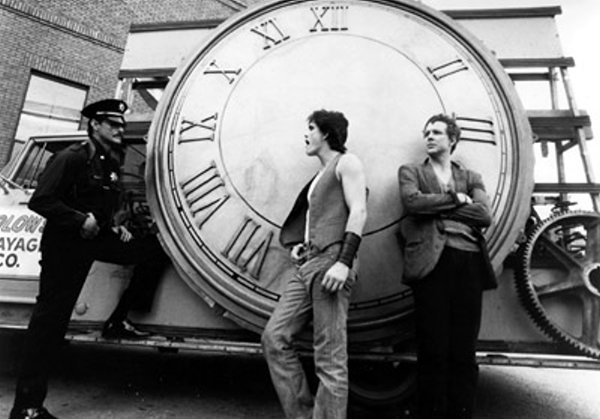
Symbolism in “Rumble Fish” includes clocks in nearly every scene (including two characters standing in front of a giant clock-face) and fast-moving billowy clouds (whether they be in straight shots or in reflections). This is obviously supposed to symbolize that time for Rusty-James is running out before he develops as big a reputation as the troubled Motorcycle Boy. It’s also great to look out—the exaggerated imagery actually amounts to something, rather than giving us something pretty to look at with no substance in the story. Here, I actually felt there was something being said within the imagery. There are also red and blue fish (the only objects shown in color throughout the film) that are supposed to represent the relationship between the two brothers. How the Motorcycle Boy explains what they represent is thought-provoking.

That’s not to say this form doesn’t have its flaws. Sometimes, the symbolism can be a little too obvious, while other times it comes off as pretty distracting. But for the most part, it does work effectively.

There’s one great effects sequence in which Rusty-James has an out-of-body experience after getting hit in the head. He levitates in the air as he literally watches his life drift by. However the filmmakers did that effect that made Matt Dillon float in the air is outstanding work on their part. Watch the scene, and tell me if you see any wires.

As an art film, the imagery and cinematography seems to overshadow the actors, but they hold up on their own. Matt Dillon has played dumb tough kids for quite some time (“Over the Edge,” “My Bodyguard,” and other Hinton film adaptations, “Tex” and “The Outsiders”), but he’s still pretty strong in the role that requires him to change from tough to weak. However, if there’s one actor that stands out among the rest, it’s definitely Mickey Rourke, who is just excellent as the Motorcycle Boy. He has such quiet authority in a role that could’ve been thankless, but he makes it into a sensible, intelligent, intriguing individual. He’s like a veteran actor who suddenly got tired of the fame that his past has brought him, and would rather live it down. Rourke is outstanding in this movie.

“Rumble Fish” is a showcase of allegory, dilemma, and emotion. It’s quite different from “Tex” and “The Outsiders” in that way, but that doesn’t mean it isn’t fascinating. It’s original, it moves, and somewhat to my surprise I found myself more invested in the tales of the reigning Motorcycle Boy.

The Boy Who Could Fly (1986)

14 Mar

MSDBOWH FE015

Smith’s Verdict: ***1/2

Reviewed by Tanner Smith

“The Boy Who Could Fly” is a movie with a great deal of sentimentality. But that’s the point. This movie didn’t need to hint out the moral to its story—it just says it out loud in the final scene. What you’ll be more impressed with is how magical it seems, given that it takes place in everyday suburban life. It’s touching, it moves, and you feel good by the time the movie is over. You either get into it, or you don’t. I did.

As the title suggests, there is a boy and he could fly. But here’s the real situation—the teenage boy, named Eric (Jay Underwood), is autistic and is constantly sitting out on his windowsill, pretending to fly. Sometimes he will even go to the roof of his own house and pretend. According to a teacher at school, Eric’s parents died in a plane crash and Eric started to pretend to fly at that exact moment, as if he could’ve saved them. Eric lives in an urban home with his constantly-drunken uncle Hugo (Fred Gwynne), who isn’t abusive but more confused because of the alcohol. He claims he has seen the boy fly, but then again, he sees a lot of things. And then there’s the story of how Eric may have flown up to a power pole to hide a neighbor’s BB gun, as well as a situation in which he is sitting at the main character’s window and when the main character turns away and back, he’s back on his own windowsill. Can he really fly? Who knows?

The main character—a 14-year-old girl named Milly Michaelson (played by Lucy Deakins)—is already told the stories about Eric’s parents and Eric’s actual flying. She also sees him pretend to fly while sitting on his windowsill. Since she moved into the house next door to Eric, she can’t help but wonder about him. She suddenly feels like it’s her responsibility to watch out for him—she’s the one who “rescues” Eric from the roof of the house (I used quotation marks because Uncle Hugo says later that he couldn’t fall). As time goes by, she and Eric become close with one another. She seems to be the only thing that can break Eric free of his world of fantasy. First he mimics her every move, then (slowly but naturally) realizes what he’s doing and tries to do his best around her. But the problem is, you never can tell what he’s thinking or even if he’s thinking. He only cares about flying…and right now, he also cares about Milly. At one point, he catches a fly ball that almost hits Milly in the head so you can tell he can set his mind to one thing, even if that one thing is caring for Milly’s wellbeing.

Then something happens. Milly is saved from almost certain death when she slips and falls off the side of the bridge while reaching for a flower. The only one that could have saved her life was Eric, who was with her at the time…and the only way he could’ve possibly saved her is if he flew.

“The Boy Who Could Fly” does a nice job of setting up its story by introducing the characters. Milly has moved into this urban neighborhood (complete with white picket fences and identical houses) with her single mother (Bonnie Bedelia) and little brother Louis (Fred Savage). The father, revealed in a scene with a cameo by Louise Fletcher as a psychiatrist, had committed suicide when he realized he had cancer, leaving the family in dismay. Milly is in high school trying to fit in with the snobby types all around her; her mother is back to doing her job in the insurance company but doesn’t know how to use a computer; and feisty Louis has his own little adventures as he tries to get around the block on his tricycle (bullies and a Rottweiler keep stopping him). We’re also introduced to Milly’s nice teacher (Colleen Dewhurst), who believes Milly can get through to Eric when no one else can.

This seems like the kind of movie Frank Capra would have liked to make—a movie that actually tells a story with compelling characters and a neat storyline. The ending, though, is somewhat preposterous but to be fair, you can already see it coming even if you don’t want to. But I was satisfied, nonetheless. In fact, before I was typing this, I was considering a three-star rating for this. I know now that I would much rather rate it three-and-a-half. That’s the kind of impression this movie left on me.

Another reason this movie works is acting, especially with the lead performance by Lucy Deakins. Deakins is wonderful as Milly. Every line of dialogue she says, you believe her. She’s so warm, empathetic, pretty, sensitive, and believable. I liked Jay Underwood, controlled and convincing as Eric; Bonnie Bedelia, convincing as a housewife mourning her dead husband; and Fred Savage who has a watchable kinetic energy to his performance.

I guess I should tell you the moral (if you want the movie to tell you itself, stop reading): if you believe and love long enough, anything is possible. It’s not subtle, but I got into it anyway because everything leading up to it. It earned its message, and “The Boy Who Could Fly” is a treasure of a movie.

Jungle 2 Jungle (1997)

14 Mar

jungle-2-jungle

Smith’s Verdict: **

Reviewed by Tanner Smith

“Jungle 2 Jungle” is the American remake of a notably terrible French comedy called “Little Indian, Big City,” and it should be noted that if you’re going to remake a movie, it’s probably best to remake a terrible one and make many adjustments for an improvement. While “Jungle 2 Jungle” isn’t necessarily a good movie, it does have its moments, which is more than I could say for the original film. This one is more mediocre than it is god-awful.

Tim Allen, the likable funnyman from TV’s “Home Improvement” (and fittingly enough, this movie is directed by John Pasquin, who has directed many episodes of that show), stars as…well, let’s face it—Tim Allen.

OK, his name is Michael Cromwell, but you’re never going to call him that.

He’s a stockbroker who wants to marry his materialistic girlfriend (poorly played by Lolita Davidovich). But in order to do so, he needs to finalize the divorce from his ex-wife Patricia (Jobeth Williams), who ran out on him thirteen years ago because he didn’t listen to her very much. Allen (er, Michael) is supposed to meet her at the airport in Venezuela, but is instead taken to a semi-Westernized Panari tribe in Canaima National Park, whom Patricia has been living with all this time. Upon arriving, Patricia reveals the news that Michael has a thirteen-year-old son named Mimi-Siku (Sam Huntington).

While staying with the tribe for a little while, Michael attempts to bond with his son after all these years of him not knowing about him. Mimi-Siku (whose name means “cat piss”—it was stupid in the original film and it’s as stupid in this remake) goes through a rite of passage that makes him a man (consider it the Panare equivalent of a Bar Mitzvah) and is given a task to go to New York City and bring back fire from the Statue of Liberty, which means Michael has to take him back to the city with him.

And thus, we have the comedic fish-out-of-water tale. Michael takes Mimi to the city, as Mimi has a hard time fitting in. He dresses the same as with the jungle tribe, shoots a bow and arrow at any pigeon that comes around, climbs alongside buildings at many stories up, scales the Statue of Liberty, and mistakes a lot of things for something else. He also has brought along his giant pet spider that attacks anyone who screams at it. (How Michael was talked into letting him bring that along is beyond me.) It traps the girlfriend in the bathroom because she can’t stop screaming at it and Mimi even sets it loose on his dad’s screaming boss.

And there’s also a dart blowgun that knocks people out instantly…how that got past airport security is beyond me. But it, along with the spider, is used for joke setups—only one of which I found kind of funny. I normally am not all for animal abuse, but the case of the girlfriend’s cat being hit by one of the darts and falling down like a rock got a laugh out of me.

With the exception of different locations (it’s New York City instead of Paris, France this time), the story is pretty much the same as the original. But certain aspects are deftly improved from the original—I laughed at a few good jokes, despite how predictable most of them were. And I surprisingly found myself invested in the family drama. Allen and the kid share a few good conversation scenes together, and there’s also a scene in which they’re dancing to street performers that I surprisingly enjoyed, despite its corniness.

What doesn’t work well is a whole subplot involving Allen and his partner, well-played by a nervously paranoid Martin Short, making deals (and misunderstandings) with the Russian Mafia, led by a cartoonish David Ogden Stiers. This leads to an uninspired climax in which they must fight them off when they take Short’s family hostage, after the Mafia thinks they’ve been cheated—the spider and blowgun come in handy here, of course.

Most of the comedy in “Jungle 2 Jungle” is more desperate than funny, particularly the slapstick humor (save for a few slight chuckles). And there are occasional repeats of the same joke, mostly involving the spider. They’re overused.

Also, I have to ask—with all these misunderstandings involving Mimi in the city, why is Michael the only one responsible for him, when Patricia should have come along to make sure he’s given the proper care? I guess it’s because she has to be with the tribe, but this is her 13-year-old son that’s going to a strange place. Sort out your priorities, lady.

“Jungle 2 Jungle” has a few good moments and has learned from the original’s mistakes in some certain ways, but the film is never as clever as we’d like it to be and fails in comparison to other fish-out-of-water stories; in fact, there were times when I was thinking that its main intention was to rip off “Crocodile Dundee.” This isn’t “Crocodile Dundee,” but I wish it wasn’t supposed to be.

The Village (2004)

14 Mar

The-Village-m-night-shyamalan-5421091-1280-720

Smith’s Verdict: ***

Reviewed by Tanner Smith

After the success of M. Night Shyamalan’s previous psychological thrillers “The Sixth Sense,” “Unbreakable,” and “Signs,” you can forgive the filmmaker for wanting to break new ground in his storytelling. In this case, he creates “The Village,” which is set in a late-19th century American village called Covington. With this new setting (he usually sets his movies in modern-day Philadelphia, which is probably where this movie was made), M. Night Shyamalan creates a story that is part fable, part “Twilight Zone.” The result is an interesting (if not groundbreaking) thriller.

Covington is surrounded by woods—the people in this village are isolated from the rest of the world and live in fear of creatures in the woods, simply known as Those We Don’t Speak Of. As far as we can tell, they are vile creatures who don’t take kindly to intruders in their woods. One of the village elders (played by William Hurt) informs everybody that a truce has been made with them some time in the past—the people don’t step into their woods, and Those We Don’t Speak Of don’t attack.

Of course, that plot point must evolve into something bigger. But there is also a love story in this movie, in which the shy Lucius Hunt (Joaquin Phoenix) falls in love with the blind Ivy Walker (Bryce Dallas Howard). Their romance is an interesting one which must be tested with bravery, endurance, and sacrifice—I’d say why but I am trying to keep from revealing any sort of plot twist. Let’s just say that Ivy has to go into the mysterious woods for important purposes.

There are a lot of plot revelations here—one, in particular, is even more upsetting than the twist ending in “The Sixth Sense.” Everybody who goes to see a movie made by M. Night Shyamalan expects a big plot twist—I don’t know what people are going to think of this one. The twist Shyamalan usually brings to his movies delivers surprising plot developments, and in “The Village,” he outdoes himself to the point of somewhat unreliability to the early storytelling. I would not even think of giving away the secret. But even though I didn’t really buy it, I did accept it. You have to suspend your disbelief for this movie.

Some of these villagers may be a bit bland, but they are believable—including William Hurt as Ivy’s father, Adrien Brody as the village idiot, Judy Greer (whom you might recall from episodes of “Arrested Development”) as Ivy’s sister who spotted Lucius first but accepts the fact that he loves Ivy more, and Sigourney Weaver as Lucius’ mother. Joaquin Phoenix is good as Lucius, but the movie really belongs to newcomer Bryce Dallas Howard, who shines throughout.

“The Village” may not be one of M. Night Shyamalan’s best, but it’s effective and creepy enough at times that I can accept it. You always want to admire Shyamalan for his filmmaking style—his pacing may be slow to some people, but what he really does is give us time to absorb what is happening here. And despite the marketing, “The Village” is not as much about invading creatures than it is about sacrifice and discovery. I like that “The Village” didn’t show much of the creatures, which makes them creepier, except for when you actually see them up close. By then, they look almost like costumes you would make at a first-time costume design class. But we can accept this too…I will not say why.

Sex Drive (2008)

13 Mar

sexdrive

Smith’s Verdict: **1/2

Reviewed by Tanner Smith

Just about every year, we get a new teenage sex comedy to relieve us from gravity and also harmlessness. 2008’s is “Sex Drive,” a movie about as raunchy and vulgar as the “American Pie” movies. Looking at the trailer for this movie, I thought I was in for yet another formulaic teen movie. But somehow, “Sex Drive” is fresher than it seems, mainly because the lead characters in the film are so appealing and likable. That’s a nice surprise for a movie like this.

The movie centers around an awkward eighteen-year-old named Ian (Josh Zuckerman) who strikes up a Chat relationship with a hot girl he met…online. She thinks he’s a jock, but the truth is, he’s kind of a dork. He doesn’t get respect at work (he’s forced to go around the mall and sell coupons for a doughnut shop…while dressed as a giant doughnut with eyes and a moving mouth that Ian operates himself) or at home. He always gets himself in embarrassing situations that bring his stepmom to think that he’s weird and unpleasant.

Ian’s best friends are Lance (Clark Duke) and Felicia (Amanda Crew). Lance is pudgy, wears glasses, and has zits…but he scores with a dozen girls because he’s so confident. He’s one of the popular guys in school who tries to give Ian some enough confidence to be with a girl. Felicia is a rebel girl who acts tough enough not to wear a dress for her cousin’s wedding, is best friends with Ian, and secretly has a crush on Lance.

Ian’s online “girlfriend” asks Ian to come down to Knoxville, Tennessee, where she promises him the best time of his life. Lance talks him into stealing his older brother’s hot-looking GTO (nicknamed “The Judge”) and travel all the way from California to Tennessee and get lucky with this girl. In tow is Felicia, who doesn’t know why they’re going to Tennessee but loves the ride.

The movie borrows a few traits from “The Sure Thing”—a teenager travels far just to save sex with someone he barely knows and winds up through a series of misadventures with his passengers. “Sex Drive” isn’t up there with “The Sure Thing.” It’s also not entirely good either. The script has some jokes that are hit-and-miss, and are neither funny nor convincing. “Sex Drive” has issues with supporting characters—there’s an older brother (played by James Marsden) who is constantly on testosterone. Like many annoying older brothers in movies, he’s obnoxious and picks on his younger brother, calling him gay because he’s still a virgin. The punchline for this character may be funny, but the character just isn’t. He’s just irritating. Then, there are the hillbillies that they run into. Then, there’s the hitchhiker they pick up. Then, there are the Amish folk that the characters meet—that whole sequence is somewhat distasteful. And there are many more uneven characters in this movie, to distracting and disturbing effect. It seems like the characters these three teenagers meet are from another planet. That makes “Sex Drive” not so pleasant an experience.

One exception to the uneven supporting characters rule is the Amish character played by Seth Green. Sporting a funny-looking beard, Green plays an Amish fellow who happens to know a thing or two (or a hundred) about fixing motor vehicles. He comes in handy when the heroes’ car breaks down. I like the scene where he and Lance have a talk about his trip to Las Vegas while riding in a horse-drawn carriage.

What’s refreshing about “Sex Drive” are the three teenagers. Ian, Lance, and Felicia are appealing and well-played by Zuckerman, Duke, and Crew. Duke and Crew, in particular, get the frequent share of one-liners and they pull through with great comic personalities. And their characters all have some unique developments (especially Lance who finally finds someone to love). Too bad they’re in a movie that exploits them rather than tries to love them.

NOTE: I really liked that doughnut suit that Ian wears a few times in the movie. That alone gets a big laugh.

Pay It Forward (2000)

13 Mar

pay-it-forward

Smith’s Verdict: ***

Reviewed by Tanner Smith

“Pay it Forward” has the idea for a “perfect world” and I guess I can buy into it—if someone does you a favor, you pass it on to three other people. You don’t pay it back, you pay it forward. Why not? Even if the world doesn’t turn out perfect (does it ever?), at least you’ll be satisfied. You should try it sometime, but you have to do them a huge favor so they can pass it on for sure…well, maybe.

The movie “Pay it Forward” is being criticized as being “emotionally manipulative”—for me, that’s too strong a criticism. I bought the message of “paying it forward” and even felt the emotions that are conveyed in this movie. It also helps that the movie is well-written, well-made, and especially well-acted by the three leads—Academy Award winners Kevin Spacey and Helen Hunt, along with Academy Award nominee Haley Joel Osment, from “The Sixth Sense.” I liked “Pay it Forward” so I guess that means I didn’t mind being manipulated by this particular film. I know that last sentence is going to be used for something sooner or later if anyone ever reads this review, but you know what? I don’t care.

As the movie begins, a washed-up news reporter (Jay Mohr) brings himself into a situation he doesn’t belong—a household robbery. You can already tell this guy has put himself into many situations where he doesn’t belong. But he gets his price when the criminals get away and the police follow him. The reporter’s car, however, is crashed into in the process. So, the guy is standing in the rain with no car and no money. Suddenly, a stranger with a dog and an umbrella walks by. Of course the guy thinks the stranger is messing with him and it doesn’t make things less confusing when he gives the reporter the keys to the stranger’s new Jaguar. Why? “Call it generosity between two strangers.”

Flash back to “four months earlier,” as we meet a young boy named Trevor McKinney (Osment) who is starting junior high school. Since this is a school in Nevada, there are metal detectors in the entranceway and knife-wielding bullies (oh yeah, and some annoying, whining classmates). What is unusual at this school is his social studies class. His teacher Eugene Simonet (Spacey), an apparent burn victim (he has scars on his face), is an intellectual who uses an impressive vocabulary, has a hint of sarcasm in his speech, and a lack of condescension when teaching. The assignment for his class is to come up with an idea to change the world. (Trevor asks, “So you’ll flunk us if we don’t change the world?” Simonet replies, “You might slip by with a C.”)

This gives Trevor the idea of “paying it forward.” He brings a homeless man (James Caviezel) into his home and gives him food and bed for the night. Trevor’s mother Arlene (Helen Hunt) is angry. She wants this man out of the house. But then she sees that the homeless man paid Trevor’s favor forward by fixing the car in her garage that hasn’t run in years.

Simonet lets it down easy to Trevor that the idea is a bit preposterous. Trevor doesn’t care because “everything sucks.” Another way Trevor tries to use his idea is by helping his mother, who is a recovering alcoholic, in having a relationship with the teacher. This leads to a loving relationship that brings Simonet and Arlene together, complications with the boy’s real father (Jon Bon Jovi), and moments of truth (How did Simonet get those burns?).

This story is told in flashback while in the present time, the reporter, played by Mohr, is trying to track down the source to this whole “pay it forward” movement. He meets the man who gave him the Jag and is told that he was helped by an African-American man who got himself arrested for pulling a gun on a nurse because she wouldn’t let the man’s asthmatic daughter be treated first. And so the reporter has to find the man who got arrested and figure out why he did it, and so on. This whole subplot is a bit flawed, especially when we’re trying to keep track of events in chronological order and focus on the relationships between Simonet, Arlene, and young Trevor.

“Pay it Forward” is mostly set in Las Vegas—the streets, the homes outside of it, the desert. It’s an offbeat setting but it works. We see where Arlene works, we see how Trevor gets to and from school on his bicycle, and we see where Arlene and Trevor’s home is located. Setting the movie in Las Vegas is appropriate for utopian ideas like the central one here.

I mentioned before that I bought the film’s emotions and the movie succeeds in creating genuine feeling for the characters. The script is partially responsible, but it’s the actors who must receive high praise. Kevin Spacey is excellent as a man trying to hide his face by using words instead of a mask—his vocabulary is his mask. His lack of condescension to his students is particularly noticeable and his wit is subtle. But he’s an intellectual who knows what he’s teaching, though he doesn’t expect an idea from one of his students to actually change the world. Helen Hunt shows some of her best work since her Oscar winning role in “As Good as it Gets” as a recovering alcoholic who loves her son but is trying so desperately to show it. And then of course, there’s Haley Joel Osment, quite good and effective as Trevor. His timing is excellent and he is a perfect co-star with Spacey and Hunt. And he can also tell the differences in people—who are nice and who are not, especially when Bon Jovi comes in and almost messes everything up.

The ending is most unsatisfying. I won’t give anything away but I don’t really think that this is the right ending for this movie. It gets worse when you really consider the idea again and think about how it led to this totally unsatisfying conclusion. But until then, “Pay it Forward” is a nice movie about three complicated people and a message that gets its way across. I may have been manipulated by the emotions, but I’ll take it.

Bruce Almighty (2003)

13 Mar

bruce-almighty

Smith’s Verdict: ***

Reviewed by Tanner Smith

Now here’s an interesting premise for a Jim Carrey vehicle—Jim Carrey is given God’s powers. Think of all the possibilities that could come out of that idea alone. Director Tom Shadyac, who also worked with Carrey on “Ace Ventura: Pet Detective” and “Liar Liar,” doesn’t use every element that could have made “Bruce Almighty” one of the funniest movies of the decade, but there are still a few good ideas and some big laughs from Carrey’s physical humor.

We get a long opening forty minutes in which we get to know Bruce Nolan (Carrey). He’s a human-interest reporter for Buffalo’s Channel 7 Eyewitness News who doesn’t get much respect or have much luck. On one particularly bad day in which he humiliates himself, loses his job, and crashes his car, he snaps at God. That’s when his pager goes off to an unfamiliar number. But even when the number appears on his pager after it seems to be broken, Bruce can’t help but call. Bruce is led to an empty building where, as it turns out, he is arranged to meet God in person. God (Morgan Freeman) wants to go on vacation so he decides to give Bruce his powers for a few days.

Almost predictably, Bruce does not do a very good job at being God. After all, why waste time with starving children when he can lift a woman’s skirt up and humiliate his snooty co-worker (Steve Carell)? There’s also a funny subplot in which Bruce teaches his non-housebroken dog to use the toilet. And “Bruce Almighty” is never subtle—for example, Bruce’s nice (“angelic,” if you will) girlfriend (Jennifer Aniston) works at a daycare center and aptly named “Grace.” Also, some of the soundtrack features songs about religion, miracles, and power (including, of course, Aretha Franklin’s “Are you Ready for a Miracle”).

My question is why couldn’t the filmmakers come up with more ways for this character to explore the ways of being God? Why not have him travel to other planets? Or stop time? I can think of many other ways these great powers can be explored. Unfortunately, the filmmakers of “Bruce Almighty” create an overly dramatic final half that tries for Capra-esque quality, but doesn’t quite make the cut and seems like another movie. There are obvious jokes that are put into the movie and a blooper reel that shows that the filmmakers are desperate to make people laugh. Some of the jokes don’t really work as well as we’d like them to.

Even though “Bruce Almighty” didn’t go where it should’ve gone, I am recommending it because there were more than three occasions (I lost count) where Jim Carrey had me laughing loudly. He’s back to his mugging and body language that made him a star in the first place. After taking dramatic roles in movies like “The Truman Show,” “Man on the Moon,” and “The Majestic,” he’s back to his rubber comic personality. I loved Morgan Freeman’s performance as God—kind of a twinkling, calm version of the Big Man Upstairs. “Bruce Almighty” is a bit of a lost opportunity, but I am giving it a mild recommendation. I did laugh.

NOTE: You know, with all I’ve said, I am aware that I am giving “Bruce Almighty” three stars while I gave other “lost opportunities” lower ratings. Well, those movies did not have Jim Carrey to lighten the mood. As inconsiderate as they may sound for the other movies I’ve reviewed that almost got the same treatment, I’m sticking by this recommendation. But one of these days, I will die and then I’ll allow God to smite that lousy star-rating system.

Real Steel (2011)

13 Mar

Real-Steal-2011-Movie-Poste

Smith’s Verdict: ***

Reviewed by Tanner Smith

SPOILER ALERT! I’m not bringing up the “Rock-Em/Sock-Em Robots” reference in this review of “Real Steel,” because everyone else already has….and OK, END OF SPOILER ALERT!

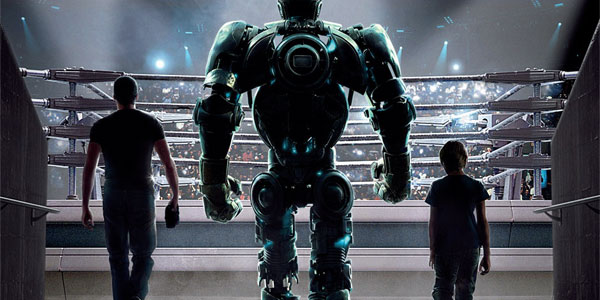
Before I go into the giant boxing mechanical robots that take up the central part of the film, “Real Steel” should first be acknowledged as that rarity of stories—a story set in a future that doesn’t suck for once. Every tale set in the future nowadays has to be some cautionary tale about how our lifestyles will lead to our downfall. But not “Real Steel.” This takes place in the year 2020, which doesn’t look much different from today. The main difference is in our technology. It has advanced to the point where human boxers are replaced by eight-or-nine-foot robots controlled by their owners/managers.

The bizarre thing is that “Real Steel” is actually convincing in making us believe that this could happen. Our technology is changing every time, so why not advance them to the point of using these new creations for underworld boxing? And it’s being taken seriously—the conversations don’t sound contrived, given the situations. They sound surprisingly realistic. Once you accept the idea that robots are fighting in matches, you can buy the movie in general. However, there is also the matter of the story, which is made up of a lot of sports clichés that either tire you or excite you. If you’re in the latter, and like I said, if you can accept this premise, you’re most likely going to enjoy this movie.

The film stars solid-as-always Hugh Jackman as Charlie Kenton, a former boxer who is now operating robots for fights. (In an opening scene, we see him operate a robot to go up against…a bull. That sequence is hilariously credible.) He owes a lot of money to his challengers and keeps repairing and purchasing new robots to go for the big win every time. Once his newest robot is a piece of scrap heap, he needs money to buy a new robot. Enter his 11-year-old son Max (Dakota Goyo), whom he hasn’t seen in years. Max’s mother has just died and Charlie is in line for custody of the child. However, Max’s aunt Debra (Hope Davis) wants to raise him. So Charlie makes a deal with Debra’s wealthy husband (James Rebhorn) that for a hundred-grand, he’ll sell his custody rights over to them. But there’s a catch—Charlie has to babysit the kid for the summer so Debra can go on vacation.

In a junkyard, Max stumbles upon a rusty, old robot called “Atom.” After doing some repairs and tinkering, with help from Charlie’s girlfriend Bailey (Evangeline Kelly), they bring the small, older robot to life. Max convinces Charlie to give him a fight, and to Charlie’s surprise, Atom winds up winning his first fight. And then he keeps winning, with Max teaching him new moves and Charlie lending his own skills in boxing. This seems a lot like a mechanical version of “Rocky,” and wouldn’t you know it? They make it to the championship where Atom must square off against the big, hulking mechanical beast called “Zeus,” run by an Asian billionaire and a female Russian manager. As if that connection to the fourth “Rocky” film wasn’t enough, they even had to deliver the line, “Whatever Zeus hits, he kills.” Sound familiar? I know I’m thinking of a Russian super-boxer from the fourth entry of a certain film series.

“Real Steel” is the kind of sports film with the reliable clichés to depend upon. And it works because of the passion that’s put into the making of it. And the best way to make you decide whether or not you’ll enjoy this movie is to set up the climax, because the climax is nothing new, but delivers those over-the-top dramatic moments of victory. It’s the underdog story, it’s the heroes looking on and smiling, it’s the villains looking shocked as if to say, “No, that’s impossible,” and the buildup to the final round. If that interests you, or if you enjoy these kinds of heartfelt climaxes, you are going to really like this movie. This is in the great tradition of those kinds of sports movies. You either eat it up or you don’t; I just had a good time.

The special effects are incredible. I hear they mixed motion-capture CGI and animatronics for the well-designed robots and choreography for these boxing matches. It’s seamlessly effective. It really looks like the robots are really there, sparring. The “Transformers” movies don’t deliver this well, because I always felt that those giant robots were too much like CGI and I didn’t really believe they were there, nor did I care much for them either. Here, it works. And the robot Atom is pretty likable, and this brings me to write one of the strangest things I’ll write in a review probably ever—if you can make a robot likable, you have quite a movie.

But the robots don’t upstage the human actors that much. In fact, “Real Steel” is actually a character-based story with people that have purpose and dimensions. The key relationship in the movie is with stubborn, handsome, sometimes-a-jerk Charlie and young, enthusiastic, bright, sometimes-a-brat Max. These two aren’t exactly seeing eye-to-eye at first, but on the road, they develop the father/son bond that should have occurred long ago, and this is their second chance.

Hugh Jackman does what he does as Charlie—this is the kind of film role he specializes in playing. And the acting from young Dakota Goyo impresses—he’s not playing the cute-little-kid role. He has more of a personality than that. I only wish that Evangeline Kelly’s Bailey was more developed, especially since she’s introduced in her opening scenes as a strong individual. Olga Fonda has fun playing the over-the-top, grim-smiling Russian manager who loves to exploit her never-losing champion Zeus.

“Real Steel” is an appealing “Rocky for robots,” if you will, and enjoyable all the way through. If you can get into the characters, the cool fight scenes, and the effects, as well as the premise, the heart-tugging, and the ending climax, you’re most likely to enjoy this movie. It’s not great art, but it’s fun, skillful, and enjoyable.

The Dark Knight Rises (2012)

13 Mar

The-Dark-Knight-Rises-and-Bane-get-high-marks

Smith’s Verdict: ****

Reviewed by Tanner Smith

Let’s face it—even if we know that the third and final chapter of a trilogy is somewhat underwhelming compared to the previous movies, we can’t help but see them anyway because we have to see for ourselves what these franchises will end on. This is especially true of the updated “Batman” series by Christopher Nolan, whose “Batman Begins” is brought the Marvel hero Batman to a new darker level, and whose “The Dark Knight” is practically a masterpiece. “The Dark Knight Rises” is the third and concluding chapter in this trilogy and it’s a marvelous, extraordinary, satisfying conclusion to one of the great trilogies in film history.

It’s unbelievable, what Nolan and his crew have not only done to Batman, but also to the superhero genre. Not only are they excellently crafted when skillful filmmaking and top-notch action sequences, they bring heavy doses of conflict and pull off the riskiest move—making the hero an anti-hero. All of that is brought to the nth degree, in that it makes the films the darkest in the genre, and that is why these “Dark Knight” films are so great. They weren’t popcorn films or even lighthearted entertainments—they were deep, rich movies that really made you think about human issues and conflict…and the protagonist just happens to sport a black mask and cape.

“The Dark Knight Rises” picks up eight years after the events in “The Dark Knight.” Bruce Wayne (Christian Bale) is a recluse and his night identity as Batman is no more. If you recall in “The Dark Knight,” the hero-turned-villain Harvey Dent was killed, with only Batman and Commissioner Gordon (Gary Oldman) knowing his true deeds. Gotham was led to believe that Dent was the hero all along and that Batman is no longer needed. Eight years later, Bruce Wayne doesn’t leave the east wing of Wayne Manor and is aided by his loyal butler Alfred (Michael Caine), who thinks it’s time for him to live a new life away from Gotham, as it just made him more miserable. Alfred believes that Wayne just wants things to go bad again so he can feel better.

And coincidentally, enter the mercenary Bane (Tom Hardy), sporting a metal breathing mask and carrying a voice that is part Sean Connery, part Darth Vader. He comes from the League of Shadows, once communicated by Ra’s Al Ghul (Liam Neeson, making a brief cameo as he reprises his role in the first film). He comes to Gotham to expertly spread chaos, and also to rule it as his own. Who can stop him?

Introduced into the mix is a heroic young cop (Joseph Gordon-Levitt), a reluctant deputy (Matthew Modine) who is forced to work that “hothead” cop, and two possible romantic partners for Bruce—one is the sexy, thieving, feisty, not very trustworthy Selina Kyle (Anne Hathaway) also known as Catwoman, and Miranda Tate (Marion Cotillard) who may be able to rescue Wayne Enterprises after Bane’s stock market wipes out Wayne’s finances. I think Wayne has more chemistry with Tate, but then again, he and Catwoman are too busy trying to trust each other to create foreplay (unless that is the foreplay).

But anyway, with help from his new sidekicks and some new gear created by the Q-like Lucius Fox (Morgan Freeman), Bruce Wayne rises again as Batman to assist Gotham in restoring its safety. However, as Catwoman states, there’s a storm coming. Without giving too much away, Bane is surely taking over Gotham and he actually manages to get Batman out of the picture so that he wins. The question is, can the Dark Knight rise again?

Too often do we get the villains attempting to succeed in taking over whatever it is they’re trying to take over. Only in the case of “The Dark Knight Rises,” Bane actually succeeds for the most part. In the middle of the movie, he is able to overrule Gotham and run things along with his followers—mainly prisoners and would-be criminals. (There’s a nice touch having the Scarecrow, played again by Cillian Murphy, being the Judge that sentences mutineers to either exile on thin ice, death by execution, or death by exile.) The city is an absolute hell-on-earth scenario, and only Batman can bring everything back to normal. But how?

As was the case with the previous movies, the action sequences are outstanding. There are scenes of physical violence involving Batman and Bane, and of course Catwoman gets in a few kicks every now and then. But there are also some great chases, with vehicles like the Batmobile, Batplane, and even a Batcycle, most of which come in handy in the sensational action-filled climax. I don’t know how Christopher Nolan is able to take an action sequence and make it look as kick-ass without being overdone, but he always seems to pull it off. I can’t necessarily explain how he does it; marvel at the action here and in his films such as “The Dark Knight” and “Inception” and you’ll see what I mean. I would have loved to see this movie on an IMAX screen—heck, I’d even see it in IMAX 3D if I could!

The Bruce Wayne character is even more conflicted this time around—he’s more heroic, but he’s also more flawed. Not only does he have some major disadvantages that come into place at crucial points in the movie, but also we get more of Bruce’s status as an anti-hero. He’s a hero who could at any point be pushed into joining the dark side, which is why we’re happy that he is our hero and wants to stay our hero. But will he stay that way or will he end up like Harvey Dent, after he realized that being a hero brought nothing to him?

All of the cast members are excellent. Christian Bale is still a solid Bruce Wayne/Batman. Gary Oldman, Morgan Freeman, and Michael Caine are still very game at their reprising roles. The almost-unrecognizable Tom Hardy is a solid villain, though his voice takes getting used to at first. And other newcomers to the trilogy Anne Hathaway, Marion Cotillard, and Joseph Gordon-Levitt are more than welcome.

The ending is just perfect. It hits all the right notes about how to conclude this story of Batman, and that is all I’m going to say about that.

How do I rank “The Dark Knight Rises” along with “Batman Begins” and “The Dark Knight?” To me, that’s kind of a tough decision to make, as I love all three movies the same. It’s like asking me which fast food chain I like better, when the answer is just unnecessary. I love this movie, it’s absolutely thrilling, and it’s one of my favorite films of 2012.

There’s something else I should bring up, and it’s very important. “The Dark Knight Rises” has a running time of two hours and 44 minutes. It was the fastest two hours and 44 minutes I’ve experienced in a cinema. I was not bored for a minute.

NOTE: I state that the third and final chapters of great movie trilogies are underwhelming only when compared to the previous films. “Return of the Jedi” and “The Godfather Part III” may not be as (I’ll just say it) “perfect” as their predecessors in their own series, but they are still fine films. And look at the Academy Award winning film “The Lord of the Rings: The Return of the King”—need I say more?

Big Fat Liar (2002)

13 Mar

mechant-menteur-2002-04-g

Smith’s Verdict: ***

Reviewed by Tanner Smith

Before I give my review of “Big Fat Liar,” I’ll just share the plot. The hero is a bright fourteen-year-old named Jason Shepherd (Frankie Muniz, “Malcolm in the Middle”) who always stretches the truth to get out of doing his homework. But when he’s caught on his latest scam, he’s forced to write a term paper, or he’ll repeat his English course in summer school, obviously the worst thing imaginable to an eighth-grader. Jason writes the paper—a story about a character that is a “big fat liar”—and is just about to turn it in when he runs into the limo of slick Hollywood producer Marty Wolf (Paul Giamatti), in this small Michigan town for a movie shoot. He likes Jason’s wit and gives him a ride, as well as some advice—“The truth is overrated.” Jason accidentally leaves his paper in Wolf’s hands and is sent to summer school for not having it. Later, Jason sees a coming-attractions trailer for an upcoming summer blockbuster, which shares the same story and title as Jason’s paper. Convinced that Wolf stole his story to create a movie out of it, Jason tries to tell his father. Unfortunately, due to Jason’s lying nature, his father doesn’t believe him. So, with his best girl friend Kaylee (Amanda Bynes) in tow, Jason flies to Los Angeles to confront Wolf and prove Jason was telling the truth. However, as it turns out, Wolf is a nasty, pompous creep, to say the least. Even though Wolf won’t tell the truth, Jason and Kaylee don’t give up and, with help from their limo driver (Donald Faison), hatch a scheme to make his life a nightmare in an attempt to get him to change his mind.

I would have guessed that “Big Fat Liar” was made for kids by kids, as the plot is essentially a kid-friendly plot full of Nickelodeon-style hi-jinks. And indeed, writer Dan Schneider (not a kid) has been associated with many Nickelodeon TV shows. But oddly enough, “Big Fat Liar” is still a quite entertaining film. It’s good-hearted, and quite funny and charming.

Kids will love it because it features smart kids outsmarting the mean-spirited adult world, and in Hollywood, no less. They’ll love the scenes in which Jason and Kaylee play Hollywood as their playground (they sneak through the Universal back lot and have fun in a warehouse full of fun props and wardrobe), and especially the scenes in which they find new ways to menace Wolf. I doubt they’ll get a lot of the show-biz in-jokes the movie has to offer (for example, Lee Majors has a bit part as a helicopter pilot), with the exception of a very funny cameo by Jaleel “Don’t Call Me Urkel” White (they air reruns of his show on ABC Family and Nick-at-Nite anyway). Adults will either enjoy it for its innocent fun, or hate it for being somewhat too tame. As for me…it’s hard for me not to laugh at Paul Giamatti playing this producer Marty Wolf so far over-the-top as a practical cartoon. The way he shouts and spews his lines in a ferocious growl is absolutely hilarious.

Oh, and he spends a half-hour of the movie with his skin dyed blue (and his hair and goatee dyed orange). You see, Jason and Kaylee dump a bottle of blue dye in his swimming pool (and orange dye in his shampoo bottle), so that when he emerges from his morning laps, he is shocked to realize that he has to go to a very important meeting looking like a member of the Blue Man Group. (How Wolf’s speedo (and eyes) isn’t affected by the dye is beyond me, but I won’t question it.) My favorite line, from Wolf to his underappreciated assistant Monty (Amanda Detmer)—“I’m blue,” Wolf complains as Monty replies, “Oh, we all have our off days.”

“Big Fat Liar” is that kind of movie. It’s confident in its goofy storytelling and strays away from becoming too stupid, and has some pretty funny moments. Muniz and Bynes have an easy chemistry and each possess a sharp wit. And of course, there’s Paul Giamatti, who is an absolute riot as the live-action cartoon simply named Marty Wolf. “Big Fat Liar” is a little treasure of a movie.