Archive | March, 2013

Sinister (2012)

20 Mar

Sinister-2012-movie-4

Smith’s Verdict: ***1/2

Reviewed by Tanner Smith

We have seen many movies with “found-footage” scenarios—“The Blair Witch Project,” “Cloverfield,” “Diary of the Dead,” “District 9,” the “Paranormal Activity” movies, “The Last Exorcism,” “Chronicle,” and “Project X.” It should be its own genre, if it isn’t already. We know what to think of them because when all is said and done, they are movies. But you have to wonder if someone did view these odd scenarios as if they really were found footage. In other words, what if these types of scenarios really were found footage, and not something staged for a production? What would be going through the head of the person who found it? What would he feel? How would he react? Would watching it have any effects on him?

“Sinister” uses that idea to tell a story about a character that grows obsessed and consumed by a mystery. Much like Alfred Hitchcock’s “Rear Window” or Michael Mann’s “Manhunter,” “Sinister” is mainly about the rules and clues within the mystery, and how it affects the person investigating it as well as how it affects those around him.

But “Sinister” is a horror movie. It has all the aspects of such—darkness, loud noises, a house with a troubled past and a mysterious attic, moaning and groaning, and murders to be investigated. Oh, and there’s also a few odd supernatural symbols and a scary demon-face that appears out of nowhere at appropriate times.

“Sinister” opens in an effectively disturbing way—a Super-8 film that shows the hanging deaths of a family of four, hanging from a tree limb. Soon, we notice that the same tree is in the backyard of the new family moving into this same house. Ellison Oswalt (Ethan Hawke) is an author of crime novels, and he knows that something grisly happened at this location, though he’s forbidden from his supportive wife Tracy (Juliet Rylance) to tell her or their two young children anything about it. Ellison is in need of a bestseller, so he decides to look more into what happened here. While searching through the attic, Ellison comes across a box of Super-8 movies. It seems quite harmless, as they’re all labeled as family home-movies, until Ellison decides to watch them.

Ellison discovers that they are snuff films that show families being murdered in various ways—throats slit in bed, multiple drowning in a swimming pool, being run over by a lawn mower, and also that hanging that was seen earlier. Ellison suspects these are all the pattern of a serial killer and decides to investigate further. But then baffling things start to happen—footsteps in the attic, the film projector starting on its own, and then there’s that ghoulish face that appears in one of the films, and also seems to move on a saved still-photograph. And it turns out there’s more than some human serial killer that Ellison is considering.

You know how the characters of horror films seem to make stupid mistakes when it builds up a climactic act? Ellison is no exception, but at least he has a reason for doing what he winds up doing as the film continues. He’s obsessed, intrigued, and even somewhat fascinated by all of this. The more clues he comes across with this, the more captivated he is by this whole situation. But of course, he also gets his family in danger as well with such knowledge. His son is having night terrors, and his daughter is possibly influenced by some sort of supernatural presence related to this.

(However, you do have to wonder where Ellison’s wife draws the line and decides to pack up the kids and leave this man before he digs deeper into this.)

“Sinister” has fun with the horror genre and also tells its story in an intriguing way so that we are learning with the character more and more as the story continues, like how most good thrillers/horror films work. And it also knows how powerful a film image, such as in these Super-8 films, can be. But what makes it more fascinating was that it was co-written, with director Scott Derrickson, by film critic C. Robert Cargill (spill.com). The fact that a film critic wrote this allows for more to be analyzed through repeated viewings. Watching the film a second time on DVD (I saw it on the big screen the first time), there are a few little things I didn’t notice before, but are starting to become clearer now. You can also tell where he got some of his influences as a writer because there is that Hitchcockian element of voyeurism, as we are watching Ellison watching these Super-8 movies that should never have been watched.

I have to come back to the first paragraph. That’s still fascinating, how it was decided “Sinister” should be, with the “found-footage” aspect. I’m very pleased that Cargill and Derrickson decided to go this route and add the elements of mystery and nosiness to it.

“Sinister” is quite an affecting horror film—it truly lives up to its name. It’s unsettling, creepy, well-executed, and like the most iconic horror films (though I’m hoping there isn’t a sequel to this), it has images that you will haunt you for quite a while, whether you like it or not.


The Gift (2000)

20 Mar

theGift

Smith’s Verdict: ***

Reviewed by Tanner Smith

Artistry can redeem any subject matter. In many cases, the material itself doesn’t necessarily matter for a film—it’s what the artist does with the material and how they handle it that really matters. In the case of “The Gift,” top-notch director Sam Raimi and his stellar ensemble cast make the best out of a standard screenplay from Billy Bob Thornton and Tom Epperson (who also wrote the terrific “One False Move”) that is not necessarily bad or even mediocre, but could have been executed like a disposable, run-of-the-mill supernatural thriller if put in the wrong hands. Thankfully, Raimi and his cast make it anything but. It’s intriguing, chilling, skillfully-made, and very well-acted.

Cate Blanchett stars as Annie Wilson, a psychic living in a backwater Southern town in Georgia. She has three young sons, has lost her husband to an accident, and makes a living by telling fortunes to local people. She genuinely has the gift of second sight (her grandmother had it as well) and has sporadic visions in her dreams and by looking at certain places or objects. She doesn’t fool with people—she listens to her clients and reasons with them in good manner. She doesn’t even ask for money, though her clients are generous enough to give donations. It’s the least they could do for having someone listen to them and give them advice.

Among her clients is a victim of spousal abuse, Valerie Barksdale (Hilary Swank). Her husband, Donnie (Keanu Reeves), is an abusive S.O.B. who beats his wife (giving her “welts the size of footballs on my back,” according to Valerie), and doesn’t approve of Annie giving Valerie advice. He threatens her and her children, even uses a voodoo doll to try and intimidate her, and says he doesn’t want her using her “devil tricks” on his wife anymore.

Also among Annie’s few defenders is Buddy Cole (Giovanni Ribisi), an emotionally troubled mechanic who is afraid he might do something bad to his father. And there’s also a possible romance between Annie and the school principal Wayne Collins (Greg Kinnear), although he’s set to marry Jessica King (Katie Holmes) whose father is highly respected in the town. Everyone else in this town either doesn’t believe in Annie’s gift or believes that she’s in touch with the devil.

Annie starts to see visions of impending doom for Jessica. Soon enough before Annie can even comprehend these visions, Jessica is missing. A few days later, the police go visit Annie to see if there’s anything she can see to give them some sort of lead to her whereabouts, even though they are reluctant to believe that she’s genuinely psychic. Annie is convinced by further visions that Jessica is dead and that Donnie may have killed her. And surely enough, the police find her body in Donnie’s backyard.

But it doesn’t stop there—Annie has to testify while trying to convince the skeptical D.A. of her gift, while also believing that there’s more to this incident than meets the eye. This leads to further plot developments that sort of run “The Gift” off of steam, but are still acceptable mainly because despite everything, we are curious to see where all of this is heading.

Admittedly, the first half of “The Gift” is even better than the second half. The setup is competently handled, and Raimi really knows how to grab our attention with his filmmaking. Notice little details in the Southern town that make it seem like a “Southern gothic” tale—it’s the kind of atmospheric detail that caught attention in Raimi’s “A Simple Plan” (minus the snow). And the story sets itself gradually with a consistently gradual pace, and the characters, for the most part, are well-developed. (For those who aren’t, they still fit their eccentric types, which is suitable enough.) The tension is present, with threats of physical violence and also those upsetting visions that would disturb any nervous viewer.

So, even if the second half of “The Gift” isn’t as intriguing as the first, as it does wind up in the traditional supernatural-thriller fashion with one or two unexpected twists, it’s still admittedly interesting to see where “The Gift” goes with this. As a result, thanks to Raimi’s filmmaking, we’re still not quite sure of what to think of everything being thrown at us, but we’re also still on edge.

The acting is phenomenal—each of the actors give a solid performance in “The Gift.” British actress Cate Blanchett as Annie Wilson, the woman who starts to see this gift as a curse (and she even admits to having a premonition to her husband’s death, thus making her feel guilt), is excellent in this movie. It’s a courageous, understated role that she’s up to (and she nails the Southern accent as well). Keanu Reeves is surprisingly great and manages to radiate pure evil in the performance of Donnie—he’s genuinely menacing. (Keanu Reeves seems to be everyone’s go-to “bad actor,” but watch his performance here and you won’t even see Keanu Reeves.) Hilary Swank makes the best of her small role. The jury’s still out on whether Katie Holmes can act, but she’s suitably cheeky here as Jessica. Greg Kinnear does what he’s required to do (which is to say he’s mild, but supposed to be “too nice”). Giovanni Ribisi is terrific as Buddy—he doesn’t play it over-the-top with the loud fear; he’s genuinely disturbed and even kind of sympathetic.

Thanks to top-notch direction from Sam Raimi and of course solid acting by the ensemble cast, “The Gift” is a good example of artistry overtaking all. This easily could have been a bad movie, given most of its supernatural elements. It’s done very well as it is.

The Rage: Carrie 2 (1999)

20 Mar

936full-the-rage-carrie-2-screenshot

Smith’s Verdict: **

Reviewed by Tanner Smith

“The Rage: Carrie 2” is the supposed sequel to the 1976 thriller “Carrie,” but it very clumsily tries to establish a connection to the original film. Maybe if it were a remake, it wouldn’t be too bad. But the film itself still suffers by the weak attempt to “continue the story,” odd choices of camera angles and cinematography, and just a carbon copy of the original film.

The protagonist is Rachel (Emily Bergl) who, like Carrie, is among the “bottom-feeders” in her high school. She’s a loner—her home life is an unhappy one with foster parents (her birth mother is locked away in an institution) and she has one friend, a fellow loser named Lisa (Mena Suvari). But soon, her world is torn apart when Lisa, heartbroken after losing her virginity to a complete jerk, commits suicide by jumping off the roof of the school building. It’s then that Rachel realizes her power to move things with her mind. She mostly does it when she gets angry or nervous.

Rachel has no one, until friendly jock Jesse (Jason London) finds himself attracted to her and asks her on a date, which she accepts. They see each other for quite a time, making his snobby ex-girlfriend jealous. So she, her friends, and a few jocks come up with a plan to mess with her. But with Rachel’s developing (and deadly) telekinetic abilities, they’re in for a real surprise that can only end in bloodshed…

What doesn’t work at all is the forced connection between Carrie and Rachel. Obviously, they’re both telekinetic, but then it turns out that they’re related—Rachel is Carrie’s half-niece. Sue Snell (Amy Irving, reprising her role as one of the survivors of the massacre at the end of the original film) is a school counselor trying to find some answers regarding Rachel’s power and sees her mentally insane mother (nicely played, given the circumstances, by J. Smith Cameron) to ask some important questions. These scenes are weakly written and serve no purpose. Why not try and make this movie a “re-imagining” rather than a sequel?

The camerawork and editing are all over the map. There are insane closeups, move-ins, “funhouse-mirror-type” imagery added to scenes, and also black-and-white shots that serve no purpose other than…being shot in black-and-white. This makes the violent climax hard to watch and really jumbled into a muddled mess, when it should have been either as chilling as or better than the climax in the original film (at least, in that climax, the only gimmickry was a split-screen effect).

There are some things that the movie does do right. In particular, Emily Bergl does a good job at portraying this high school outcast looking to belong. And the relationship between Rachel and Jesse is well-developed and the actors do show good chemistry together. You can see that Jesse genuinely likes Rachel, and is not in on the joke or seeing her because someone asks her to. (That’s an upgrade from the original film, which used the relationship between the girl and boy as a pity date.) I was more interested in this opposites-attract relationship than with any of the telekinesis stuff. And there are some nice touches of foreshadowing, like a song called “Backstabbing Liar” being played just before Rachel is about to be humiliated.

“The Rage: Carrie 2” is just a mess. There’s too many things going on, only very few to care about, and despite winning performances by Emily Bergl and Jason London, there’s nothing really memorable about it. While the original film wasn’t perfect, it knew how to set up the horror aspects of a teenage girl’s powers taking over. “The Rage: Carrie 2” just knows how to set up an unpleasant orgy of carnage.

Final Destination (2000)

20 Mar

Final Destination2

Smith’s Verdict: ***

Reviewed by Tanner Smith

Death is all around us. It’s an unseen malevolent force that decides when we all die. It has this grand design that is already set in motion. But if that design is tampered with somehow, it only becomes worse for those who were meant to die in the first place. One by one, those who were meant to die originally die right away (not later—right away) in all sorts of freak accidents.

That is the premise for the movie “Final Destination” and what they don’t answer in this movie (or maybe the writers are just afraid to) is where religion fits into all of this. But once you take this premise and combine it with a dead teenager movie, you get a fun, scary thrill ride. This is the same league as dead teenager movies, such as “Scream” and “I Know What You Did Last Summer,” but somehow it’s better because it takes this premise seriously. The teenagers in this movie talk about their situation and try to deal with it before they die in horrific ways. Also, what makes this different from previous dead teenager movies (and more effective) is that the killer in this movie is Death itself—you can’t see it, you can’t feel it, you can’t escape it. That’s chilling enough.

The film opens with a terrifyingly convincing sequence in which a high school senior named Alex Browning (Devon Sawa) and his classmates are leaving on an airplane, heading to Paris for a class trip. But something goes horribly wrong and their plane explodes. This sequence is frightening for anyone about to take a trip on an airplane.

This sequence is a premonition from Alex. He sees the explosion and wakes up at the moment when the plane is about to take off. But he fears that this was no dream and he freaks out, getting himself and a few others (including a teacher) thrown off the plane before it takes off. It turns out his vision was accurate and they all watch as the most horrific occurs. OK, so they escaped Death for now, but this is just the beginning…

Now the question is who’s going to die next and how. One thing is certain—Death is not going to stop and (this is the goofiest part of the movie) no death will be subtle. It seems that Death is a huge fan of Rube Goldberg contraptions. All sorts of unexpected traps are set up to kill off these teenagers one by one. But strangely, it works, especially in a scene where it seems that a teenager is done for—a train is coming while the most macho and idiotic of the teenagers, Carter (Kerr Smith), has parked his car on the tracks; his seatbelt is stuck and the doors suddenly lock. The train is coming and despite the obvious oncoming, I bought the suspense.

Another element I liked about the movie—the teenagers talk about their situation. They have meetings. They try to figure out a way to cheat Death’s design. It’s fun to watch them talk about this preposterous yet terrifying situation. Alex and his girlfriend Clear (Ali Larter) even come in touch with a mysterious mortician (Tony Todd, “Candyman”), who seems to be Death’s spokesman and even has that chilling line, “I’ll see you soon.” (That’s even in the trailer.)

What really helps in the movie is that I actually did care about who lived and who died. Devon Sawa and Ali Larter are appealing as the two leads. The only exceptions are Kerr Smith, who is just plain obnoxious, and Seann William Scott (whom you might recognize as Stifler from “American Pie”), who overdoes it with the white guy-black guy wannabe persona and wardrobe.

Like the “Scream” and “Nightmare on Elm Street” movies, “Final Destination” will inspire the obligatory sequels. I hope at least one of them is as good as the original. But then again, I’m asking for too much. Director James Wong, whose previous TV efforts are impressive, has created a dead teenager movie that has a new twist in the plot, a talented cast, and an intelligence that can’t be described if you asked me to describe it. “Final Destination” is scary, thrilling, well-acted, and well-directed. It is also silly. This is not a great film but a good film. I just hope Death doesn’t take that last sentence the wrong way. If so, I’m committing myself into a padded wall room in a mental institution.

The Thing (1982)

20 Mar

images

Smith’s Verdict: ***

Reviewed by Tanner Smith

What can I say about “The Thing?” On one hand, it’s an effective, well-made science-fiction/horror movie with a sense of atmosphere and ultimately nifty, well-crafted special effects with elements that I hadn’t seen before. On the other hand, there is a lot of gore and disgusting imagery involving the hostile creatures in this movie, most of which I’m not sure I would even want to see again. It’s an uneasy movie to watch, but it is well-executed—I guess that makes it a reason to recommend the movie as a critic.

“The Thing” centers around a U.S. Antarctic expeditionary crew who follows their routine one day until a dog appears on their outpost, followed by a Norwegian chopper in pursuit. With the Norwegians dead, the dog stays at the post as the people go to figure out what’s going on. They find the Norwegian’s base and find all sorts of secret documents and videotapes, containing information about some thing that was frozen underground and unthawed. No prizes for those who guess that the thing is a spaceship.

But that’s just the tip of the iceberg. It turns out the dog wasn’t the innocent victim of a hunting game. It was actually an alien creature that was buried in the ship long ago and revived by the Norwegians. (How? I don’t know—they didn’t explain it very well.) It turns out this dangerous creature has the ability to digest anything it comes in contact with and then turn into them after it kills them. By the time the crew realizes what’s exactly going on, the peril intensifies. Since this “thing” can transform into anything it touches, no one knows who’s a human and who’s an alien.

Most of what “The Thing” has to offer are the creature effects, which compose of some of the most shocking, slimy, nauseating sights you’ll ever see in a movie. As the dog opens its mouth, it turns itself inside out to reveal a creature head, grows many spider-like legs, and sprouts a lot of twitching tentacles to reach out and grab things, including the other wolves in the pen. Then, there’s a scene in which a dead person, killed by the thing, is operated on and then his stomach suddenly opens up and grows a set of large fanged teeth (yes, teeth), bites the operator’s hands off, and grows beanstalks from his neck, which decapitates him. And then the head grows more tentacles and walks around like a spider! And there’s more. Many more. They’re all convincing, but that’s what makes them most revolting.

One other problem with “The Thing” is its poor characterization. The characters are either poorly developed or not developed at all. As I check the cast list, most of the many victims are played by seemingly popular character actors. But aside from Kurt Russell as the film’s tough hero, no one in this movie stands out. Unfortunately, this means I didn’t care much for who all lived and died, and that’s a key element for a horror movie.

Why can I recommend “The Thing” if I tell people that they might be revolted by its disgusting imagery and lack of character development? Well, the effects are well-done and if you’re in the right mind set, they are fun to watch. I like the creativity that came with these special effects—there are some unique monsters here. I also liked Kurt Russell as the hero, because Russell at least made an effort to do something with his character. And there’s a real sense of atmosphere in this movie—the director John Carpenter, who made great atmosphere out of the suburbs in the creepy “Halloween,” makes use of his surroundings and effectively recreates the Antarctic. It looks real and feels real, so the action and terror surrounding it makes for some good tense moments. So don’t say I’m going soft on “The Thing,” because if I was, then…maybe I’m a Thing. (Mwahahaha!)

Lethal Weapon (1987)

19 Mar

images

Smith’s Verdict: ***1/2

Reviewed by Tanner Smith

I suppose the “buddy-cop picture” is a genre. You know the story—two mismatched cops who work together to solve a case and form a bonding friendship along the way. There have been many of this type of movie, but “Lethal Weapon” is the best. “Lethal Weapon” is an action-packed thriller that does feature a pair of mismatched cops working together to solve a case, but also features character development and wry humor. But of course, it does have its dose of adrenaline within itself so that the film has a share of characters, comedy, and action.

Danny Glover stars as police sergeant Roger Murtaugh, an uptight family man with just a few weeks left until retirement. He’s “over the hill” now and constantly says he’s getting “too old for this sh—.“ Mel Gibson co-stars as Sergeant Martin Riggs, a loose cannon who lost his wife in a tragic accident. He blames himself for her death and even considers killing himself. Because he doesn’t think he has much to live for, he’s suicidal in the way that he doesn’t fear anything.

Murtaugh and Riggs are paired up and assigned to investigate the seemingly apparent suicide of the daughter of an ex-Vietnam War compatriot (Tom Atkins). But soon, it seems like that this death was an element of a drug smuggling plot. The leader of it is mercenary General Peter McAllister (Mitchell Ryan) and his right-hand man is the menacing, torturous Joshua (Gary Busey). Murtaugh and Riggs get into more than they expected.

But it’s not just about that, even though this plot detail is crucial (not to mention easy to follow). It’s also about the characters. We know and see clearly how Murtaugh feels about getting closer to retirement, and we also see the pain in Riggs’ eyes when he’s not making people believe he’s crazy. Then, we have the scenes in which Riggs interacts with Murtaugh’s family. They have dinner together and Riggs has a playful flirtation with Murtaugh’s teenage daughter (Traci Wolfe). But we also see how he envies Murtaugh’s home life.

A word about Riggs’ attitude—he loves to make people think he’s crazy by throwing himself in every dangerous situation he can get into as a police officer. When we first see him, he’s walking through the line of fire during a madman’s gunfire attack onto a school playground and standing dead center in the playground, opening fire at the madman. That’s when we know that he may be crazy until we see him at his home—a trailer near the beach—and realize that he thinks that he has nothing to live for due to blaming himself for the tragic death of his wife. So he does anything that no one else would do—this leads to a scene midway through the film in which he deals with a man threatening to jump from a building. This scene is played for comedy, and the payoff at the end of the scene is just fabulous.

The bad guys are genuinely threatening. Even if McAllister is a standard villain, Joshua is a real creep. This guy is so frightening that if he was in charge of the whole operation, there’d be a higher body count for this film. He proves himself to be a worthy antagonist for Riggs to encounter in the end, which is what they do, but that’s all I’m going to say about that, except this—the final action climax is the least interesting part of “Lethal Weapon” when compared to the character development and wry humor that came before it, even though other action scenes were also featured within the previous acts as well.

The action scenes are brought to life by director Richard Donner, director of “Superman.” His choreography and cinematography is outstanding in the scenes involving a shootout and an armed helicopter. When the lengthy climax comes into place, the action is exciting for a while but comes close to wearing out its welcome. But because we care about the characters and have an interesting bad guy, it’s not totally worthless.

Mel Gibson and Danny Glover are perfectly cast as the two heroes. They have great onscreen chemistry and become characters rather than caricatures. Mel Gibson is no stranger to action films (remember, he is Mad Max), so the real surprise is Danny Glover who previously acted in dramas like “The Color Purple.” He’s up to it.

“Lethal Weapon” has just what an audience wants in an action picture—action and comedy. First you can laugh, then something big happens, then you can relax again after that. It’s an action-thriller with a sense of humor and a sense of pace. That’s what makes the film special and different from most buddy-cop pictures.

The Incredible Hulk (2008)

19 Mar

images

Smith’s Verdict: ***

Reviewed by Tanner Smith

When Ang Lee’s “Hulk” was released in 2003, it left many movie audience members (and a few fans of the original Marvel comic book series) feeling disappointed. I think it was due to the fact that it was heavy on character development rather than action sequences (the special effects didn’t impress them either). So, a sequel was out of the question and a “reboot” was called on schedule to completely ignore the 2003 disappointment.

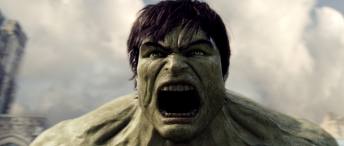
As a result, the reboot, entitled “The Incredible Hulk,” is a fairly decent superhero movie. When “Hulk” was more of a character piece, “The Incredible Hulk” has some of the same characters (Bruce Banner/Hulk, Betty Ross, and General Ross), but not much development. And no, I don’t just mean compared to the 2003 film either. But on the plus side, Bruce Banner is given enough development—that counts, considering he is the central character. And the character is played by a terrific actor who almost always has great screen presence—Edward Norton. I have to be honest—I wasn’t sure Edward Norton could hold a candle to Eric Bana (who played the Bruce Banner character in the 2003 film). Eric Bana showed a great sense of vulnerability as the character and was the subject of a tragic case. In Norton, I felt he was just as strong and added some original touches to the character.

The movie begins with an opening credits sequence that shows images of Bruce’s back-story. Bruce Banner was part of an experiment for the government that went totally wrong. Bruce became the Hulk as a result—for those who are new, the Hulk is the nickname for a giant green monster that Bruce transforms into when he gets angry. When the opening credits are over, we see Bruce hiding out in Brazil, where he learns to control his anger so the Hulk doesn’t take over, much like “Jekyll and Hyde.” Bruce is trying to find a cure for…I was going to say, “disease,” but what exactly do you call this? I dunno, but if he wants it gone, it’s a disease in this case. Anyway, Bruce works at an energy-drink bottling plant, where a drop of his blood accidentally drips into one of the bottles. This leads to General Ross (William Hurt, chewing the scenery here) discovering where Bruce is and sending his soldiers to chase after him.

This leads to a few action sequences that I have to admit are more fun than in the 2003 film. They’re so alive and energetic. They’re as much fun to watch as the action sequences in “Iron Man,” of which this film is in the same universe (you’ll find out what I mean when you see the very last scene of this movie). But what doesn’t quite work in “The Incredible Hulk” was an element that helped make “Iron Man” a strong piece of work—the love story. While the romance between “Iron Man’s” Tony Stark and Pepper Potts was fresh and very sweet, the romance between Bruce and Betty Ross (Liv Tyler), the daughter of General Ross, just seems all too generic. Also, Liv Tyler’s performance was pretty bland. But to be fair, I think that had to do with the way the character was written. There isn’t much juicy material written within the Betty character. There is one exceptionally clever moment with Bruce and Betty’s relationship later in the film as Bruce and Betty are about to make love when Bruce realizes that he can’t get too excited. (I would love to explain the dangers of a superhero sex scene, but I’ll save it for a superhero movie that actually has one.)

I also should say I like this 2008 Hulk better than the 2003 Hulk. It looks a lot better than the former Hulk (which looked more like Shrek on steroids) and has better movements. Sure, it’s CGI and there were times when I didn’t believe it was there. But in the 2003 film, I really didn’t believe the Hulk was there. Wrapping this up, what have I left out? Only the soldier played by Tim Roth, whose character’s motivations are given away by the film’s trailers (shame on the marketers, by the way).

Little Miss Sunshine (2006)

19 Mar

26suns.2.600

Smith’s Verdict: ****

Reviewed by Tanner Smith

“Little Miss Sunshine” answers the question, “Is it possible to create something great with elements of a formula road movie?” The answer for this movie is yes. “Little Miss Sunshine” could be described as a road movie because a dysfunctional family is forced to travel halfway across the country, but what makes it very original, compelling, and funny is that this movie is also a character study. These characters within this family are well-developed and are unique individuals. They give “Little Miss Sunshine” its strength.

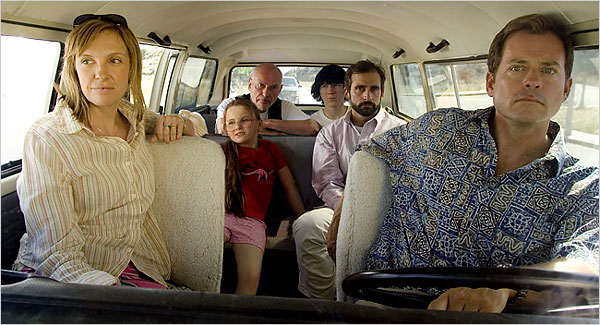
These people are the Hoovers. To call them dysfunctional is an understatement. The man of the house is Richard (Greg Kinnear), an overconfident, winning-obsessed life-lessons coach who can be unbearable to live with. His wife is Sheryl (Toni Collette), a completely honest housewife who tries to keep her family from falling apart. Sheryl’s brother is Frank (Steve Carell), a suicidal, gay Proust graduate. Richard and Sheryl’s children are seven-year-old Olive (Abigail Breslin), a glasses-wearing girl a little on the plump side who is determined to win a beauty contest someday, and teenager Dwayne (Paul Dano), an oddball who reads Nietzsche and has taken a vow of silence. That leaves Grandpa (Alan Arkin), a heroin-snorting wise guy.

These people are so original and so much fun to watch. They deliver the strengths to this story, which is interesting and funny because of the more appropriate reason—its script is funny. The writing here is Oscar-worthy. It’s rich, alive, funny, and touching. All of these elements of the writing are put to the screen to perfection by directors Valerie Davis and Jonathan Dayton, and by the actors, who know these characters by heart and don’t seem like they’re reading lines at all. I loved watching these people act and listening to them speak.

For example, there’s a dinner scene in the beginning of the film, in which all six family members are eating chicken at the dinner table. Here we get to know who these characters are, without annoying exposition. Too many introductions to characters just read lines that describe to the audience who they are at random. But in this dinner scene, they made cute, little Olive the questioning little girl who causes Frank to explain his reason for committing suicide. He explains it as calmly as possible.

But soon, it’s time to hit the road. Olive is in a top spot in a little girls’ beauty pageant and has a chance to compete in Little Miss Sunshine. They drive an old, yellow VW bus to California, where the contest is being held. But it doesn’t seem like the bus will survive this trip. Its clutch is shot so they have to run out and push it to start it. That’s one of many road trip problems this family goes through—there is also comedy, tragedy, and revelations, all of which written very well. But nothing could prepare them for when they finally make it to Little Miss Sunshine. I will not give away the outcome except to say that it comes totally unexpected and will cause discomfort for some people but big laughs for most.

And let’s be honest–these types of pageants are disturbing, disturbing, disturbing! And “Little Miss Sunshine” thankfully knows that enough to make audience members cringe at certain moments. But at least the movie delivers a solid punchline.

The story is somewhat similar to a lesser family road movie released earlier in the same year (2006), “R.V.” This one—“Little Miss Sunshine”—has more heart and more humor, as well as a lack of cliché. In “R.V.,” you knew the R.V. was going to be dumped in a lake. In “Little Miss Sunshine,” you may think you know what will happen when Richard confronts a man who ripped him off and they have an argument near a swimming pool. If you’ve seen as many movies as I have, you would think that Richard would throw the man in the pool…but he didn’t! Another great bit is when Dwayne writes in his notepad to explain to Frank that he hates everyone. Frank asks about his family, and that forces Dwayne to underline the word “Everyone.” There are many other great bits in this movie and a few great scenes as well, like the dinner scene. I love the scene in which Grandpa gives some vulgar advice to young Dwayne, every scene in which the family has to get out and start the bus, an encounter with a highway patrolman, and other scenes as well-written and acted as those.

The acting is top-notch. Greg Kinnear is well-cast in a role that basically requires him to be a pompous, winning-obsessed man. Toni Collette is great as the pro-honest mother. Paul Dano does everything he can with a performance that requires hardly any dialogue—his facial expressions say everything about the character. Abigail Breslin is an absolute delight as Olive. She’s very talented and understands her part very well. And she doesn’t go for the deadly cuteness that many child stars fall into. Alan Arkin steals all of his scenes as Grandpa. But the biggest surprise here is Steve Carell, who plays it straight in this role. Carell is wonderful as this strange person. His line-delivery and facial expressions are unique—sometimes they’re funny and other times, they make us care for him. This is a career highlight for Steve Carell.

“Little Miss Sunshine” is a delightful movie—funny, charming, and alive. With its clever script and truly original characters who are well-acted by the actors, “Little Miss Sunshine” is the movie that “R.V.” wanted to be.

Prince of Darkness (1987)

19 Mar

POD Catherine

Smith’s Verdict: **

Reviewed by Tanner Smith

“Prince of Darkness” is a thriller by John Carpenter, who clearly knows how to set up a story for such. His eye for relativity and terror in the more ordinary settings and situations is what made the thriller “Halloween” so special. And “Prince of Darkness” does have an intriguing idea and a promising setup—using scientific experiments that result in bringing the Devil back to life. You can play a lot to that. But unfortunately, the movie results in predictable jump-scares, too much mumbo-jumbo, and a climax in which a possessed person bangs a person’s head against a wall when he should be tearing it off. It doesn’t become exciting or suspenseful. Heck, it doesn’t even become cheesy. It just becomes boring.

It’s about a priest (Donald Pleasance, from “Halloween”) who enlists the help of a physics professor (Victor Wong) and his students to work on something peculiar in the basement of his church. Pleasance believes that the Devil’s return is near and it must be prevented. Wong (in on the theory) arranges for experiments that could stop the Prince of Darkness from appearing, without telling his students what they’re really doing. But who can ignore the big green thing in the giant glass tube that seems to be growing? Oh…may it be a life form?

So here we have a potential battle between certain science and the chaotic supernatural. But unfortunately, that’s not what we get. What we get is a horror movie, in which the evil force possesses each of the good guys and the ones that are left are forced to fight for their lives. When we hear about the Prince of Darkness about to rise, we expect something very interesting. But it turns out to be a washout. I don’t want vicious zombies taking over here. I want a fear of Armageddon. But no such luck. And of course, there’s a violent conclusion, followed by a twist ending that I really don’t follow very well.

Also, the movie’s pacing is poor. Everything moves so slowly, and not even a rock music score can keep it going. In fact, the music, co-composed by Carpenter himself, is quite terrible and hardly ever shuts up.

The setup is promising as the characters are introduced and the theory of the differences between our world and the supernatural is quite intriguing. But “Prince of Darkness” shows itself as pretty thin and lazy very quickly once we get into the story’s “conflict.”

NOTE: The opening credits lasts for nine minutes—that’s got to be some sort of a record, right?

Over the Edge (1979)

19 Mar

images

Smith’s Verdict: ***1/2

Reviewed by Tanner Smith

This had to happen sooner or later. Kids are pushed over the edge by their parents. They feel alienated and condescended by authority. At least, that’s what psychiatrists would conclude about the outrageous behavior the kids pull off in the movie “Over the Edge.” The marketing for the film tells it appropriately: “They were old enough to know better but too young to care.”

“Over the Edge” is a depressing and quite genuine film about the lives of troubled youths who live in a Denver suburb called New Granada, still in development. The kids spend their days at the local recreation center while the adults—parents, cops, and schoolteachers—try to find a way around the “youth problem,” since they feel that the kids are in the way of their paradise. One cop, in particular, practically stalks these kids each day to try and catch something on them. This is Deputy Doberman (Harry Northup), who is not really a bad guy but a deputy who knows more about the law than about human nature.

The kids have their own fun avoiding the adults during the day—going to parties, having a little hash or speed, playing with a gun they stole from someone else’s home, and talking about sex. It should be added that most of these kids aren’t bad. They just feel unwelcome by the adults, especially when they close down the rec center so the Texas investors who visit New Granada won’t think the suburb is invested with youths. That’s really low.

The main character is a good kid named Carl (Michael Kramer). He hangs with tough guy Richie (Matt Dillon) and has other friends who are into dope, hash, and speed. His parents love him and think that he’s hanging with the wrong crowd. (And Carl, like most kids in his situation, can’t fully explain under so much pressure.) He has a crush on a girl named Cory (Pamela Ludwig), who is said to have a sexual reputation which may not be true, and she has feelings for him. Soon, they become very close with one another.

But disaster strikes and Carl winds up in a nasty situation when Doberman shoots one of his best friends. This leads up to the climactic, violent ending, in which the kids are over the edge and ready to strike back at the adults. They don’t perform physical harm to the adults, but they make them suffer by showing them what they can do when pushed over the edge. The ads for this movie apparently found the climax promotable and made the whole movie sound like a youth version of “The Warriors.” I’m serious—this ending is ultimately violent. There are destroyed cars, exploding gas tanks, and more.

The ending may be a bit unconvincing but what leads up to it is exceptionally brilliant. We get to know these kids, we feel for them even when we shouldn’t, and we care about what happens to the kid who is doomed to be shot and killed (not saying who it is). “Over the Edge” gives a great portrait of teenage life. The kids are portrayed in a convincing way—they have adolescent values and real emotions. This is helped by great performances by the young actors. Michael Kramer is convincing as the trouble teenaged lead. Matt Dillon is convincingly tough as Richie and he has the best line: “I only got one law: a kid who tells on another kid is a dead kid.” Pamela Ludwig shares some terrific scenes with Kramer. Their scenes together seem so wonderfully crafted; everything they say and do make them right for each other. There’s another kid, played by blond-haired, wide-eyed Tom Fergus, who steals every scene he’s in.

Actually, if you think about it, maybe these adults have gone too far. Maybe they deserve to see what they’ve stooped their kids into doing. Maybe. But the scary thing is that there are kids in the real world who are like the kids in “Over the Edge.” They’re old enough to know better but too young to care.