Archive | March, 2013

River’s Edge (1987)

22 Mar

images

Smith’s Verdict: ***1/2

Reviewed by Tanner Smith

It’s one thing to make a teen drama. It’s quite another to make a teen drama inspired by a true story. The fact that the film “River’s Edge” is inspired by a true story makes the film even more disturbing. The film features teenagers who drink, do dope, and have no real purpose in life. Just the way these kids are depicted is unnerving enough, but the main storyline is about one of those teenagers killing another of their own without any remorse. Why? She was talking too much. And it’s a true story. A high school student, in real life, did strangle his girlfriend and showed the body to his friends. What’s worse? The friends never said anything about it to the authorities for quite a while until one of them finally confessed.

“River’s Edge” is not a forgettable film. It’s a disturbing, unnerving, creepy portrait of stoned teenagers who think they mean well but really they’re just confused. The way they act is unsettling for any parent. There is one kid who more heartfelt than the others, but he still smokes dope—his mother also thinks he’s stealing her dope. The kid scolds his younger brother, who is a 12-year-old, sadistic little creep who just dumped away his little sister’s beloved doll. “You’re stupid enough to pull a stunt like that, but then to go and brag about it…”

Not much later, the kid and his friends are taken to the side of a river to see the naked dead body of a girlfriend of one of the teenagers. The film is not really about the girl’s killer (Daniel Roebuck), who couldn’t care less about what could happen to him if anyone else finds out. The film focuses its attention on the group’s self-appointed leader Layne (Crispin Glover), who has obviously taken one shot of speed too many. Layne wants to protect his friend and orders the others not to say anything. But the sensitive kid, Matt (Keanu Reeves), doesn’t want to wait much longer. Also, there’s a girl named Clarissa (Ione Skye) who asks, “She was our friend. Shouldn’t we feel sorry for her? Are we supposed to just ignore it?”

What’s even more haunting about these kids is that the young actors portray them all convincingly. Is this what America’s youth will be reduced to? It is too late for the kids in this movie—they are so far into drugs and alcohol that they can only fear their own futures and their pasts. In particular, Crispin Glover’s performance is quite memorable—the way he uses body language and that weird voice of his to try and get his point across is electric. And then there’s Joshua Miller as the sadistic kid brother Tim. This kid is definitely not likable and a beating would be a celebration for his deeds…but he is all too real, and you know he’ll be as messed up as the older kids.

Another great performance is given by Dennis Hopper as Feck, a drug dealer who supplies the kids with dope and befriends the young killer because they both have something in common. They both killed their girlfriends. Feck shot his in the head out of passion. But his way of living and hiding out soon comes to question in his own mind when the kid comes clean about why he strangled his girlfriend to death.

“River’s Edge” was directed by Tim Hunter, who also directed “Tex,” which also featured troubled teenagers. In this movie, Hunter gives the teenaged characters not much room to grow (it’s unclear if they can grow) and surrounds them with a crisis even bigger than what they’ve already been exposed to. It’s a despairing, horrifying, yet effective portrait of adolescents who just don’t care much for what’s happening around them.

North (1994)

22 Mar

images-1

Smith’s Verdict: Zero Stars

Reviewed by Tanner Smith

How in the world did this happen? How was this movie made? How did anyone think this idea could possibly work for a family film? How were all of these talented actors sucked into performing in it? The answers to all of those questions at once could make for a movie actually worth seeing. “North” is not worth seeing for any reason. It is a very bad movie—one of the worst I’ve ever seen. It is unfunny, manipulative, limp, very unpleasant to watch, and worst of all, it’s for kids. That meant kids were suckered into seeing this because they saw the trailer and expected it to be a delightful little romp—I feel sorry for those kids, but there’s comfort in knowing that there were much better films suitable for them out there.

“North” stars Elijah Wood as a young boy named North, who feels that his parents don’t appreciate him. The parents (Jason Alexander and Julia Louis-Dreyfus, very odd casting if you’ve watched episodes of “Seinfeld”) are too busy arguing to even notice him. North hires a lawyer (Jon Lovitz) and goes into court in order to divorce himself from them and search for new, loving parents. This idea is contrived enough, but the way the movie goes through with it is shocking enough (this is just the beginning)—the parents are comatose with shock after realizing what North is planning to do and are set in display in the courtroom, unable to move or speak. This leaves Alan Arkin to overact horribly as the Judge and grant North the wish to find new parents. And if North doesn’t find new parents soon, he’ll be sent to an orphanage. Are you still with me?

North interviews different sets of parents, each of them taking place in truly awful sequences (about as awful as Alan Arkin’s overacting, the courtroom scene itself, and Jason Alexander’s pants-inspecting jokes). Many talented actors are victims in these sequences—Dan Aykroyd and Reba McIntire are Texans; Kathy Bates is an Eskimo; and so on. Not only are these sequences painfully unfunny—they’re unforgivably inaccurate, and not in a funny way. Aykroyd and McIntire are Texans who dress like Cowboys on Ice and give in to nonstop stereotyping dialogue about their daily routine, which is “dig for oil, bust a few broncs, rope some doggies, and eat, eat, eat!” (There’s also a painful musical number midway through this bizarrely unfunny scene.) And whose idea was it to cast Kathy Bates as an Eskimo with blackface? There’s also a set of Hawaiian parents who give off one of the most unpleasant lines in movie history (I won’t share the line, but it has to do with why the parents can’t have children). These characters are brought in strictly to become comic caricatures. They are badly written, broad, and ultimately desperate. There is no redeeming factor to any of these characters.

I have to wonder, did the writers mean to make jokes this bad? These jokes are horrible. Consider the courtroom scene where North’s original parents are comatose with shock—their lawyer says, “The defense rests.” Is it possible the script was written by a smart computer? It would surely explain the artificiality of the writing. This is the bottom of the barrel in Hollywood screenwriting.

Oh yeah, and I forgot to mention two other characters who play big roles in the movie. First, there’s Winchell, played by a nails-on-the-blackboard annoying Matthew McCurley. Winchell is the editor for the school newspaper who has become the most powerful man (or boy) in the world since North’s case hit mainstream—kids order their parents now, threatening to divorce themselves too. When North finally realizes what he must do to make things right, Winchell sends a hit man out to kill him. The other character worth mentioning is a man played by Bruce Willis. The man seems to follow North around everywhere, like a guardian angel. He appears in many forms—the Easter Bunny, a cowboy, a beach comber, an Eskimo, and a Federal Express driver (product placement plug). North believes this guy looks familiar every time he sees him. Well, he is. Is he funny? No. Is he insightful? Not for a minute.

Elijah Wood should not have been saddled to play a role that no actor could have possibly pulled off. He’s not to blame. The blame has to go to the director of the film, who is Rob Reiner. Reiner has made some terrific movies (“This is Spinal Tap,” “The Sure Thing,” “Stand by Me,” “The Princess Bride,” “When Harry Met Sally,” “Misery,” “A Few Good Men”) and must have thought “North” could have worked as a movie. But I don’t think he, nor any other gifted filmmaker, could have made this lame story idea into something enjoyable. “North” is an unholy mess, to say the least.

NOTE: This movie is so bad that I’m actually going to save you the trouble of finding that line said by the Hawaiian parents about why they can’t have children. Here it is—“Hawaii is a lush and fertile land. There’s only one barren area on our islands. Unfortunately, it’s my wife.” I feel dirty just writing that. I wonder how the screenwriter felt while writing that.

Weekend at Bernie’s (1989)

22 Mar

corpse smell of mccarthyscareer

Smith’s Verdict: *

Reviewed by Tanner Smith

Any subject can be done well, but I’d imagine it’d be hard to make a comedy surrounding the idea of constantly dragging around a dead body and hiding it. Alfred Hitchcock was mildly successful with “The Trouble with Harry,” but it hardly seems like the filmmakers of the comedy based around that premise, entitled “Weekend at Bernie’s,” are trying to see what they can really do with this idea. Rather, it seems like they only see the gimmick and surround it with uninteresting (and unappealing) characters and off-hand subplots. The result is an unfunny comedy in which two guys we don’t care about drag around a dead body from place to place.

The story’s two central protagonists are two young men (Andrew McCarthy and Jonathan Silverman) who work for an insurance company. Someone is cheating the company and that “someone” is their boss named Bernie (Terry Kiser). Bernie knows that the boys know his secret and invites them to his summer home on an island to have them killed. But when Bernie is fatally poisoned, the boys, not knowing what’s happened, prop Bernie on the couch as a flow of houseguests step in for a party. But the gag is, nobody—except the boys—knows that he’s dead. (A masseuse thinks he’s just relaxed, for example.)

But it doesn’t stop there—most of the humor follows with the two guys as they continue trying to cover up Bernie’s death until they can find out exactly what is going on. And this is after a lot of scenes in which the guys want nothing to do with the body, and it just keeps popping up every now and then. For example, in a stupid subplot in which Silverman and a girl played by Catherine Mary Stewart are on an on-again/off-again (and entirely boring) relationship, they roll around on the beach and what should pop up when the tide comes in? You got it; it’s the body.

I didn’t find all the material very funny; I thought the timing was off, the jokes were predictable, it was too macabre to laugh at almost every supposed joke in this movie, I had an excuse for not laughing at. But I will be fair and admit to chuckling at a scene that involves poor Bernie being dragged by a boat. I thought that was a nice sight gag and I laughed, despite myself.

But without the working humor, there’s the boring subplot featuring the dull romance I mentioned above, an even more boring subplot involving Bernie’s killers who want to kill the two guys as well, and the two unappealing characters that we have to follow. “Weekend at Bernie’s” is just an invaluably empty film.

Working Girl (1988)

22 Mar

images

Smith’s Verdict: ***1/2

Reviewed by Tanner Smith

“Working Girl” is an entertaining spin on the traditional story of a plucky young woman making it big in business, but only by bending the rules. The story is updated to 1988, when the movie was made, and made into a very funny, engaging comedy.

Melanie Griffith stars as Tess McGill, a secretary working on Wall Street at a mergers and acquisitions department. She’s a bright woman—smart and aggressive with some good ideas about how to make money in this business…if only she was in a position to state them. And even if she did, it’s unlikely that anyone would listen to her, since she has the verbal wit of a precocious little girl.

Tess gets a new job and a new boss—a woman her age named Katharine Parker (Sigourney Weaver). They get along fine and Tess even shares some of her ideas with Katharine, who seems interested in what she’s saying. However, when Katharine breaks her leg (in one hilarious short scene featuring an unexpected scream) and is to be in traction for weeks, Tess is in possession of her computer files and comes across one of Tess’ own ideas, which Katharine was stealing to claim as her own.

Angered by her boss’ deception, she decides to create a little deception of her own. She is going to pose as a firm executive and meet up with another executive named Jack Trainer (Harrison Ford) to bring new ideas to life. They meet at a bar, without saying each other’s names (Tess says who she’s waiting for, and Jack decides to have some fun with this), and they get drunk and wind up in the same bed the next morning. Only at work does she realize who this guy is. However, despite Tess’ silly behavior that night, it turns out to be OK, since Jack likes Tess and he will take her ideas seriously.

So, you know the drill. Tess is continuing with the masquerade, keeping it a secret to Jack, despite their growing relationship. It’s only a matter of time before Katharine is able to come back to work and become a risk to Tess’ breakout, revealing the lie. And yes, we do get that obligatory “liar revealed” scene, in a boardroom with a lot of people, no less. It ends with shocking discoveries, a villain’s smirk, and walkouts, leading of course to scenes in which the heroine must question what to do now and…of course find a solution that will bring her back on top. The story is traditional, but updated with a quick-witted screenplay. However, a weakness with the film is that that “liar revealed” cliché is still played out just as idiotic as it almost always is in movies. But the movie saves itself with a line from Harrison Ford’s character that should have been used minutes ago, and leads to a climax that’s both suspenseful and satisfying.

While Melanie Griffith has received third billing in the credits (with Harrison Ford first and Sigourney Weaver second), this is really Tess’ story being told here. We see from her point of view and it’s really her journey that’s being shown here—her pluckiness, her mistakes, her ideas, her victories, etc. Griffith is an effective casting choice—fresh, likable, and funny. Meanwhile, Harrison Ford does fine work and shares good chemistry with Griffith, and Sigourney Weaver is great as the kind of villain (or villainess) you love to hate. Of the supporting cast, Joan Cusack, as Tess’ best friend Cyn, has some of the funniest lines in the movie, particularly in the scene when she poses as Tess’ secretary—“Anything I can get for you? Coffee, tea, me?”

If I’ve made “Working Girl” out to be a well-acted update on this standard story, I should also point out that this movie is really funny. There are hilarious one-liners delivered greatly, a lot of which centered around Tess’ naivety—for example, when she first meets Jack (without knowing who he really is), she states, “I have a head for business and a body for sin.” How can you not love that?

Take Shelter (2011)

22 Mar

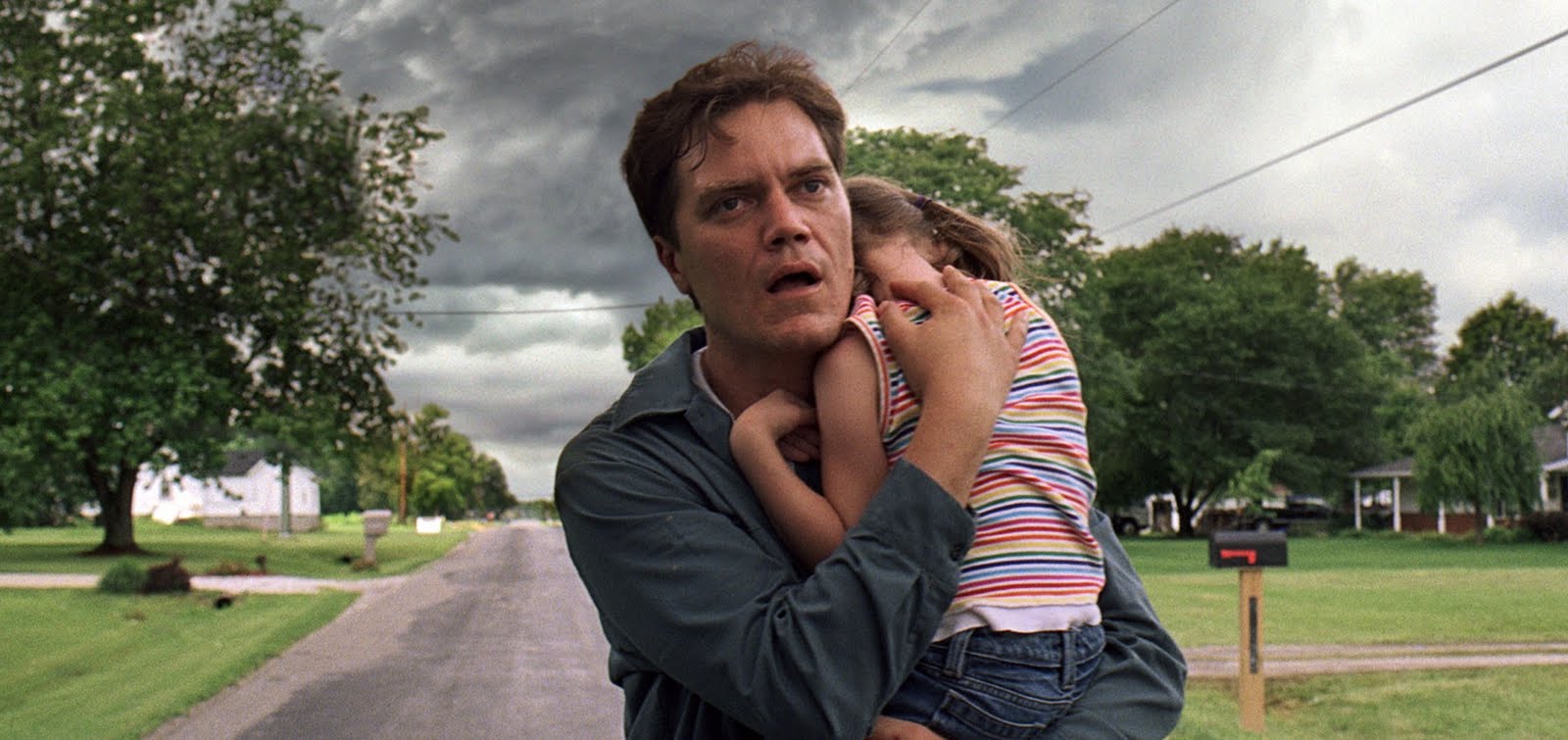
TAKE-SHELTER-Jeff-Nichols

Smith’s Verdict: ****

Reviewed by Tanner Smith

“Take Shelter” brings about a subject that is one of the main envelopments of mankind—fear. Everyone is afraid of something, and how we deal with that fear is up to us. “Take Shelter,” written and directed by Jeff Nichols, is essentially about a man who deals with his fears while not completely understanding them.

The man’s name is Curtis (Michael Shannon). He’s a working-class man in his mid-30s with a loving wife named Samantha (Jessica Chastain) and an adorable little daughter named Hannah (Tova Stewart), who is deaf. Curtis has a nightmare about a strange thunderstorm that oddly rains what looks like motor oil. He dismisses it as just a strange dream, but the next night, it’s even stranger when he dreams of the same storm and the family dog attacks him. But while the dog only bites him in the dream, Curtis can still feel the pain when he wakes up.

The nightmares get worse and more vivid. Curtis dreams of the same storm with the strange rain that apparently causes people to act crazily and violently. But during his day job as a sand miner, he has hallucinations of a similar theme—he’s the only one who notices that the birds in town are acting strangely. He soon starts to believe (and fear) that the dreams are not only dreams, but also visions of an impending disaster. So he gets the idea of rebuilding the old tornado shelter in his backyard and reconstructing it into a safe haven for him and his family if the visions are indeed accurate.

But there’s a problem here—Curtis is dealing with his fear in this way while also fearing something that runs even deeper. You see, his family has a history of mental illness—his mother (Kathy Baker) has been confined to a home since Curtis was ten years old. Is Curtis slowly but surely going crazy? Are these visions signs of possible schizophrenia? It’s unclear, but while Curtis goes to see several doctors and counselors about his dreams, he’s still working on that shelter to be ready in case he isn’t crazy. How’s everyone else with his “home improvement project?” Samantha is concerned, but will stick with him through thick and thin like the loving wife she is. Curtis’ work buddy Dewart (Shea Wiggum) helps him a couple times, though it means borrowing a few things from work.

What’s really happening here? Curtis doesn’t know, and a great thing about “Take Shelter” is that I didn’t know either. I’m watching this man as he deals with his fears in these ways. Is he going mad? Is there something dangerous headed our way? Is Curtis protecting his family from an impending storm or himself?

“Take Shelter” is a piece of masterful filmmaking. Jeff Nichols, whose previous outing as a writer/director was the excellent indie film “Shotgun Stories” (which also starred Michael Shannon), creates this story with a real intelligence for its audience. For example, the dream sequences—anyone in the audience can tell that a certain scene is one of Curtis’ nightmares. And I hate those old, cheap payoffs in which the dreamer wakes up in a cold sweat. But the thing is, there’s always a small feeling that these aren’t just dreams. With the way the story is developing, it’s hard to tell whether or not what we just saw will relate to anything else in a later scene or not. That’s another great thing about “Take Shelter”—its lack of predictability. The story is told in a way that any of the two possibilities could be real, and it keeps us guessing. And then when the film hit the climactic moment in the final moment, I had chills. I couldn’t tell what was going to happen. I won’t dare give away what will happen, but either way you’d expect it go down, it’d be hard to deny that the final product has a great sense of dramatic tension.

Also, there’s the excellent cinematography (by Adam Stone) from the open skies to Curtis and Samantha’s bedroom to inside the shelter, while the special effects blend in credibly. There’s a sense of atmosphere here.

Michael Shannon and Jessica Chastain deserved Oscar nominations for their work (and unfortunately, the whole film was snubbed). Shannon—one of the perhaps odd but most reliable character actors working today—delivers a powerhouse performance, showing emotional fragmentation, and Chastain is excellent as the reactor to Curtis’ problems and deeds.

To be honest, I’m not sure if I’m making “Take Shelter” sound like the great movie that I sincerely think it is. Let me put it this way—I wrote in an above paragraph that I thought Nichols’ earlier film “Shotgun Stories” was excellent, and I think that his follow-up “Take Shelter” is even better. If that’s not enough, let me put it this way—I think this is the best film I’ve seen in 2011. It’s inspired, unpredictable, chilling, wonderfully-acted, well-executed, and intriguing.

Where the Wild Things Are (2009)

21 Mar

where-the-wild-things-are-061

Smith’s Verdict: ****

Reviewed by Tanner Smith

How did I feel about “Where the Wild Things Are” immediately after I saw it? I imagine it was the same reaction that open-minded audiences had when they saw it in on the big screen—stunned silence, followed by a stating “Huh,” and then walking out trying to think about what they just saw. That happened to me as well. This is one of those late-reaction movies, where you have absorbed everything that the movie has thrown at you, and once it’s over, you slowly but surely realize how much of an impact it left with you.

What can I really say about “Where the Wild Things Are?” It’s adapted from a short children’s book and directed by Spike Jonze of “Being John Malkovich” and “Adaptation.” It has a fairly simple family-movie idea to start with—a little boy goes to a mystical island to have fun with gigantic, playful beasts. But it goes way beyond the silliness of that idea, and manages to give a pleasurable mix of concepts, imagination, director’s vision, and complexity that goes deeper into the original source material. It is also, in my opinion, just one of those absolutely perfect movies. Everything about it works, from beginning to end. I can’t seem to find a single thing wrong with it.

The fact that it’s a family-oriented picture makes it even better because there’s something here for everybody. Although, some parents may complain it may be a little “too dark” for their kids to see, but the movie earns its dark moments by playing it straight. It’s not dark; it’s deep, and not in a ridiculous way either. And the kids are probably going to see a bit of themselves reflected in this film—the emotions that the young protagonist goes through are relatable to, I believe, every kid.

A little boy named Max (Max Records) is a wild little boy. Sometimes, he can be sweet and loving, while other times, he’s moody, lonely, reckless, and even violent in some cases (he tries to bite his mother at one point). One day, he feels lonely and left out when a snowball fight with his older sister (Pepita Emmerichs) and her friends ends gloomily, and his mother (Catherine Keener) ignores him because she has a date (Mark Ruffalo). Angry, Max escapes into his deep imagination and appears on an island where the natives are gigantic, furry creatures known as the “Wild Things.” There are about seven of them, each of which represent a part of Max’s being. They make Max their king, and they all have fun together—running, playing games, being wild. But soon, Max learns that these Wild Things do actually have conflicts the same as he does back home. There are issues with a certain group (or “clique,” if you will), games can get a little too rough, and feelings that can be hurt as easily as Max’s was. These are all issues that Max has to deal with back home, and he learns that things aren’t as different here as they were there.

“Where the Wild Things Are” has a low-key approach—it’s more soft and bitter in its key sequences while using pure emotion to tell most elements of the story. This could have been handled with more of a blockbuster feel with a lot of machinery and cuteness to try and appeal to a mainstream audience (see the deplorable Dr. Seuss film adaptations, for example). It’s amazing how director Spike Jonze and co-writer Dave Eggers somehow managed to take a simple story and create a soft, deep family movie that is not like many others in recent memory.

The idea of Max running off to the fantasy island of Wild Ones is Max’s way of escaping into his own imagination, which is why these beasts resemble parts of Max’s psyche. Max develops a strong bond with a few of them, particularly Carol (voiced by James Gandolfini) who represents Max’s soul—someone who seeks friendship and love while feeling destructive when internally pushed. There’s also a kindly Wild One named KW (voiced by Lauren Ambrose), who represents Max’s unconditional love for his family.

This couldn’t have been as clear (or as effective) without the fifteen-minute-long prologue that shows Max’s recklessness, imagination, the way he sees the world around him, and of course his relationships with his mother and his sister. Everything comes back around for Max on this island. Things start to fall apart on the island, as Max’s fantasy world starts to turn against him. It’s then that he learns certain things about his own life, including how hard it is to negotiate with family and friends. When Carol is suddenly destructive, and Max has to reason with him, it’s really Max’s way of understanding himself more.

As for those Wild Things themselves, they’re not only imaginative in their creature designs (live-action but not cartoony, looking like they stepped right off the pages of the original book); but they have distinct emotions and personalities. The effects team gets the look of each of these creatures exactly right, and the voice actors (which also include Chris Cooper, Catherine O’Hara, Paul Dano, and Forest Whitaker) do successful jobs of helping make them three-dimensional.

Every kid likes to pretend they’re somewhere else when they’re all alone with no friends or family members to interact with. While doing so, they make up people or creatures or all sorts of characters to interact with, and the kid can further figure out certain things this way. That is really what this fantasy land is all about with “Where the Wild Things Are”—it’s Max’s way of figuring out what’s happening around him in reality. The film is more fascinating in this sense. “Where the Wild Things Are” is truly an excellent film. It’s insightful, indefinable, and enchanting, to say the absolute least.

Birdy (1984)

21 Mar

MV5BMjA3NzIzMzk2MF5BMl5BanBnXkFtZTcwOTM3NDQyNA@@._V1._SX640_SY433_

Smith’s Verdict: ***

Reviewed by Tanner Smith

There’s a beautiful movie surrounding Alan Parker’s fantasy-drama “Birdy,” and it just needs to be found. But as it is, it’s still intriguing, strange, and surprisingly moving, given its subject matter. It’s about two friends from South Philadelphia who have served in the Vietnam War—one of them, Al (Nicolas Cage), is called to a mental institution to try and reach his best friend, nicknamed “Birdy” (Matthew Modine), who is trapped inside of his own mind. If Birdy is proven mentally unstable, he will be taken away.

There’s nothing new to be said about the Vietnam War here, but that isn’t important. What is important is the friendship between these two friends who wind up serving in it. They both arrive back, scarred—one physically (Al has disfigured his face, so he keeps bandages covering most of it), the other mentally. Most of their story is told in flashback sequences as we see what led to this. The boys grew up in South Philadelphia. Al is a smooth guy with self-confidence and a natural ability to pick up women. Birdy is a different story—he’s an oddball who is weirdly fascinated with birds and dreams of flying himself. He has a pet canary, he has a pigeon suit to try and capture pigeons (while hanging upside down from elevated tracks), creates an ornithopter (a small flying device), and even some homemade wings to try out in hopes of flying.

Al and Birdy become great friends, as we see in the flashbacks. Although, they become somewhat separated by their pursuits for different things—for Al, it’s more women; for Birdy, it’s a further obsession with flying. But they’re still good friends with each other and share some unique adventures together.

In the present time, however, Birdy has apparently been pushed over the edge, presumably because of his experience in the war. He’s at the point where he actually thinks he’s a caged bird, with his cell as his cage. He looks sideways, looks longingly at the window to see birds fly free, has his head cocked to the side, and doesn’t even say a word. Al is trying to reach him by making him remember the good times they had together and make sure he’s not crazy, but he is not sure what he’s thinking, or even if he’s thinking.

“Birdy” is successful in its storytelling, as it doesn’t tell the story in chronological order, rather than let us figure out for ourselves in what order these events—past and present—happened so we can understand a certain thing about the other. It’s fascinating that way. We also get some deeply effective moments that go deep into Birdy’s perception. We can understand how much he wants to fly, and notice his “transformation” as it continues to develop. We realize his love for birds, as well as his hopes of being free to fly out of this miserable world he lives in, what with a difficult mother and other people (including a girl Al pushes him into dating) calling him weird. This Birdy is quite a terrific character, and played so well by Matthew Modine. I’m surprised his performance wasn’t nominated for an Oscar—I really think it’s an Oscar-caliber performance.

I get the feeling there was a lot more to “Birdy” than what was ultimately released to cinemas and home media. There are many parts of the movie that either feel rushed or not developed at all. For example, in an early flashback scene showing when the two boys first meet, it’s a misunderstanding and then a bit of confusion. Then, we get a montage of the two boys hanging out together, as if all of a sudden, they’re just best friends now. We never saw what made them really connect with each other in the first place. So in that way it is somewhat hard to believe that Al would hang out with Birdy all this time, despite his odd obsession with birds and flying. I also could have used more of Al teaching Birdy to be more sociable in high school. And I also would have loved to see how these two reacted to serving in Vietnam—we only get just a few brief scenes, and that’s not particularly good enough. And the ending is just too ambiguous—it was as if I was reliving my thoughts on the anticlimactic ending for “An American Werewolf in London.” What I’m saying is I could have used a lot more of this material, and that’s saying something, especially considering that this movie is two hours long. I would have watched an extra half-hour if they had something to deliver.

Shiloh 2: Shiloh Season (1999)

21 Mar

Zachary-Browne-Shiloh-2-Shiloh-Season-shiloh-2-shiloh-season-1999-30555098-608-336

Smith’s Verdict: **1/2

Reviewed by Tanner Smith

I hate to knock a feel-good family movie that has good intentions and positive messages to convey. But the main problem with “Shiloh 2: Shiloh Season,” sequel to the terrific 1997 family drama “Shiloh” and based upon the novel “Shiloh Season” by Phyllis Reynolds Naylor, is that it felt the way you couldn’t label about the first film (or at least, most people couldn’t say about it), and that is “preachy.” This just felt to me like generic, wholesome fluff with nothing too memorable to gain from it.

The original film, “Shiloh” (which I loved), had its morals and messages too. But they were in a film that was written more intelligently and with more subtlety than what the filmmakers of this sequel were going for. I don’t mind that messages from the original film are carried over a little further if it’s done right. But throughout the movie, I felt as if I was being had—as if I was being hammered with the ultimate lesson this movie had to deliver. And I never felt that way about the original film. And I know what you might be thinking—“It’s a kid’s movie! They’re supposed to hammer the message down hard on the kids watching it!” A) It’s supposed to be a family movie, not a “kid’s movie.” B) I don’t think kids like to be manipulated by what they watch as much as their parents like to imagine.

Maybe I’m being a little too harsh. After all, at least these issues are addressed in this movie, and they are ethics that kids can identify with. (I give credit to the original “Shiloh” novels for that.) The “Shiloh” stories are about protectiveness, determination, and helpfulness in the tale of a boy protecting a dog from its cruel owner (the original film) and seeing if the owner can change his cruel ways (this film).

“Shiloh 2: Shiloh Season” brings back the characters from the original film, including young Marty Preston (Zachary Browne, taking over for Blake Heron) who is still learning life lessons while protecting his dog, the cute, adorable beagle Shiloh, which Marty earned from its mean owner, Judd Travers (Scott Wilson, reprising his role from the earlier film). Judd is so unpleasant that even the local women are secretly talking about boycotting him away from town. He gets drunk constantly, he shoots what he doesn’t care is in season or not, and has a resentful attitude toward Marty for now having his dog.

Someone is pulling pranks on Judd—letting loose his hunting dogs, scratching his pickup truck, and knocking over his mailbox. Judd thinks Marty’s to blame, and this leads to many confrontations between Judd and Marty, and Judd and Marty’s dad, Ray (Michael Moriarty, also reprising his role from the earlier film).

Also back is the character of Marty’s mother (Ann Dowd), who does what she’s required to do, same as in the original film. There’s also Doc Wallace from the original film (again played by Rod Steiger) who is still around to give helpful advice, and while the character does seem like more of a fortune cookie this time around, he does manage a couple convincing helpful scenes with Marty. New characters include Marty’s rapscallion school chum David (Joe Pichler) and his new middle school teacher, Miss Talbot (Dawn McMillan), who knows how to teach the right ethical lessons to her class.

Of the acting, Scott Wilson is the most interesting performer in the cast, but that’s probably because his Judd Travers has always been the most interesting character in these stories. He has the role of a pathetic man—mean and lowly only as a way of not showing how he really feels. He was kicked around as a child, and now he kicks his dogs around and he’s a lonely man who feels better when he’s drinking or hunting. That doesn’t leave much for society to bear with him; he’s seen as a mean SOB. But can he change? Is anybody truly cruel forever? Can a troubled past keep a man troubled for the rest of his life? For all the machinery that this movie is composed of, Wilson manages to give a solid performance here.

Mainly, what it comes down to with the teachings of the morals & ethics for “Shiloh 2: Shiloh Season” is whether or not you buy it. I guess I didn’t for the most part. It does have its moments, when it’s mainly focused on the Judd Travers character, and the ending kind of works. But it’s too wholesome and generic, and not convincing enough to accept what we’re supposed to take from it.

Like Mike (2002)

21 Mar

1

Smith’s Verdict: ***

Reviewed by Tanner Smith

“Like Mike” is an entertaining movie that brings a kid’s fantasy to life. A lot of kids dream to be like Michael Jordan—though I think I can omit the word “like” and just say they want to be Michael Jordan. Kids even wore Air Jordans because they thought these sneakers contained a special super power that made them like Mike. “Like Mike” is a movie in which that actually happens, and more.

“Like Mike” is about a thirteen-year-old kid living in an orphanage and hoping to be adopted by a loving family some day. His name is Calvin Cambridge (rapper Lil Bow Wow), who has an undying optimism and a real love for basketball. The problem is, he’s not very good at it—he’s small and not very coordinated. In the film’s opening scene, he’s humiliated on the group home’s back court by his enemy Ox (Jesse Plemons).

Calvin comes into possession of Michael Jordan’s old sneakers he wore when he was a kid (that would explain why they fit Calvin perfectly…or not). How does he know it’s Michael Jordan? He’s told the shoes belonged to the “tall, bald basketball player,” and the initials “M.J.” are written inside the tongue. Who else could it be? But Ox throws the sneakers so they hang by their laces over a power line. That night, Calviin goes to retrieve them during a thunderstorm. Lightning strikes and somehow Calvin and the sneakers are magically linked together so that when Calvin puts them on, he’s “like Mike.”

When Calvin and his friends Murph (Jonathan Lipnicki) and Reg (Brenda Song) receive tickets to an L.A. Knights basketball game, Calvin wins a contest at a halftime show and is called down to the court to play a game of one-on-one with Knights player Tracey Reynolds (Morris Chestnut). Because of the sneakers, Calvin is unbeatable. He scores twice (one of those shots from forty feet away) and then on the final shot, stuns everyone watching by actually dunking the ball after flying up to the hoop! This gets the attention of the Knights owner’s representative (played by Eugene Levy, who scores a few laughs) who convinces the coach (Robert Forster) to sign him onto the team. At first, it’s for public appearance to sell a lot more tickets. But Calvin does end up on the court and becomes the youngest NBA superstar. (Actually, because of his amazing skills in flying and dunking, he makes Michael Jordan look bad compared to him.)

The story, of course, leads to many, many games in which Calvin helps the Knights win and leads them to the finals. And of course, once someone very unreliable finds out about Calvin’s magic sneakers, this becomes a major complication. It’s the orphanage’s sleazy caretaker Bittleman (Crispin Glover) who signs to be Calvin’s legal guardian and get about half of Calvin’s investments.

However, this does bring the question, why would he later bet on the Knights to lose the Big Game, when he has enough money already? Why bother stealing Calvin’s sneakers so they’ll be sure to lose? And who appointed this man as the caretaker of an orphanage? He’s so evil that he even nearly burns Murph’s only picture of his late mother while interrogating him to find the sneakers in the first place. What a slimeball.

Another complaint I have is that among the cameos by real-life NBA players, such as Jason Kidd and Allen Iverson, Michael Jordan isn’t among them. OK, I guess the one-line joke about “losing to the Bulls” is supposed compensate for that. But I kind of missed him. I wonder what the movie would have been like if suddenly he realized Calvin’s secret and recognized his sneakers. Wouldn’t that be very interesting?

For what it is, however, “Like Mike” is an entertaining movie. A lot of credit must go to Lil Bow Wow, whose energetic charisma brings a lot of charm to the screen. He’s able to carry a movie. He’s confident, relaxed, funny, and convincing, as well—he plays this fantasy as if it were real.

I also enjoyed the kid’s relationship with Morris Chestnut’s Tracey Reynolds. At first, Tracey is annoyed by this kid after being beaten by him, and even more irritated by having to room with him. But they do form a nice friendship together that eventually turns into a father/son type relationship, which is obligatory but still nicely handled and well played by the two actors.

“Like Mike” isn’t terribly original with its standard scenes involving the bully, the relationship with an adult mentor, the orphanage situations (potential parents only want to adopt the smaller children), and the Big Game. But it does have a few things going for it, like a winning performance by the right young actor, a nice attempt at playing to a kid’s fantasy, and a sharp wit to the script as well.

The Five-Year Engagement (2012)

21 Mar

the-five-year-engagement

Smith’s Verdict: ***

Reviewed by Tanner Smith

Really? Five years? Eh, whatever. Should be an interesting TEN-year separation. (Hey, there’s a sequel idea! But I digress.)

“The Five-Year Engagement” is a dopey romantic comedy from the guys that brought us “Forgetting Sarah Marshall” (director/co-writer Nicholas Stoller, star/co-writer Jason Segel, and producer Judd Apatow), and while it’s not quite up there with that hilarious, heartwarming treasure of a movie, it’s still a nicely-done romantic comedy. This is good in my book (or review), especially compared to the many terrible romcoms that just keep coming to the dismay of us critics, but the general public seems to eat up. Come on, how many sappy novels did Nicholas Sparks write that his film adaptations keep coming every year? But I digress.

Jason Segel and Emily Blunt are an appealing couple and exhibit great chemistry on-screen. They play Tom and Violet, whose story begins just how most romcoms would end—a marriage proposal. In an opening scene, Tom accidentally ruins the surprise for Violet that he has set up for a proposal during a skit, but nevertheless, Violet says “yes” and the movie begins.

But the big question after the OTHER big question is, when’s the big date? Violet tries to plan the perfect wedding, while waiting for a college professorial opening in psychology, and Tom is doing well at work as a chef, a job that might get him a promotion. But soon, things start to spiral downward when Violet’s dream job offer arrives. The job is in Michigan, not in the Bay Area, meaning Tom has to quit his job, relocate with Violet, and start anew. Violet is happy with her new job. But the wedding doesn’t seem to be happening anytime soon because of this. As time goes by, Tom starts to become more resentful of Violet’s newly developed success and the continuing engagement seems like it could working its way up to a breakup.

The romcom rulebook states that there must be many concerned family relatives and the best friends who are simply there to provide comic relief. I’m usually very sick of these people because they slow things down and cause the kinds of clichés that I truly cannot stand in romcoms anymore (misunderstandings, revelations, etc.). And while they do slow things down at certain spots, and there is a slight misunderstanding involving Violet and her new boss (Rhys Ifans), they don’t damage the story to the point where it becomes annoying. In particular, we have Tom’s wisecracking best friend Alex (Chris Pratt) and Violet’s sassy sister Suzie (Alison Brie) who meet and married well before Tom and Violet. These two do what their stereotypes have them do, but they still provide laughs. Brie, in particular, has a hilarious imitation of Elmo as she discreetly discusses this “five-year engagement” (yes, the title tells no lie) with Violet in front of her four-year-old daughter. (And Blunt, as wonderful as she is, deserves credit for her equally-funny imitation of the Cookie Monster.)

There are also some funny supporting characters involving Ifans and his psych-study group, which includes Mindy Kaling and Kevin Hart who make the most of their scenes with some very funny one-liners.

One major problem I had with “The Five-Year Engagement” is that it goes on for too long at two hours and four minutes of running time. It especially shows in many scenes that have made their point already and yet are still rolling. You just want to yell “Cut!” at certain points or just wish the editing was tighter.

But what makes “The Five-Year Engagement” worth watching are the performances from Jason Segel and Emily Blunt. Segel has always played a likable, hulking, sometimes-dim guy and he’s just as appealing here. Even when he makes some mistakes (and there are people who even rank him out as stupid), it’s hard not to like him. Emily Blunt is marvelous as always. She’s likable, pretty, funny, and just a fabulous screen presence. I will watch her in anything she acts in.

“The Five-Year Engagement” has just what we want in a romcom—two appealing lead actors and some very funny gags (including one involving a babysitting job and a crossbow). I just wish it was tightened up at least a little bit in the editing process. There’s a very good romantic comedy buried in filler, but it’s better than buried in…well, never mind.