Archive | March, 2013

License to Drive (1988)

27 Mar

papa_cadillac_1988_2

Smith’s Verdict: **1/2

Reviewed by Tanner Smith

“License to Drive” seems like it’s going somewhere special. It has the premise of a kid failing his driving exam yet he still wants to drive. You would expect something fresh to come from this idea. But you’d be wrong. Instead, “License to Drive” gives us an entire second half of complications, out-of-control, near-death car accidents (none of which fatal but they’re still not funny), and a long chase sequence. That’s too bad too, because the first half is quite amusing.

The movie stars Corey Haim as an average teenager named Les. Like many high school students, he has a crush on the pretty girl in school—in this movie, she has the nice name of Mercedes—and really wants to drive. But of course, he isn’t focused enough in studying, and his wild, reckless best friend Dean (Corey Feldman, who co-starred with Haim in “The Lost Boys”) isn’t very motivational—“You’ve been a passenger in a car all your life—you don’t need to study.” Les does, however, have a brainy twin sister who studies very hard. When it’s time to take the test, his sister passes, but Les is unfortunate enough to fail. Even more unfortunately, he already scheduled a date with Mercedes (Heather Graham) that he certainly can’t bail on now. So Les asks (right to the camera, breaking the fourth wall and letting us know that we’re in for a different movie), “An innocent girl, a harmless drive, what could possibly go wrong?” There’s always a line like that in these movies.

I wish “License to Drive” hadn’t driven down that route, so to speak, because the first half is most enjoyable. Corey Haim plays a different character than he plays in “Lucas.” While his character in “Lucas” was more original, his character in “License to Drive” is more the same as any other teenager. That’s not necessarily a bad thing because we can identify with him as he goes through his high school problems—wanting to impress the girl, living with his family, and taking the driving exam. Haim is appealing here. Even more so are his family, with Carol Kane as the pregnant mother (I love the bit where she fixes herself a full plate of mashed potatoes with ketchup all over them and says as her teenaged kids look in disbelief, “For your information, this is exactly what I ate when I was pregnant with all of you and you turned out OK.” That’s a great line.) And Richard Masur who is a riot as Les’ overreacting (well, not really overreacting but he shouts a lot) father. Then there’s the scene in which Les takes the test. First, he must take the computer exam (kind of odd, considering he was supposed to take that long before, but oh well). We feel the pain on Les’ face as he tries to get questions right. This scene captures feelings of desperation and the want to drive. Les fails but since his twin sister passed (and with the computers conveniently crashing after Les hits the computer in frustration), he is allowed to take the driving part of the exam. This is the funniest scene in the movie. His driving instructor, played by James Avery, is a military man who uses a cup of coffee (filled to the brim) instead of a clipboard. He tells this scared kid that if that coffee spills on his pants, he fails.

Well, that’s pretty much my review of the first half of the movie, which deserves three-and-a-half stars. But then the long second half approaches us and the film has gone downhill. Les is willing to steal his grandfather’s Cadillac to take Mercedes on a date. Only problem is, he has no license. So the script calls for all sorts of incidents to occur—none of them particularly funny, which is what the main purpose is with this movie being a comedy.

It’s sad to see a movie with comic potential go downhill like this. I really liked the first half of this movie—it had insight, good humor, appealing characters, and true moments of fear of looking like an idiot while trying to impress your dream girl. But they all go through the wrong lane (OK, enough driving puns) as “License to Drive” approaches a dead end (OK, I lied).

Maybe cars themselves are not very funny. What can you do with a piece of metal and machinery that could possibly be funny? Crashes aren’t funny. Cars spinning out of control aren’t funny. Chases aren’t funny. So what can be done with cars as humor? I wish the writers of “License to Drive” took more time thinking of an answer to that question.
Kramer vs. Kramer (1979)

27 Mar

Kramer_vs_Kramer_26856_Medium

Smith’s Verdict: ****

Reviewed by Tanner Smith

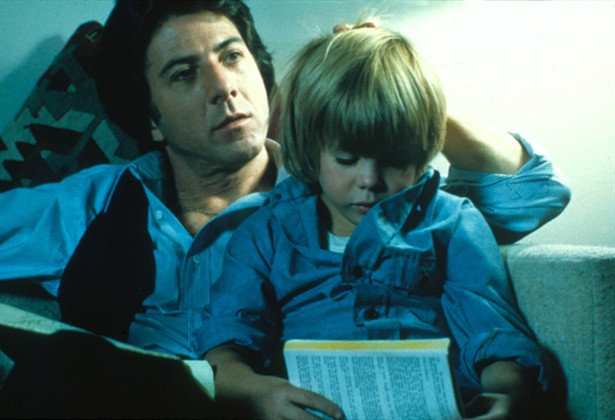
“Kramer vs. Kramer” is a well-acted family drama concerning divorce and child custody. It could have been a sappy made-for-TV melodrama, but this screenplay (based on a novel) has its characters dealing with things either lightly or poorly, depending on the circumstances—just like real people. In that way, this movie is intriguing in the way it deals with the situations at hand because the people in this movie deal with them in realistic ways. That’s why “Kramer vs. Kramer” hardly steers wrong.

It begins as Joanna Kramer (Meryl Streep), a married woman, tells her seven-year-old son Billy (Justin Henry) that she loves him. The son Billy, half-asleep, says, “I’ll see you in the morning.” One look at Joanna’s face and you know that he won’t.

Joanna is leaving her workaholic husband Ted (Dustin Hoffman) and little Billy because she doesn’t feel like she belongs in their lives anymore. She’s unhappy. She has tried to talk to Ted about it, and even tries to tell Ted that she’s leaving, but he’s wrapped up in his work to listen. Eventually, Ted does understand and tries to talk Joanna out of it, but it’s too late.

The next morning, Billy goes into his parents’ bedroom and sees Ted sleeping alone. He wakes him up, asking “Where’s Mommy?” twice. Ted asks what time it is, Billy looks at Ted’s wristwatch and says, “The little hand’s on the 7 and the big hand’s on the 9,” before immediately asking again, “Where’s Mommy?” This scene shows that Ted hasn’t exactly been paying much attention to his son either. But Ted knows his plight and does what he can to please Billy.

He cares for the boy for 18 months. Sometimes Billy complains that something “isn’t the way Mommy does it,” Billy interrupts Ted while he’s working, Billy has an accident on the playground so Ted has to take him to the emergency room quickly, and Ted teaches Billy how to ride a bicycle. A real bond forms between a father and son. These scenes are really the highlight of the movie—furthering the relationship between Ted and Billy and showing just how much Ted cares for his son.

So when Joanna finally returns, wanting her son back, you feel something.

“Kramer vs. Kramer” made the wise decision not to tell it from the child’s point-of-view and showing us his plight. Instead, we see the plight of the parents. They make some wise decisions regarding it, but they also make not so wise decisions as well. What they both want is attention from their own son, instead of the son wanting attention from both parents. You want a movie with the exact opposite premise, see the Little Rascals short “Big Ears,” featuring little Wheezer getting himself ill so his parents will notice him. “Kramer vs. Kramer” doesn’t work that way.

“Kramer vs. Kramer” leads to the custody case in court, which from what we’ve seen should be a no-brainer. We’ve spent so much time with Ted that the movie actually seems to take his side—the kid is going to stay with him, no question. But when they call Joanna to the stand and she gives her testimony, she actually proves to have some good points about why she should be in custody of her son. That’s when “Kramer vs. Kramer” decides not to take sides, and just let the case play out with these characters. The ending of the movie isn’t predictable.

Great performances hold the movie together. Dustin Hoffman does some of his best work here, playing Ted as very normal and all the more convincing. His love with the kid, played by Justin Henry with unforced charm, comes off as genuine. You truly believe these two as father and son. Meryl Streep shows from the first shot that she’s an actress of many emotions. Watch the first shot that is just a closeup of her face as she’s thinking of leaving her son, but not truly wanting to because she loves him. You can practically sense her mind leading to a decision. And when her character Joanna gives her testimony in court, you feel the sincerity that Streep brings to the scene. Also of note is Jane Alexander, who is winning as Joanna’s friend whom Ted sometimes turns to for advice.

“Kramer vs. Kramer” is a winning movie with a talented cast and a brilliant screenplay. It’s an appealing family drama that plays itself realistically and succeeds in showing a very good portrait of divorce and child custody. They’re both tricky subjects; “Kramer vs. Kramer” pull them off.

Be Kind Rewind (2008)

26 Mar

be_kind_rewind_still

Smith’s Verdict: ***1/2

Reviewed by Tanner Smith

“Be Kind Rewind” can be easily described as overtly whimsical. And that’s exactly what it’s supposed to be. I can see a lot of people—or critics who in some ways resemble people—being somewhat annoyed by everything thrown at us by visionary director Michel Gondry (“Eternal Sunshine of the Spotless Mind”), and others completely won over by the magic of it all. I fall into the latter category.

Sometimes, “Be Kind Rewind” is sticky. Other times, it’s forced. Mostly, it’s enchanting. It takes place at a street corner in Passaic, New Jersey, which seems to be stuck in a time warp. It has probably the last VHS rental store in the world (the movie’s world, anyway)—no new releases, because those are available on DVD of which there is none on display whatsoever. It’s said to be the birthplace of jazz pianist “Fats” Waller, as store owner Mr. Fletcher (Danny Glover) believes. But it’s implied that that’s not the truth. The store is set up for foreclosure and demolition to make way for modern conveniences. Fletcher leaves town to see what he can do, leaving his faithful live-in employee Mike (rapper Mos Def) in charge with instructions to keep his klutzy, annoying friend Jerry (Jack Black) out of the store.

Jerry works at the nearby power station and in a half-baked scheme to sabotage it, he becomes “magnetized” and accidentally winds up erasing every tape in the store. Desperate and panicked, Mike and Jerry grab a vintage video camera and set out to make their own versions of popular movies and rent them out instead. With help from their friends, they start with “Ghostbusters,” then “Rush Hour 2,” and then these homemade versions become so popular that it becomes a new business with a system—name which movie you want “sweded” (that’s the term they choose because they insist that the tapes come from Sweden, but who are they fooling?) and they deliver the goods. Suddenly, the store has the best business it ever had, but that doesn’t seem to please the copyright holders of the original films very well, especially since people seem to enjoy these shorter, reenacted versions better.

That story is bizarre enough, but it’s far from predictable and it’s very intriguing in its whimsy. Gondry loves to experiment with quirky, awkward humor to further the production and there’s plenty to be found here, which I’ll leave for you to discover.

The casting is inspired. I’ve always been a fan of Jack Black, but he has found a role that suits him better than a lot of his earlier roles. Mos Def is quite good as Mike—he’s calm and relaxed in contrast to Black’s zaniness. Melonie Diaz sports a cute smile and a can-do attitude as Alma, a local woman who helps Mike and Jerry with their business. (It should be noted, though, that a potential romance between Alma and Mike is immediately forgotten about after it’s set up.) Veteran actors Mia Farrow and Danny Glover are excellent in supporting roles.

The film is also a heartfelt tribute to independent filmmaking if I ever saw one and the way these “films” come about and how many people support them are great to watch, especially for an indie filmmaker such as myself. On top of that, Mike and Jerry’s new versions of these films such as “Ghostbusters” and “RoboCop” are so enjoyable, so funny, and very quirky. That they made them in just a few hours made me think back to the times when I was a kid making movies with no experience and very little equipment. I just wanted to put on a show, as these guys did.

The ending is just wonderful. It brings the tribute full-circle and becomes a sequence so heartwarming, so enchanting, so whimsical, that I couldn’t help but smile and even start to cry. I was actually wishing for the end credits, not because of usual reasons, but because I wanted to keep the tears from coming. That’s how well “Be Kind Rewind” worked for me. It’s sweet, cute, and just downright enjoyable.

Darkman (1990)

26 Mar

Darkman_2

Smith’s Verdict: ***1/2

Reviewed by Tanner Smith

Sam Raimi’s “Darkman” is a rarity in the movies—a superhero story that didn’t used to be a comic book series at first. It feels like it could be a comic book series, or a graphic novel series, and has fun with its energetic story and appealing “origin story.” Every superhero requires an origin story—how the hero gained his or her powers or skill—and “Darkman” is a doozy from the start. It gets stranger as it goes along, but that’s what makes it so entertaining. It’s engaging from beginning to end.

“Darkman” opens with criminals making deals and killing off those who disappoint. One bad guy in particular has a weird habit of breaking (severing) his victim’s fingers and keeping them as trophies in a small case, like a jewelry box. Strange enough, but then we’re introduced to our protagonist—a scientist named Peyton Westlake (Liam Neeson) who is developing a new type of artificial skin to help burn victims. The experiment isn’t going very well, as the skin disintegrates after being exposed to light for 99 minutes.

We know that these two plot elements are going to come together soon enough. That they’re both equally strange story aspects keeps you curious about how they’ll be handled once the meat of the story kicks in.

Anyway, as dumb luck would have it, just as Peyton discovers that the best way the skin can stabilize if it stays in darkness (apparently, this synthetic skin is photosensitive), this is when his laboratory is invaded by mobsters who know he has an important document that proves that a real-estate developer is bribing members of the zoning commission (and wouldn’t you know it—Peyton’s girlfriend Julie, played by Frances McDormand, is an attorney who was responsible for the document).

Are you getting all of this? Are you still with me? If so, you’re a bright reader.

So the bad guys blow up Peyton’s lab and Peyton is horribly burned alive. He survives the tragic ordeal and escapes from the hospital, but his face and hands are horribly disfigured. Oh, and a lot of his nerves are severed, so he can’t feel pain. To exact revenge on the people who did this to him, he creates a new lab in a condemned building to make new masks. He makes one of his original face so he can be with Julie again, though not telling her of his condition. Other masks are created for his enemies—he can observe them and study them, and then use the masks to become them one-by-one, in order to thwart them. The problem is he has only 99 minutes with each mask.

This leads to some fun comic scenes in which Peyton keeps his cover while impersonating these people. And give credit to the actors for imitating Liam Neeson imitating them. In particular, there’s Larry Drake, who plays a mobster who catches Peyton in disguise. Playing against himself (if you will) is a challenge and it confuses us as well as the henchman who is trying to figure which one is which. (My favorite moment in the film is when they’re both held at gunpoint and one of them shouts, “Shoot him!” while the other shouts “Shoot him!”)

“Darkman” has fun with its creative storytelling and unique visual style—the kind that Raimi has specialized in the “Evil Dead” movies (particularly the second one, which had an appealingly bizarre visual taste). “Darkman” has that hazy, dim comic-book look resembling a dark Batman tale and goes about with neat, tricky shots of people or objects popping into the frame and out and intriguing camera angles that keep action scenes not only exciting but also comic. Nicely-handled special effects help as well.

Liam Neeson, as the conflicted hero Peyton, is solid. He makes an interesting individual to follow in this superhero tale and does great work at showing the lighter and darker sides of this person who has lost his looks, restored his intelligence, but also struggles with the feeling of revenge, whether or not he can control it. At one point, he’s on a date with Julie at a fair and gets angry for a simple thing such as a worker stiffing him from a prize, and his anger which comes from previous experience with his enemies, comes through in an effective way. Neeson is well-cast here, and so is Frances McDormand as Julie, who is consistently appealing and shares some good chemistry with the hero.

One major problem I have with “Darkman” is that Peyton never really becomes Darkman. It’s said at the beginning that Peyton’s masks are only stabilized in darkness, and yet he’s constantly using them in the daylight. This means that this never becomes a crucial point of the plot and so the film doesn’t have a clear motivation. Maybe “Darkman” should have begun right at the end, when Peyton realizes who and what he is.

But then again, now that I think about it, maybe I didn’t want “Darkman” to be so simple that Peyton would actually use his replicating inventions in the dark when it’d be easier. If he did that, we wouldn’t have a constant troublesome conflict of having to be rid of a mask after 99 minutes before he gets caught. And of course, this means “Darkman” wouldn’t be as much fun.

And that’s what “Darkman” is—fun. It’s an intriguing mix of superhero origin story and unique visuals. It’s its own creation for film, not based on a comic book, and it’s quite an effective thrill ride.

The Rescue (1988)

26 Mar

rescue_in2d

Smith’s Verdict: ***

Reviewed by Tanner Smith

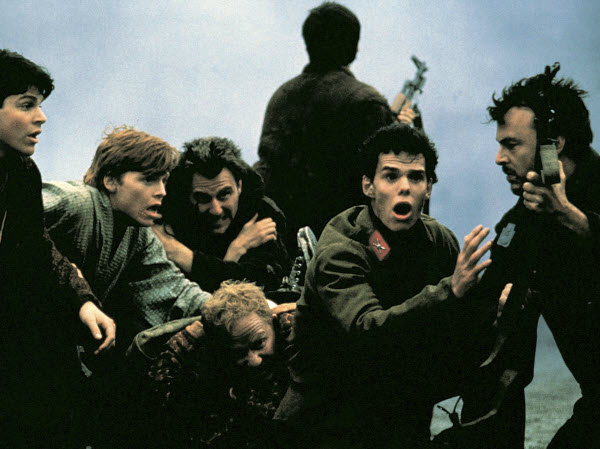
If a teenager can hack into the defense network system (“WarGames”), build his own atomic bomb (“The Manhattan Project”), and fly a jet into enemy territory to save his father (“Iron Eagle”), then why shouldn’t four teenagers and a younger kid be able to sneak into North Korea and save their Navy SEAL fathers from a Korean prison, while making little attempt to disguise themselves?

That’s the central story element of “The Rescue,” a gutsy, well-shot movie that has high spirits and a likable if unspectacular young cast. The whole idea of the movie may be preposterous and that’s most likely the word that almost every other film critic used in their negative reviews of this film. But strangely, I got into the movie. So what if it’s preposterous? So what if (spoiler) everything works out for these kids? It’s a teenage adventure movie—leave it at that and enjoy.

Four Navy SEALs stationed in South Korea are sent on a mission to destroy a disabled U.S. submarine in enemy North Korean waters. They succeed, but are captured and sent to a North Korean prison. A month passes and the imprisoned SEALs are scheduled for execution.

Teenagers Shawn Howard (Ned Vaughn) and Adrian Phillips (Christina Harnos) each have a father that is a prisoner. They use a friend’s homemade listening device to eavesdrop on a discussion of a rescue mission to go in and get the men back. But they are shocked to know that the plug has been pulled on the plan. They and the friend—Max Rothman (Marc Price, TV’s “Family Ties”), the son of the SEAL head—tell the news to rebel J.J. (Kevin Dillon), another son of a captured SEAL. J.J. comes up with the idea of stealing the government rescue plan and taking matters into their own hands. They’ll get a boat, escape the border patrol, find the mission operative, and get their fathers back. They have an unexpected ally—Shawn’s ten-year-old brother Bobby (Ian Giatti), who followed them to help.

“The Rescue” could be made as a silly kids’ movie, but it’s not dumb and it’s not boring either. A lot of that has to do with the masterful direction by Ferdinand Fairfax, who shoots with a great visual style. The climax is surprisingly well-handled, despite the preposterousness of the situation. But I felt involved—at one point, when the plane they use to escape in loses both engines and comes close to a nose dive, I even held on to my own stomach. That’s really saying something about the look of the film.

The young actors are fine and likable—even Marc Price, who was so obnoxious as the neighbor Skippy in “Family Ties,” is likable. Kevin Dillon (seen in “Platoon” and “The Blob”) is a convincing rebellious hero, Ian Giatti has a special enthusiasm that comes with the age, and Christina Harnos is spunky and has some karate moves to use on some (get this) Korean gangsters. The only problem is that their characters aren’t fully developed and neither one is given a chance to stand out.

So what if all of these kids have it easy with one too many close calls? It’s entertaining as a PG fantasy—you know nothing bad will happen to these kids, but let the direction by Ferdinand Fairfax guide you. “The Rescue” isn’t a great movie, but I liked it enough to recommend it. It’s a high-spirited teenage adventure film—deal with it.

Hot Shots! (1991)

26 Mar

500full

Smith’s Verdict: ***

Reviewed by Tanner Smith

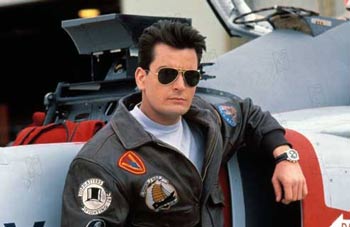
Now here’s something strange—we have a parody film called “Hot Shots!” that mostly lampoons elements from a movie I didn’t like, which was “Top Gun,” and I liked this parody. Weird, how I’d prefer this ridiculous but often very funny film over the movie it borrows elements from, which had great-looking dogfights, but a boring human story. Maybe the filmmakers of “Hot Shots!” knew that some people felt that way, and made fun of that material and more. But whatever they did, it worked for me.

Charlie Sheen plays (and plays with) the Tom Cruise role in “Top Gun” for “Hot Shots!” and his poker face makes him right for the role of Topper Harley. Whenever people look at him, he just likes to show how tough he is by tightening his lip and keeping his eyes open. But when he isn’t trying to act tough, he’s just a macho buffoon, like he’s supposed to be in a film that is like films such as “Airplane,” “Naked Gun,” and not to mention “Top Secret.” These films are funny by giving us silly humor that makes us laugh rather than roll our eyes. In fact, some of the filmmakers of this film also made “Airplane” and the “Naked Gun” movies. You can’t stop yourself from laughing at a good joke and there are plenty in “Hot Shots!”—most notably, a scene in the beginning of the film in which Sheen, playing a young test pilot, passes by an attractive woman on horseback on his way to the air base and he copies her movements on his own motorcycle. That is truly hilarious and we would expect him to bump into a tree branch or fall off or run into that old comedy cliché of someone being distracted and then running into something, killing the infatuation. But he doesn’t and thank goodness he doesn’t—that joke of running into something while distracted is too old to be funny anymore.

Another good running gag is the vision of one of the test pilots, played by Jon Cryer—his vision is distorted by a bad case of “wall-eye.” He keeps missing something he reaches for.

That is all I wish to say about this movie, other than the fact that I laughed a lot during this movie. There are some parody scenes that aren’t that funny, but the funniest moments are when we’re caught by surprise. There are plenty of those moments in “Hot Shots!” We also get strong supporting, comedic work by Lloyd Bridges and Cary Elwes, not to mention as much work as we can get in a movie like this from beautiful Italian actress Valeria Golino as the love interest. But like I said, Charlie Sheen’s poker face will make you laugh.

Red Riding: In the Year of Our Lord 1974 (2010)

25 Mar

images

Smith’s Verdict: ***1/2

Reviewed by Tanner Smith

“Red Riding: In the Year of Our Lord 1974” is the first in a trilogy of British TV films, later released theatrically. But even most of it is setup material for the second and third entries, it can be taken as a stand-alone. Whether or not this will stand above the rest remains to be seen, as I haven’t yet seen the other films. But this is an effective first entry that works well on its own, but does have me interested in seeing the later entries.

“Red Riding: 1974” is a mystery fable, set apparently in 1974 (as the title suggests, though it could have taken place anytime, I guess). Its hero is a young reporter named Eddie Dunford (Andrew Garfield) based in the dark little town of Fitzwilliam, West Yorkshire. Eddie is given the task to report on the mysterious child killings. The police aren’t making much progress, though they say they’re working on the case. Eddie doesn’t particularly care much for the story, as he’s somewhat of a slacker. But there are two things that keep him interested—the romantic relationship he winds up sharing with Paula Garfield (Rebecca Hall), the mother of one of the dead girls; and the death of his friend Barry Gannon (Anthony Flanagan) who has stumbled upon something that could or could not related to this case. As Eddie digs deeper into the case, he runs afoul of certain characteristics with policemen and rich businessmen, particularly land developer John Dawson (Sean Bean) whom Eddie suspects of the murders.

“Red Riding: 1974” is more than a serial killer mystery. Without giving too much away, we can tell from the final act of “Red Riding: 1974” that this is a brutal tale of power and corruption, mainly involving police. And the later entries will no doubt dig further into that. Police corruption isn’t new in movies (or in life, for that matter), but the approach that’s given in this movie is so unbending and careless that it’s kind of sick, and yet effective at the same time. There’s a torture scene near the end of the film that’s especially fierce that is followed by a very tense moment involving two police officers taking joy in practically scaring the hero to death. And the hero learns the hard way that only one thing matters in this sick little world that he didn’t make—power.

This could have been great. It has a neat look—it was shot on 16 mm film and has chosen a suitably bleak town for its location. The acting is very good—particularly by Sean Bean and Rebecca Hall, while Andrew Garfield is merely OK. (He doesn’t make the strongest impression as the leading man.) The way the story develops into this heavy corruption tale is nicely-handled. The ending is uncompromising and memorable.

But if I have to criticize, I’ll say that the story isn’t precisely clear and there are some moments where I’m wondering how exactly we got to a certain spot. Maybe after another viewing of “Red Riding: 1974,” I’ll be able to understand it better and give it a more positive review. As it is the first time around, it is an effective introduction to a promising trilogy of films.

NOTE: Another little nitpick is that the thick British accents made it difficult to understand what some of the characters were saying. Is it weird that I think subtitles for an English film can be necessary sometimes?

Sylvester (1985)

25 Mar

syn__0023_sylvester

Smith’s Verdict: ***

Reviewed by Tanner Smith

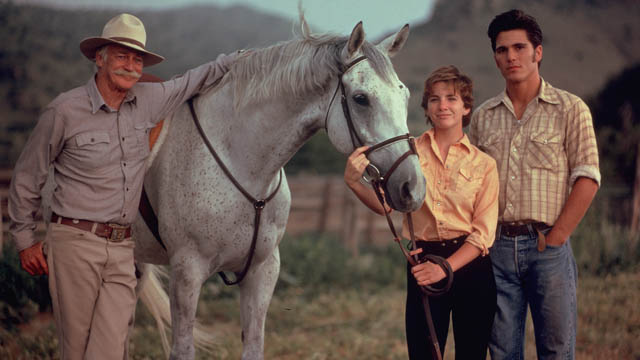
The story for “Sylvester” is nothing new. It’s the story of a spunky young woman and her equally gutsy horse. The horse is reckless at first, but maybe it can be trained to become a champion. We’ve seen this before, particularly in “National Velvet” starring Elizabeth Taylor. But “Sylvester” has something going for it, and it’s not in the predictable story; it’s in the actors’ performances and the story around the girl and the horse.

Melissa Gilbert, from TV’s “Little House on the Prairie,” turns in an excellent performance as Charlie, a sixteen-year-old orphan girl who cares for her two younger brothers by herself and works at a ranch. She wants to train horses and wants a challenge. She finds one, all right, in Sylvester Stallone (no, really—that’s what she names the wild horse of the bunch). This is a wild, unruly horse—not the kind of horse you’d see competing in the steeplechase trials.

But hey, maybe…just maybe…Sylvester will be able to do it.

OK, we all know the conflicts at hand here. Charlie has to deal with the court officials concerning her and her brothers living alone; they later live with the farmer who becomes a father figure; the father figure is skeptical about the horse being trained by Charlie; Charlie gets Sylvester in good riding form; and of course, with help from the farmer, her brothers, and her boyfriend, Charlie is able to compete in the steeplechases. We go through the checklist of events.

BUT among the formula and the obligatory scenes that come with it, we still have the pleasure of watching of viewing the actors portraying these characters. Melissa Gilbert is great in this movie—she has a unique star presence and brings conviction to the role of young Charlie. Richard Farnsworth is also great as the grizzled old farmer who takes her and her brothers in, showing more dimensions than we’re used to. Even Michael Schoeffling (“Sixteen Candles”), as the obligatory handsome boyfriend, does a nice job.

The horse is the least interesting element in the movie. He’s just there as a way to get the story and the heroine in the directions they’re supposed to go. But to be fair, I’m glad this isn’t one of those movies where the horse makes everything happy when the girl is sad. The horse isn’t a practically human reincarnate. It’s just a horse. The story isn’t about the horse, despite this horse’s name Sylvester being the title of the movie. It’s about the people this time.

“Sylvester” isn’t particularly original, except for when it’s dealing with Charlie’s issues and the development of the people around her. It is also harmless for kids and I think adults will enjoy the more mature aspects of the story. It’s a nice family film that could have been great, but as it is, it’s a good movie.

The Good Girl (2002)

25 Mar

425.goodgirl.lc.020711

Smith’s Verdict: ***1/2

Reviewed by Tanner Smith

“The Good Girl” is a story about a woman in crisis—stuck doing the same routine with nothing new in her life. She works at the local discount store in her hometown—as you’d expect, she hates her job. Her husband is a loser—a slacker who would rather sit on the couch and watch TV with his best buddy than be with his wife. Nothing is as it should be, and she goes about her day in a constant state of quiet and imprisonment.

The woman’s name is Justine and she’s played by Jennifer Aniston, an actress you wouldn’t expect to play the part, given her mostly-TV-based career, but proves herself to be more than capable. Aniston is nearly unrecognizable as Justine—you never see her as Rachel from “Friends”; you see her as Justine.

Justine’s working-class lifestyle is, as she puts it, like being in prison on death row. Her job as a retail clerk at a Wal-Mart knockoff, called “Retail Rodeo,” doesn’t mean anything to her and she feels crippled by it. Then there’s her husband Phil (John C. Reilly), who’s not a bad person, but a lazy, pot-smoking slacker who spends most of his time watching TV with his friend Bubba (Tim Blake Nelson). He’s not abusive and does care for Justine, but he just doesn’t seem like the man Justine married years ago.

Then, Justine meets Holden (Jake Gyllenhaal), a 22-year-old loner-poet who joins Retail Rodeo and keeps to himself, reading “Catcher in the Rye” (he says he’s named after the protagonist, but he really named himself after him). Justine sees that Holden is having the same problem as herself—feeling suffocated by routine. She draws herself to him, and they spend a lot of time together. This leads to an affair that these two felt desperate to have. But the more time they spend together, the further Justine notices that maybe Holden isn’t too well—he has an unstable mentality and impulsively says things like, “I want to knock your head open and see what’s inside” (which he thinks is a romantic come-on).

The screenplay for “The Good Girl” was written by Mike White (who also co-stars as a religious security guard); he creates a grim (though realistic) outlook on life, credible main characters, and quirky side characters that seem like people you would see working at a retail store. That particular third element includes a supporting character that steals the show—a profanity-spewing, deadpan-sarcastic co-worker played by Zooey Deschanel. Her spin on the “attention shoppers” announcements is hilarious. Moments like those inside the retail store make for effective satire.

Those expecting a lighthearted comedy starring Jennifer Aniston in her typecast-“Rachel” phase should just keep looking (or go rent “Picture Perfect”). “The Good Girl” displays Jennifer Aniston’s true acting talent—credible, dynamic, and effective. Those three adjectives describe the whole movie in general.

Reckless (1984)

25 Mar

aidan reckless

Smith’s Verdict: **1/2

Reviewed by Tanner Smith

“Reckless” is about a bad boy and a good girl who are attracted to one another, and it’s not as much a ripoff of “The Wild One” or “Rebel Without a Cause,” because really this sort of youth melodrama is its own genre. While “Reckless” deserves credit for its proficient acting and occasionally complex drama, and it’s certainly a step up from the awful “Tuff Turf” (a similarly-themed teen film released the same year as this one), It’s not as dramatically satisfying or revealing as we would like it to be.

Aidan Quinn stars in his film debut as Johnny Rourke, a high school teenager from the wrong side of the tracks. His fellow students think he’s weird because he mostly keeps to himself and likes to ride around on his motorcycle. Oh, and he’s a deadringer in every way for James Dean’s “rebel without a cause.” He’s handsome, he’s moody, he speaks in a soft monotone, and loves to mope around.

It’s the intention that Quinn resemble James Dean, and the truth is, Quinn completely pulls it off. This could easily have been a pale imitation, but Quinn plays it with enough authenticity and conviction that really makes the role of Rourke his own. He makes us feel for his pain and angst. He’s more the rebel with a cause—he has something difficult (if uncomfortable) to deal with, and the time he spends to himself makes him more comfortable. That’s my take on the character, anyway.

Rourke has to put up with his irresponsible, lazy, drunken father, as well as working at the steel mill, being blamed for something that isn’t entirely his fault (but because he looks rough, he’s immediately to blame), and being stared upon by his fellow students who refer to themselves as “normal” compared to him. But one day at a school party, he is paired up with the girlfriend of one of the football jocks, and they share a fun dance to new wave music. This is Tracey (Daryl Hannah, very good), a good girl who, after the dance with Rourke, realizes that he is everything she is not. She has never taken chances and is the “model girl.” Rourke’s recklessness attracts her, and they spend some time together causing trouble—breaking into the school, trashing the principal’s office and classrooms, and sharing an explicit sex scene in the boiler room to 80s rock music.

That sex scene is actually one of the more original parts of the movie, which is mostly utterly predictable. We can tell where this relationship is going to go, and we know they’re going to spend some time apart before ultimately getting back together after much convincingness. I wouldn’t mind so much except that the supporting characters don’t have dimensions of their own, so we’re pretty much stuck with these two characters who feel like they’ve got no direction—well, we certainly know where this is going, for sure. Rourke’s father (Kenneth McMillan) only has a couple scenes that give us the point—and he has only one note: drunken. The football coach (Cliff de Young) is too much of a hard-case. And Tracey’s boyfriend (Adam Baldwin) is too much of a stereotypical jerky boyfriend that he is just plain boring.

It’s not enough that we have two likable characters if we can tell where the story is going and they (or rather, the screenwriter) constantly kid us with it.

I liked Aidan Quinn and Daryl Hannah as the two central star-crossed lovers. And the cinematography and direction is well-done. But “Reckless” needed more work done on its screenplay if it was going to be as special as a film about a bad boy and a good girl can be.