Archive | March, 2013

Horrible Bosses (2011)

2 Mar

charlie-day-jennifer-aniston-horrible-bosses

Smith’s Verdict: ***

Reviewed by Tanner Smith

“Horrible Bosses” does indeed feature three horrible bosses—bosses that go beyond the very description and just venture into dreadful people entirely. There’s a sadistic psychopath, a vicious sexual predator, and a coke-addicted tool. Those are the three “horrible bosses” of three underappreciated friends who would like nothing more than to kill them and end their misery. And “Horrible Bosses” is a movie with that very premise.

Cheerfully macabre, “Horrible Bosses” is an effectively comedic version of “Strangers on a Train,” and also following 1987’s black comedy “Throw Momma From the Train” (both films are mentioned by the characters in this movie). The guys want to kill their own bosses, but they realize that they each have their own motives. So they all agree to kill each other’s bosses instead of their own.

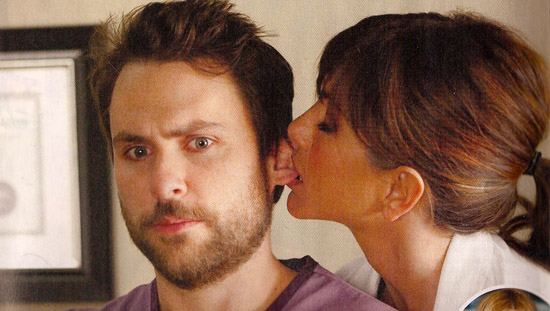
And trust me—these bosses are horrible people indeed. You have to praise the casting on this one. While the writing of the characters’ descriptions are suitably horrid in their favor in the screenplay by Michael Markowitz, John Francis Daley, and Jonathan Goldstein, the casting of the bosses must be given as much credit for bringing them to life and making us love to hate them. Kevin Spacey plays to his strengths as a disdainful sadist who loves to mess around with his middle manager Nick (Jason Bateman). Jennifer Aniston plays against type as a sexy dentist who wouldn’t know the meaning of sexual harassment if it came onto her as much as she does with her nervous (and married) assistant Dale (Charlie Day). Colin Farrell, a handsome guy who allows the makeup artist to make him look as repulsive as possible, plays Bobby, the cokehead son of Kurt’s (Jason Sudeikis) beloved employer (Donald Sutherland) who unfortunately dies at the beginning of the movie.

Nick, Dale, and Kurt don’t know anything about killing while covering up their tracks, and they’re not as sophisticated as they pretend to be. So they go to a rough bar, where they hope to hire someone to help them out. They come across someone they think is a hitman (whose name has undoubtedly inspired the MPAA’s R rating), played by Jamie Foxx. It’s his idea to have them swap murders. But first, they must do some reconnaissance, which involves breaking into their houses to find weaknesses of the bosses. Most of the laughs around these three come from bumbling about and only occasionally (and accidentally) doing something right.

Jason Bateman, Charlie Day, and Jason Sudeikis are reliable comic actors (though Day can occasionally become obnoxious and unbearably annoying), but their characters are not particularly well-written. The characters aren’t developed properly and there isn’t a great deal of chemistry among the three (mainly because Day has a tendency to make things a bit awkward). But they are individually funny enough for us to laugh at them, as well as sympathetic enough for us to root for them.

The final half is when things really start to heat up. Without giving too much away, things get even more sadistic, and funnier as well, as the Spacey character becomes less of a sadistic jerk and more of a psychopathic unstable mind. Spacey really sells it here.

“Horrible Bosses” has a good amount of gleefully vulgar moments, a few cheerfully stupid moments, and slick evil performances from Spacey, Aniston, and Farrell that makes for a funny hard-R-rated comedy. The movie has a wicked energy in its situation comedy that results in some big laughs. And who can look at Jennifer Aniston the same way again after seeing her as her crazy bitch of a character?

Brave (2012)

2 Mar

Brave-2012-movie

Smith’s Verdict: ***

Reviewed by Tanner Smith

“Brave” is an animated family movie that at first seems to go back to the traditional Disney princess material. But it’s far from that, for you see, the Scottish heroine Merida (voiced by Kelly Macdonald) is a princess, in the Viking era, but not the dim, usual damsel-in-distress who constantly needs to be rescued by a handsome prince. She’s actually a brave, adventurous, quick-witted, free-spirited tomboy who is great with a bow and arrow. It’s her mother—Queen Elinor (Emma Thompson)—who wants her to be the standard princess character. She doesn’t like the idea that Merida is…independent! Oh heaven forbid!

Merida is apparently at the age to be married, as Elinor decides it’s time to choose among three possible royal suitors. There are two problems, however. The first is, Merida doesn’t want to be forced into marriage—she isn’t ready, if only her mother would listen. The second is that all three suitors are bumbling idiots—one of which is an absolute weakling. After putting herself into an archery contest (saying she’s shooting for her own hand in marriage) and being scorned upon by her mother because of it, Merida hops on her trusty steed Angus and rides off into the forest, where she encounters some will-o’-the-wisps that lead her to a witch’s house (which looks like a woodcarver’s shed with many wooden bear figures around, but go outside then back inside and look what you get—I love magic). Merida offers to buy everything in exchange for a spell from the witch (Julie Walters) that will give her a different fate. The easy solution—give the mother a cursed treat that will change her mind about the marriage situation.

What happens to Queen Elinor is something that the advertisements have tried to keep hidden from the audience before seeing the movie, and it really ticks me off that the critics reviewing this movie are giving it away now that it’s released. I didn’t know what was coming when I saw this movie and it’s a good thing I read the reviews after I saw the movie. So I’m going to try and do the noble thing and just say that what comes after some magical occurrence leads to quite a troublesome situation that Merida has to deal with herself. And along the way, she learns that the relationship between mother-and-daughter is a strong one and in order to save the day, she and Elinor must rekindle their love.

“Brave” is the latest film from Disney and Pixar and while it’s not quite up there with “Finding Nemo” or “Up” (though to be fair, not all animated family films can be), it’s still a pretty entertaining film. It has a lot of funny moments, the characters are memorable, and as you’d expect from Pixar, it has top-notch computer animation. But it does bring about a personal disappointment for me, because this could have been great. For the first hour-and-a-half, it is pretty great. In the final twenty minutes, however, it resorts to one of those obligatory action climaxes that seem to come into place in family films that run out of ideas.

It’s strange too, because it seems like it’s saying, “Hey! You know that thing we do in the end of most family films nowadays? We’re not going to do that!” But once we get to a huge misunderstanding, it immediately tells us, “Psych!” and gives us a series of chases, fights, tears afterwards, and then a cheerful ending. I’m sure the makers of “Brave” could have thought of something better.

The characters are indeed memorable. Merida is a lot of fun as a teenage tomboy who fends for herself and is very spunky and quick-thinking. Her peg-legged, dim-witted-but-supportive, overweight Viking of a father King Fergus (Billy Connolly) is an absolute riot. Whether he’s going on about going after the gigantic bear that bit off his leg or constantly being used as a pawn in Elinor’s trickery to get Merida to the status quo, he’s just a ton of fun to watch. The three wild little brothers of Merida’s have been marketed like crazy, and deservedly so. These kids are just hilarious. They have little to no dialogue, so their facial expressions, body language, and just overall speed (whenever they sneak around the castle or run away after pulling a prank) take up most of their roles. Queen Elinor is a bit of a blank slate. But just what until you see what happens to her after she eats the cursed treat.

Do I even need to say how great-looking “Brave” is? I mean, it’s Pixar animation. Call me lazy, but it’s just pointless to talk about the visual creativeness of “Brave.” But if I had to point out some highlights, one prime example is a scene that has been used in every trailer, when Merida fires her arrow at a target with another arrow at the bull’s-eye (with Merida already a more-than-sharp shooter, the outcome is incredible). It’s a perfectly-animated moment. Another example is a slapstick comedy sequence in which Merida, with help from her brothers, has to sneak out of the castle while distracting her father and his buddies—the physical comedy is so well-timed, you can feel it off the screen. I know Pixar animation isn’t supposed to be known for its slapstick comedy visual gags, but this really was a treat to watch. I laughed and laughed.

“Brave” ends with a message of self-fulfillment and a mother and daughter finding common ground with each other. It’s sweetly-handled in the way that you can kind of forgive the movie’s flaws (aside from the standard climax, there are a few little inconsistencies in the story) and just enjoy “Brave” for what it is. It’s not one of Pixar’s best, but I enjoyed it nonetheless.

Con Air (1997)

2 Mar

con-air_1561256i

Smith’s Verdict: ***

Reviewed by Tanner Smith

“Con Air” is an energetic, thrilling action flick that delivers what audiences (and secretly, most critics) want from a film like this—absurd action, impressive pyrotechnics, over-the-top villains, a reckless good guy, and dumb, dumb, dumb authority figures. They always have to be dumb in these movies, don’t they? They never listen to the sensible one who knows what’s going on, and so that person tries his hand at helping to solve the situation with the hero.

But I digress. “Con Air” stars Nicolas Cage as the hero—ex-Army Ranger Cameron Poe, who has served eight years in prison on a manslaughter charge, after accidentally killing a man who threatened his pregnant wife). Eight years later, he is going home on parole to see his wife and meet his daughter for the first time. He and his prison buddy Baby-O (Mykelti Williamson) catch a flight, which also carries a load of the most deadliest criminals in America, on their way to a new Alabama prison. These sick thugs include the insane Cyrus “the Virus” (John Malkovich); black militant Diamond Dog (Ving Rhames); and 23-time rapist Johnny 23 (Danny Trejo) who hopes to make the female guard Bishop (Rachel Ticotin) his 24th. (“It would’ve been Johnny 600 if they knew the whole story.”) There are many more of these creeps on board, including intellectual-type serial killer Garland Greene (Steve Buschemi) who is quite the possibly the scariest man on the flight in his ways of looking at the world.

Unfortunately, they get loose, kill the guards hostage (except Bishop, who is now a hostage and the subject of Johnny 23’s taunts), and overtake the plane, with Cyrus in charge. Cameron and Baby-O pretend to be involved in the scheme, while Cameron tries whatever he can to secretly inform the authorities of what’s happening. Once word gets through, on the ground, we meet U.S. Marshal Larkin (John Cusack), a good guy who tries to resolve the condition peacefully, while a S.O.B. Federal agent (Colm Meaney) wants nothing more than to blow the plane out of the skies.

“Con Air” shares the common aspects that producer Jerry Bruckheimer’s (and his late partner Don Simpson’s) other action films had—fast editing, macho style, swift camera shots, and a booming soundtrack. While it’s not as smart or as intriguing as 1996’s “The Rock,” for example, the fun comes through and “Con Air” becomes a wild ride. Unfortunately, its weakest part is its final act, in which pure, nonsensical action completely takes over and becomes less interesting as the plane must ultimately land, and Cameron must finally square off against Cyrus.

What leads up to that is quite a kick, as action and comedy have an effective blend with each other. The criminals each have a sickly sardonic edge to themselves, and there are some grotesquely funny sight gags (including a corpse that falls from the plane and causes a traffic accident—and just when the driver had washed his car!). And how about those one-liners, especially including Cyrus’ whisper to the psychotic Garland when he first meets him (“You’re your work!”). There are also real moments of tension, when the criminals are so close to getting caught or when Cameron is almost given away one time too many. And I don’t even want to bring up the sequence in which a little girl may or may not become Garland’s latest victim.

The actors are game for their roles. John Malkovich is very menacing as the insane, predatory Cyrus the Virus. Among his backup, Ving Rhames is suitably nasty as Diamond Dog who plans to make his move against Cyrus soon enough. Steve Buschemi is absolutely mesmerizing as Garland Greene, the serial killer with reason and a soft voice that makes him even creepier—this character could have been just a cardboard cutout version of Hannibal Lector, but Buschemi makes it his own. John Cusack is game for his role of second-hero (though most of his role requires a lot of desperate shouting over the phone).

Also, Dave Chappelle, as a convict nicknamed Pinball, has some very funny lines that we’d like to expect from the great comedic actor.

I didn’t forget to mention Nicolas Cage as the hero Cameron Poe. But he is admittedly one of the least interesting parts of the movie. As much fun company he was as the hero in “The Rock,” here, he just seems rather bored and would rather be somewhere else. I understand that’s what any good-guy would feel like in a situation like this, but you know you’re in trouble when Steven Seagal is more exciting in “Under Siege” than Nicolas Cage is in “Con Air.” He’s not charismatic, nor is he very convincing with his too-thick Southern accent.

That aside, “Con Air” is a neat series of action scenes, witty dialogue, and I cannot believe I forgot to mention lots of explosions! And need we forget that while Cyrus’ cohorts walk away from explosions in an abandoned air field, Cyrus alone is man enough not to look back? Well, there you go.

Bill and Ted’s Excellent Adventure (1989)

1 Mar

eaclose2

Smith’s Verdict: ***

Reviewed by Tanner Smith

It’s the moment in “Bill and Ted’s Excellent Adventure” where California dudes Bill S. Preston, Esq. and Ted “Theodore” Logan meet their future selves that really let me know that I was in for a treat. About twenty minutes into the film, we’ve met these two lunkheads and were already introduced to an earlier plot point involving the future. Bill and Ted are sitting on the curb outside a Circle K, studying for their history class oral report (they ask passersby when the Mongols ruled China) when suddenly, a flying telephone booth lands in the parking lot. A strange man (from the future) steps out of it and approaches the awed dudes. They don’t know what to make of it, until another flying telephone booth lands next to them. In this one are Bill and Ted from some point in the near future. They approach their present selves and joyfully tell them that they’re going to have an excellent adventure through history, using the phone booth that is really a time machine from the future.

This is a great moment—my favorite line in this scene is from Future Bill who says, “Look dudes, we know how you feel. We didn’t believe it either when we were you and we-us said what we-us are saying right now.” It lets us know, as well as Bill and Ted, that what will follow is going to result in silly fun.

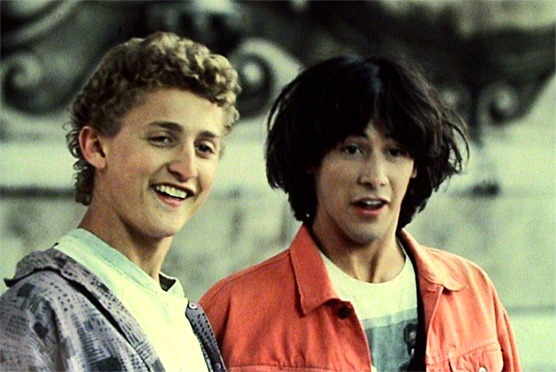
And that’s what “Bill and Ted’s Excellent Adventure” really is—silly fun. Bill and Ted (Alex Winter and Keanu Reeves) are two friends who live in San Dimas, California, and apparently each share a brain…or whatever they have. These two may seem dumb (they speak in dude-surfer talk and say phrases like “Excellent!” or “Whoa!” or “Bogus!”), but they’re smart enough to know that if they fail their final history exam, they’ll fail the class and Ted’s uptight father will ship him off to military school. This is real “bogus,” because if that happens, Bill and Ted will be separated and never start their own band, Wyld Stallyns.

This is where Rufus (George Carlin), the man from the future, comes in—you see, Bill and Ted are supposed to start their band so that they become world famous and create a movement that will eventually lead to world peace. Rufus is sent to help them pass their report so that Ted won’t be sent away and ruin the space-time continuum. Confused? Don’t worry—it’ll make sense soon.

Wait a minute! That’s what Rufus said at the beginning of this movie! (Don’t worry—it DOES make sense soon. That time, it was me saying that.)

And so, Bill and Ted use their new time machine to go to many places in the past and take with them many historic figures, including Billy the Kid, Socrates, Napoleon, and Abraham Lincoln. They have to get them all together, have them experience San Dimas, and have them speak for their presentation about what they think.

That’s a fun premise and the movie keeps to the silliness of it, making it “silly fun.” It also has fun with uses of time travel—I love the scene in which Bill and Ted use it to create multiple diversions in order to free their new friends from jail. Keanu Reeves and Alex Winter are likable, but also convincing as doofuses. It was fun taking this adventure with these two—it’s not “excellent,” but it is in their vocabulary.

Three Men and a Baby (1987)

1 Mar

selleck-danson-guttenberg-three-men-baby

Smith’s Verdict: ***

Reviewed by Tanner Smith

“Three Men and a Baby” is the American remake of a French comedy, which I never saw. But it doesn’t matter much anyway, since remakes are supposed to stand alone as movies instead of always being compared to the original all the time (even though we can’t help ourselves). So I don’t know what was upgraded and what was downgraded for this American remake of “3 Men and a Cradle” (the French film). But as a movie, “Three Men and a Baby” is a nice, gentle comedy with good laughs and a real sweetness to it.

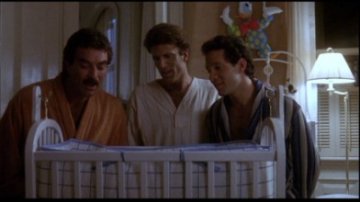
The movie features Tom Selleck, Steve Guttenberg, and Ted Danson as three bachelors who share a luxury apartment as their own bachelor pad in New York. (By the way, I love the look of the place; paintings of the city and portraits of the three guys outline the walls…though I don’t think it’d be suitable for a bachelor pad.) The first fifteen minutes of the film is just them delivering wisecracking dialogue and gawking over women. They have a seemingly endless series of girlfriends, some of which we see at a birthday party of one of the guys.

Then, the next day, actor Jack (Danson) leaves to shoot a film in Turkey for about ten weeks, but architect Peter (Selleck) and cartoonist Michael (Guttenberg) find a big surprise waiting on their doorstep. It’s a little baby, asleep in a bassinet with a note attached to it. The baby is Jack’s after an affair from long ago. The mother has sent the baby, named Mary, to the apartment. With Jack not around, Peter and Michael are forced to handle the situation, but of course know absolutely nothing about taking care of a baby. They refer to Mary as “it,” don’t know how to entertain her when she’s crying, doesn’t know what she eats, and, in one of the film’s funniest scenes, they figure out how to change a diaper. Their confusion is not helped when they go out to the store to buy baby food, and there seems to be a lot depending on the age, which they don’t know. Each day passes by and they’re still miserable and confused with this bundle. All the baby does is eat and poop. But later with each day, they actually start to love Mary.

When “Three Men and a Baby” focuses on these scenes in which these guys deal with the baby and grow to love her, it works. There are a lot of big laughs in the complaints that these men have (such as how Peter wonders if feeding the baby every two hours means from start to finish) and in how people react to the situation (a grocery clerk asks suspiciously, “You don’t know how old your own baby is?”). And then when Jack comes home, Peter and Michael use this as revenge for leaving them here with his own baby. Jack nervously tries to handle it himself, as Peter and Michael did, because “I’m an actor—I can play a father.” He tries to get his mother to help, but she sets him straight, saying it’s his turn to take care of things for himself for once.

The best moment in the movie is when all three guys softly sing the baby to sleep with “Good Night, Sweetheart.” It’s a touching, genuinely moving scene.

“Three Men and a Baby” succeeds when handling this forming relationship these men have with the baby. What doesn’t work is a tired subplot involving another package delivered to the apartment; only, this one is full of heroin. Some drug dealers come by, asking about the package, which the guys at first think they mean is the baby. Once they realize what they really want, they can’t find the package and are not only in trouble with the dealers, but also with the cops who are investing a drug-included case. And this leads to a confrontation between the men and the drug dealers in a construction site, the screenwriter’s reliable Hollywood cliché. Why, when the central story is cute and funny and heartwarming, did they have to add a subplot about drugs? It’s unnecessary, and the final confrontation is not effectively staged, even though director Leonard (Spock) Nimoy and writers James Orr and Jim Cruikshank try their best to keep it tense. I guess it’s supposed to show how far the guys will go to protect the baby, since the dealers actually leave a note saying they’ll take her next time. But we didn’t need a drug-related subplot.

But there is plenty of material with the three men and the baby that the comedy elements outweigh the “suspense” elements. All three actors do game jobs, especially Tom Selleck who does a great job mixing tenderness with light comedy. He’s convincing throughout the movie. Steve Guttenberg has good moments (such as when he tries to entertain the baby while she’s crying) and Ted Danson is credible as a snobbish, handsome actor.

“Three Men and a Baby” is a funny, moving movie when it focuses on the title roles. Sure, the screenplay doesn’t take the high road and like I said, I could’ve done without the drug stuff, but it mostly succeeds in winning us over.

The Battle of Shaker Heights (The Project Greenlight Movie) (2003)

1 Mar

MV5BODcyMzg0MzQ4NV5BMl5BanBnXkFtZTYwODAzMDk2._V1._SX485_SY331_

Smith’s Verdict: ***

Reviewed by Tanner Smith

“The Battle of Shaker Heights” is the second movie filmed out of competition for the “Project Greenlight” contest. “Project Greenlight” was an HBO behind-the-scenes TV series that documented the winners of a contest for screenwriting and directing (sponsored by Matt Damon and Ben Affleck and Chris Moore)—amateur writers and directors who never worked on a movie before finally get their chance. The series followed the contest winners as they get together to make a movie with a small budget given to them. Throughout the series, we were with the people as they talked through their problems of making this movie and understood what they were going through. Then they finally get their movie done and the movie is shown in theaters on a limited release with the tagline “The Project Greenlight Movie”—a somewhat sad distinction. However, I can’t really say that the movies themselves are more compelling than the TV series that shows them being made. The show had more a more compelling storyline and even more compelling “characters.” The first “Project Greenlight” show featured the making of the movie “Stolen Summer,” a coming-of-age movie featuring Aidan Quinn and Bonnie Hunt (and a couple of annoyingly-cute child actors), if you recall. Now, the second “Project Greenlight” movie features the making of the movie “The Battle of Shaker Heights,” a coming-of-age story about a teenager who is ticked off at life.

The show is more interesting than the movie. But does it look like a movie more than a product? Yes. Is it worth recommending? Just barely, but there are some things to like about it.

I saw the show—I felt like I was with screenwriter Erica Beeney and directors Efram Potelle and Kyle Rankin as they had arguments/disagreements about certain parts of pre-production, production, and post-production. Beeney has a lot of potential in her screenplay and Potelle and Rankin show some talent, but there’s too much going on in the screenplay and sometimes the movie is uncertain about which way it wants to go.

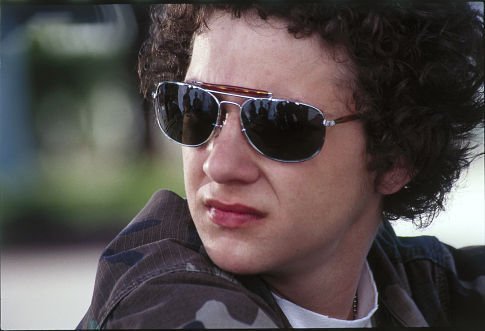
The main reason I am recommending this movie is because of the lead performance by Shia LaBeouf, who is very appealing as the lead named Kelly Ernsweiler, a 17-year-old war reenactor who takes his hobby very seriously and puts down the other reenactors who aren’t very serious—and he questions his history teacher about his teaching methods. His home life isn’t pleasant—his mother (Kathleen Quinlan) is an artist and caring enough, but Kelly doesn’t like his father (William Sadler), who used to take drugs and tries to tell the boy that he’s clean now (Kelly replies, “So what? I’ve been clean all my life.”).

Kelly makes a new friend in Bart Bowland (Elden Henson), a rich kid Kelly meets on the reenacting battlefield. They bond and become great friends and together, they form a plan to gain revenge on the school bully who gives Kelly a hard time. There’s a problem here—Kelly has a crush on Bart’s attractive (and engaged) older sister Tabby (Amy Smart) and so, Kelly is trying to impress her but Tabby only finds him slightly amusing. She doesn’t take his puppy love seriously. (Of course, what Kelly doesn’t know is that his attractive co-worker at a grocery store has a crush on him—that story element has been done too often, and here, it’s underdeveloped.)

There you see how much is in Beeney’s screenplay—I won’t even go into Bart’s father’s weird hobby of collecting nesting dolls. But there are a lot of clever lines in this movie—I’m glad to see on the show that none of them are improvised (at least, not a lot).

Shia LaBeouf is a very talented young actor, and here, he makes his character winning and three-dimensional. Elden Henson (“The Mighty”) and Amy Smart are very good here as well. Elden Henson, in particular, seems like someone you would want as a best friend.

I’m recommending “The Battle of Shaker Heights” just barely. I liked the performances very much. Maybe what would have improved the “Project Greenlight” scenario is if Matt Damon and Ben Affleck really got into the action instead of just disappearing and showing up when they need to. Then they could convince Miramax to send them a real budget. The possibilities (especially since “Good Will Hunting”) are endless.

Kick Ass (2010)

1 Mar

2010_kick-ass_005[1]

Smith’s Verdict: ***

Reviewed by Tanner Smith

As far as I can tell from reviews, “Kick-Ass” is a movie you either love or you hate. Is it possible to “only like” it? I guess it is possible, because I “only liked” it. I did not love it, but I do not dislike or hate it either. Yes, it is overly violent. Yes, it has uneven humor. Yes, it tries to be a mixture of both. But about that last “yes,” it does work at a mixture of both funny and violent. We’ve seen the superhero-set-in-reality gimmick before, like we did with the great Disney/Pixar film “The Incredibles” and Will Smith’s surly superhero “Hancock”—we just haven’t seen it with teenagers in the lead roles or with graphic violence that would make Tarantino wince. The movie takes place in the “real world”—crime is where you least expect it and nobody has superpowers.

The film’s narrator Dave Lizewski (Aaron Johnson) is a geeky high school teenager who is just plain average—his only superpower is being invisible to girls, he doesn’t have a lot of friends on MySpace, and he has his own fantasies. He is heavily influenced by comic books and wonders why nobody ever tried to become a superhero in this crime-ridden world—he thinks that all a person needs in order to be a superhero is a costume and a weapon. So, under the name “Kick-Ass,” he tries it out—he orders a green wetsuit complete with mask, carries two blunt objects, and looks for crime. His first attempt is a failure as he is almost killed. But that doesn’t stop him. Soon, he scares off a group of muggers and is caught on somebody’s iPhone. Soon, Kick-Ass is a YouTube sensation and the inspiration for other “superheroes.”

If Kick-Ass’ beatings are violent enough, you haven’t seen anything yet. A subplot involves a mob boss (Mark Strong) who kills people mercilessly without explanation—a bad influence for his teenage son (Christopher Mintz-Plasse, best known as “McLovin”). In one scene, the man even fries one person with a man-sized microwave. But even that’s nothing compared to what I am about to explain next. It turns out that a father and daughter have become costumed vigilantes of their own, inspired by Kick-Ass. They are Big Daddy and Hit Girl. Big Daddy dresses up like Batman (complete with Adam West voice—he pauses. like. this.) and his true identity is a near-crazy father to eleven-year-old Mindy, who is Hit Girl. How crazy? Consider an early scene where he uses his own daughter as target practice (Mindy wears a bulletproof vest so she can feel what it’s like being hit with a bullet). He wants to do it three times—Mindy asks for ice cream and bowling afterwards. Big Daddy has taught Mindy the ways of the weapon—from butterfly knives to handguns—and together, Big Daddy and Hit Girl are more experienced than Kick-Ass.

_1271370281

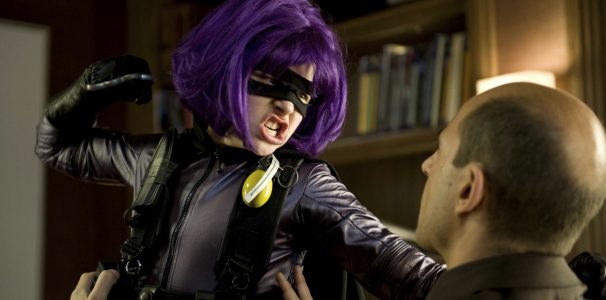
Here’s what will draw the most controversy for “Kick-Ass” but will also be the most memorable—Hit Girl is not playing a game like Kick-Ass is. She is overly serious about this new identity—she doesn’t just outsmart the criminals; she kills them stone-cold dead. She cannot be reasoned with. Complete with a purple wig, a leather outfit and mask, Hit Girl is an eleven-year-old nightmare for all parents.

The crime boss doesn’t like that Kick-Ass, Hit Girl, and Big Daddy are wasting his men, so he declares open season on them. His son gets a costume of his own and names himself Red Mist. His job is to trick Kick-Ass into leading him to Hit Girl and Big Daddy. This sets up the final half of the movie, which is more violent than funny. But when you raise a climax for a movie like this, what more can you ask for? It’s a final showdown—you saw it coming, deal with it.

What I liked about “Kick-Ass” was that it featured a main superhero that has no experience whatsoever. As a hero, Kick-Ass is better off staying home. But he tries his best. This is what gives the film an edge—both for effectiveness and for humor. I liked Kick-Ass’ true identity Dave’s high school problems that could be resolved with his secret identity now that he has self-confidence. He even scores the girl of his dreams (Lyndsy Fonseca), who at first thinks he’s gay. Now, portrayed by Aaron Johnson, Dave may be a bit bland, but he is believable and that’s what the film needed. He is not supposed to steal the show, so he doesn’t. What really gives “Kick-Ass” its kick are the characters of Big Daddy and Hit Girl. Big Daddy is played by Nicolas Cage in his craziest performance in a long time. He understands this material and plays with it. I can’t think of another actor who could pull off this character. I love it when he says his dialogue while in the Big Daddy suit—his speech impediment in those scenes makes the film work greatly for Cage. Chloe Grace Moretz is a true find as Hit Girl. She may get the most attention for a girl of her age doing all of these horrible things to people, but it helps that she is an extraordinary young actress.

“Kick-Ass” is original, alive, well-made, and powerfully-acted—it also bloody and violent. It deserves its R rating. The trailers for this movie make it seem like a PG or PG-13 family superhero movie. (Parents will most definitely be shocked by the language that comes out of this little girl’s mouth, though the kids will love it.) I was interested in these kids and I feared for them when they were in real danger. Not that I approve of Hit Girl killing hit men. But done in the wrong hands, this material could’ve easily failed. Luckily, it finds its place and keeps it there. Is “Kick-Ass” a masterpiece? No. But it’s a fun thrill ride.

Bad Boys (1983)

1 Mar

4513729_l2

Smith’s Verdict: ***

Reviewed by Tanner Smith

The opening-credit sequence in “Bad Boys” includes pictures of who I suppose are the actors (or specifically, in this case, the characters the actors portray) as little children. They look like harmless, clean-cut, innocent, sweet kids and they probably were for a time. But they must have gone down the wrong path to become what the title of the movie describes them as—“Bad Boys.” What caused them to be like this? It could be neglect, abuse, or maybe (and most chillingly) they just didn’t care about anything anymore. Any one of those would be good reason as to why these boys act like this. In “Bad Boys,” the bad boys aren’t romanticized, but are more like objects for a cautionary tale.

Sean Penn acts convincingly in a role that made him a star as the main focus of this story—a young Chicago thug named Mick O’Brien. The only thing he’s ever cared for is his girlfriend JC (Ally Sheedy). He hates his life at home and performs felonies all over the city. But one night, something goes wrong with a local drug dealer—Paco Mareno (Esai Morales), also a teenager—and results in the death of Moreno’s younger brother. O’Brien is sent to a juvenile reformatory where the worst sort of teenagers do time and act out violently against each other.

The first half of “Bad Boys” is the best part of the whole movie. While O’Brien is in the reformatory, he learns the ropes, finds out who to trust—including his smart-aleck roommate Horowitz (Eric Gurry), and later becomes respected after pummeling a couple of sadistic thugs nicknamed “Viking” (Clancy Brown) and “Tweedy” (Robert Lee Rush). He learns that in this place, only the strong survive. The strengths of the first half come from the first-rate direction by Rick Rosenthal and the performances from the actors—especially Sean Penn, who is excellent and three-dimensional as the bad boy who seeks redemption in the wrong places.

But when Moreno brutally rapes O’Brien’s girlfriend and is put into the same reformatory as O’Brien, the movie starts to become predictable. It’s obvious that the two are going to duel to the death and that’s exactly how the movie is going to end. On top of that, it’s sort of obvious who’s going to win. Was a fighting climax really necessary?

But you can’t let something like that stop you from recommending a movie that is so strong up until that point. “Bad Boys” works for the most part because it shows realistic situations involving troublesome (and troubled) teenagers together in one building. Like I said, only the strong survive here. But these are people whose adult lives are over before they’ve barely begun. It’s a sad case for these kids because very few of them will get redemption—the rest of them will simply ask for more trouble. Take Horowitz, for example. There’s a scene later in the movie when he sets up a radio to explode in Viking’s face. Sure, Viking was a sadist to begin with and probably deserved what he had coming. But now, Horowitz has a troubling punishment all because of his actions. Only he’d stopped to think. That’s what the audience would think about every central character in this movie at this point. Actually, that’s something else to think about too—after the big climax at the end, everyone else is surprised by the outcome. Since I am recommending “Bad Boys,” I guess it’s fair to say that you should watch the final scene and wonder what the characters are thinking.

“Bad Boys” isn’t a great movie, but it comes so close to it. The performances from Sean Penn, Esai Morales, Eric Gurry, Ally Sheedy, Clancy Brown, Robert Lee Rush, and Reni Santoni (he plays a counselor in the reformatory) are very strong. The direction from Rick Rosenthal is excellent. Why did the movie have to end with a fight climax?