Archive | March, 2013

Body Snatchers (1994)

3 Mar

snatch10

Smith’s Verdict: ***

Reviewed by Tanner Smith

“Body Snatchers” is not necessarily a full adaptation of the famous novel of the same name, written by Jack Finney. In some ways, it’s a sequel to the 1978 film adaptation “Invasion of the Body Snatchers” (which itself was a remake of the first film adaptation from 1956). That’s one way you could look at this 1994 version, in that we’re secluded to one particular setting that could show that the events in the original 1978 film are just continuing with the characters in this one.

For the few who don’t know who (or what) these “body snatchers” are, they’re pod-like alien beings that come to invade Earth by cloning humans and taking their place (and destroying the originals). The scary thing is that anyone on Earth could be one of these aliens. It could be your mother, father, sibling, lover, friend(s), mailman—anybody. There is one giveaway—they may look normal, but what keeps these duplicates indistinguishable from normal people is their complete lack of emotion.

“Body Snatchers” takes place on a military base, which is probably the perfect place for these “body snatchers” to hide. For one thing, they have easy access to weapons and armored vehicles. And also, the soldiers there are already practically emotionless to begin with. Who would suspect these stone-faced people to be pod people if you didn’t already think they sort of were? That’s a clever move that this movie makes.

Teenager Marti (Gabrielle Anwar) has moved to the base with her family. Her father (Terry Kinney) is an E.P.A. consultant brought along to study these drums of toxic chemicals put on the base. Marti, like most teenagers, is bummed about the move, but more unnerved by a visit to a gas station on the way, where she is grabbed by a runaway soldier (Forest Whitaker) who screams hysterically, “They’re out there!”

He’s right—the body snatchers are taking over the base, unloading pods in a nearby swamp. The soldier warns “they get you when you sleep,” meaning that the pods unleash tentacles that trace around people’s bodies and snake into noses, ears, and open mouths so that they drain their life forces. Then the pods are grown into perfect clones of those people, who have been literally drained of their lives in the process.

Marti’s stepmother (Meg Tilly) is the first of the family to fall victim to the body snatchers, and the only one who knows is her five-year-old half-brother Andy (Reilly Murphy) who, in an effectively disturbing scene, has witnessed her mother’s lifeless body crumble before his eyes and the new duplicate walk out of the closet, naked. Andy can’t get Marti or Dad to believe that this person isn’t Mommy. But then things get really crazy as the stepmother, along with just about everyone else on the base, goes after the three of them.

Now to be honest, I wasn’t really enjoying the first half of “Body Snatchers” very much. Gabrielle Anwar, who was luminous as Al Pacino’s dance partner in “Scent of a Woman,” comes off as sort of bland in the lead role of Marti. And Terry Kinney, as her father, is worse. One would suspect that he already is a body snatcher just by looking at him, even though he isn’t supposed to be. A lot of moments seem rushed and others seem painfully obligatory. And also, Meg Tilly doesn’t have much of a character to show enough dimensions for us to know the difference between her human form and her alien form. But to be fair, there are a couple genuinely creepy moments that kept me interested in seeing if the movie could top them. One is a scene featuring Andy in a daycare center, as every other kid has the same drawing (of tentacles spreading) except him. And another is the scene I just mentioned, in which Andy sees a newly-formed alien in the form of his mother.

Then about forty-five minutes into the movie, “Body Snatchers” really comes alive with a tense, suspenseful second half in which Marti, her father, Andy, and her helicopter pilot boyfriend (Billy Wirth) are on the run from the pod people. The structure is very clever, the horror continues with further suspense, we feel the characters’ fear, and the visuals are stunning.

Frightening moments include—shots of the pod people giving chase in packs (it’s always frightening when groups of people go after one small group); a scene in which the boyfriend finds Marti in a shed full of pods ready to take over (her body double is already formed as the boyfriend must save the real Marti); and a sequence involving an attack on a helicopter.

There are many other unnerving moments, mainly those including the few human characters left having to pass themselves off as a pod person in order to blend in and attempt an escape from the base. For example, when the young pilot boyfriend is confronted by duplicates of his friends, he forces himself not to show an emotion. But then there’s a line that would get any teenage boy angry and you have to wonder, can he keep pulling this off so he’ll still convince them? This scene is carried over in a scene where Marti is looking for Andy—if she asks the wrong person to help her, she gives herself away. Who can be trusted?

This is the strength of “Body Snatchers”—the situations are well-established so that the terror generates convincingly.

I may have complained about Meg Tilly, but how can you not love the scene where she widens her eyes and lets it clear to Kinney, in a disturbingly calm manner, that there’s nowhere to run or hide. Tilly owns that moment, as well as a following point when she points her finger at the escaping family and screams hysterically—by the way, that’s the signal for the body snatchers to give chase.

Even if the characters aren’t well-developed and some parts of the story come off as pretty obvious, “Body Snatchers,” mainly in the second half, works as a horror film. It’s suspenseful, has a few shocking surprises, and keeps you interested in the story’s outcome. That’s good enough for me to recommend “Body Snatchers.”
Beverly Hills Cop (1984)

3 Mar

beverlyhillscop_article_story_main

Smith’s Verdict: ***

Reviewed by Tanner Smith

Reportedly, the screenplay for “Beverly Hills Cop,” an action film about a Detroit cop solving a case in Beverly Hills, has been passed around for years before it was finally greenlit. It went through several story developments, and tossed around actors for the lead role such as Mickey Rourke and Sylvester Stallone. But then came Eddie Murphy for the part, which led to massive rewrites. Although, if you ask me, that’s a little hard to believe, because Eddie Murphy is such a master of improvisation that I wouldn’t be surprised if director Martin Brest just informed him of the situation his character was in, and then rolled the camera to see what he could do.

If that was the case, why was the screenplay for “Beverly Hills Cop” nominated for an Academy Award? The writing, aside from Eddie Murphy’s one-liners (most of which I believe were improvised), is quite generic.

Eddie Murphy stars as a tough, streetwise Detroit detective named Axel Foley. He gets himself in trouble with his commanding officer because he does things his own way. Axel’s friend comes to town, after six months of working in California. But some unfriendly visitors follow him because the friend has negotiable bonds that belong to them. They murder Axel’s friend, and Axel decides to use his “vacation time” to go to Beverly Hills and track the guys who did this. And while solving the case, Axel finds himself more at home in these posh California settings than in his ghetto Detroit origins, as he constantly adjusts to Beverly Hills customs.

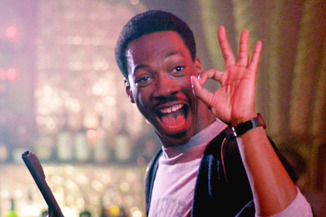
Let’s face it—no one really cares about the story for “Beverly Hills Cop,” because mainly people seem to like “Beverly Hills Cop” just because of Eddie Murphy. Suffice it to say, Eddie Murphy is hilarious in this movie. Coming off of “SNL,” “48 HRS,” and “Trading Places,” Murphy again proved that he was one of the great comedic talents of his generation, and in “Beverly Hills Cop,” he does what he did best—playing the fast-talking, with-it underdog who also ended up being the smartest guy in a rich world. You can keep calling him Axel Foley in this movie, but let’s face it—we all called him Eddie Murphy. And no one plays Eddie Murphy like Eddie Murphy.

The entertaining aspects of “Beverly Hills Cop” aren’t merely the action scenes that take place, though admittedly some of them are kind of fun (including an opening chase scene in Detroit). Instead, they are the scenes in which Axel finds new ways to get by in Beverly Hills, always having the upper hand. It’s just a great amount of confidence that doesn’t get Axel down—there’s never a scene where he mopes because he doesn’t feel like he belongs. He’s just on vacation, and happens to be solving a case as he goes along with this challenge.

The only bit of this sort I didn’t find funny was the scene in which Axel loudly intimidates the desk clerk of a fancy hotel, playing the race card and thus getting himself a suite with a single-room discount. This scene was just uncomfortable to watch and listen to, and it’s also kind of embarrassing in the way it’s portrayed.

But just about every other scene of this sort gets a good laugh. Axel’s beater of a car driving on the same streets as Porsches and Cadillac’s is a good sight gag. Axel’s reaction to Michael Jackson impersonators walking the streets is good for a laugh. And how can you not love his reaction when he is thrown out of a window by five bodyguards of Axel’s main suspect, art dealer Victor Maitland (Steven Berkoff)? Axel was there to ask Maitland a few questions (and Maitland does not look like the trustworthy type, despite his sophisticated manner), and then security came along, threw Axel out of a plate-glass window, and the cops show up. “You believe this?!” Axel asks the cops. “I can describe all of ‘em!” Then the cops arrest him. But why? “Disturbing the peace?! I got thrown out of a window! What’s the charge for getting pushed out of a moving car? Jaywalking?!” (No prizes for whoever guesses correctly whether or not that line was improvised.)

There are many other funny moments like that, and they also come with the Beverly Hills police force who get to know him after arresting him. Two detectives—stuffy sergeant Taggart (John Ashton) and young naïve Rosewood (Judge Reinhold, very funny)—are hired to follow him around, and Axel manages to befriend them because he’s able to teach them how to bend the rules and come up with fish tales to get off the hook. (Of course, he manages to befriend them after sticking a banana in the tailpipe of their patrol car, distracting them with a shrimp sandwich.) Axel takes them to a strip joint, where they manage to stop a violent situation from occurring.

But of course, there’s also the plot as it thickens. Maitland, it turns out, did arrange for Axel’s buddy to be murdered, and Axel sets out to prove it. Taggart and Rosewood wind up helping him, going beyond the book and doing things Axel’s way. And Axel’s old girlfriend Jenny (Lisa Eilbacher, quite appealing) gets caught up in the mix and gets kidnapped. And of course, this all leads to a climactic gunfight between the cops and the armed guards at Maitland’s house.

Actually, even in the action-filled climax, there are some good laughs to be had here—though, it’s mostly with Taggart and Rosewood reacting to their current situation. (it’s usually not a good idea to hold up a policeman’s badge and yell to a bunch of armed security that they’re all under arrest.)

Eddie Murphy, as I’ve said, is a lot of fun and has a great comedic energy to his performance. But he also has some interesting comic foils to work with and play off of. John Ashton and Judge Reinhold are effective while playing their roles straight, especially Reinhold whose naivety is quite amusing. Ronny Cox has some good moments as a Beverly Hills lieutenant who can’t believe how Axel is able to mess with two of his detectives. Lisa Eilbacher is game for reacting to Murphy’s antics. And there’s also a small part by Bronson Pinchot as one of the art gallery workers—his odd accent is indistinguishable, and Pinchot even manages to steal scenes from Murphy. And that’s no small feat.

But really, it all comes back to Eddie Murphy. He knows what he’s doing throughout this movie, and he’s clearly having fun while constantly keeping the upper hand. Even with the screenplay he’s saddled with, he still manages to make us laugh and care. He makes “Beverly Hills Cop” worth watching.

Chasing Amy (1997)

3 Mar

chasing-amy-1997-ben-affleck-joey-lauren-adams-pic-1

Smith’s Verdict: ***1/2

Reviewed by Tanner Smith

Kevin Smith is a great screenwriter—he doesn’t just write dialogue; he creates characters that actually have something interesting to say. His characters are quirky, three-dimensional, and fun and when they talk, it feels like regular everyday people talking. Even Smith realized this when he tried to create an action comedy with slapstick and special effects in his less-than-successful 1995 film “Mallrats.” In fact, he even calls himself a horrible director and actor, but a great writer. He’s better off writing—his direction is not special in a certain sense. But with his movies, we don’t really care because his direction lets the characters breathe and talk through his writing. He did it with his debut “Clerks,” a low-budget comedy, directed by him, with a fantastic script, written by him. Then when “Mallrats” was released, it was such a disappointment that during the screening for his next movie “Chasing Amy,” Kevin Smith even apologized for it. And in the end credits of “Chasing Amy,” this quote is used—“And to all the critics who hated our last flick—all is forgiven.”

“Chasing Amy” is linked with “Clerks” and “Mallrats” with some of the writer/director’s trademarks like pop culture references (discussions of “Star Wars”) and a touch of “Jaws” (in “Chasing Amy,” two characters discuss their scars…from what, I won’t give away). It also has raunchy and vulgar humor and here, it almost goes a little overboard with its frankness of sex. But I have to give credit for not wimping out during these discussions, especially when the main male character asks how the main female character, who is a lesbian, is able to have sex with women. Some people may laugh out loud—others may cringe. But there are many other big laughs, great surprises, and a heart that comes along in the midst of this story.

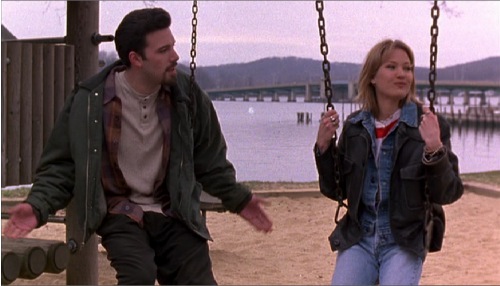
The premise of “Chasing Amy” may sound like another dumb sex comedy, but Smith handles it more intelligently than you could possibly imagine. Two comic book artists—laid-back Holden (Ben Affleck) and his brash roommate Banky (Jason Lee)—are signing autographs at Comic Con for their latest creation—a comic book about stoner superheroes called “Bluntman and Chronic.” They meet another comic book artist—a woman named Alyssa Jones (Joey Lauren Adams)—and Holden has a crush on her. But then he finds out that she’s a lesbian. But even though she’s gay, he falls in love with her and tries to have a loving relationship with her. This premise may sound confounded, but it’s handled so maturely that you have congratulate Smith for creating something so fresh.

I mentioned above that the characters are fun to watch and that they talk like regular people rather than characters—even though they are playing characters—and they do. Holden and Banky create comic books—what do I know about comics? Very little. But it’s great to listen to these guys talk about their work because that’s what they love doing. These characters are so well-developed. I loved the relationship that Holden and Banky have as great friends (although for Banky, it may be a little more). And then there’s the discussions Holden has with Alyssa (sometimes, Banky has his own conversations with her). This is the heart of the movie. Watching these two talk and relate to each other is great to watch and fun to listen to. These two have great chemistry together. But then there comes the more serious scenes which are even better. Holden tells Alyssa that he loves her in one scene and Alyssa doesn’t have a clue about how to respond. Is it possible for her to have second thoughts on her sexuality? Could Holden have a chance with her? One of the very best things about “Chasing Amy” is how unpredictable it is. If you can answer those questions right away, I bet you would be only close but with very little dice.

The script is full of wonderful dialogue. There’s a supporting character—a gay black man named Hooper (Dwight Ewell)—who has a whole speech about racism involved with the “Star Wars” trilogy and his own opinions on the sexuality of Archie and Jughead. And then there’s Jay and Silent Bob, returning from “Clerks” and “Mallrats” and played again by Jason Mewes and Kevin Smith himself, who has their own conversation with Holden. Once again, Jay is a foul loudmouth who can’t shut up. But here’s a surprise—Silent Bob finally opens up and gives his own speech about who the titular Amy was and why she was worth chasing. And also, have you ever wondered what lesbians thought about sex and virginity? Well, those discussions are here too.

“Chasing Amy” is one of Kevin Smith’s best films—funny but also intelligent. When it gets into serious mode, we are brought right into it. We believe everything that is happening on screen because it is handled so maturely and delicately. It’s helped by a fantastic script, a touch of comedy, drama and romance, and its ensemble of great actors. Ben Affleck, who plays Holden, is a nice guy for us to follow, Jason Lee goes as far as he can go with Banky without making him so obnoxious that he’d be unwatchable, and Joey Lauren Adams, who is a real discovery, embodies a really complicated character who is forced to think about her own self and creates a surprising amount of range and wit. Minor missteps for this movie can be forgiven and so can Kevin Smith for “Mallrats.”

Scott Pilgrim vs. the World (2010)

3 Mar

scott_pilgrim_vs_the_world_01-535x294-454x249

Smith’s Verdict: ***

Reviewed by Tanner Smith

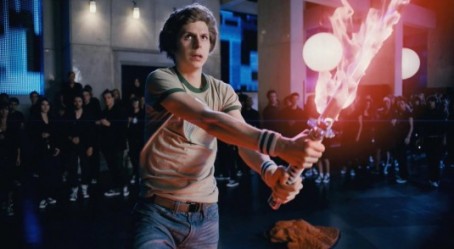
What a world that Scott Pilgrim has to fight through! In this “world,” Scott Pilgrim (along with us, as the audience for the movie “Scott Pilgrim vs. the World”) is sucked into action sequences that defy gravity, bend physics, and seem almost hilariously and epically vicious. What a trip.

“Scott Pilgrim vs. the World” is a movie based on the popular graphic novel of the same name. I guess it could be described as a satire—not only of the graphic novel, but of comic books, video games, and all graphic novels. This movie was brought to the screen by Edgar Wright, whose previous films were “Shaun of the Dead” and Hot Fuzz,” and he specializes in this sort of satire. There are quickly paced editing in non-action sequences, good pacing, great comedic writing, and then there’s the action itself. These action sequences blend comic books, graphic novels, and video games into one and the result is outstanding. Scott Pilgrim and his opponent face each other in exaggerated (but very funny) manner, then they fight—they jump high through the air, freeze when necessary, punch and kick each other even harder than you can without getting seriously injured, and when the opponent is defeated, he explodes into coins (points you would receive when playing a video game for an extra life). Scott has to do the same thing multiple times in this movie.

OK, I’m praising the action a bit too early. Let’s just talk about the plot to “Scott Pilgrim vs. the World.” Scott Pilgrim is a 22-year-old Canadian currently dating a Chinese high school girl named Knives Chau (Ellen Wong). Scott plays in a hardcore rock band called Sex Bob-omb and lives with a gay roommate (Kieran Culkin, sort of overdoing it with the gayness, but mostly funny). He has fun with Knives at first, but he starts to get a little tired of it. Enter New York transplant Ramona Flowers (Mary Elizabeth Winstead). To Scott, this is the coolest girl in the world. She’s a tough babe sporting leather jacket and boots, as well as changing her hair color every week. Ramona tells Scott that they can date if he can fight and defeat her “seven evil exes.” And just like that, the battles begin!

These action sequences will relieve those who were disturbed by the graphic realistic violence in this year’s earlier comic book superhero-satire “Kick-Ass.” In that movie, you knew that there really were people becoming part of a bloodbath. With “Scott Pilgrim vs. the World,” it’s different because this movie does not take place in reality (I don’t think). It’s exaggerated, fun, hilarious, and amazingly done so that we don’t feel disturbed. Good casting composes of Brandon Routh (the previous Superman) and Chris Evans (the Human Torch) as two of the evil exes.

Oh, I cannot believe I forgot to mention the actor playing Scott Pilgrim. Well, it’s Michael Cera, who has great deadpan comic timing, which he proved so with the TV show “Arrested Development” and with the movies “Superbad” and “Juno.” Recently, he hasn’t been in a good movie since “Juno,” in my opinion. I didn’t like “Nick and Norah’s Infinite Playlist,” “Year One,” or “Youth in Revolt.” The material just wasn’t there for him. Here, Michael Cera feels right at home, oddly enough. His deadpan comic personality fits right in with the video game/comic book scenarios. He can seem like a sissy and he shows that he might be, especially when he has to break up with Knives so he can be with Ramona—“I think we should break up, or whatever…”

I laughed a lot at the non-action scenes, especially the “Seinfeld” satire (complete with music and laugh track). I liked the songs performed by Sex Bob-omb and how the movie kids with the video game elements (the Universal logo even gets the treatment). There are many overly edited bits that are just plain funny. And there is an action sequence that I couldn’t help but laugh out loud with. It’s another one of the evil exes that Scott has to vanquish, in which Mae Whitman (recently co-starring in the TV series “Parenthood”) plays the evil ex (don’t ask). Diehard “Arrested Development” fans (like me) may recognize her as Michael Cera’s “Arrested Development” character George Michael’s girlfriend Ann. Maybe I was just having my own imaginative battle while watching this particular one, but watching George Michael and Ann fight in an overly-exaggerated action sequence just made me laugh out loud.

I have a couple of criticisms—one somewhat obvious and one somewhat personal. The one personal criticism, just to get it out of the way, is that I would have loved to see more of Anna Kendrick as Scott’s younger sister. Anna Kendrick is a go-to actress for any movie, even if it’s just a small part for her. She has that gutsy, witty attitude that I just can’t resist. I think she’s criminally underused here. An obvious criticism—seven evil exes just seems like too much. The movie stretches out a bit too long. Maybe it would’ve been better if Ramona just had five evil exes.

I would probably take “Scott Pilgrim vs. the World” over “Kick-Ass.” Over “Sky High?” Well, maybe. This is a crazy and exaggerative but hilarious and awesome movie. I haven’t read the original graphic novel of the same name, so I can’t make comparisons. On the film adaptation, however, it’s a fun ride to take.

Hot Tub Time Machine (2010)

3 Mar

hot_tub_time_machine_a_l

Smith’s Verdict: ***

Reviewed by Tanner Smith

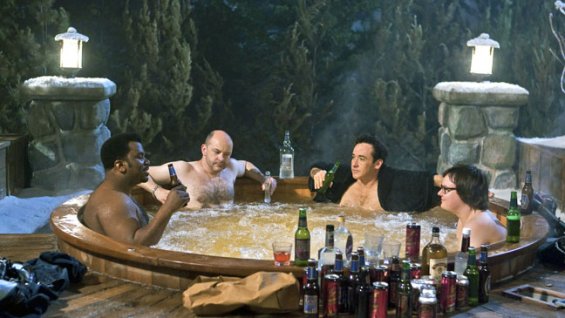
Four men from 2010 have just discovered that they are in 1986. They believe that the hot tub they partied in is the cause of this. How does one of them consider this phenomenon? “It must be some kind of…hot tub time machine.”

That line in the movie aptly titled “Hot Tub Time Machine” is said directly to the camera, almost as if saying, “I know it sounds crazy. Just go with us.” That kind of confidence (I really believe that’s how the line was implied to turn out) is what makes “Hot Tub Time Machine” not as bad as it may sound. The filmmakers take chances with this premise and the actors have fun with it.

“Hot Tub Time Machine” is a cross between “Back to the Future” and “The Hangover” (with a hard R rating). Four men take a road trip to recapture their youth, and after stepping into the hot tub time machine, they find they are now living their youth in the mid-80s. While there, they try to have some fun, but also discover that they were just as miserable then as they were in 2010.

The friends are miserable enough. First, there’s Nick (Craig Robinson from TV’s “The Office”), a dog groomer whose wife is cheating on him. Then, there’s Adam (John Cusack), an insurance salesman whose wife just left him because he’s a bit boring. Then there’s Lou, the worst of them. He’s a party animal who may be suicidal. He lives too much in the past and never stops with the constant partying and ranting. Nick and Adam decide to bring Lou to the ski lodge they messed around at when they were young and having fun. Along for the ride is Adam’s 20-year-old nerdy nephew Jacob (Clark Duke), much to Lou’s anger.

When they find themselves back in 1986, looking the way they did back then (Jacob looks the same because he wasn’t even born then, although he flickers at some points that require it). They have to relive the events that occurred when they originally lived it—breakups that end in pain (for Adam, that pain comes from being stabbed in the eye with a fork) and concerts (Nick was a musician) that may go wrong. In the meantime, the hot tub time machine is being fixed by a mysterious fix-it guy, played by Chevy Chase. But trying to relive these events is harder than they imagined but funnier to us.

Lou supplies most of the film’s raunchiness and vulgarity. He’s played by Rob Corddry, who was previously seen in “Harold and Kumar Escape from Guantanamo Bay,” a film I hated (Corddry’s over-the-top performance in that movie didn’t help much either). I recall writing my review for that movie and stating that Corddry’s well-done yet ultimately sleazy and nasty performance as that movie’s main racist villain should have received a punch in the face for being so unlikable. He barely redeems himself here, stealing every scene he’s in (give or take about 3 or 4). It is possible to dislike this guy as Lou, but once you’ve gotten into the mood of the movie like I have, you come so close to forgiving him. OK, Corddry, you’ve gotten away with it this time.

The film is alive and supplies two terrific running gags. One involves a squirrel (I wouldn’t dare give away the surprise) and the other involves Crispin Glover as a bellman who has only one arm in 2010 but both arms in 1986…but it doesn’t seem like his arm will last long. This is a great running gag; many accidents happen in which the man may have lost his hand. If and when he loses it in their time period doesn’t matter. I laughed loudly. I also laughed at many of the complicated occurrences, such as when Jacob meets his future mother, who is a horny slut, and also funny are the pop-culture 80s references. There’s a great cover of “Jesse’s Girl,” a retro look at the ski lodge, and a ski patroller who believes the time travelers are actually Russian spies and that their energy drink-can is actually a bomb. Oh, and there’s a cameo by William Zabka (the bully from “The Karate Kid”).

John Cusack is good, but then again, he usually is. Craig Robinson and Clark Duke are great deadpans and strike the right notes in their performances—they’re very funny. It all comes back to Rob Corddry, who practically steals this movie. Like I said, he’s very easy to dislike and I’m willing to let him slide for this movie. After all, he just wants to be funny.

Oh, and there’s Chevy Chase as the mystical hot-tub repairman. I really didn’t find him very funny or effective at any point of the movie. He doesn’t even serve much of a purpose—he just shows up, winks at the audience, and that’s it. Worst of all, like I said, he’s just not very funny.

I enjoyed “Hot Tub Time Machine” for its quirkiness, its comedy, and its vulgarity in the right places. It’s not for everyone. Certainly not for people offended by the f-word (said probably more than 200 times here) and definitely not for people who think the whole idea of a hot tub time machine is lame.

I Love You, Man (2009)

2 Mar

alg-i-love-you-man-jpg

Smith’s Verdict: ***

Reviewed by Tanner Smith

I’m going out on a limb here having to explain the details of a “bromance.” A “bromance” is a special platonic relationship between two men who not only see each other as best friends, but also as brothers (or “brothers-from-other-mothers”). When it comes to movies, we’ve had plenty of male-bonding/”buddy” movies, but “I Love You, Man” is billed as the first “bromantic”-comedy to be released. This means there’s more emotion to the guys than just being buddies, and it’s like a romantic comedy, but without the sex.

Peter Klaven (Paul Rudd), a real-estate agent, is engaged to marry his adorable, loving girlfriend Zooey (Rashida Jones). But as they start to prepare their wedding, they draw a blank at the position of “best man.” Peter realizes that while he gets along great with women, he has never had any male best friends. He’s one of those guys who has had more longing relationships with women than men. Even his dad (J.K. Simmons) and brother Robbie (Andy Samberg) are that close to him, though the two are best friends with each other. So Peter decides to search for a new best friend in the way that one would search for a romantic partner—“man-dates.” These don’t work, and in the film’s funniest scene, a candidate played by Thomas Lennon may seem like the right guy but…just wait and see.

At an open house (Lou Ferrigno’s house up for sale), Peter meets Sydney Fife (Jason Segel) and they hit it off pretty well. Sydney’s a beach bum (who invests every now and then) who likes nothing better than to hang out and do stuff when he’s not lazing about in his “Man Cave,” a separate garage beside his house. Peter and Sydney start hanging out together—they both love the band Rush, they’re honest with each other, and their friendship grows…while Peter’s relationship with Zooey is being questioned.

I had a friend like Sydney. He’s the kind of guy that in many ways is not the right friend for you, but in most ways, he’s the friend that kind of helps boost your self-esteem because he does the things that guys only think about. He just likes to have fun and wants to share it with you. Peter needed a Sydney to balance out his well-organized (albeit boring) lifestyle, especially to boost his own self-esteem. You see, Peter is, with all due respect, a loser. He fails at imitations (he always winds up with an Irish accent), comes with up strange nicknames that don’t make any sense at all, and tries unsuccessfully to deliver jive-talk wisecracks to fill in awkward pauses. He may have a Zooey in his life, but he needs a Sydney.

Paul Rudd as Peter and Jason Segel as Sydney are both likable and play well off one another. You really buy these two as best friends. Of the supporting cast, Rashida Jones is lovely and gamely comedic as Peter’s fiancée, J.K. Simmons and Jane Curtin do nice work as Peter’s parents, and Jon Favreau and Jaime Pressly are hilarious as the married couple from hell—the couple that argues constantly that is not only a funny running gag, but also a clever, subtle message about finding the right partner (romance or bromance, doesn’t matter). Andy Samberg, as Peter’s gay brother who helps set him up on man-dates in the earlier scenes, is basically a one-joke caricature, but he has a few funny lines as well. Thomas Lennon, though his role is short, is freaking hilarious. His voice and mannerisms reminded me a lot of Bill Murray and I mean that in the best possible way.

But wait, how’s the humor? This is after all a comedy and “I Love You, Man” even has this premise that would have fit in a sitcom. And as a result of a funny script, there are many funny one-liners, some shock-value chortles, character-based jokes (such as what goes on inside Sydney’s “Man Cave”), and a great running gag about Lou Ferrigno that is probably best left from this review. However, there are some gags that are hit-and-miss, that leave a trail of awkwardness because there’s hardly a way to recover from them. You have to wait for the next one. And there are also a few jokes that are almost too self-referential that you wonder if Judd Apatow was involved in this project. For the most part, though, “I Love You, Man” is a well-executed, funny, feel-good “bromantic” comedy with engaging performers and surprisingly something sincere to say about relationships.

Shanghai Knights (2003)

2 Mar

shanghai-knights-1

Smith’s Verdict: ***

Reviewed by Tanner Smith

“Shanghai Knights” is the sequel to the 2000 comedic Western “Shanghai Noon,” teaming up kung-fu expert Jackie Chan with smooth-talking, surfer-type Owen Wilson. That film was a modest success, with mainly the likable presence of both actors to make the film consistently entertaining. “Shanghai Knights,” three years later, brings Chan and Wilson back for another crazy adventure, but this time is different in these ways—the film moves to London, England, there are a lot more choreographed fight sequences, and the humor comes from all sorts of historical inaccuracies that recall moments from “Bill and Ted’s Excellent Adventure.” As a result, “Shanghai Knights” is a bit of a mess. It’s dumb and tries too hard at certain points when it loses consistency from the rest of the movie. However, it is also cheerfully goofy and quite funny. Chan and Wilson remain as likable as in the previous film, but also, “Shanghai Knights” delivered more stupid laughs from me than the predecessor did, which I liked fine.

I suppose I should start with the plot, which is arbitrary to say the least. Chan reprises his role as Chon Wang (say it out loud), who is now a sheriff in Carson City, Nevada. (Although, what happened to his Native American wife in the original film is anyone’s guess.) Someone has murdered Chon’s father—the guardian of the Great Seal of China— and Chon hears of the tragedy from his sister Lin (Fann Wong), who has tracked the murderer to London. So Chon goes to team up with his old friend Roy O’Bannon (Wilson) and together, they travel to London to find the culprit and…

Do you even care about the plot? No. Do you get nervous about the tight spots in which Chon and Roy get involved? No. “Shanghai Knights” is merely a source for mindless entertainment. It’s just a setup for comedy, action, or sometimes both. There are many fight sequences in the movie that are choreographed as if they were musical dance numbers (of course, the instrumental score helps to keep the moves in sync). My favorite is a sequence in which Chon is fighting off a gang of thieves in Fleet Street and grabs ahold of an umbrella—cue the “Singin’ in the Rain” music! These sequences are fast, amusing, and just a ton of fun.

It makes things better that Chan does most of his stunts. At least, that’s what I’m assuming, since the outtakes reel at the end show Chan messing up on certain stunt work (though, not terribly). Fann Wong, as Chan’s sexy sister whom Wilson of course becomes interested in, has some feisty moves as well.

Most of the gags come from the use of locations in royal olde England and characters in English literature. We have gags involving an encounter with Jack the Ripper, a visit to Buckingham Palace (they make fun of the royal guards—they don’t like to be touched), and a close call on the minute hand of Big Ben (a la Harold Lloyd). Also making appearances are Charlie Chaplin and Sir Arthur Conan Doyle, and Sherlock Holmes also makes his name known. Neither are those are meant for any type of historical accuracy. The filmmakers know they’re making a silly movie with these references and they just have fun with them. (So what if they add some 1960s pop songs that don’t fit at all?) And I also appreciate the main portion of “Shanghai Knights” takes place in London for evil plotters to make their schemes and moves.

Chan and Wilson are appealing, as is the whole movie. It’s dumb, silly, and thoroughly enjoyable all the way through. Even in the blooper reel, I was cracking up. It shows that the people involved in the making of this movie were clearly having a great time.

Fear (1996)

2 Mar

fear4big

Smith’s Verdict: ***

Reviewed by Tanner Smith

“Fear.” What a generic title if I ever heard one. You could give that title to any thriller and it’d make about as much sense. It’s a thriller, it’s a horror film, it acts upon fear. There has to be a better title than…”Fear.”

Now that I’ve got my issues with the title out of the way, I’ll state right away that “Fear” is a well-made thriller that fits into the class of deceptive-individual movies. Those are movies in which a character is introduced as a nice person for the other character to befriend and interact with, and then by the end of the movie, that person will have tried to kill the other person after revealing his or her true nature. There’s a whole list of them—“Firstborn,” “Fatal Attraction,” “Single White Female,” “The Hand that Rocks the Cradle,” “Unlawful Entry,” all of which follow the same formula. “Fear” still manages to succeed due to craftsmanship and conviction.

“Fear” takes its time to develop the characters so that it’s all the more troubling when things inevitably don’t turn out to be as they seem. Instead of the antagonist being the most interesting character, as most of these movies go, the protagonists are set up in an interesting way so that we grow to care about them and root for them when things get ugly.

16-year-old Nicole Walker (Reese Witherspoon), after living with her mother for most of her life, is now living with her father Steve (William Peterson), his second wife Laura (Amy Brenneman), and their son Toby (Christopher Gray). As to be expected, she doesn’t quite like this adjustment. The problems with this family are developed in a credible way, with tension and partial dysfunction.

While at a rave with her best friend Margo (Alyssa Milano), Nicole meets an older, gentle guy named David (Mark Wahlberg), who seems like the perfect boyfriend. He’s a nice guy, he respects her wishes, he doesn’t pressure her into sex, and says and does everything right. Nicole falls for him, and Laura sees him as a nice guy for her stepdaughter to date. But Steve, on the other hand, has his suspicions. To him, David just seems too right. And when David starts to show signs of his real (dangerous) personality, and Nicole comes home with a black eye, it becomes clear that David is not the nice guy that Nicole fell for.

This was Mark Wahlberg’s first real chance to handle a difficult acting lead role after his former fame as the rapper Marky Mark. As David, Wahlberg delivers a genuinely unnerving performance in the way he switches back and forth from kind and earnest to psychotic and furious. It’s like you can actually hear the ticking of the timebomb about to go off in his mind. As for the other actors, Reese Witherspoon is very convincing as the innocent, corrupted Nicole; William Petersen does strong work as the father trying to protect her; and Amy Brennerman is fine as the confused parent in the mix.

“Fear” doesn’t offer that many surprises, but it is well-acted and effectively creepy. It sets up the characters in interesting ways and plays the story from the sympathy we gain for the protagonists, so that the horrific moments really mean something. Everything builds up to an inevitable climax in which David and his friends attack the house with the family inside. It’s standard, but offers a few surprises as well. “Fear.” Boring title, nicely-done thriller.

Rise of the Planet of the Apes (2011)

2 Mar

images

Smith’s Verdict: ***

Reviewed by Tanner Smith

I’ll admit I was never really interested in seeing this movie. I mean, what can be done to create the origin story of “Planet of the Apes?” We all know what’s going to happen and we know things are going to work out terribly for us human beings so that primates can rule the world. However, “Rise of the Planet of the Apes” (which should simply have been changed to “Rise of the Apes”) finds a way to beat that problem. The result is a sometimes-silly, sometimes-scarily-effective B-movie.

“Rise of the Planet of the Apes” isn’t the first movie to feature an animal as the main character, however it is the first movie to treat the animal as an actual main character. This animal—a chimpanzee named Caesar—is actually thoughtful, feeling, and self-aware. Caesar was born to a mutated laboratory ape which was injected with an experimental gene-therapy drug created by scientist Will Rodman (James Franco). The drug was invented as a possible cure for Alzheimer’s disease and was tested upon the chimp to see the effects. With the ape taken away after a rampage (caused by a side effect), and now that the experiment is shut down because of it, the chimp’s baby—Caesar—was secretly left in the care of Will.

As years go by, we learn that Caesar has inherited his mother’s genes and has exhibited human intelligence and understanding. The early scenes featuring Caesar adapting to the world, being what he is, is done quite effectively, especially in the scene where he goes outside on his own for the first time and learns the bad side of humans (he scares a couple kids, whose father goes after him). And there’s another effective scene in which Will takes Caesar to a redwood forest park and discovers the meaning of “pets.” Will has to convince Caesar that he’s not a pet and he’s much more than that.

After Caesar hostilely defends Will’s father (John Lithgow) from an angry neighbor, Caesar is placed in an animal sanctuary, where he is with regular apes (chimps, gorillas, and orangutans). It’s a hard life that constantly eats at Caesar’s nature more and more until he finally decides to hatch a plan to turn the tables on man…

“Rise of the Planet of the Apes” takes a lot of its time building up to the inevitable climax—the beginning of the end, if you will—and that’s what really surprised me. We see a lot of this ape, and even more surprisingly, we understand his plight. I love movies that take its time to build up the story elements, so that when the payoff occurs, it really means something, as it should. It’s in the final half-hour that Caesar uses this drug to effect all the apes, escape their prison, run amok, and attack whoever tries to stop them. This sequence is as terrifying (though sometimes as silly) as it’s been built up to be.

Apes can be smart and friendly, but they can get bigger and quite vicious. With Caesar as this sort-of humanistic ape, if you will, it fits into the always-reliable allegory of who-is-man-and-who-is-beast. It’s the allegory that seems like an old friend that comes to visit in science-fiction thrillers, for the most part, and it’s welcome when it can experiment new territory.

Caesar is a very well-developed character. We experience the important elements of the story with him. A lot of credit for that has to go to the performance by Andy Serkis, who performs in the role of Caesar thanks to performance-capture and computer effects. Serkis has carried this sort of performance before as Gollum in “The Lord of the Rings” and Kong in “King Kong.” With Caesar, he can add himself as a special name in motion-capture animation history. Serkis gives the best performance in the movie.

The human performers more or less do what they’re required to do, and some of them are either useless or underused. James Franco is a little bland as Will, and that’s unfortunate considering that he’s practically the father of the apocalypse. Freida Pinto, as Will’s girlfriend, is essentially pointless other than just being the hero’s girlfriend. Tom Felton plays the nasty son of the sanctuary owner (Brian Cox, doing what’s required of his underwritten role), and his name is Dodge Landon (an in-joke referring to the original 1968 “Planet of the Apes” movie), but you might as well keep calling him Draco Malfoy. The best human performance comes from John Lithgow, heartbreaking as Will’s Alzheimer’s-diagnosed father.

“Rise of the Planet of the Apes” has its pleasures—an extraordinary use of CGI effects, a convincing animal protagonist, and some terrific sequences of real power—and for that, I’m recommending the movie. But one major problem I had with this movie was its ending. Not only does the story just come to a halt, obviously setting for a sequel (I guess the origin story isn’t enough to set up the events in the previous movies), but it delivers mixed feelings about what we’ve just seen—all this violence and anger, ending on a triumphant note. Is it supposed to be a happy ending? Watch the movie, watch the ending, and watch James Franco’s face as he observes this new “revolution,” and maybe you’ll see what I mean.

Frequency (2000)

2 Mar

frequency_2000_2

Smith’s Verdict: ***

Reviewed by Tanner Smith

Remember the scene in 1986’s “Peggy Sue Got Married” where Kathleen Turner’s character has just traveled back in time and was shocked to hear the voice of her dead grandmother on the telephone? That was a heartbreaking scene because it tapped into genuine emotions. What would you say if a dead relative—one that was very dear to you—was suddenly speaking to you again? What would you feel? Your heart would probably leap into your throat and you would probably want to cry for them.

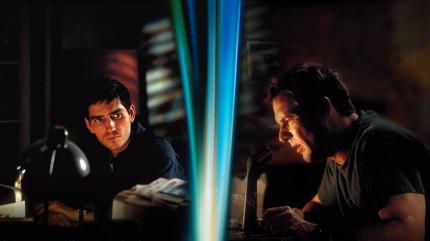
“Frequency” is a science-fiction film that plays that way. It’s about a man in 1999 who finds his late father’s old ham radio and finds he is actually able to talk to the father from the year 1969. It’s as if time is continuing 30 years ahead or behind, depending on which side you consider.

The man in 1999 is a cop named John Sullivan (Jim Caviezel). When he was six years old, in 1969, a warehouse fire took the life of his firefighter father Frank (Dennis Quaid). One night, John looks through his father’s old trunk and finds his father’s ham radio. The radio still works and John decides to try it out. But who calls him on it? A man who seems to be “lost in the past,” if you will. This man is Frank. He’s talking about the 1969 World Series, and John laughs about the games he saw then. Frank wonders what he means, since the first game had just started. But John knows something about the outcomes of the games.

It’s later revealed to both John and Frank that they’re talking to each other thirty years apart via this ham radio. It’s a miracle that seems to have occurred thanks to extraordinary solar activity (Aurora Borealis). It’s a big, unbelievable occurrence.

Like most films dealing with such oddness in time, like time-travel stories, John learns that time can be altered. On the day that Frank is supposed to die in that warehouse fire, John warns him not to trust his instincts for once and he won’t perish in the flames. It works—the present time has changed.

This must be somewhat complicated. In fact, there are certain things that I was a bit confused by. For example, John feels like he remembers the original timeline but still has new memories of the altered timeline. If he and Frank changed the future, wouldn’t John be an altered John? He probably wouldn’t remember the old timeline. Everyone else has changed; they believe that Frank died of lung cancer instead of a fire. But then again, I don’t think you ask those kinds of question in time-travel stories.

Then, things get even more complicated as it turns out that this change in time has set off a chain reaction for the new present. The film transforms into a murder mystery as John discovers that the infamous Nightingale Killer has taken ten victims instead of the original timeline’s three. And one of those victims is his own mother (Elizabeth Mitchell). So, Frank and John use information they gain from their own time periods to put pieces of the puzzle involving the killer’s identity in order to prevent the killings from occurring, thus changing time again and saving lives.

The entire second half of the movie is focused on this murder mystery, and at first, it’s quite intriguing in the way that it’s set up. But then it sort of grows tiresome and drags on when we’d much rather see more of the relationship between father and son, which is really the heart of the story. That’s why I’m recommending “Frequency.” There are a few plot holes and inconsistencies, but the premise of the film and this relationship between Frank and John is endearing enough to make me care.

Dennis Quaid turns in a terrific performance as Frank. He’s likeable, convincing, and quite a father too. Jim Caviezel as John is merely adequate, but he does sell those intense moments. Of the supporting cast, Elizabeth Mitchell is underused as Frank’s wife and John’s mother, but Andre Braugher is excellent as Satch, Frank’s best friend.

The science of “Frequency” shouldn’t really matter, as not much is made out of it. But the fiction is a true delight. It shows good family values with its engaging premise and the relationship between a man and his late father provides the film’s heart.