
Archive | February, 2013

Some Kind of Wonderful (1987)

14 Feb

images

Smith’s Verdict: ***

Reviewed by Tanner Smith

“Some Kind of Wonderful” is written by John Hughes and has a similar story to Hughes’ other screenplay, “Pretty in Pink.” The story itself is old, but people will see the connection from “Some Kind of Wonderful” to “Pretty in Pink” because they were both written by John Hughes and they both feature teenagers. (Both movies also have the same director—Howard Deutch.) What’s the story? A high school outcast has a crush on a more popular student, while the outcast’s best friend (of the opposite sex) has a crush on the outcast and situations follow that could or could not bring them together. You know, the protagonists in these movies never know better than to just go with the pal—see “Secret Admirer,” see “The Sure Thing,” even see “Lucas” and you’ll see what I mean.

The story follows a high school senior named Keith (Eric Stoltz), who comes from a working-class family, loves art, works at a gas station, and is an outcast at school because of all of the above. His best friend is a tomboy named Watts (Mary Stuart Masterson), who cares about two things—her drum-kit and Keith. But of course, Keith doesn’t even know about Watts’ feelings towards him, because he has a crush on Amanda Jones (Lea Thompson), the school’s rich “uptown girl.” He gets his chance to ask Amanda out on a date when her boyfriend Hardy (Craig Sheffer) cheats on her and she says yes to Keith.

Keith finds out that if he goes on his date with Amanda, then Hardy and his friends will humiliate him that same night, but Keith decides to continue with the date and hopefully find some way to teach Hardy a lesson. But on his date with Amanda, he asks himself what he should have been asking himself before. Is he interested in Amanda’s soul or just her body? In fact, that’s exactly what Amanda asks Keith on their date to an art museum, after Keith hangs up his own painting of her. And what about Watts…? This is the movie’s more intriguing concept—to ask the question of whether or not the guy deserves the girl, not merely the question of will the guy get the girl?

While all this is going on, Keith is constantly pushed by his father (John Ashton) to start applying to different colleges, so he’ll get into at least one. But Keith doesn’t want to go to college—his father never went to college, and Keith would rather devote his life to artwork. And here we have a rarity in John Hughes’ teenager movies—an adult character that is just as interesting as the teenagers. I can only remember two before “Some Kind of Wonderful”—the father characters in “Sixteen Candles” and “Pretty in Pink”—here’s another one. (The principal in “Ferris Bueller’s Day Off” was only interesting in that movie’s first half.) And it’s pleasing to see how the situation resolves—not with a shouting match, but with a civilized argument.

There are problems with “Some Kind of Wonderful”—some scenes progress slowly, and some characters are pretty standard; particularly Hardy, who’s a one-dimensional snobby, begrudging rich kid. But it’s pleasing to see Keith make friends with someone who could have been a villain—a punk kid named Duncan (Elias Koteas) whom Keith meets in detention. I suppose that’s supposed to make it OK that the rich Hardy is the villain of this movie. There’s also Keith’s incorrigible junior-high-aged sister (Maddie Corman), who, like most junior high girls, is a brat who just wants to be cool.

(By the way, the funniest scene is when the sister just flat-out SCREAMS when her father says, “Hi, honey,” outside her classroom at school. Tip for junior high school kids—if you want to be cool and not be made fun of, don’t scream in the classroom.)

The three central young actors are appealing—Eric Stoltz is dim but likable as Keith, and Lea Thompson isn’t the snob that Amanda could have been. But my favorite is Mary Stuart Masterson as Watts. As a tough tomboy, she’s a lot of fun, though she has a tough exterior but a soft interior. She’s dedicated to the things she cares about. She even volunteers to chauffer Keith and Amanda around on their date—it’s weird, but kind of sweet. And who could forget the look in her eyes when she sees the other two together? There are a lot of scenes in which Masterson must feel one way about something while pretending to feel another way, and she’s a fully capable actress.

“Some Kind of Wonderful” is an improved version of “Pretty in Pink,” which was too full of itself, in my opinion. “Some Kind of Wonderful,” for it’s faults, actually takes more chances for us to like the characters and has an ending that is near perfect for the movie. It’s a movie about insecure teenagers making smart and dumb decisions and dealing with rejection and acceptance. It’s a nice movie.

Children of a Lesser God (1986)

14 Feb

6a00d8341c5d8753ef0120a8ac9371970b-800wi

Smith’s Verdict: ****

Reviewed by Tanner Smith

When someone going to the movies sees a title like “Children of a Lesser God” on the marquee, I imagine just looking at the title turns them off, not knowing at all what the movie is about. And I’d be lying if I said I wouldn’t feel the same way—I did feel the same way having heard the title a few times, not knowing what the film was about. Thankfully, after watching a vintage 1986 “Siskel & Ebert” two-thumbs-up review of the film, I was interested in what they were saying about the film so I was actually interested in the film itself.

“Children of a Lesser God”—how pretentious of a title could you get? That may seem like a downer title for a film, but the truth is, the actual film itself is a true delight.

“Children of a Lesser God” is a love story, and a wonderful one at that. It’s the story of a relationship that develops between a young woman who is deaf and a teacher determined to bring her out of her shell. Along the way, the teacher learns about love and about accepting his lover’s needs.

William Hurt plays the teacher, named James Leeds. He has an impressive resume and is welcome to teach at a school for the deaf, where he’ll teach his students to read lips and speak without using sign language. His methods are somewhat unusual but very effective, like, for example, when he stands on his head and can’t use his hands for sign language so he must speak, or when he uses timing and rhythms to teach music to the students.

On his first day at the school, a beautiful woman Sarah (Marlee Matlin) catches his eye. Sarah works at the school as a janitor, is very bright but also very stubborn, and is completely deaf. He wants to know more about her, and arranges for her to meet with him so he can teach her to speak. But Sarah couldn’t be less interested—she doesn’t believe she needs to learn how to speak. She’s accustomed to being deaf and using sign language all her life and doesn’t feel like she needs to belong in a hearing world. This brings more determination from James to bring Sarah out of her shell, but he also finds himself more and more attracted to her. “You’re the most mysterious, beautiful, angry woman I’ve ever met,” he finally tells her.

James and Sarah do go out on a date together and that leads to trust and respect for each other’s company, but the tension and determination is still there for James and he knows that Sarah will never break. But if she could have a meaningful relationship, would it matter?

A love story, especially one as complicated as this one, wouldn’t work unless there was chemistry amongst the leads. William Hurt and Marlee Matlin play characters who are constantly in a battle of wits, but mostly attracted to each other because of their own qualities. Hurt and Matlin work great together—they’re comfortable with each other and you can feel their chemistry on screen as their relationship continues.

The writing of “Children of a Lesser God” is just fabulous. There are many great moments in the story—not just with the relationship between James and Sarah, but with James and his students. The first scenes in which he teaches them to speak are freshly well-handled. There’s also a scene midway through the film in which they dance and sing to a pop song on Parent’s Day.

My favorite scene in the film comes after a loud party at James’ apartment with James’ students. When everything is finally quiet, James tells Sarah that he’s going to rest his hands and his eyes and just listen to 20 minutes of Bach. He says he hasn’t been able to listen to Bach since Sarah moved into his home, Sarah thinks he blames her, James says otherwise, Sarah says to go ahead, James turns on the music and listens for a moment…he can’t enjoy it. He sees Sarah sitting at a table, staring off into space and waiting. That’s when James thinks, how can he enjoy it if Sarah can’t enjoy it? And then Sarah asks him to “show” him the music like she “shows” him the sound of the ocean waves. He can’t do it. That’s a beautifully-written, wonderfully-acted scene that pretty much states the purpose of the entire relationship—if he truly loves her, he must welcome himself into her world of silence.

William Hurt has been good in movies before, mainly because he acts in roles that are written within his limitations—he’s not terribly exciting or expressive, but he’s mostly charismatic. This is his first role after his flamboyant Oscar-winning performance in “Kiss of the Spider Woman” and in an arguably more demanding role, he’s just fine. Marlee Matlin, who really is deaf, has the more complicated role—using facial expressions, body language, and sign language to get her point across. In a silent role, she owns the screen. She’s beautiful, forceful, haunting, and all-around brilliant as Sarah—it’s an excellent performance. And like I said, both Hurt and Matlin have great chemistry together, and I cared very much about their characters. Another good performance comes from Piper Laurie as Sarah’s mother, who hasn’t seen her daughter in quite a long time and regrets that.

When all is said and done, James realizes that he should become part of Sarah’s world if they are together in love and learns a thing or two about respect for deafness and about respect for his lover. “Children of a Lesser God” is a wonderful love story with clever storytelling, great acting, and a subject that really should be taken into consideration. And don’t let that downer title fool you—“Children of a Lesser God” is great.

(500) Days of Summer (2009)

14 Feb

500_days_of_summer_2

Smith’s Verdict: ****

Reviewed by Tanner Smith

“(500) Days of Summer” is the best romantic comedy to come around in a long, long time. There were many terrible ones and a few mediocre ones, though there have been a few fair ones, but none as fantastic as this one. I’d even put this in a class with Woody Allen’s “Annie Hall” and that’s a pretty highly-regarded class indeed. It’s a romantic comedy for those who normally don’t go to romantic comedies because there were so many bad ones. You know it’s different from the hilarious disclaimer at the beginning, which states it isn’t based on anybody in particular. (“Especially you Jenny Beckman. Bitch.”)

But the situations that ensue in this story of boy-meets-girl feel like they’ve happened to you. Even if they haven’t, you still feel the reality of the situation. This is a romantic comedy that doesn’t result to cheap ploys such as sappy overhanded drama or ineffective, unfunny gross-out gags. The comedy comes from the realism, which is portrayed in a pleasant but unforced fashion.

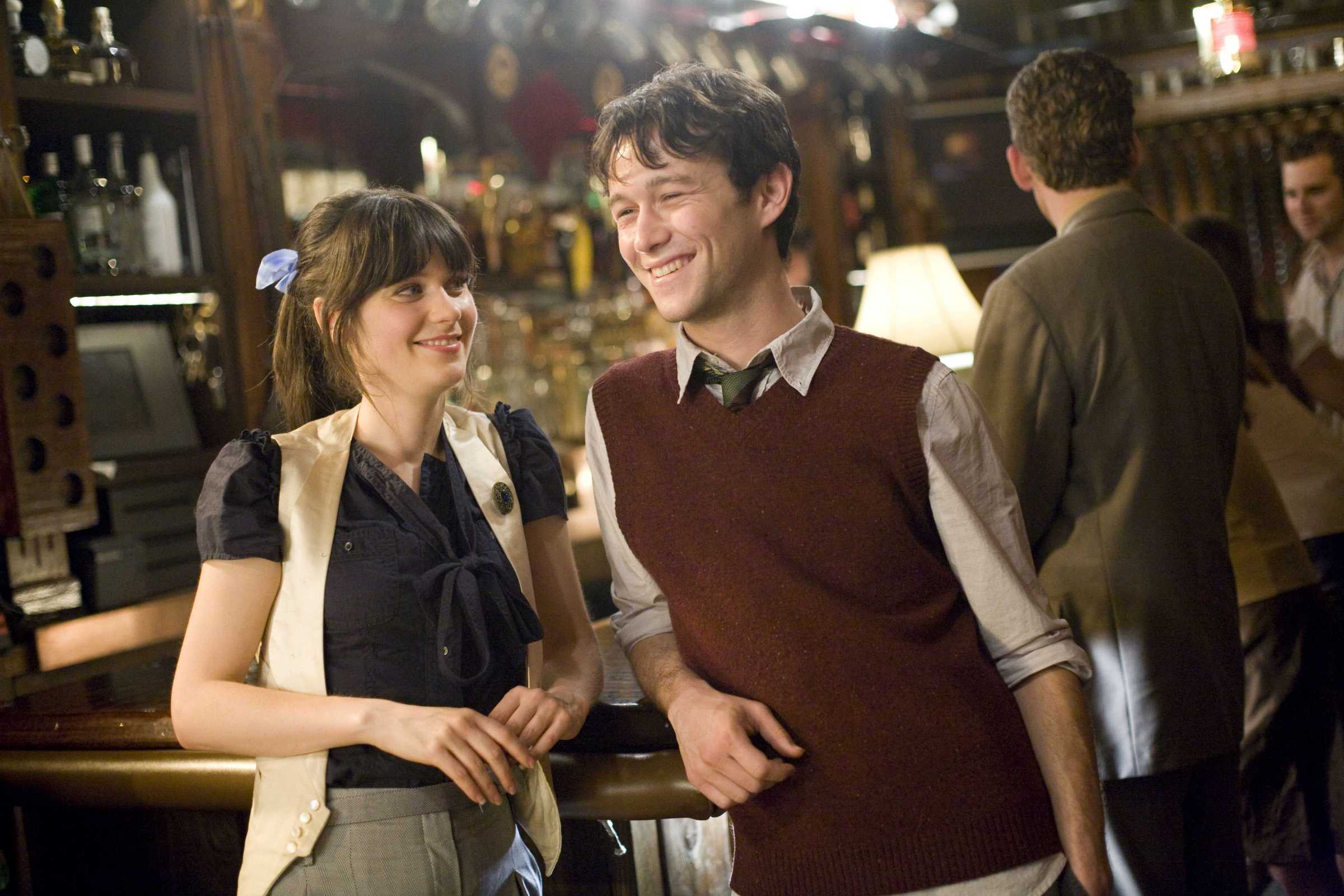
The film chronicles the 500 days surrounding the romance between Tom (Joseph Gordon-Levitt) and Summer (Zooey Deschanel)—from their first glances to their final goodbyes. Everything in between is complicated enough, that Tom would rather remember the good times of the relationship than the bad. Wouldn’t we all, though? The story is told in a non-linear fashion, with a segue that ensures us of which day we’re in. Now, we already know that things aren’t going to turn out well between Tom and Summer, but it’s fun to see the events play themselves out.

Tom is a hopeless romantic who believes he’ll never find true love until he meets “the one.” Who is “the one?” Tom believes it is Summer, a realist who doesn’t necessarily believe in the idea of love. Despite this, Summer likes Tom and wants them to be friends. They hang out together, fool around together, and eventually, they start a potential boyfriend/girlfriend relationship. But will it last? Reality takes its toll, unfortunately.

“(500) Days of Summer” doesn’t result in ridiculous clichés to tell the story of this relationship. There are no silly misunderstandings where the characters think they hate each other and they mope until they realize they do. There are no stupid bullies—like an ex-boyfriend—trying to keep the lovebirds apart. Heck, Tom and Summer aren’t even necessarily “lovebirds.” Tom is the one head-over-heels in love with Summer, and it’s Summer that isn’t so sure about the idea of being someone’s romantic partner.

Instead, we have genuine chemistry between Joseph Gordon-Levitt and Zooey Deschanel, who are both excellent in their roles. Gordon-Levitt, in particular, has the same starmaking ability that made Tom Hanks a household name. I really think he’s that good. It’s his character’s story that’s being told throughout “(500) Days of Summer”—he’s likeable and convincing all the way through. And Deschanel is the kind of fun, free-spirited, attractive woman that we all wish we could meet.

Supporting roles consist of Tom’s wisecracking buddies played by the appealing Matthew Gray Gubler and Geoffrey Arend who have a lot of fun with these obligatory roles; Tom’s surprisingly-insightful younger sister, nicely played by Chloe Grace Moretz; and Tom’s boss, played by Clark Gregg. They all have their fine, funny moments here.

There’s a lot of offbeat humor throughout “(500) Days of Summer,” most of which comes from Tom as the unreliable narrator—we get many sequences that play with whimsy and perception. For example, after Tom and Summer finally have intercourse, we get a bright musical number—a song-and-dance sequence set to Hall and Oates’ “You Make My Dreams Come True.” Everyone is politely nodding/greeting and then they all join Tom as he dances with joy. This is complete with a marching band and an animated bird.

And how about the sequence shown in split-screen, differing “expectations” from “reality?” How often have we been down this road? We expect one thing—one great thing to occur the whole evening—when we wind up with something totally different than we wanted. This is my favorite scene because I can relate to it. It’s a very satisfying scene.

This humor shows that this isn’t one of those gritty indie films that try to make it feel like we’re eavesdropping on the characters. We know we’re seeing a story unfold.

“(500) Days of Summer” is as far from formulaic as you can get, and that’s one of the many reasons I loved it so much. There’s a lot to love in this movie. Aside from the perfect casting, authentic chemistry between the two leads, and a great deal of funny offbeat comedy, there are little things to acknowledge as well—the soundtrack (particularly the Smiths, which Tom likes to listen to), the whole deal with the greeting card company’s creativity or lack thereof, Tom and Summer’s attempt at copying a porno film, the satire of a sad French film when things start to go wrong for Tom and Summer, I could go on and on. Many pleasantries can be found in this wonderful, wonderful movie.

The Secret World of Arrietty (2012)

13 Feb

The-Secret-World-of-Arrietty-image-6

Smith’s Verdict: ****

Reviewed by Tanner Smith

Ever since I was a child, I was a fan of the stories involving the Borrowers—the little people who live in the walls or under the floors of your house. There was a series of books written by Mary Norton that made them popular, as well as a few film adaptations—including two 3-hour British TV specials and an entertaining 1998 update on the story. And I just love the idea of this secret world that would be In jeopardy if it was found out by human beings (or as the Borrowers call them, “beans”), so when I heard that Studio Ghibli was making a new adaptation (yes, with the great Hayao Miyazaki one of the people behind the production), I was hyped. The child in me was curious and the critic in me was interested in how this new version would turn out. I can now say that this film—entitled “The Secret World of Arrietty”—is the best representation of the Borrowers that I’ve ever seen.

Miyazaki’s company Studio Ghibli has delivered some of the best-looking animated features anybody has ever seen. The visuals stand out as mesmerizing and serve the stories well—see “Princess Mononoke,” for example. There’s such a distinct look and feel to the animation in each of these films and each detail is given special attention. I’ve said the same thing about PIXAR’s computer animation, but that doesn’t make this any less of a compliment, except that the animation is hand-drawn (with occasionally computer help) and thus more complicated than you might think.

One great example of this look in “The Secret World of Arrietty” is the scene in which the three-inch adult Borrower named Pod (voiced by Will Arnett for the US dubbing) takes his 14-year-old daughter Arrietty (Bridgit Mendler) on her first trip into the house they live under. Their first stop is the kitchen—with the kitchen being so huge from their point of view, it makes for a threatening environment. Another example is the outside yard of the house, where Arrietty spends a lot of her time. Look at the leaves and the plants next to her as she walks/runs. It looks like another world when it’s really our own.

The story of “The Secret World of Arrietty” is mostly the same as the first “Borrowers” book and has the same basic idea. There is a family of three Borrowers secretly living within a house in the middle of the forest—Pod, his wife Homily (Amy Poehler), and their daughter Arrietty. They have their own home underneath the floorboards and when the “beans” aren’t around, they sneak into the house to “borrow” the essential needs of survival—mind you, it’s never borrowing; it’s stealing, but it wouldn’t make them look good if they were known as the Thieves, right? This family is seemingly the only family of Borrowers in the house. In the old days, there used to be more families until they were discovered by beans and had to move away (it’s also hinted at that others were squashed by the beans). Life is a danger for Borrowers and there’s always a high risk, which is why they have to be extra-careful not to be discovered while they go on their occasional “borrowings.”

The characterizations are direct. Arrietty, just turning 14 years old, is tenacious and courageous. She uses her size as an adventure and delights in discovering more about the world outside her own. Her father Pod, kind of a three-inch Indiana Jones type, is more surly with age. He has had too much adventure in his life and is probably getting too old to borrow. But that doesn’t stop him from smiling when Arrietty fights off a bug (to her, it’s about the size of a canine)—“That’s my girl,” he declares to himself. Homily, however, is a nervous wreck, all the time—always worrying, screaming, shrieking, trembling, nervously rambling on and on, etc.

On Arrietty’s first borrowing in which she “borrows” a sugar cube, she is seen by a sickly human boy named Shawn (David Henrie) and drops the cube. But Shawn doesn’t pose as a threat and kindly leaves the sugar cube next to where he thinks these little people live, with a note saying, “You forgot something.” This increases Arrietty’s curiosity of the outside world and starts to wonder if not all beans are dangerous. But Pod makes it very clear that once Borrowers are seen, they must move away to make sure it doesn’t happen again and that their world is never discovered. Despite this, Arrietty and Shawn do meet each other and form a friendship. However, once the housekeeper Hara (Carol Burnett) notices strange things happening around the house lately, that’s when the Borrowers’ secret does indeed turn to jeopardy.

The elements that made the Borrowers special are present here—the Borrowers sneaking around avoiding being caught, the interaction and friendship between a Borrower and a bean, and the world that the Borrowers created. There’s a lot of tension in the scenes where they go outside, hoping they aren’t seen by beans. There’s a great, tense scene in the middle in which a crow attacks little Arrietty and Shawn must rescue her. And of course, there’s the cat that sometimes chases her around (you can tell Arrietty is faster and used to it—the cat just misses her and she smiles and waves while taunting, “Nice try”). There are a lot of things that are updated from the original story. For one thing, we see more detail in how these Borrowers move around, instead of just climbing or rappelling down a rope tied to a fishhook. Early on, for example, we see that in order to climb something like a cabinet, they use double-sided tape on their hands and feet to scale it. That’s a very clever bit. There’s also a neat invention with sewing thread and a weight that works as an elevator. The biggest difference from the original book to this film is that there is no climax involving the exterminators threatening to destroy the Borrowers’ home, but I didn’t miss it. What they went with, with Hara capturing Homily and Arrietty and Shawn having to find a way to rescue her, is good enough. I was actually glad that they didn’t have to succumb to a basic action climax, and very surprised too, considering that studios love to end family films in that way. But instead, we have a thoughtful climax and a moving ending that opens more for curiosity. Also, the complex issues present in the book like friendship, bravery, and settling are all present and very effective.

The growing friendship between Arrietty and Shawn is well-handled. It takes a while for Arrietty to finally trust Shawn and go visit him, adding more to the discovery of the outside world and the new curiosity that she has surrounded herself with. When it gets there, though, it’s very touching and she even gives this boy who’s twelve times her size helpful advice about being brave when he reveals that he needs an operation for his heart.

Each character is memorable. In particular, Arrietty is a fun character, Pod is an interesting figure, and there’s another Borrower that they meet later in the movie—a wild-boy Borrower named Spiller (Moises Arias) who tells the family of more Borrowers out in the forest. The voiceover work is nicely done. Bridgit Mendler, of Disney Channel’s “Good Luck Charlie,” brings a fresh friendliness to the role of Arrietty. Will Arnett is suitably rogue as Pod. David Henrie is just OK as the boy—sometimes a line of dialogue rings false, but his speech about the character’s illness is actually heartbreaking. Amy Poehler, voicing Homily, is an absolute hoot—she’s very funny in the way she quickly delivers the nervousness in the scenes in which she’s panicking for her family and especially when she is seen and trapped by the housekeeper. Speaking of which, Carol Burnett as the housekeeper Hara is a lot of fun as well. The way she’s drawn is funny enough (looking more like E.T.’s grandmother), but with Carol Burnett adding several “Hmm’s” to each confused facial expression, it’s downright hilarious.

“The Secret World of Arrietty” is a wonderful movie for people of all ages. It’s obviously marketed at children, but adults will most likely enjoy it as well. Even if some children won’t appreciate the complexity of many of the moments in this movie, they at least deserve to choose whether or not they’ll accept them, especially considering the fast-moving, action-packed movies that they watch. Should they decide to watch something a little quieter, “The Secret World of Arrietty” is the movie for them.

The Hunger Games (2012)

13 Feb

images

Smith’s Verdict: ***1/2

Reviewed by Tanner Smith

So imagine this—sometime in the distant future, the nation of Panem has grown from the remains of what used to be North America. A new world order has been arranged, as Panem is divided into 12 districts surrounding the powerful central Capitol. After a failed rebellion with a 13th district, there was a peace settlement that comes with a raffle (known as a “Reaping”) that forces the other districts to participate in the death match known as the “Hunger Games.” Every year, two “tributes” are chosen from each district. The tributes are a young man and young woman in the age range of 12 to 18 who compete against the other tributes (and each other) in a gladiatorial battle for the biggest televised event in the nation. The only way to win is to survive.

That’s the main plot element to “The Hunger Games,” a post-apocalyptic action-thriller based on the popular novel of the same name by Suzanne Collins.

The “Hunger Games” book series is probably the most popular book series out nowadays. The teens are drawn in and adults take notice as well. So it should come as no surprise that when a film adaptation of the first book is announced, a huge amount of hype is garnered. But does the movie lead up to its hype?

The answer is yes. “The Hunger Games” is an intense, entertaining action-thriller that remains faithful to its source material. Fans will be happy, and I think those who aren’t familiar with the books are going to be drawn in as well.

The heroine of the story is 16-year-old Katniss Everdeen (Jennifer Lawrence) from District 12. She’s a strong young woman who cares for her mother and younger sister Prim (Willow Shields). She also has experience in hunting and is a darn good shot with a bow and arrow, as she illegally hunts for food outside the boundaries with her best friend Gale (Liam Hemsworth).

The 75th annual Hunger Games are approaching and the Reaping begins as the movie does. But the female tribute turns out to be Prim, and so Katniss volunteers to take her place in order to save her. The male tribute is Peeta Mellark (Josh Hutcherson), a baker’s son who is very strong, but also gentle. Katniss and Peeta are escorted to the Capitol and advised by impressionist Effie Trinket (Elizabeth Banks, sporting a ridiculous amount of makeup), former champion (now bitter drunk) Haymitch (Woody Harrelson), and stylist Cinna (Lenny Kravitz) to prepare for the Games.

The 24 tributes train in preparation, are evaluated for odds by viewers of the televised show, and are interviewed by the blue-haired on-air commentator (Stanley Tucci) to win support from the public before the big event. Katniss gains the most odds with her showmanship and confidence, but for Peeta to enhance his own image, he announces in his TV interview that he has had a crush on Katniss, letting the “star-crossed lover” angle win both of them admiration from the public. However, as it turns out, Peeta was honest in his statement and Katniss does develop a genuine interest in him. But this comes as a problem, since he must die in order for her to win.

The movie has a running time of two hours and twenty-four minutes. It takes an hour and ten minutes, more or less, to set up the Hunger Games and introduce the characters. Once the actual Games, set inside a giant outdoor arena, are underway, you realize how much is at stake by this point. I admire that the movie takes its time to set up the action before it happens and the entire second half is intense, brutal, and thrilling. It involves Katniss relying on her wits and her skills to survive her competitive, bloodthirsty peers, including the fearsome Cato (Alexander Ludwig) and the knife-throwing Clove (Isabelle Fuhrman).

I should add that despite the ages of these young people competing in the Hunger Games, there is a lot of violence and plenty of gore, pushing the boundaries of the PG-13 rating. The way it starts is particularly cruel, as a bloodbath ensues before some of the tributes have a chance to get their supplies. This is not a film for young children.

This is a shocking development for entertainment—young people killing each other as hidden cameras are placed in the trees to show it—and it seems like the people watching really get a kick out of the violent nature of it. And the fact that these 24 competitors are in the age range of 12 to 18 is scary enough to think about. But the fact that this new world order is forcing them all to accept it for their own good makes it all the more effective. And the villains of the movie—the gamemaker Seneca Crane (Wes Bentley) and snarling President Snow (Donald Sutherland)—are ruthless enough to show exactly where these people stand. They even force obstacles upon Katniss and Peeta to make sure nothing comes easy, even setting their part of the forest ablaze. This movie is a great mix of action-violence and social commentary. Is this what mankind could succumb to when things go very wrong for us?

The original novel of “The Hunger Games” is mainly popular because of its protagonist Katniss Everdeen, and for good reason—she’s an interesting, compelling heroine to follow. She fends for herself, but also cares for those who need (and deserve) her help. She knows how to hunt and survive, but isn’t a bloodthirsty monster. In the movie, she’s brought to life by who is probably my favorite young actress working today—Jennifer Lawrence. Lawrence is absolutely perfect for the role and delivers an excellent performance, giving the right blend of strength and vulnerability for the character. She’s in almost every shot of this two-and-a-half-hour movie—she’s captivating to watch throughout. And I’m going to just say it—even though I respect the other actresses who auditioned for Katniss (including Shailene Woodley and Saoirse Ronan), I couldn’t imagine anyone else other than Jennifer Lawrence to portray the role. Or maybe she’s just that good.

The supporting cast does a nice job—I especially liked Woody Harrelson and Lenny Kravitz in their roles, and the constantly working yet mostly-underrated young actor Josh Hutcherson (in his fifth book-to-film-adaptation, I believe) is solid and likable as Peeta.

“The Hunger Games” was directed and co-written by an unlikely source—Gary Ross, the co-creator of pleasant comedy-dramas like “Big” and “Pleasantville.” As much as I respect Ross, I wouldn’t have expected him to handle the violence of the actual Hunger Games event so effectively. But the truth of the matter is that he’s fully capable of keeping us involved. I have to admit I thought he was relying too much on the “shaky cam” gimmick in the first half of the movie, but as with the “Bourne” movies, once the action kicks in, it adds to the intensity and brutality of the action scenes. Even before the action, there are plenty of quiet moments to be invested in—in particular, the scenes with Katniss saying goodbye to her family and Gale, and Peeta’s talk with Katniss about how he’s not just a pawn in the Games. Credit for keeping the audience involved should also go to the actors, but also to the other two writers of the screenplay—Billy Ray, writer of “Shattered Glass,” and Suzanne Collins, the author of the original source material this movie is based upon.

Having read the book, I was less concerned about story changes (of which there are little to none) and more concerned about how the violence of the Hunger Games would be handled. But the truth is that “The Hunger Games” is very well-done—the Games are gripping, the action is intense, the parable aspect is clear (subtly, but still there), and we have a compelling character played by a fully capable actress.

I look forward to the film adaptations of the other two books in the series, although this movie works well as a stand-alone movie.

2012 (2009)

13 Feb

2012moviebooks

Smith’s Verdict: **1/2

Reviewed by Tanner Smith

John Cusack plays Jackson Curtis, a talented but struggling author of adventure novels who is divorced from his wife Kate (Amanda Peet). Kate has a new boyfriend (Tom McCarthy)—a nice guy who loves their two small children (Liam James and Morgan Lily) as much as Jackson, who spends very little time with them. Now something is destined to bring this broken family together and Roland Emmerich doesn’t disappoint with a simple solution. What is the solution? Well, seeing as how it’s a Roland Emmerich movie, you know it has something to do with massive destruction. But here’s something that makes it even harder—it’s the whole planet that’s now a hazard! We’re talking violent earthquakes, monster tsunamis, and a massive volcanic eruption that destroys all the major cities in the world like Los Angeles, Las Vegas, and Washington, D.C. We also get annihilation on Mount Everest, in which everyone must be protected from the grandmother of all tsunamis.

Wow! What a trip! Roland Emmerich and his co-writer Dean Devlin have done it again—they destroyed a lot of popular landmarks and killed dozens of people. Only this time in the movie “2012,” they’ve really gone too far—they’ve turned the whole world into the Poseidon ship from “The Poseidon Adventure.” This makes their earlier end-of-the-world movie “The Day After Tomorrow” look simple. This movie, “The Day after Tomorrow,” and “The Poseidon Adventure” are all disaster movies in which something hazardous occurs and a colorful group of people must set aside their differences in order to survive together.

But is “2012” as good as those other two disaster movies? I’m afraid, not quite. There is hardly a sense of quality character development (then again, there is hardly any quality in this movie), there are many scientific inaccuracies that would have been OK if it didn’t seem too silly, and the movie runs for almost 2 hours and 40 minutes which seems way longer, even through what the characters have to go through in the final half. But there are things I found pleasurable about “2012.” One is, even though these characters aren’t particularly well-developed, I still get an adrenaline rush watching them survive one disaster after another, barely escaping death about…2,012 times! I’ve always liked John Cusack, who is one of the most reliable actors not to get to an Oscar nomination yet, and he makes his writer character likable enough for us to root for him. The best performance in the movie goes to Chiwetel Ejiofor, who carries the movie’s major subplot. You see, while Cusack is racing to keep his family safe as the world collapses around them, Ejiofor is a geologist who really knows what’s going on and constantly argues with his superior (Oliver Platt), telling him that they need to save as many people as possible. But Platt is telling him that there’s no time and that they need to save the people they reserved for seats in secret arks (don’t ask) and not to worry about the other people. So while Cusack races to save his family, Ejiofor races to save what’s left of humanity and that’s kind of interesting to me. Plus, Chiwetel Ejiofor is an actor who has one of those voices that you can’t help but listen to in times of warning and trouble.

There are some pretty nifty disaster scenes, including the destruction of Los Angeles. These special effects are definitely top-notch. The adventure is set in motion when Jackson grows suspicious after what he had heard from wacky radio operator Woody Harrelson (a hoot), who warns Jackson of the coming apocalypse and shows him a video he made indicating when it would happen (reminds me of the video in “Jurassic Park”). So when Jackson returns home in a stretch limo, he picks up his wife, her new boyfriend, and the kids and they drive away right when the monstrous earthquakes (excuse the pun) shake everything up. To me, it’s fun when you’re driving away from something and there’s someone shouting, “Car! Tree! Donut!” (The big plaster donut rolls along the streets of LA.) There are also attempts at black humor, such as when the big Randy’s Donuts plaster donut comes sliding down the street and when the boyfriend says to take the freeway, there’s an instant cut to the freeway being destroyed as well. Now, it’s impossible to outrun falling buildings and earthquakes in a stretch limo, but I have to admit I didn’t care. All I kept thinking was, “GO GO GO!!!”

There are many more disasters these characters must face. Will they survive all of them? Well, let me say this. This is another Roland Emmerich disaster movie that makes you feel good at the end. Billions of people may have died, but as the feel-good music is heard, you feel a sense of redemption and relief. But there is a sense of creeping past billions of people who are definitely not going to make it out alive while you’re rooting for the main characters (including kids and a little dog) to survive. While I can’t recommend “2012,” I do have some affection for it. This is kind of a black joke at prophecy and disaster movies themselves and at that level, I guess I enjoyed it. But as a whole, the movie tries too hard and gets too silly that it’s almost tiresome.

Star Trek II: The Wrath of Khan (1982)

13 Feb

images

Smith’s Verdict: ****

Reviewed by Tanner Smith

When “Star Trek: The Motion Picture” was released in cinemas in 1979, audiences—particularly fans of the original TV series “Star Trek”—were either glad to see the familiar characters again or upset that the movie tried to pass off a sci-fi “experience” rather than an adventure. “Star Trek” was never intended to be an out-of-body experience, like “2001: A Space Odyssey” was, but “Star Trek: The Motion Picture” seemed to forget that “Star Trek” was mainly about ideas, characters, and creativity—not stunning visuals.

Luckily, the following “Star Trek” movie, subtitled “The Wrath of Khan,” put “Star Trek” back to the status quo. The result is not just a satisfying “Star Trek” movie, but in my opinion, one of the best science-fiction films. Period.

“Star Trek II: The Wrath of Khan” gave “Star Trek” the certain gusto it needed after the slow pacing of the first movie. The elements that made “Star Trek” special are back, and they’re even updated—the Enterprise looks great this time around, the special effects are better, and the occasional drama is even somewhat heavier. The result is a strong piece of work. And of course, the “Star Trek” characters—the crew of the Starship USS Enterprise—are back and still as likable as they were on the show. We have the egotistical but likable Capt. James T. Kirk (now promoted to “Admiral”), his loyal half-Vulcan (and half-human) friend Spock (Leonard Nimoy), skeptical and arrogant Dr. Bones McCoy (DeForest Kelley), and the four memorable flight crew members—Uhura (Nichelle Nichols), Chekov (Walter Goenig), Sulu (George Takei), and Scott (James Doohan).

I understand that “Star Trek II: The Wrath of Khan” is necessarily a sequel to a first season episode of the show (“Space Seed,” unseen by me). It features the villainous Khan (Ricardo Montalban), who long ago was marooned on a desert planet by Kirk. Since then, his brilliant mind has crossed with insanity. He and his leftover crew members/followers have found a way to escape, and all that’s on his mind is revenge. He hijacks a Federation starship, tortures newly appointed crew member Chekov and his captain Terrell (Paul Winfield), and steals a new project called Genesis, created by Kirk’s ex-lover Carol (Bibi Besch) and David (Merritt Butrick), the son Kirk hasn’t met yet. Genesis was created as a way of creating new life on barren planets, though if proven wrong, it could be used as a doomsday weapon. With Khan in possession of it, it’s up to the Enterprise crew to save the day.

There’s a lot of creativity flowing through the storyline of “Star Trek II: The Wrath of Khan.” In particular, the Genesis device is quite intriguing in the way it can be used for either regeneration or Armageddon, there’s a frightening subplot involving parasitic creatures that Khan uses to torture Chekov and Terrell, and there’s an epic space battle near the end that’s very enjoyable.

Ricardo Montalban creates a terrific villain as Khan—an intelligent person driven to madness and crime by isolation and betrayal. He wants to kill Kirk, but more terrifyingly, he realizes that when Kirk and his crew may be stranded somewhere, it’s actually better to make them suffer as he and his own crew did. Characterization aside, Montalban has a unique, slimy delivery that helps make Khan a strong and chilling villain.

The conversations/bantering between the Enterprise crew is fun, and leads to some nice character development, such as how Spock is becoming more human and how Kirk goes through a middle-age crisis. William Shatner is strong in the role of Kirk, mixing gallantry with vulnerability. DeForest Kelley as McCoy still has winning sardonic one-liners, and Leonard Nimoy is comfortable in the role of Spock—Nimoy really sells an important scene near the end, and the less said about that, the better. A surprise in the cast of heroes for this movie—Kirstie Alley, of TV’s “Cheers,” acquits herself nicely in the new role of Vulcan recruit Saavik. She has a handful of scenes to steal.

“Star Trek II: The Wrath of Khan” is a well-executed, wonderful adventure that not only would delight fans of the original series, but also people who aren’t affiliated and would just appreciate an entertaining sci-fi film. The heroes are appealing, the villain is intriguing, the imagination is existent, the story moves quickly, and we’re met with real tension along the way.

Milk Money (1994)

13 Feb

600full-milk-money-screenshot

Smith’s Verdict: *

Reviewed by Tanner Smith

Is “Milk Money” for kids or adults? I think a better question is—is “Milk Money” trying too hard to let itself off easy? Either way, it stinks.

This is either a charming family film, a romantic comedy, a thriller, or all three. I can’t tell, because it switches back and forth. What’s the premise? Well, a trio of pre-teen boys go to the city to see a naked lady and she winds up living in their suburban home, where she hides from gangsters and falls in love with the single father of one of the boys.

Wow. With a premise like that, I’m surprised you’re still reading this.

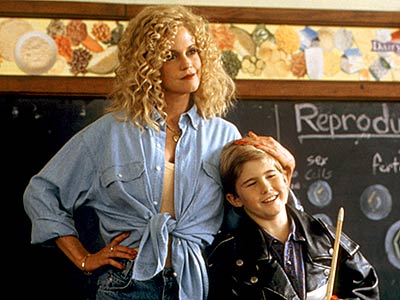
The boys—shy Frank (Michael Patrick Carter), neat-freak Kevin (Brian Christopher), and cool Brad (Adam LaVorgna)—are about twelve years old and go to middle school, where they learn sex education. (By the way, isn’t 9th grade when you’re supposed to start taking that class?) In an opening scene, we see them talk about stuff they find in their mothers’ and sisters’ rooms, like a diaphragm. They notice the girls in their school, and they also watch porn, to look further into their curiosity.

The boys come across some money and they ride their bikes into the nearby city of Pittsburgh, where they hope to find a prostitute naked and pay her for it. This is where they meet “V” (Melanie Griffith), who takes her shirt off for $103.

Right away, you can probably tell how uncomfortable this is. The scene in which she takes her shirt off to the boys is creepy. OK, we don’t see any nudity except from the back, since this movie is rated PG-13, but that doesn’t make the scene any less creepy to see the boys’ reactions—one of which has his eyes closed. (“I can’t do it—I wanna be a gentleman!”) How does the movie try to force itself out of the awkwardness? By cutting to the boys walking down a nearby alley, with cigarettes in the mouth—the cigarettes aren’t lit and there’s cheerful music playing over the scene. This is far from less-than-awkward.

The boys’ bikes are stolen, so V gives them a ride home. But as V drops Frank off at his house, her car stalls and she’s forced to stay in the suburbs—specifically, Frank’s treehouse. Frank’s dad Tom (Ed Harris) is led to believe she’s a math tutor, helping a friend with his homework. And of course, there are many misunderstandings and misreading of double meanings, neither of which are more painful than funny. This sets up the romantic angle of the film, as V and Tom start to fall for each other, with Tom not knowing until later that she’s a hooker living in his son’s treehouse until her car is fixed. It’s more unfortunate that Griffith and Harris don’t share much chemistry together, so it’s harder to buy into their supposed romance.

But wait a minute—it turns out the broken-down car belongs to V’s pimp (Casey Siemaszko) who has hidden a load of money in the trunk (V doesn’t know this). So, an angry gangster, who has killed the pimp, is looking for V because he knows she has the money and thinks she stole it. This leads to an action climax to show that the film surely just does not care about what it’s supposed to be about. We have it all—the gangsters crashing the kids’ school dance, the kids getting away by driving a car, and can you believe that car actually blows up?

The worst scene in the movie is when Frank brings V to class for his sex ed presentation. Tell me if this makes any sense—Frank locks the teacher out of the classroom, surely doesn’t get graded for this, sneaks V in through the window, uses her as a visual aid for a reproduction assignment, and doesn’t even get punished for it.

What were these writers thinking when they wrote “Milk Money?”

The three young actors—Michael Patrick Carter, Brian Christopher, and Adam LaVorgna—are fine, despite given clichéd writing to their characters. Ed Harris does what he can with his role and even manages to give the character some dignity—he’s a high school science teacher trying to save some wetlands. But Melanie Griffith, who used to be an exciting comic actress (see “Working Girl”), is pretty bad. She fails miserably at her dramatic moments and her comic moments are merely OK.

“Milk Money” is a mess. When its writing isn’t embarrassing, it’s very much clichéd. The film pretty much fails when the setup makes itself known, the stuff with the gangsters is completely unnecessary, the romance isn’t convincing, and it tries to make itself into a charming family comedy when really it’s a mashup of stuff for kids and adults. Well, let’s face it—“Milk Money” isn’t for either. It’s made for rocks.

The Perks of Being a Wallflower (2012)

12 Feb

the-perk-of-being-wallflower101

Smith’s Verdict: ****

Reviewed by Tanner Smith

People will say that they hated high school. I think they’re only thinking of the bad occurrences (lost opportunities, broken hearts, feeling left out of the crowd, etc.), rather than the warm, nostalgic, refreshing moments that changed their lives forever (friendships, accomplishments, even quirkiness in classrooms). High school may have had its negative moments, but its positive points were always present. It can be weird and crazy, but also warm and funny. That statement alone can be used to describe “The Perks of Being a Wallflower.”

“The Perks of Being a Wallflower” is a true delight and it understands what it was like to be an outsider during high school. People looking back will notice that they all went through the motions of high school—awkwardness, loneliness, confusion, and the unexpected camaraderie that came with—and then they’ll realize that they all felt like outsiders, even the popular crowd. “The Perks of Being a Wallflower” doesn’t present these elements as a bad thing. It’s a moving coming-of-age story about such a high school kid who begins his freshman year miserably, but finishes it by embracing who he really is.

Based on a popular young adult novel, the film takes place in the early 1990s as a teenager named Charlie (Logan Lerman) begins his first year of high school. Charlie is a shy, quiet kid who has trouble making friends, and his old friends are too busy with their new crowd to pay attention to him. (And he also has a troubled past, which is revealed later.) The only connection he makes so far is with his English teacher (Paul Rudd).

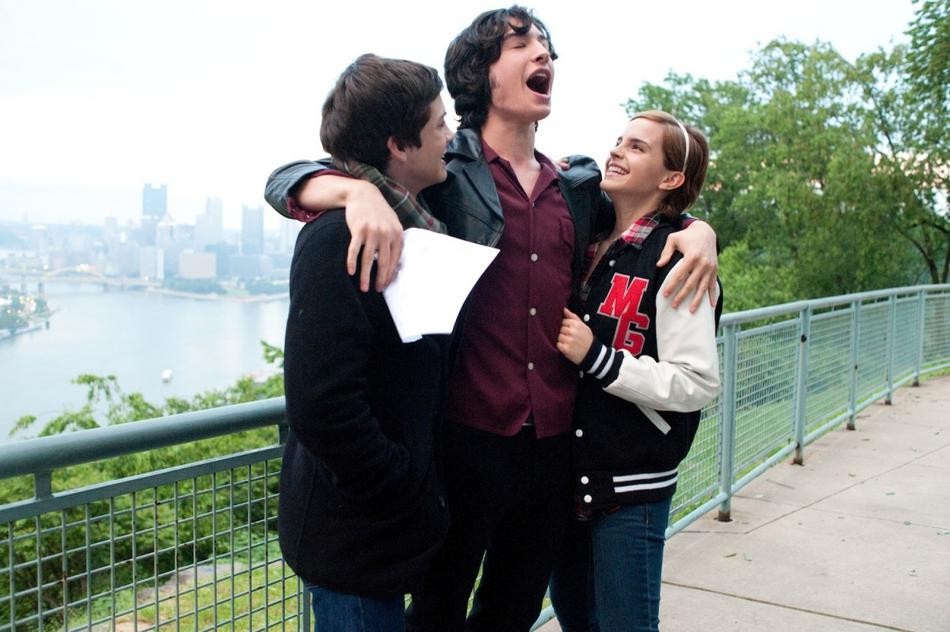
Soon enough, Charlie meets two seniors—Sam (Emma Watson) and her stepbrother Patrick (Ezra Miller), who aren’t conformists in the slightest and revel in knowing so. When they learn that Charlie doesn’t have any friends, they welcome him into their crowd. They enjoy each other’s company.

For Charlie, this is a way of stepping out of his dork-status and his despair. It’s a despair that runs deeper than one might expect that comes with clues such as his constant writings to a certain “friend” about certain updates, and his late aunt (Melanie Lynskey) who had a certain bond with the boy, and possibly something a little more suspicious (things are left vaguely). His parents (Kate Walsh and Dylan McDermott) are in their own world, and his usually reliable older sister (Nina Dobrev) is in a somewhat odd relationship with an idiot named Ponytail Derek (Nicholas Braun). Bottom line is, this is a kid who needs friends in his life. Who better to be his friends than Sam, friendly and appealing, and Patrick, witty and high-spirited (and openly gay).

Charlie isn’t the only one with problems, of course. Patrick and the football jock Brad (Johnny Simmons) are seeing each other secretly, as Brad isn’t ready to come out of the closet yet. But the tension is getting to be too much for him. And Sam is trying to live down a reputation, which began during her freshman year. She regrets the past, and dates someone else—a nice college guy named Craig (Reece Thompson). Charlie develops a quick crush on Sam, but still supports their friendship. But Sam, not knowing that Charlie is hopelessly in love with her, keeps finding ways for Charlie to like her even more, which makes things very difficult. Life may be sweet, but also very complicated, and it gets even more so when Charlie finds himself in a weird relationship with punk-Buddhist Mary Elizabeth (Mae Whitman).

If any of this sounds familiar, it should. We’ve not only seen this in many high-school coming-of-age movies, but I think most of us have known what this felt like when we were in high school. We can’t deny it—we have all felt the confusion, the awkwardness, the loneliness, and the unusual developed friendships that come with high school. And this movie knows what high school felt like. What surprised me is how this film separated itself from the “mainstream” aspects by really tapping into its subject matter, as well as developing into a rather dark final act (which I will not give away). The screenplay by Stephen Chbosky (based upon his own novel!) is warmer than I expected it to be. It’s insightful, sincere, and very effective.

What also makes “The Perks of Being a Wallflower” special are the performances. Logan Lerman is likable and effective as Charlie. Emma Watson, in her first attempt to distance herself from the Hermione Granger image that made her noticeable in the first place, does great work as Sam. She has more of a display of range and ability than the “Harry Potter” movies ever permitted her to show. (Both Watson and Lerman share convincing chemistry together.) But the real surprise was Ezra Miller as Patrick. Miller plays the exact opposite of his psychopathic-teenager role in last year’s “We Need to Talk About Kevin,” and he delivers a performance equally strong. Miller is enthusiastic, energetic, likable, credible, and engaging.

If you feel alone, then remember that good things can happen in ways you don’t expect them to. That’s the overall moral, you could say, for “The Perks of Being a Wallflower.” With a smart script, good acting, and an overall feel for what it’s like to be a high school outcast, this movie is observant, fun, amusing, sweet, sad, nostalgic, and very effective.

The Sure Thing (1985)

12 Feb

images

Smith’s Verdict: ***1/2

Reviewed by Tanner Smith

Rob Reiner’s “The Sure Thing” could have been one of those dumb teenage sex comedies of the 1980s, and for those who were tired of that “genre,” the opening scenes probably turned them off immediately. You’d think you could tell from the first five or ten minutes what was going to happen in this movie, but you’d be wrong, and that’s how the movie tricks you. Rather than going along the lines of the distasteful “Porky’s,” “The Sure Thing” is sweeter and more mature in tone than one might expect.

Surely enough, “The Sure Thing” starts offputtingly. For one thing, the opening credits (which are written in that cheesy, pink-colored cursive font you see in most 80s teen comedies) are played over a sequence in which the title character—a blonde bombshell in a bikini—sits on a California beach and rubs lotion all over herself. Very appealing to look at, I have to say. But there are many other teenage movies that start out this way. Then, we meet our main character—a recent high school graduate named Walter “Gib” Gibson (John Cusack) trying unsuccessfully to pick up girls at a party, and then chatting with his buddy Lance (Anthony Edwards) who keeps telling him to “get back out there” and get laid. Lance is just as annoying as any other “supportive-sexist-best-friend” character you see in this kind of movie—we’ve seen this guy before. He’s boring.

In fact, we’ve seen this opening before. Any groaner will tell you that “The Sure Thing” is going to be just another one of those sleazy teen sex romps. But this is a most pleasant surprise—instead of resorting to that sort of sleaziness that made movies such as “Porky’s” and “Losin’ It” box-office hits at the time, “The Sure Thing” turns out to be a gentle love story that begins as Gib attends an Eastern college and meets Alison Bradbury (Daphne Zuniga) in his English class. He’s attracted to her, and he uses unusual pickup tactics to ask her out. But Alison is not one of your standard dumb movie broads—she’s an intelligent woman (who happens to be good-looking). On their date together, just when the two start to really hit it off, Gib ultimately winds up acting like a total jerk.

Lance invites Gib to spend Christmas vacation in Los Angeles, where a “sure thing” (the blonde at the beginning) is waiting for him—no strings attached, no guilt involved. He plans to get there, from New England to Los Angeles, any way he can. So, he goes to a bulletin board offering rides, and gets a ride with a friendly, showtunes-crooning couple (Lisa Jane Persky and Tim Robbins), but guess who’s also along for a ride to L.A. That’s right—it’s Alison. She’s on her way to spend the holidays with her preppy boyfriend (Boyd Gaines). From here, it’s a combination of a road movie, a comedy, and a romance.

“The Sure Thing” follows a basic Hollywood three-act structure. The first act introduces the characters at the northeastern university; the second act, the most lengthy section of the movie, in which they travel to California while running into some trouble and hitching rides, while surely becoming attracted to each other; and then the final act, in which they reach their destination and ask themselves if they’re there with the right person. You can guess the outcome of the story, but that’s not the point of the movie. What really counts about “The Sure Thing” is that there is genuine chemistry between the two leads, as every good romantic comedy should have. For us to buy the story, we have to buy the attraction between the two. There is conflict between the two at first, but as they get to know one another, they start to really like one another. Sure, they’re opposites, and they’re going to California for another person. But when has that ever stopped true love? We like Gib and Alison—we care about them and we root for them to end up together. And that’s a compliment to the script and a key tribute to John Cusack and Daphne Zuniga, who are both gifted, charismatic, and convincing when playing the old reliable “love/hate” interaction.

My favorite scene in the movie is when Gib and Alison share a bed together. Alison is the first to awaken in the morning, and she notices that Gib has his arm wrapped around her. How does she react? She smiles and keeps lying there. That’s a genuinely sweet moment and it becomes an important turning point in Gib and Alison’s relationship.

And “The Sure Thing” does what every romantic comedy should do once they’ve gotten the sweet elements out of the way—provide the comedy. And surely enough, there are many comedic moments in this movie that work greatly. These scenes include—Gib’s introduction to the “sincerity lie” by his college roommate (Joshua Cadman); a predictable scene involving Alison hitching a ride with a redneck that suddenly becomes unpredictable once Gib comes to her rescue in a hilarious way; a scene in which Gib teaches Alison to “shotgun beer”; and more. More importantly, the comedy comes from the character’s behavior and the situations they go through.

More pleasantly, “The Sure Thing” is not about the “sure thing” (and there’s never any “meanwhile in California” scenes to interrupt the road trip). It’s about this young man falling genuinely in love. When Gib and Alison finally arrive in L.A., and end up at the same party, Gib is starting to feel as if he’s there for the wrong person. Little does he know that Alison feels the same way—she feels no excitement with her boring, middle-class boyfriend.  “The Sure Thing” has something to say about sex and love, and it’s one of those rare teen-comedies in the ‘80s in which sex and love are two completely different things. (So many others at the time pretended they were one and the same.) With realistic teenage characters, a funny script, and a tenderness to the story, “The Sure Thing” is a treasure in the teenage romantic-comedy genre.