Archive | February, 2013

In & Out (1997)

16 Feb

1852104

Smith’s Verdict: ***

Reviewed by Tanner Smith

“In & Out” stars Kevin Kline as a high school English teacher who is neatly-dressed, reads Shakespeare, watches Barbra Streisand movies, and is somewhat of a wimp. Those four traits are thrown in the way of his masculinity when everyone in the movie thinks he’s a homosexual.

It begins as Kline’s character Howard and his fiancée Emily (Joan Cusack) are watching the Oscars, rooting for one of their former students, who is one of the Best Actor nominees. He’s apparently so successful that Glenn Close spends so much time talking about how great he is, and then just says the other actors’ names as if they’re not important. (By the way, who would have thought Steven Seagal would be nominated alongside Paul Newman, Clint Eastwood, and Michael Douglas? Nice joke, though.)

Anyway, the actor—a goof named Cameron Drake, played by Matt Dillon—wins the Academy Award for playing a gay soldier, and in his speech dedicates it to Howard, “who is gay.” This comes as shocking news to everyone, including his fiancée, his parents (Wilford Brimley and Debbie Reynolds), his students, and the high school principal (Bob Newhart). But Howard keeps telling everyone that he isn’t gay. His students want to believe him, but they consider the facts about his personality and aren’t so sure. He hasn’t even made love to his fiancée in the three years they’ve been engaged—even the Parish priest he goes to believes he’s gay. The premise may sound like dark-comic indie-crowd fare, but “In & Out” is a jolly PG-13 mainstream comedy that’s about as innocent as it can get, given its subject matter. The result is a mostly funny and well-acted, though flawed, comedy.

When Kevin Kline turned into Jim Carrey is beyond me, though I suppose winning the Oscar for his nutty character in 1988’s “A Fish Called Wanda” helped a lot. The movie’s funniest scene is when he proves his masculinity to himself by playing a self-help tape, but can’t resist those distracting showtunes thrown in as tricks. The tape shouts back as if it’s talking right at him. Kline’s very funny here. He’s well-suited with Joan Cusack as his fiancée who has lost about 75 pounds working out to Richard Simmons’ workout videos, and now feels her world falling apart when she thinks she doesn’t know as much about Howard as she thought.

In a movie that has a solid cast and interesting character development (including Matt Dillon as the actor, who had no intention of ruining Howard’s life and whose intentions are revealed later), the best performance in the movie goes to Tom Selleck as a celebrity gossip TV journalist who believes Howard is gay and arrives to this small town in Indiana to make a documentary about his eventual coming-out. Selleck is perfect in his role—effectively convincing throughout as this dedicated TV personality out to get the real story. There’s not a moment when he steers wrong.

“In & Out” has humor and heart, but what didn’t work for me was the ending. It bogs down into a cornball confrontation that interrupts a high school graduation ceremony to allow Howard to win the people’s respect again. It involves everyone shouting “I’m gay” to get at the principal, who just can’t find a good explanation for firing Howard other than he’s gay. It was too uplifting that it wound up as just cloying. But give the scene credit for not taking place in a courtroom.

There are a few slight problems such as the cheesy feel-good music that tells you what to feel when the actors are doing a well-enough job of that. And also, I could see a few things coming a mile away. But what I couldn’t see coming were the movie’s best jokes—a bachelor party that goes unexpectedly, a hilarious snap at Barbra Streisand, that self-help tape scene I mentioned above, and some terrific one-liners. All of the actors are solid, the writing is sharp, and the movie has an overall positive feel to its subject matter. “In & Out” is a certified crowd pleaser.

Child’s Play (1988)

16 Feb

images

Smith’s Verdict: ***

Reviewed by Tanner Smith

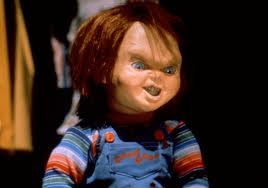
There are many horror-slasher movies with villains that are scary and villains that look scary. “Child’s Play” has a villain of both sides. At first, this “doll”—you read right, it’s a “doll”—looks nice and friendly (and it’s called a Good Guy), but then he was inhabited by the human soul of a serial killer…and now, he looks and acts like someone’s worst little nightmare! With a blade in his hand, a different, scary smile, and a voice that could be Jack Nicholson’s (but it’s actually Brad Dourif’s), we have Chucky…

You know those three heavy musical notes that play in the movies and on TV that are played when someone says something that scares people? Those would fit great if I gave my review on an Internet video.

I don’t really like Freddy Krueger (of “Nightmare on Elm Street”) as a villain; I just see him as a comedic scarface trying to be the big shot. And Jason Voorhees (of the “Friday the 13th” sequels) is still a hard person to figure out. Even the Shape (you know, Michael Myers of the “Halloween” movies), who I thought was scary in the original “Halloween,” tires me with his ridiculous sequels. But Chucky, whose name when he was human was Charles Lee Ray, scares me in appearance and in spirit. This little guy is everybody’s worst little nightmare.

“Child’s Play” begins with Ray, a notorious voodoo-educated serial killer, getting shot by a cop and dying. He’s not ready to die. He screams a revenge threat at the cop and tries to get out of the toy store he’s in so he can find somebody to use his voodoo knowledge on so he can possess the person, but instead he finds one of the Good Guy dolls, a nice, friendly-looking, red-haired doll. After a freak accident, we can assume that he’s now the doll…

The doll, nicknamed “Chucky,” is bought by Karen Barclay (Catherine Hicks) as a present for her six-year-old son Andy (Alex Vincent). The doll comes off as just a doll, staying quiet and whatever the Good Guy dolls are supposed to do. But when Andy’s babysitter is pushed out a who-knows-which-story window, Andy can only say “Chucky did it.” It’s the truth, but his mother and the police don’t believe him and start to be concerned about him. Nobody believes him until his mother discovers that Chucky is talking even though he doesn’t have any batteries in him.

Then, the police don’t believe Karen when she tells them that Chucky is alive. But the movie kicks into more horror when the cop barely escapes Chucky’s wrath and especially when we learn that Chucky needs to possess Andy or else be stuck in the doll’s body forever.

Why is “Child’s Play” worth recommending? Because it’s well-made, contains very good performances from Hicks and Vincent as the scared family, and the villain is a psychotic doll. How else can I explain Chucky except for telling that every time I see his picture on a poster or a cover of a video box, a shiver crawls my spine?

I also like the plot gimmick they use here, such as when Andy tries to tell his mother and the police, they don’t believe him. And then, when his mother founds out the truth by discovering no batteries in him, she tells the police and they don’t believe her either. Then, the cop—Detective Mike Norris (Chris Sarandon)—is attacked by the little devil and barely survives.

And also, that scene in which Karen finds out the truth is a real scary scene.

She’s walking in with the doll, very depressed. Then, she leaves the doll in the living room and goes into the kitchen. She’s about to throw away the box, when…uh-oh–batteries fall out. Then, she slowly walks into the room, cautiously picks up the doll, opens the battery case, and sees nothing…then the doll turns its head and says in a child’s computerized voice “Hey, wanna play?!” The mother screams and drops the doll then Chucky really makes himself known…

That is one creepy scene and also, one of the great things about the movie is the good-looking demonstration of the mad slasher genre. When you think the killer is dead, he really isn’t. You could shoot him multiple times, stab him multiple times, and even burn him to a crisp…he still isn’t dead. The way they do it here is quite interesting.

The director of the film Tom Holland delivered the goods in 1985’s “Fright Night”; he does it here too. He knows how to make an audience go for horror films and he treats them right. Both movies mix some funny dialogue with some flat-out horror and work. Although the gimmick of the “child-in-jeopardy” is sort of cheap, it works here because the little boy played by Vincent isn’t just screaming for his mommy. He has something to do and he stands up to the little devil. Once again, I really like the way the filmmakers made that doll from a nice-looking cute doll to a more horrifying, ugly thing. “Child’s Play” is a well-made horror film with an actually scary villain.

Star Trek III: The Search for Spock (1984)

16 Feb

621_356_star_trek_3_the_search_for_spok

Smith’s Verdict: ***

Reviewed by Tanner Smith

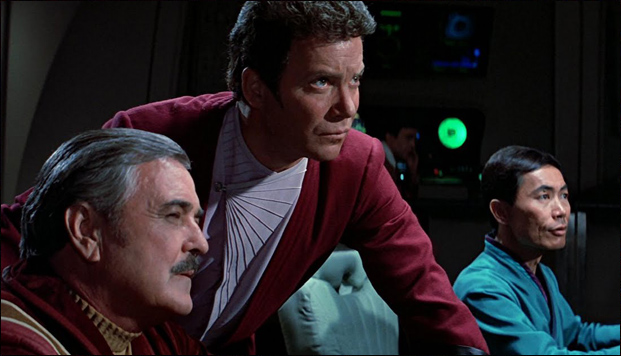
The third “Star Trek” movie is subtitled “The Search for Spock,” leading to the possibility that by the time this movie is over, Mr. Spock will return to join the USS Enterprise crew once again. But it starts out with Spock not merely missing—in fact, for those who don’t recall the end of the previous movie (if you don’t, this movie recaps the moment), Spock sacrificed his life to save the ship and the crew. The crew threw a funeral for him, launched him out into space, and fans of the series undoubtedly cried at the fact that Mr. Spock (Leonard Nimoy), arguably the most famous character in the “Star Trek” franchise, has died. But in the movies, anything can happen—thus, we have “Star Trek III: The Search for Spock,” in which Admiral Kirk and his crew are going to find Spock and bring him back from wherever he is.

Strangeness occurs that gets the search underway. For one thing, Dr. Bones McCoy (DeForest Kelley) seems to be of two minds, so to speak. It seems as if some of Spock’s memories have been stored into McCoy’s mind. He begs Kirk (William Shatner) to find Spock on the Genesis planet, where it turns out Spock has been reborn due to the planet’s growth. (At least I think that’s how it worked—certain parts of the story seem kind of odd to me.) For those who remember, the Genesis planet, from the previous movie, was created for new life. Kirk and the crew are to be reassigned and are forbidden by the Federation to go to the planet to search for Spock. But they disobey their orders and go for it anyway. However, they run into trouble with a ship of aggressive Klingons, led by the ruthless Kruge (Christopher Lloyd), who want to steal the secret to Genesis.

The search is a good deal of fun, though the scenes leading up to it could’ve used either tighter editing or a simpler script. There’s a great deal of heavy exposition involving the location and rebirth of Spock, mostly by Spock’s father (Mark Lenard), and they go on for quite a while. But once Kirk steals the Enterprise from the Federation, in a terrific ten-minute sequence, the movie gets on its feet and gets more interesting. The afore-mentioned sequence is quite impressive and very well-paced. There’s some tension on the planet, as Kirk’s son David (Merritt Butrick) and Vulcan Saavik (Robin Curtis, taking over for Kirstie Alley) make their own expedition on the planet for inspecting a “mysterious life form.” The Klingons continue to zero in on the heroes, such as when the Enterprise is met with a Klingon bird-of-prey. And of course, everything must come down to a battle between Kirk and the nasty Kruge, and once that’s done, we can deal with the matter of Spock’s return.

Christopher Lloyd’s Kruge is just an OK villain—he doesn’t really have the same kind of menace that Ricardo Montalban’s villain had in the previous movie. Sometimes, with Lloyd’s eyes bugging out half the time, it’s hard to take him seriously. And when you’re familiar with the actor’s other work, hearing him speak Klingon (which sounds like a cat throwing up half the time) is, let’s face it, quite hilarious.

I won’t be spoiling anything when I say that Spock does return at the end. What, did you expect the Enterprise crew do go on this search and not find him? This isn’t that kind of movie, guys. I’ll praise the scene involving his return because it reigns as one of the more satisfying moments in the “Star Trek” series—I was glad to see him again.

“Star Trek III: The Search for Spock” isn’t as great as “Star Trek II: The Wrath of Khan”—there are some overlong scenes, some moments that are silly, and the villain isn’t particularly compelling. But the theme of sacrifice is still present—like how Kirk has to sacrifice just about everything to save his best friend—and the action is still tense and exciting, while leaving for the beloved character interaction “Star Trek” fans have grown accustomed to. This is a good “Star Trek” movie, but not a great one. Still, like all good movies, that doesn’t mean it doesn’t deserve to be checked out.

Back to the Future (1985)

15 Feb

Back To The Future 2

Smith’s Verdict: ****

Reviewed by Tanner Smith

“Back to the Future” is an enjoyable, well-crafted, fantastic movie that has probably one of the best screenplays ever executed to film. Written by Robert Zemeckis (who also directs the film) and Bob Gale, I can just watch this movie and imagine what it would have been like for these two to write this script. They must’ve had a great time—I see beers and snacks all around, with chuckling, laughing out loud, and collaborating on new ideas and nodding in agreement. Or maybe I’m just being too positive. But what they delivered is a screenplay that, directed by Zemeckis, makes for a fun, entertaining, very well-written, even deep-at-some-points movie.

The story for “Back to the Future” takes place in 1985 (when this movie was made). Why do I bring this up? You’ll find out—though most of you reading this will already know why.

The hero is a California teenager named Marty McFly (Michael J. Fox). He plays lead guitar for a garage band and has a nice, attractive girlfriend, but his home life is an embarrassment. His older brother and sister are underachievers, his mother is a chronic drunk, and his father is such a nerdy wimp that he still lets his high school bully push him around.

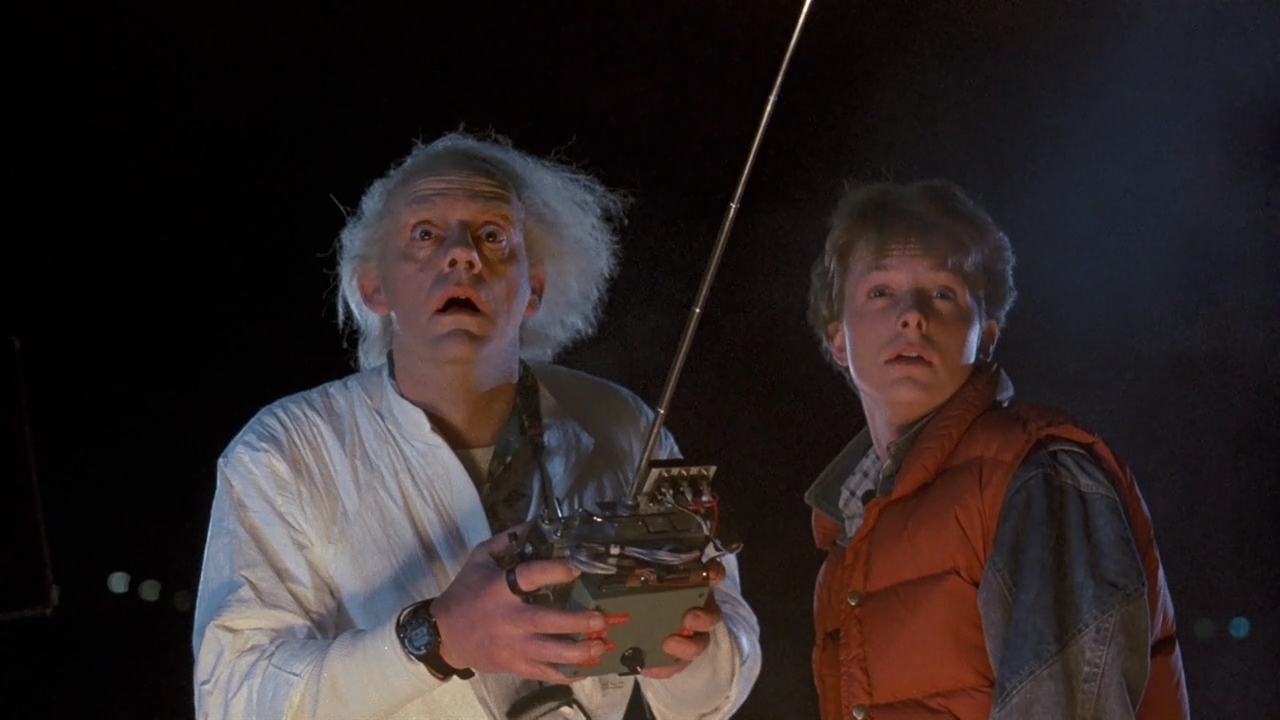
Marty’s zany scientist friend Doc Brown (Christopher Lloyd) is excited about his newest creation and asks Marty to come to the local mall and document by video camera the experimental testing. The invention is a DeLorean vehicle that turns out to be a time machine. Doc has remodeled it with all sorts of gadgets to make it possible, and it turns out to work like a charm. But for complicated reasons, Marty winds up in the car/time machine and accidentally sends himself thirty years into the past.

It’s the year 1955. It’s the same town, same school, and same neighborhood…but the twist is that he’s now the same age as his parents. This is where the story really gets interesting and very funny—Marty’s relationships with his parents, who of course don’t know who he really is. Marty befriends his father George (Crispin Glover), who is still as nerdy now/then as he was then/now and letting the school bully Biff (Thomas F. Wilson) pick on him. His mother-to-be Lorraine (Lea Thompson), who in the future became a skeptical, slightly-ugly, overly protective mother, is a beautiful, popular girl who cheats on school exams and follows boys around. These two are supposed to meet an upcoming school dance and fall in love. But Marty accidentally interferes with their meeting for the first time and Lorraine, his own mother-to-be—get this—is infatuated by him. This means that Marty has to undo the mess he made and set up the date with George and Lorraine himself, so they’ll meet, fall in love, and have children…or he’ll be erased from existence.

Marty never would have thought that his mother used to act this way or that his father was always as wimpy as he is. But something that just every person thinks of their parents, or at least every kid or teenager, is that their parents were never young. They were always the cynical, uptight beings that their kids see them as. Maybe the adults think they’re never as old as they really are, I don’t know. But “Back to the Future” has a pleasant fantasy spin to that. It answers the question of how a teenager would react if he saw his or her parents as teenagers.

Anyway, a few circuits on the time machine have been fried and as he convinces the 1955 version of Doc Brown that he’ll create this contraption, it turns out that the best thing to start it back up is with a bolt of lightning. But luckily, Marty knows when lightning will strike the town’s central clock tower and they have a week to prepare for it and get Marty back to the future. In the meantime, of course, Marty must settle things with his parents if they are still to become his parents.

This is great stuff! “Back to the Future” is full of neat ideas, it’s played for laughs (though there are some serious moments in the mix), its characters are memorable, and it constantly pleases with surprise after surprise. Everything has a setup and it all pays off by the time the movie is over—even the little details that you notice the second or third time watching it. There’s a great sense of comic timing along with its charming, lighthearted feel that you love watching this movie, even if the best parts haven’t occurred yet.

Some of the funniest bits involve the “fish-out-of-water” story with Marty interacting with a different place—or in his case, the past. For example, everyone mistakes his down jacket for a life jacket, and he can break the handles off of a scooter and use the board as a skateboard to escape from Biff and his cohorts. My favorite bit is how everyone reacts when he performs guitar at the dance and plays his solo a little too wildly. What really should be noted is the set design for the town, recreating a 1980s small town to show certain similarities and differences for the ‘50s version. It’s very well-done and quite creative.

With the wrong actor to play Marty, the character wouldn’t have gained our sympathies with him and since a lot rides on him, we wouldn’t have cared that much for the movie. This shows that a great screenplay doesn’t just make a movie—execution is probably the most important detail, and that includes casting and acting. But Michael J. Fox is perfect as Marty—he’s cocky, frantic, and wisecracking, but he’s also friendly, bright, and has an unforced, natural charm that makes us like Marty and root for him to work everything out.

Christopher Lloyd, as both versions of the Doc (past and future), is memorably wonderful. He plays him like a stereotypical mad scientist (and even sports a lab coat and a fright wig)—brilliant, zany, and constantly exclaiming in excitement. He has some of the best, funniest reaction shots I’ve seen in a movie. The supporting cast is also solid—Lea Thompson and Crispin Glover have fun with their roles, past and present. (Glover, in particular, is wonderful as the nerdy George who just needs to boost his self-respect and self-esteem.) Thomas F. Wilson is cartoonish but very memorable as the bully Biff.

There is so much to enjoy in “Back to the Future” that when it’s over, we feel joyful, energized, and glad to have seen it. I can’t imagine anyone not enjoying this movie—it’s fantastic fun.

The Social Network (2010)

15 Feb

The Social Network

Smith’s Verdict: ****

Reviewed by Tanner Smith

It’s hard to make a good or great movie about networking, but it is possible—I am referencing television networking in that statement. It’s even harder (and seemingly impossible) to make a good or great movie about the creation of a social network via computer. But “The Social Network” amazingly pulls it off—this is a great movie, not just because it knows what it’s talking about when it comes to developing this website, but because it’s so skillfully made and highlights a great cast and a sharp script.

You can see in the TV ads that “The Social Network” is the true story about the creation of Facebook, the social network we all (or most of us, anyway) know and love. But you’d be surprised that this is more about people than about Facebook. Facebook was created by an intelligent young man named Mark Zuckerberg, whose creation made him the youngest billionaire in America in his early 20s. In the movie, Mark is played by Jesse Eisenberg as a Harvard student who thinks he is right all the time. This doesn’t do him well with social situations—in an opening scene, he uses logic with his date Erica (Rooney Mara, soon to be known as The Girl with the Dragon Tattoo) to the point where she dumps him and calls him an a**hole. Indeed, he is arrogant, persistent, and may be an a**hole, but he’s intelligent and somewhat witty in his own logical arguments.

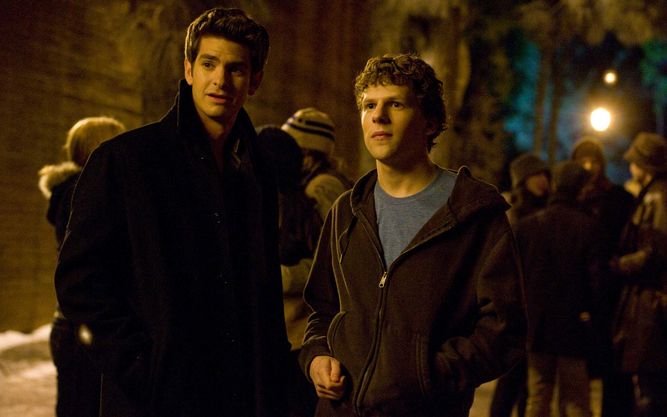
Mark gets the idea while drunk and blogging that he could develop a site where fellow students could decide which of two Harvard girls is hotter than the other. He hacks into the system with the “facebooks” of students on campus computers, creates the site, and is declared an even bigger a—hole. But this brings the attention of identical twin brothers Cameron and Tyler Winklevoss (Armie Hammer), both of which are on the university’s rowing team, and their business partner Divya Narendra (Max Minghella). They tell Mark that they want him to help them program a new website called The Harvard Connection. Mark agrees, but goes to his best (and only) friend Eduardo (Andrew Garfield, soon to be known as the next Spider-Man) with the idea of making this idea into something bigger—“Thefacebook,” an online social network to Harvard students, where people can display personal information.

Mark and Eduardo eventually launch the site, which brings them popularity and trouble. The film intersects back and forth between those scenes and scenes involving Mark being sued by both the twins, for stealing their idea, and by Eduardo, for reasons to be explained later in the film. This shows you can be popular with one idea, but an enemy to others. In the storytelling scenes, we see as Facebook develops into a wider network, Eduardo is made CFO and pays thousands of dollars to help program it, and we later meet Sean Parker (Justin Timberlake), the founder of two music web startups (Napster and Plaxo). Sean is brought in to give insight on “Thefacebook” (drop the “the,” expand it, create a Wall, etc.). Sean is a manipulative creep who has Mark in his hands and pulls him into the big time. Why expand Facebook—well, why make millions when they can make billions?

The story for “The Social Network” (of which some elements are true, but like most biopics, they add flights of fancy) seems impossible to make into a movie. But the storytelling is amazingly well-developed with an excellent script. This is a great movie to listen to—the dialogue that these bright Harvard students say is on-target and amazing, but never to the point where we’re annoyed. And I love movies that show the whole process of creation—even if the idea of writing or filming how they begin to invent Facebook sounds unfilmable and illiterate, the script still surprises us with spellbinding writing and explanations in ways we can understand. This screenplay, written by Aaron Sorkin, really deserved the Oscar nomination for Best Adapted Screenplay (the film is partially based on the book, “The Accidental Billionaires”). It never falters, condescends, or dumb down the material or the characters. It’s amazing how this writer Aaron Sorkin and the film’s director David Fincher is able to tell this story without boring audiences.

Also, the script is excellent in developing the characters. Mark Zuckerberg is a nonsocial smart aleck, Eduardo is reliable but has a breaking point, and Sean is a bigger a**hole than Mark, but tries to cover it with manipulation and charm. The story gets heavier when Mark doesn’t even realize that Sean redrafts the financial arrangements to keep Eduardo out of the picture. All three roles are wonderfully acted and even “wonderfully” is not a strong enough adjective to describe these performances. Jesse Eisenberg deserves an Oscar (or at least a nomination) for his portrayal of Mark Zuckerberg. We all know from “Adventureland” and “Zombieland,” in which he starred as the lead role, that Eisenberg is a great young actor with a dry, highly verbal sense of humor. Here, he gives his best performance—he gives that same personality in this movie, but he gives something more to the character so we understand his arrogance and intelligence. He makes Mark Zuckerberg a living, breathing character rather than the butt of a joke this movie could have become. He has great screen presence, remarkable comic timing, excellent acting range, and is absolutely fantastic in this movie. Other strong performances—Justin Timberlake is memorable as Sean and Andrew Garfield is very good as Eduardo.

With a great cast, sharp direction, and an excellent script, “The Social Network” is, in my opinion, the best film of 2010.

Friday the 13th (1980)

15 Feb

FT13th_Still_2

Smith’s Verdict: *1/2

Reviewed by Tanner Smith

“Friday the 13th” started a ridiculously popular series of deplorable slasher films, neither of which I can recommend. Did this film deserve a sequel to lead to more sequels? Well, no. In fact, I really don’t understand why the film was so popular with the horror-movie crowd. It’s poorly made, slow moving, and, to be honest, not very memorable, save for a few creepy moments.

It is, however, another example of a slasher film in which teenagers, mostly women, are alive at the beginning, and then dead by the end. Ever since the iconic “Halloween,” there have been so many of these going around. Heck, the filmmakers actually make a note that their intention for “Friday the 13th” was to “rip off ‘Halloween’”—class act. All that was missing was the tension, excitement, and suspense—instead, we just have pretty, poorly-developed young people as characters waiting to be hacked off one by one.

The story pretty much sets them up for it. It’s about a closed-down summer camp that is finally about to be reopened years after supposed deaths. There is rumors spread by the nearest town’s loony that it has a “death curse,” and the locals refer to it as “Camp Blood.” But the new owner Steve Christy (Peter Brouwer) decides to get finally get things up and running again. The movie takes place in a day and night at the camp in which six counselors get everything prepared for campers. But someone is watching them from afar…

Many people know the killer Jason from the “Friday the 13th” series—the husky, silent killer in the hockey goalie mask that never stops killing and never dies permanently (he always comes back). But wait a minute—Jason isn’t the killer in this movie. In fact, he doesn’t even appear until the very end of the movie, and that’s just Jason as a little boy, in a dream. And I have to point that that dream sequence in which little Jason suddenly pops out of the river, grabs the Final Girl, and pulls her under (then she wakes up) is a shocker, although I think the better credit for that should go to the music accompanying it.

Speaking of which, Harry Manfredini’s music score for “Friday the 13th” is simple but effective, and it really ups the creepiness when the killer is around and something is about to happen. I don’t normally like it when the music sets up something big to happen, but the music here is something that gives “Friday the 13th” some merit.

And there are times when “Friday the 13th” is atmospheric, using the outdoors as the wide-open space that it is, where there are many places to run, but not always to hide.

The characters are paper-thin, and there are only three that are memorable for unfair reasons. One is Jack, played by Kevin Bacon—the reason he’s memorable is because…he’s played by Kevin Bacon, who went on to bigger and better things long since this movie. Another is Ned, played by Mark Nelson—he’s memorable because…he’s annoying as hell. And then there’s Alice (Adrienne King). She has no personality, but we’re supposed to follow her because she’s the film’s obligatory Final Girl who fights off the killer in the final act. Only one character seemed kind of interesting—an independent young woman named Annie (Robbi Morgan), the camp’s hired cook, who is hitchhiking to get to the camp…and gets murdered for it. I liked her; she had an appealing presence and before they could develop her character, they killed her off after a few scenes.

Another problem with “Friday the 13th” is its terribly slow pacing. The scene just goes on and on with many characters, individually, until the killer finally kills them off. We’re just stuck waiting and waiting for the person to die, without any sense of nail-biting tension. This is the movie that people are afraid of? I can’t imagine an audience being on the edge of their seats during this movie.

The final twenty minutes of the film is where the action picks up, as Alice is forced to fight against the killer after learning the killer’s identity. I won’t mind giving away the “big secret” because a lot of other people have. The killer isn’t Jason—it’s his mother Megan Voorhees. She’s played by Betsy Palmer, in a Razzie-worthy performance; her role and her motive is laughably absurd and her wide-eyed imitation of her son saying, “Kill her Mommy! Kill her!” is just embarrassing.

“Friday the 13th” is unremarkable. It’s a deplorable, weak rip-off of “Halloween” (and no, that’s not a compliment to the filmmakers). It was just another one of those unnecessary movies that led to unnecessary sequels and you can’t believe it got this popular status.

The Borrowers (1998)

15 Feb

MSDBORR EC007

Smith’s Verdict: ***

Reviewed by Tanner Smith

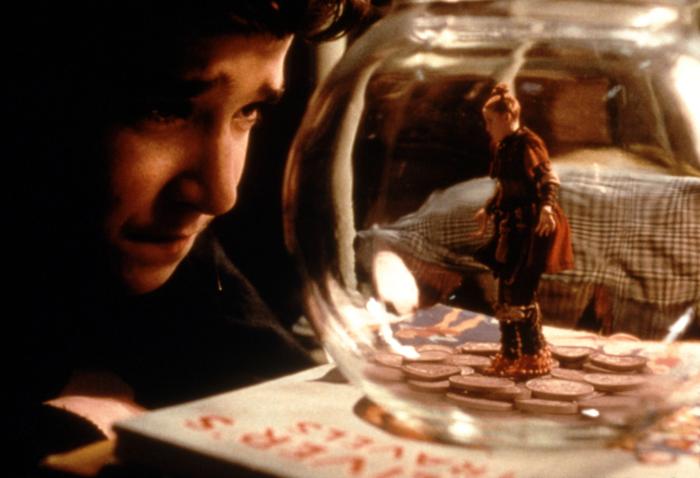
“The Borrowers” is based upon a series of books (by British novelist Mary Norton) centered around a premise that has always fascinated me ever since I was a child. You know how little things around your house seem to go missing? We naturally think we merely misplaced them and can’t remember where we placed them before, but what if there was another reason? What if there are little people living under the floorboards or within the walls, and they pilfer these objects when we don’t notice? These tiny people are known as “Borrowers,” as they “borrow” (kind term for “steal,” in their case) their survival needs—just little things lying around the house. The idea is intriguing and any book or movie centered around it interests me.

Now to be sure, this 1998 film adaptation “The Borrowers” from director Peter Hewitt is very, very loosely based on its source material. The only elements that remain the same are the central idea and the “Borrower” characters. But I don’t care how little it has to do with the book; as a stand-alone movie, it’s a charming, entertaining family film. It has fun with its premise, has top-notch special effects, and is flat-out entertaining.

The four-inch Borrowers that serve as the central characters of the movie are the Clock family—Pod (Jim Broadbent), his wife Homily (Celia Imire), and their two children Arrietty (Flora Newbigin) and Peagreen (Tom Felton). They live under the floorboards of the Lenders’ house, unbeknownst to the Lenders who serve as their human “beans” who unknowingly provide them with things to borrow, but will squish them once they see them. At least, that’s how it goes. Arrietty goes exploring the bedroom of Pete (Bradley Pierce), the child of the “beans,” and winds up being seen. But when she finds that the boy doesn’t want to hurt her, she’s able to convince her parents to let him help them out of the house, which is about to be demolished.

However, on the way to their new location, Arrietty and Peagreen are accidentally separated from Pod and Homily. The kids make it back to the house in time to notice that an evil lawyer, Ocious Potter (John Goodman), has in fact cheated the Lenders out of their house by lying about the will for the house never showing up. It turns out Potter has found it and wants to destroy it. But the Borrower kids mess with his plan by “borrowing” the will in hopes of saving the day. So Potter, along with an exterminator (Mark Williams), comes after them.

This leads to several events in which the kids are placed in more danger by the gigantic bean, but always have the upper hand in comic fashion. Actually, you could call this movie “’Home Alone’ with tiny people” in the way these four-inch children (later joined by another young Borrower, named Spiller) constantly outsmart the normal-sized lawyer in a sort of live-action cartoon violence. Potter is covered in burning insecticide foam; he’s slightly electrocuted; he has a needle stuck in his behind; and so on. Neither of these is terribly harmful, compared to the “Home Alone” movies, but they are enthusiastically exaggerated and still force chuckles out of the ingenuity of the idea that these “little” kids always have the upper hand on this guy.

This fantasy-adventure is brought to life with sensational special effects and amazing-looking, greatly-imagined sets. The sets that make the everyday world, with everyday items all around, look giant. Most of the charm comes from these set pieces alone. And the more complicated effects, integrating the humans with the Borrowers (including one complicated shot that looks like a steadycam shot of Pete looking down and talking to Arrietty who is standing on a table), are competently well-done.

There are many creative, adventurous sequences that follow as the plot continues. Most of these involve little Peagreen. One has him clinging for dear life onto a dangling light bulb, as Potter turns on the light and is ready for the bulb to burn his hands so he can fall. And Arrietty has to save him with a tape measure.

Another, quite possibly the most exciting scene in the movie, is the sequence in which Peagreen ends up in an empty milk bottle and taken to a dairy plant. Arrietty and Spiller (Raymond Pickard) must race to save him before it fills up with milk and is capped shut.

All of this is good fun, and it moves at a brisk pace. I admire the visual imagination and the creative storytelling that went into this film. Although, a minor drawback is that because it’s so fast-paced, that it’s kind of easy to miss something in the plot. We never even see Arrietty convincing her family to trust a previously-feared human “bean” to let him help them; they’re just in the back of the moving truck, and Pod just sort of trusts Pete. Other little details like that get kind of annoying, but I didn’t mind all that much.

Solid characterizations are given to the Borrowers and the beans, and they make the film more successful than it already is. And the characters are well-played by an ensemble of game actors. John Goodman is clearly enjoying himself, playing the nasty Potter who will stop at nothing to get his way; Flora Newbigin is excellent as the feisty, teenage Borrower Arrietty; Jim Broadbent is entertaining as Pod, who winds up barking orders at the human-sized Pete in order to find his and Homily’s children; and Mark Williams (as Potter’s henchman “Exterminator Jeff”) and Hugh Laurie (as a patrol cop) are on hand for effective comic relief.

Director Peter Hewitt has shown in “Bill and Ted’s Bogus Journey” that he’s game for visual imagination and creative storytelling, and he’s just as solid in exhibiting it this time, though maybe on a larger scale (so to speak). “The Borrowers” is a delightful, entertaining fantasy-adventure that makes great use of its fascinating premise and delivers the goods.

A Good Day to Die Hard (2013)

15 Feb

A-Good-Day-To-Die-Hard-Trailer-2013

Smith’s Verdict: **

Reviewed by Tanner Smith

1988’s “Die Hard” is considered one of the very best action films ever made, and their sequels have their shares of thrills as well. Though, it’s hardly a secret that the first film’s exhilaration has since diminished with each sequel…and unfortunately, its fifth installment, “A Good Day to Die Hard,” is enough evidence to show that the franchise is dying…hard.

“A Good Day to Die Hard” doesn’t even seem or feel like a “Die Hard” movie. It just seems all too generic—here’s a conflict no one should care about; here’s a few generic bad guys who love to shoot everything up; and here’s a load of explosions, and lots of ‘em! Add the wisecracking hero and an annoying sidekick, and…really? This is “Die Hard?” The other movies had more going for them than this—characterization, proper setups-and-payoffs, and memorable villains. Those elements are what made “Die Hard” and some of its following sequels fun to watch—they added to the excitement of the action sequences so we cared about what was happening on-screen.

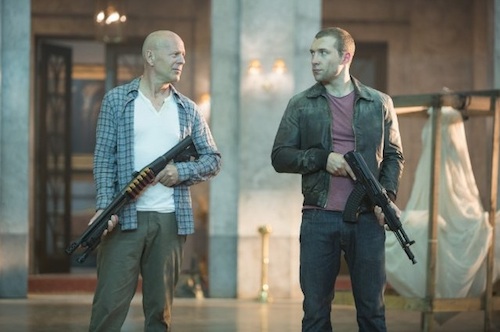
But at least we have Bruce Willis, again playing the hero cop Det. John McClane and again finding himself in one unusual predicament after another. And to be fair, he’s the best thing in this movie. Sure, he’s noticeably aged, but his wisecracking personality is still welcome. (He even says his “yippie-ki-yay” line, which I’m sure people missed in the previous “Die Hard” film.) However, there’s one question regarding his character—why is he suddenly so freaking invincible?! Remember when in the first movie, his feet were torn to shreds after having to escape barefoot on shards of broken glass? Now, whenever he crashes through plate-glass windows or survives car crashes, he only has a few scratches instead of ten or fifteen broken bones! Did John McClane just turn into the Terminator, as he got older?

But I digress. The action takes place in Moscow, Russia. John’s son Jack (Jai Courtney), a CIA agent, has been arrested for murder and is awaiting trial. John and Jack haven’t spoken to each other in years, but John wants to travel to Russia to…actually, I just realized I have no idea what his original plan was. Was he going to try and negotiate with the authorities? What can he say? He’s obviously out of his jurisdiction, to say the least. On top of that, he can barely speak a word of Russian. So what was he going to do originally? Plan a jailbreak? He’s clearly working alone!

I don’t know; and frankly, I don’t care. But it doesn’t matter anyway because as John gets to the courthouse, all hell breaks loose and Jack manages to escape Russian justice. Along with him is a political dissident, Komarov (Sebastian Koch), who has some sort of…”McGuffin,” I guess, that a band of terrorists are trying to get their hands on. John ends up in the mix, and thus we get to add awkward father/son bonding to standard, generic, shoot-em-up, action-movie elements. Oh. How. Exciting.

While the “Die Hard” movies have had some pretty effective villains (the one that particularly comes to mind is Alan Rickman’s Hans Gruber from the first movie), there is no real villain in this movie, strangely. There are just certain villainous characters who seem to one-up each other for complicated reasons, along with several henchmen. When the top villain is finally unmasked, however, it comes as no surprise (you’ll figure it out early on). Motivations are clumsily written, and so it’s hard to follow everything that’s being thrown at us. The action, as a result, comes across as (broken record) generic.

Bruce Willis is Bruce Willis, and he’s still likeable as always. But as his sidekick in the action, Jai Courtney is just a crushing bore. He’s whiny, annoying, and ultimately bland. Oh, and here’s the worst thing about him. He’s the central figure of this “Die Hard” movie—not John; he’s merely there for support. Yeah, because I’m sure we want to see this guy backed up by the iconic Bruce Willis character!

“A Good Day to Die Hard” at least has a few good-looking action sequences, and director John Moore is evidently a capable action director. But the main thing missing from this action film is the energy and creativity that the original film had. It just feels like a throwaway action flick that is subjected to our minds and then leaves very little impact. Maybe it’s time for this “Die Hard” franchise to…”die hard.”

Warm Bodies (2013)

14 Feb

warm-bodies-image08

Smith’s Verdict: ***1/2

Reviewed by Tanner Smith

Ever so often, we get one of those “zombie-movies” in which a strange infection devastates a population, and a small, diverse group of survivors defend themselves against a hostile race of staggering, man-eating walking-dead, and sometimes against each other. “Warm Bodies” is not that movie.

Yes, “Warm Bodies” is a zombie-movie, and the zombies are as predictable as you’d expect. They groan; they stagger; they crave human flesh; they lurch; and they get shot in the head by human survivors of…I don’t know, insert apocalyptic reasoning here. And the people include the usual gun-toting military who will shoot first and ask questions later (if at all), and of course, because they’ve never seen zombie movies, they use a special device to make sure that someone is or isn’t a zombie. Yeah, because it’s so hard to tell by appearance, isn’t it?

But wait! Didn’t I say “Warm Bodies” was not the typical zombie-movie? Yes I did. In fact, this is one of the more original zombie-movies to come around in a long time. It mixes elements of “Dawn of the Dead” with some of “Romeo and Juliet,” and it tells the story from the zombies’ point-of-view! It’s a refreshing move (among many in this movie), as if to say, “Forget the boring people who are trying to defend themselves! Let the zombies tell their story!” For the longest time, zombies have been simply known as walking allegories (who’s more human in the case of people-versus-zombies?) and have become more predictable as a result. Not here.

The main protagonist of “Warm Bodies” is “R” (Nicholas Hoult), a young zombie who narrates the story through thought. He knows he’s a zombie; he knows he has to eat human flesh; and he knows his many limitations. R slouches around the post-apocalyptic ruins of a city, and mostly hangs around an airport terminal and an airplane he has made his home. (And he doesn’t remember his first name, but he knows it starts with “R.”)

Those who have seen “The Princess Bride” will know that “there’s a difference between mostly-dead and all-dead.” Such is the case in “Warm Bodies,” in which the “all-dead,” the truly-dead zombies, have become so hungry for human flesh that they have even eaten their own, revealing skeletal bodies and becoming even more brutal monsters known as “bonies.” There’s no hope for them anymore. Is there hope for the, um, “mostly-dead?” This is where “Warm Bodies” develops its plot, as a young woman named Julie (Teresa Palmer), one of the human survivors, scouts the outskirts of the city with others for supplies, and to shoot up anything that staggers. Surely enough, some zombies find them and R eats the brains of Julie’s jackass boyfriend (Dave Franco). This somehow triggers some of the boyfriend’s memories, and also starts R’s own transformation to live again. His heart starts beating; he can form words; and he is smitten by the appearance of Julie, and he even protects her from the other zombies.

This begins a star-crossed romance, as R takes Julie to his home. Julie learns to trust R; R becomes more human as they spend more time together; they both have fun together; and they form a strong bond together.

Wait a minute—Romeo and Juliet? R and Julie? I just got it! (And yes, there is a balcony scene in this movie.)

Anyway, the idea is that love is the main thing that can bring the dead back to life. At least, that’s the case for the “mostly-dead,” and not the “truly-dead” bonies who have no purpose but to chase and kill.

There are a lot of refreshing pleasures to be found in “Warm Bodies,” thanks to some clever writing by Jonathan Levine (who also directed the film, and whose previous film was “50/50”). For example, R’s narration is full of deadpan-satiric references to other zombie-movie elements; some nice inside-jokes (though with some more obvious than others); and such.

Now I’m going to tell a little story:

I was not so anxious to see this movie. Seeing the trailer, I could see where the originality was coming from with the plot elements of this zombie-human love story (though, admittedly, I kept flashing back to “Twilight”), but I thought I could tell where the movie was going to go. I went anyway, because of a few friends who were saying how much they loved this movie. But I was constantly on guard. I was expecting to predict what was going to happen with each plot development. And because I liked the beginning of the movie so much, as R narrates his life (very clever writing involved here), I whispered a silent prayer that this would not go the way I expected. As it turned out, whatever I thought was going to happen either did happen in a more delicately-handled way, or not at all! For example, when we meet Julie’s cocky boyfriend, I immediately thought he was going to be the boring, jealous villain at whom everything in the obligatory action-climax could be pointed to. And what happens? He’s disposed of quickly!

Then, R takes Julie back home after he first meets her. I asked why Julie didn’t just run, since these zombies are somewhat slow—as it turned out, these zombies are kind of fast when they need to be.

And of course, I kept saying to myself that there would be a “liar-revealed” type of cliché in which Julie would find out that R has eaten her ex-boyfriend’s brains and then suddenly not trust him, and leave him, and there’d be a long, long stretch of time before R has to find some way to make her forgive him so they can be together in the end…Granted, that is a very grim situation and I wouldn’t expect Julie to shrug it off, but then again, the longer they hold out this secret, the more it becomes annoying when you think about it. So how does this secret become revealed to her, and how does she respond to it? All I can say is, it was treated in such a plausible way that I just let it be…

But then of course, there’s the obligatory military force who will shoot any corpse that comes their way, and ask no questions. Yeah, yeah, yeah—the leader of the force is Julie’s father (John Malkovich); he’s a hardass; he won’t listen to reason; he’ll never understand R and Julie’s love; blah blah blah, I kept waiting for this one. It’s the “prejudice” element that comes about in every one of these movies. But even this plot element is well-handled! And so is the climax in which the military doesn’t know which to shoot—the zombies or the bonies who seem to be fighting each other?

I wouldn’t want to give away too much, but you get my point. “Warm Bodies” ultimately won me over by how smart its writing was. Whichever direction I expected it to take, it either didn’t take or did take it, but with nice touches. I actually wanted to yell in the theater.

Nicholas Hoult and Teresa Palmer, as the two leads, are both winning and appealing in “Warm Bodies.” Hoult gives probably the best “earnest performance” that an undead character could be given. Palmer gives her character Julie good doses of sweetness and spunkiness—even if she does a few dumb things, you forgive her because of that. Both actors exhibit convincing chemistry on-screen, and they manage not to make a romance between a beautiful girl and a walking corpse less icky than you might imagine.

Of the supporting cast, there are two actors who deserve mention. One is Rob Corddry, who does a great job as R’s friend M who has his own transformation as well; and the other is Analeigh Tipton, who is very funny as Julie’s friend who awkwardly accepts the fact that Julie is with a zombie. John Malkovich is…well, let’s face it, he’s John Malkovich.

I can’t think of any recent zombie movie with this much heart added to it. “Warm Bodies” is sweet, original, nicely-directed, and over in just an hour-and-a-half. And even though some of it is silly (and the herky-jerky effects of the bonies don’t help much either), the movie has the nerve to be upbeat and optimistic with its subject matter, as well as tell the familiar story from a different viewpoint. It’s a terrific film; my favorite film of 2013 so far.
The 40-Year-Old Virgin (2005)

14 Feb

40_year_old_virgin

Smith’s Verdict: ****

Reviewed by Tanner Smith

“The 40-Year-Old Virgin”—with a title and story idea like that, you would expect a dumb vulgar comedy. But you’d be wrong…because it’s actually a smart vulgar comedy with more to it than its title and idea. This is one of those comedies where you laugh loudly at many scenes, but more importantly, you feel sympathy for the main character when it goes for drama and it works. “The 40-Year-Old Virgin” is a guy movie written and directed by Judd Apatow and I was surprised by how wise, funny, and insightful this movie really is. There is so much to those standards that yes, I am giving the movie four stars.

One of the movie’s best qualities is the lead performance by Steve Carell. Carell, who also co-wrote the movie along with Apatow, plays Andy, a stockroom clerk who is forty years old and a virgin. He lives all by himself in an apartment full of action figures and video games, and he watches “Survivor” with the neighbors upstairs, although he has to bring the TV. He tried to have sex in high school and in college, but everything turned out so wrong that he just stopped trying. During his job, he has kept his virginity a secret from his ten-year-younger co-workers until they invite him to play poker one night and they share their own sex stories. Andy unintentionally gives away his secret when he says that women’s breasts feel like “bags of sand” to him. The buddies ask if he’s a virgin—he is.

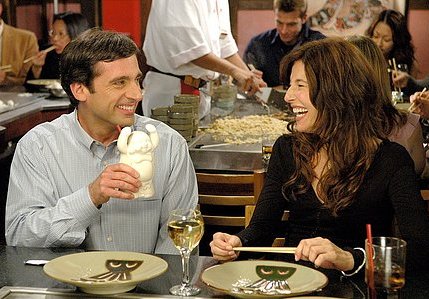
So the buddies—wonderfully-played by Seth Rogen as a guy with advice such as “date drunks,” Romany Malco as a ladies’ man who seems to know his way towards women, and Paul Rudd who can’t seem to get over a breakup with his previous girlfriend—decide to work on him. All three guys have major flaws in the ways of seducing women, and they have major problems of their own, but they truly believe that they know what to do. But their plan to fix Andy with somebody special—actually, that’s a lie; they want to set him up with anybody—does not go very well. They set Andy up with wrong women, including a drunken woman (Leslie Mann, Apatow’s wife) who drives Andy home, barely making it alive and hardly making it clean. (You’ll see.) But midway through the film, Andy meets Trish (Catherine Keener), a kind woman who runs a store across the street from the mall, where she takes your stuff and sells it on eBay. She’s about Andy’s age and is probably not a virgin, but she is attractive and kind. And they start to go out on dates…

This is where the serious side of the movie takes place. How Trish coaxes Andy into asking her on a date when Andy is afraid of looking silly is surprisingly charming and well-written. This sets up their relationship through the rest of the movie, which is handled so wonderfully you forget the movie is also a comedy until Andy or the friends screw up again. The relationship between these two is sincere and very beautiful.

Steve Carell is pitch perfect in this role. He has that balance between comic and sincerity. He makes Andy a lovable main character. And he’s joined by many wonderful supporting characters, including the buddies who have brilliant comic timing, and Paula (Jane Lynch), a tall, striking woman who is Andy’s boss and gives him a tip about the term “sex buddy”—I love the scene where she sings him a Guatemalan love song without even stammering. And Catherine Keener is always fantastic one movie after another—she’s one of the best character actresses ever. Her character likes this guy; we know she’s probably going to end his virginity, but she is also very understanding.

Also, the movie has some huge laughs. One sequence in particular shows Andy getting his incredibly hairy chest waxed. That scene is hilarious and the outcome of that scene is even funnier. And then there’s a Bollywood tribute involving the four guys that had me laughing out loud. There are many other scenes like that that made me laugh—I won’t name them all to make the review funnier. In a way, this movie works both ways (quite strange for a movie called “The 40-Year-Old Virgin”). It works well as both a comedy and a romance.

Now, at almost two hours’ running time, this movie does feel a bit too long—that’s one minor criticism to this otherwise sensational comedy/romance. Judd Apatow and Steve Carell must have tried everything they could to make us laugh and cry. They succeed with flying colors. Thanks to clever writing and superior acting, “The 40-Year-Old Virgin” is a great romantic comedy. With a title like that, who would’ve thought?