Archive | February, 2013

Harry Potter and the Prisoner of Azkaban (2004)

18 Feb

harry-potter-and-the-prisoner-of-azkaban

Smith’s Verdict: ***1/2

Reviewed by Tanner Smith

It seems like young wizard Harry Potter is heading straight into darker territory. I think he is cursed in the way of never having a quiet year at Hogwarts. He’s 13 years old and he has already searched for the sorcerer’s stone and discovered the Chamber of Secrets. And now, he is being pursued by a Prisoner of Azkaban. OK, enough with the bad title references. You get my point though—Harry Potter will go through four more years after this and he will never have a quiet year at Hogwarts. Let’s just hope he is able to survive so he can graduate Hogwarts School. To think he is the Boy Who Lived possibly leaping towards certain doom—wonder what is in store for him in his seventh and final year at Hogwarts…assuming he lives that long.

I’m making the third entry in the “Harry Potter” series—entitled “Harry Potter and the Prisoner of Azkaban”—sound too grim. Indeed, Hogwarts has become menacing and even more dangerous than before. But this is probably nothing compared to what may happen in the later installments.

Harry Potter (Daniel Radcliffe) has grown as a person—he is not the poor young boy living a miserable life with his hateful relatives. This time, he’s developed an edge to himself. This is proven in the opening scene, in which he is fed up with an overly unpleasant relative invited to dinner and casts a spell that blows her up like a balloon and floats her away. This would’ve been one of the cruelest things a young wizard can do…but it’s just so funny.

Harry runs away to meet his old friends in time to leave for Hogwarts (this is after a wonderful scene in which he boards a fast-speed wizard bus with a Cockney guide and a shrunken head for a navigator). He is reunited with the still-cheerful Ron Weasley (Rupert Grint) and still-bookish Hermione Granger (Emma Watson). But something is wrong this year—the sinister Sirius Black (Gary Oldman) has escaped from Azkaban Prison. Sirius is said to have betrayed Harry’s parents and was the cause of their murderous deaths by Lord Voldemort, the late Dark Lord who killed Harry’s parents and failed to do so with Harry as a baby (hence the scar, in case you forgot, which you probably haven’t). On the search for Sirius are a swarm of Dementors, which are hovering, life-sucking demons that pay Harry unfriendly visits from time to time.

This year at Hogwarts, there are new faculty members. One is Professor Lupin (David Thewlis), the newest teacher of the defense against the dark arts. Harry knows that Sirius will finish what he started and come after him, so he asks Lupin to train him to protect himself. But it’s not so easy. Then there is the addition of Professor Trelawney (Emma Thompson), a psychic teacher who believes the blackness in Harry’s tealeaves means death. Also, Hagrid (Robbie Coltrane) is promoted to teaching—he has a large feathered animal named Buckbeak, which is a Hippogriff. Harry is to ride the bird-beast to set an example, but pathetic Draco Malfoy (Tom Felton) is too much of a show-off. This is why the audience cheers when Hermione finally gives him a punch right square in the face. “That felt good,” she says to her friends after Malfoy runs away whimpering. What a wimp Malfoy is.

This time, Harry doesn’t go looking for trouble, but trouble always seems to find him, Ron, and Hermione. Once again, they are propelled on another journey within school grounds and are met with many terrific action sequences. They encounter a shape-shifting dog, a werewolf, and (my most favorite) a living tree that tries to crush anyone who comes near with its branches and limbs. That tree is a beyond-terrific computer effect—I don’t believe real trees can shake off leaves in the fall and snow in the winter (I love it when the snow hits the camera).

And then there is an enchanted map that shows where people are within every minute of every day inside the school—it can be brought to life when Harry summons, “I solemnly swear that I am up to no good” and turned into a regular piece of paper when he says, “Mischief managed.” Also, there is the final half of the film—not giving anything away, but it fiddles with time in ways we’ve always admired in time-travel movies. It works here as well.

But the important thing here is that Harry, Ron, and Hermione are not children anymore. They are teenagers. Their characters have grown, but so have Radcliffe, Grint, and Watson. In later installments, they will still be likable even when they are young adults ready for something bigger in the final chapter of the final entry. Radcliffe is still a likable young hero, Grint is still cheerful but comically nervous when it comes to terror, and Watson has a way of taking charge no matter what. Coltrane as Hagrid continues to be lovable, Emma Thompson is a delightful addition to the movie, David Thewlis is great as the new teacher with a secret, and Michael Gambon, filling in for the late Richard Harris as Dumbledore, has the convincing mysticism of bearded headmaster Dumbledore.

Hogwarts may have gotten darker, but it’s still wonderful. And you do want Harry, Ron, and Hermione to be there when Hogwarts is under terror again. The series is approaching something bigger than this. It’s only a matter of which movie it will start. “Harry Potter and the Prisoner of Azkaban” is not quite up there with the first two films, but it’s still a terrific adventure.

Phantasm (1979)

18 Feb

396119_317996628300224_1279472888_n

Smith’s Verdict: ***

Reviewed by Tanner Smith

“Phantasm” has just about the best piece of marketing you could ask for in a horror movie—it has the great tagline, “If this one doesn’t scare you…you’re already dead!” Well, there are a couple scenes in “Phantasm” that did scare me, but I think the exaggeratory marketing that comes in all movies (not just horror movies) is starting to wear thin.

All the more, “Phantasm” is a well-made, fun horror movie directed by Don Coscarelli, who was in his early 20s when he made it. When he was a freshman in college, he started out with a film called “Jim, the World’s Greatest,” unseen by many people, including me. But then a year later, he made a sweet little gem called “Kenny & Company,” unnoticed by most people in America, but a success in Japan. Then, Don Coscarelli directed, wrote, and produced “Phantasm” in a way that shows us that he loves horror movies and just wants to thrill us by capturing the imagination of the kid in all of us. This is an R-rated horror movie yet with the mind of a young teenager that is obviously the film’s target audience.

“Phantasm” has just about everything a fun horror movie could ask for—two or more scary scenes, a tall boogeyman of some sorts, dwarfish lurkers, a cheesy flying creature, a mortuary, mystery, a haunting musical score, a plucky kid we can root for, some interesting characters who stand by the kid, and more. But this film also has one of the most ingenious killing devices ever put in a horror film. It’s a flying silver ball that senses body heat and charges for its victims in mid-air. Then it hooks to the victim’s forehead, and then the drill comes out of it and drills right into the victim’s brain—blood from the victim spurts out from the back of the sphere.

The film’s hero is a thirteen-year-old boy named Mike (Michael Baldwin, “Kenny & Company”) who is worried that his older brother and guardian (their parents are dead) Jody (Bill Thornbury) will leave him so he follows him everywhere. One day, he follows his brother to a funeral for Jody’s friend, who has just been murdered. When Mike spies through the bushes, he notices that after everybody leaves, a mortician comes along and carries the coffin without even breaking a sweat. Mike knows that something very strange is going on at the mortuary and there is something definitely not right with the mortician.

This character is known as the Tall Man. Apparently he is from another planet and to his aid are three-foot dwarves, who we learn are reanimated dead bodies crushed to half-size. Why are they crushed to half-size? I’m not sure I fully understand. Anyway, Mike gets Jody and Jody’s friend Reggie (Reggie Bannister), an ice cream man, to believe him and they try to get to the bottom of this and solve the mystery of the Tall Man.

This sets in motion a series of scenes set in one night in which the trio find different clues and try to solve them. Along the way, they run into their share of scares. There’s a mysterious Lady in Lavender, who seduces men before killing them. There are those cloaked, hooded dwarves that attack (one of them even drives and chases them). There is a cheesy-looking fly-like creature that morphs from one of the Tall Man’s dismembered fingers (the Tall Man can grow them back). All of this is fun but the Tall Man’s menacing look and stance and walk is what gives me chills. There is one scene in particular where Mike has a dream that the Tall Man is standing right above his bed and that part scared me. And then there’s that raspy voice he has when he says things like, “I’ve been waiting for you” and “BOY!!!” Played by Angus Scrimm, the Tall Man of the greatest bogeymen ever put in a horror film and he has a great weapon along with him—that flying silver ball.

Scary and fun moments aside, there’s a really satisfying scene where Mike gets Jody to believe him about the Tall Man. He cuts off one of the Tall Man’s fingers, with yellow blood oozing from the wound. Mike takes the finger home and shows it to Jody. The finger is still wiggling and Jody simply says, “OK, I believe you.” I love that Jody is so quick to believe Mike after being shown that finger.

My complaint was how it all ended. The script plays with the audience so many times that when the film ends, it feels like a cop-out. I won’t give away the ending but I will say that it’s most disappointing. A weak payoff for a terrific setup. I can say, “See it but prepare to be disappointed.” I won’t have much of a problem saying that because the setup in “Phantasm” is most fun.

Star Trek IV: The Voyage Home (1986)

18 Feb

vs8

Smith’s Verdict: ***1/2

Reviewed by Tanner Smith

“Star Trek” has been known as ideal science fiction—it’s an intriguing, fun presentation of ideas and creativity when it’s not filled with action and visuals like the “Star Wars” movies. The “Star Trek” TV show, created by Gene Roddenberry, may have been silly in execution, but you can’t deny that there was effort to try and make it work. There were interesting concepts and fun characters to follow, even if the effects were pretty cheesy.

Then, the movies based on the series came about. The first movie—“Star Trek: The Motion Picture”—had some creativity put into it, but was mostly a dull attempt to become the next visual treat (complete with long effects shots of the ship moving into space…slowly). The second movie—“The Wrath of Khan”—was an improvement, bringing back the imagination, the terror and excitement of the subjected “trek,” and the same chemistry among the characters seen in the series. The Vulcan Spock sacrificed his life to save his friends on the U.S.S. Enterprise at the end of that movie, leaving an open door for the third movie—“The Search for Spock”—that brought Spock back to life, but after the others deal with those menacing alien species known as Klingons.

That brings us to the fourth movie “Star Trek IV: The Voyage Home,” which in my opinion is the most imaginative and most enjoyable in the series.

“The Voyage Home” takes place where “The Search of Spock” left off. Spock is brought back to life on the Vulcan planet and the rest of the crew have to repair a stolen Klingon ship (after the Enterprise was destroyed in the previous movie) to get back. But there isn’t going to be a welcome back, as they’re approaching a court martial for blowing up their ship and disrupting the “peace treaty.” Yeah, ‘cause Klingons are known for peace after blowing up whatever they don’t understand, but I digress.

Now, see if you can follow this. A space probe threatens to destroy the Earth by draining all of its oceans, unless its call is responded to. The Enterprise crew, on their way back home, receives a distress call from Earth and discovers what the call means. Unfortunately, the call comes from the sound of humpback whales, a species extinct in the 23rd century. They have a new mission—to travel back in time to the late 20th century and pick up some humpback whales to bring back to the future with them so they can answer the probe, thus saving Earth.

It’s fitting that “Star Trek IV: The Voyage Home” would be released the same year as “Crocodile Dundee”—both movies have a plot element known as the “fish-out-of-water” tale. In “Crocodile Dundee,” an Australian jungle guide was brought to venture New York City. In “Star Trek IV: The Voyage Home,” the Enterprise crew—Admiral James T. Kirk (William Shatner), Mr. Spock (Leonard Nimoy), Dr. Bones McCoy (Deforest Kelley), Uhura (Nichelle Nichols), Sulu (George Takei), Scotty (James Doohan), and Chekov (Walter Koenig)—are in the year 1986 to explore San Francisco, California. When you know who these characters are and become accustomed to them, it’s a lot of fun to see them in strange places. What stranger place for them to explore than…ours?

All of this is good fun. I imagine the writers of “The Voyage Home” must have decided to forget the stuff with the Klingons and the family history involving Kirk (his son died in the previous movie), and decided to have some fun with this series. There are some very funny bits using the fish-out-of-water formula—Sulu, the pilot of the Enterprise, is now flying a simple helicopter; Scotty, the computer expert on the Enterprise, is working simple systems and baffling a curious computer operator in the process; and Chekov…well, let’s just say a Russian in the Cold War era asking where he can find nuclear vessels (to power the ship they came in) is not in good taste.

The funniest bits involve Mr. Spock as an alien come down to Earth. He uses a headband to cover his pointed ears, so people just think he’s some weirdo. He uses his sleeper hold on a punk who has his boombox turned up too loud on a public bus. And he can’t pass off as human—he learns from Kirk that adding profanity in every other sentence is effective; Spock can’t pull it off. He also can’t tell lies, so there’s constant banter between him and Kirk, particularly when they’re asked if they like Italian food—“Yes.” “No.” “No.” “Yes.”

The crew finds a pair of humpback whales held in captivity. A marine biologist (played with great spunk by Catherine Hicks) plans to release the whales into the ocean. It’s Kirk and Spock’s job to find out when that will happen so they can set out to find them and beam them aboard their ship (there’s a special tank for them, in case you’re wondering). This means that Kirk must ask her out to dinner.

This entire portion of the Enterprise crew in 1986 San Francisco is the best part of the movie. The setup is typical and the final climax is the least interesting part of the movie. But when they’re in San Francisco, the movie is a good deal of fun. It’s not just entertaining because of the situations the characters get into, but also because since it’s the fourth movie, there was time to develop the relationship between the crew, after a whole TV series and three feature-length adventures. There’s a sense of easy interaction among these characters; they talk with each other, gently joke with each other, and seem comfortable with each other.

“Star Trek IV: The Voyage Home” is fun and imaginative without having to resort to a real villain or a lot of action (the sequence at the end is a pushover). Instead, it tells an intriguing story that allows the characters to breathe (with an interesting romance between Kirk and the marine biologist) and enlivens comic situations that could have been silly in the wrong hands. “Star Trek IV: The Voyage Home” is a fun voyage indeed.

WarGames (1983)

18 Feb

wargames-hacker

Smith’s Verdict: ****

Reviewed by Tanner Smith

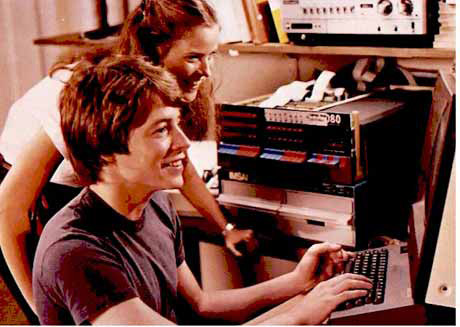
It’s a little tough to review “WarGames” without pointing out that this film is more like a time capsule from the 1980s. The technical aspects within the film’s story are really dated with how our computers worked back then, as opposed to the tremendous upgrades decades later. In fact, every year, our technology is growing more impressive, with new and expensive ways to advance our technology. We, as mankind, have gone pretty much to the point where we can’t progress without our computers, which is why many people were paranoid about the theory of Y2K.

But there is that fear that while our technology is advancing as time goes on, it could be getting to the point where it winds up destroying us. (Not that I believe it—how does technology expect to take over mankind if my cellphone keeps acting up on me?) That is why the story of 1983’s “WarGames,” still in the time of the Cold War, is still engaging and thrilling, even if its technical aspects have grown dated. It’s an entertaining film and an effective cautionary tale.

It opens brilliantly with a great teaser scene, in which a launch test brings about the tensions of being in charge of what could lead to a nuclear launch. The two men at the hand (played by Michael Madsen and John Spencer) don’t know that their current job is just a drill and they panic as they confront the possibility that they could be starting an international nuclear attack by order. It’s a brilliant scene—it sucks you in and keeps you on edge. However, the movie that follows doesn’t quite bring about what to expect from this opening.

Fortunately, “WarGames” gets on track as it leads to an action (as a reaction to the two men) that leads to the real story. And we’re already drawn in to see what’s coming next.

NORAD is relying more on computers for evaluating and preparing for nuclear attacks, so John McKittrick (Dabney Coleman) and a few other experts are called in to bring in a supercomputer named WOPR. It has a system that plays war games and strategizes appropriate responses to crises.

Enter our protagonist David Lightman (Matthew Broderick), a teenage computer hacker who can break into the school’s computer network from home and change his failing grades to passing grades. Along with his girlfriend Jennifer (Ally Sheedy), David is able to sneak into the WOPR system through a backdoor. David and Jennifer find some pretty interesting games in the computer and decide to play one particular war game called “Global Thermonuclear War.” But what they don’t know is that while playing this game, the computer is taking over NORAD and scaring the agents into nearly launching a strike.

McKittrick tracks down young David and forces into an interrogation. David’s story doesn’t sound convincing to him. McKittrick can’t believe that this high-school kid caused this chaos by himself and thinks he might be a spy. But David knows for sure that the computer is continuing to play the game on its own and force NORAD into launching DefCon1, resulting in Armageddon.

The tension that comes with the well-produced 1983 reality is outstanding. The idea that one little act from a high school kid has the possibility of an even bigger problem (for all of mankind, no less) is an uneasy one and “WarGames” handles it effectively, with a mix of intrigue and complexity. The film starts out fun, as David and Jennifer are playing with their computer before coming across all of this. It evolves into something more complex.

There’s also a fascinating sci-fi edge to it, as the computer is learning as it continues to play the game. David at one point asks the computer, “Is this a game or is it real?” The computer responds, “What’s the difference?” It’s thinking on procedural rules, not ethical ones. This leads to a tense climax in which David and the original creator of the machine, Dr. Falken (John Wood) must attempt to force it into learning that this game should not (or cannot) continue. And they have to do it before time runs out…

What also stands out in “WarGames” are the performances, particularly from Matthew Broderick, Ally Sheedy, Dabney Coleman, and John Wood. Broderick has a nice blend of cockiness and innocence that makes us sympathize with David. Sheedy is the kind of girlfriend teenage geeks hope for—cute, fun, and willing to listen to you talk about your computer skills. Coleman is sardonic but ethical as McKittrick, and Wood, showing up late in the movie, has an effective speech about natural selection.

That speech, by the way, is the setup for the climax. Dr. Falken makes that speech to David and Jennifer, after learning that they’ve played with his creation and is willing to accept his fate so that something else will rise after humans. David retorts by stating that it shouldn’t be this way if there’s a way to stop it.

The only thing I don’t like about the movie is the music score. With its overblown orchestral tune, it just sort of grows annoying. That aside, though, “WarGames” has a thrilling story with good acting and execution, and is a genuinely moving thriller. A lot of it may be dated, but it’s more of its time and can’t be complained about.

Amid Amor (Short Film) (2010)

18 Feb

mqdefault

Smith’s Verdict: ****

Reviewed by Tanner Smith

(Originally reviewed in Spring 2011)

“Amid Amor” is a most pleasant surprise. It’s a seven-minute short film made by teen-cousin filmmaking prodigies Andrew and Matthew McMurry for the 48 Hour Film Project in Little Rock, Arkansas. And I must say, it’s very impressive and surprisingly treasurable for a film with such a short length. This short film won the Audience B Award at the 48 Hour festival—it’s easy to see why.

Andrew and Matthew McMurry take unusual measures for this new project, compared to their other projects. For one thing, they don’t star in it—they have a unique screen presence in their previous work. For another, they have story help from Michael Scott, the filmmaker behind the “Scot Murray” film series (my guilty-pleasure films) on Vimeo. But some of their trademarks are present—the comedic effect of special effects (forgive that pun), the whimsical directing style, and the odd-but-charming storyline.

Michael Scott stars as Ben, who is actually Cupid. Yes, the Cupid. We see in an opening scene that he can shoot balls of light from his hands that cause a man and woman to fall in love—kind of a cheat, but hey it’s Cupid. Ben leads kind of a superhero life in the way he can’t tell anyone who he is or show his abilities. He’s also the person you’d least expect to be Cupid. He has no tutu, wings, or bow-and-arrow and he’s not the best-looking guy in town. But Michael Scott is a nice choice for the role. His personality and tone of voice would remind people of Barry White crossed with Bill Murray. In that way, he’s a perfect casting choice for Cupid—just a smooth-talking average Joe…who is anything but smooth.

Austin Blunk, star of the “Scot Murray” series, plays Ben’s best friend Geoff Cooke, a camp counselor who tells Ben about Camp Kettle (one of the 48 Hour requirements was to mention a camp counselor named Geoff Cooke). Ben and Geoff are sitting on a bench in the local park when a girl named Gina catches Ben’s eye—they both are reading John Grisham novels; nice touch. Ben is nervous talking to her—hey, just because Cupid can make people fall in love, that doesn’t make him a ladies’ man. So just this once, he tries to use his powers to make her fall in love with him. But the plan backfires and Gina instead falls in love with Geoff, so they spend a wonderful afternoon together while Ben can only watch.

And that’s not the end of the movie. I don’t know if you can believe that. I shouldn’t spoil the ending for you, but I will say that it has a good message—you can’t force love. It’s subtle and very sweet.

Austin Blunk isn’t given a lot to do in the acting department because he’s given very little screen time—well, what’d you expect when Cupid is the lead character in a seven-minute film? But given the circumstances, that’s amazing. Let me explain—as Scot Murray, Austin Blunk was the irrepressible, ruthless loudmouth who wouldn’t shut up. But here, he’s calm and relaxed. This is not the Austin Blunk I recognize.

Anyway, why is Gina worth it for Cupid to break his own rules? Because she’s played by Enji Wagster (credited as Angie Wagster), that’s why! She made this film on her day off from performing for my romantic-comedy-drama-fantasy, “Interior/Exterior.” That was the movie in which Enji played my character’s romantic interest, who was mainly a voice in my head until we saw how beautiful she was in a mirror in one scene. In this film “Amid Amor,” she has the same acting treatment as Austin Blunk, but hey, she’s beautiful and fun.

“Amid Amor” is solid proof—Andrew and Matthew McMurry are filmmakers. They have the equipment, they have the special effects (the balls of light that Cupid shoots out of his hands), they have the stories, and they have the direction. These are the guys responsible for two of my favorite short films, “9/19/2055” and “Dad vs. Boy” (both of which can be found on www.youtube.com/user/pinnaclepointstudios along with this one). “Amid Amor” is their best film and I will make room for it on my Best Films of 2010 list. I mean it; it’s that good.

Cotton County Boys (Short Film) (2011)

18 Feb

timthumb.php

Smith’s Verdict: ***1/2

Reviewed by Tanner Smith

One of the films I looked forward to seeing at the 5th Annual Little Rock Film Festival in early June 2011 was “Cotton County Boys,” Collin Buchanan’s senior thesis film for the UCA (University of Central Arkansas) Filmmaking Program. What drew my attention to it was its clever, 70s-retro-style 3-minute trailer and its cast, which included Levi Agee (film columnist for the Arkansas Democrat-Gazette), Lynnsee Provence (actor in “Shotgun Stories”), and Natalie Canerday (the mother from “Sling Blade”).

So on June 5th, 2011 in Little Rock, I saw “Cotton County Boys” (which is 30 minutes long) when it was screened with five other short comedies made in Arkansas. I was hoping to like it…and fortunately I did. This is an enjoyable short comedy with a lot of laughs and many moments when I had a smile on my face. It also has a heart—the film fit right into its LRFF category title, which was “Hijinks and Heart.”

The titular Cotton County Boys are three dim-witted but well-meaning Southern brothers who still live with their mother and spend most of their time messing around and shooting each other with 4th-of-July rockets. That’s actually how the movie opens—one of the brothers smells the morning air in a brief tender moment right before the others playfully shoot fireworks at him.

The conflict of the story is that the Cotton family needs to come up with $12,000 to save the family house from foreclosure (it was originally $11,000 until one of the brothers broke the process server’s car’s back window). So the brothers—Bobby (Terrell Case), Bo (Levi Agee, who also co-produced this film and is credited here as “Reuben Agee”), and Sammy (Lynnsee Provence) Cotton—decide to go job-hunting. Bobby finds a job at a fast-food restaurant, where he develops a crush on the attractive co-worker Hattie (Kelsie Louise Craig), and Bo and Sammy find a job painting birdhouses. (This is shown in a montage, which features cameos by Arkansas Democrat-Gazette film critic Philip Martin and Candyce Hinkle, who played the landlady in “True Grit.”) Soon enough, though, they get the idea to win the money by making their own funny home videos and sending them into their mother’s favorite TV show, which can be seen as a clone of “America’s Funniest Home Videos.”

This results in multiple shots to the crotch and other injuries. Now, as tired as I am of the comedic “shots to the crotch” cliché, it works here because a) they’re still funny here and b) they help serve the story. The sequences in which the boys film their own stunts using the family video camera are amusing, fun to watch, and actually about something. This could have been a formulaic romp about cardboard characters who simply run around nearly getting themselves killed. But no—director Collin Buchanan is very careful in making us empathize with the characters. They’re not completely idiotic—in fact, Bobby, Bo, and Sammy are smart in their own way. And everything they do is for the family. This is where part of the film’s heart comes into place. There are also some brief awkwardly-funny but somewhat-sweet moments between Bobby and Hattie, although their relationship could have gotten a little further before the emotional payoff at the end. Actually, this is what cost the film half-a-star. Maybe if the film were a little longer so it could have a few more moments with Bobby and Hattie, this would have gotten four stars instead of three-and-a-half.

But the true heart of “Cotton County Boys” lies within the relationship of the Cotton family. Terrell Case, Levi Agee, and Lynnsee Provence give good performances as these likable characters and have a nice rapport with each other, as well as with Natalie Canerday, who plays their mother. They add to the humor and heart of this endearing short film. But wait! What review of a movie with ridiculous stunts could resist the joke, “Don’t try this at home?”

Foot Soldier (Short Film) (2011)

18 Feb

Foot_Soldier2-1317227267

Smith’s Verdict: ****

Reviewed by Tanner Smith

Oh boy… how am I going to talk my way through this one? To tell the honest truth, it’s hard for me to explain why this unusual short film “Foot Soldier” works. It just sort of does. It’s weird with its odd little touches that move the story along, but it’s also exceedingly original and very well-executed.

Foot Soldier” is a Southern Gothic tale with cinematography that captures the essence of the backwoods of the South. It’s desolate, yet comforting and wistful. Making his way through a small town with that sense is a door-to-door Bible salesman named Emmitt (Dustin Alford, giving an excellent performance with a convincing blend of innocence, gullibility, and sorrow). Emmitt is apparently homeless, as he wakes up in an abandoned house and has very little money in his pocket. He lives by his belief in God and by his door-to-door sales.

Oh, and he also has this habit of stuffing the inside of his shoes with pebbles and gravel, so that he’ll endure the pain to continue with his faith, while attempting to continue his sales. But it’s after an uncomfortable encounter with a sleep-around (Natalie Canerday) that Emmitt starts to lose his faith and see things in a new, twisted way. But his next attempt at challenging his own faith leads to a new view on life.

I don’t want to give too much away, except that after that encounter, Foot Soldier features Emmitt as he makes a ill-advised choice and then finds himself in the company of…well, about the one who delivers helpful advice, you will either accept, laugh at, or (possibly) be offended. In fact, the entire second half of “Foot Soldier” had me questioning why it worked as well as it did, considering the choices being made. But I am praising it for its originality and its sense of humanity. When “Foot Soldier” was over, I found myself wishing to see more of this protagonist’s journey, and oddly enough, I found myself enjoying the little things in life a little more.

The Conversation (Short Film) (2011)

18 Feb

mqdefault

Smith’s Verdict: ***1/2

Reviewed by Tanner Smith

The Conversation features the chronicles of a blind hit man, although he constantly reminds the reporter that’s interviewing him that he’s not “blind,” but “visually impaired.” And yes, it turns out there is a difference. The hit man — Trench (well-played by Chad Bradford) — explains it to the reporter (Paige Reynolds, whose overly polite manner in this film makes me wonder if she can play a psychopath) in honest terms, and that most people don’t know it. They either say to him, “Oh you’re blind — let me help you” or “You can see — get it yourself.”

The Conversation tells Trench’s story in just ten minutes and it’s a nicely-done dark comedy about the ups and downs of being visually-impaired and a mercenary. Flashbacks are shown as a way of answering the reporter’s questions. Does he use his disability as an advantage? How do his relationships work out? What are his thoughts on the blind and music? Where does he have the most problems dealing with people? Does he hire a driver to drive him to his hits? Do people pick on him?

All of these questions are answered in a very funny way, with fresh writing displayed here. My favorite is how he responds to the question of where he has the most trouble—“Restaurants.” I wouldn’t dare give away how he reads the food menu. These jokes make you laugh, but they also make you think. Just about every question that’s answered in this movie—broadly or subtly—serves as credible accuracy.

The Conversation was written and directed by Leon Tidwell, who himself is visually impaired. My guess is he wanted to show that “blind” and “visually impaired” are totally different. In an interview with Arkansas Democrat-Gazette film columnist Levi Agee, he claims that the inspiration for The Conversation was his own experiences. He’s not a hit man, but he did have frustrations in finding work because of his disability—it comes across through the character of Trench in this film. The Conversation is a terrific short film (at ten minutes, it’s not too fast or too slow; it’s just right); I look forward to Leon Tidwell’s further work.

NOTE: The interview with Leon Tidwell by Levi Agee can be found here

Ballerina (Short Film) (2011)

18 Feb

film_June

Smith’s Verdict: ****

Reviewed by Tanner Smith

“What I’m about to tell you is hard to believe — I only ask that you hear me out.”

This is the start of a bizarre conversation between two men—one of which is telling the other something that is indeed hard to believe. What he’s about to say will shatter one’s vision of reality. That’s the setup for the short film Ballerina, which tells a story in an unusual way—just telling the story. The whole film’s running time of 16 minutes is centered around these two men—one talks, the other listens and reacts. It works because it’s acted with such conviction and credibility, and filmed with a disturbing mood to sink us in, that I found myself (risking a little embarrassment here) mouthing the word “Wow.”

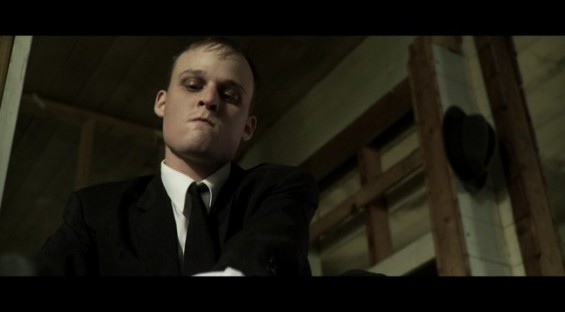
Presented in black-and-white, we see a man named Frank Gross (Dean Denton) sitting in his living room on a quiet afternoon, reading a book as his young daughter Katie (Weslee Denton) draws pictures. It seems like a quiet, normal day until the doorbell rings. Frank answers the door; a man in a suit—Dr. David Sinclair (Ed Lowry)—stands outside, asking for a moment of Frank’s time. What is this about, Frank asks. “What I’m about to tell you is hard to believe—I only ask that you hear me out.” Sinclair starts by performing a few parlor tricks, but are they really tricks? (“I’m bad at that sort of thing,” he explains.) For example, he tells Frank to pick up the book he was reading and pick two numbers between 1 and 20. He does, and then states what word is on what line and order with those same numbers! He then proceeds to state the family history, including Frank’s current job and his deceased wife. At this point, you’re wondering what is going on here, who this strange person is, why he’s here, what he’s going to say next, etc. What follows is quite unusual, very odd, and just so intriguing. Watching this film, you can either be very invested, very disturbed, or both.

How do I explain just how powerful Ballerina is without going into too much detail about the further-developed plot points, especially in a short film? Even though most of you reading this review have seen the film online by now, I stick to methods of reviewing.

Sinclair’s words dig deeper and deeper into the strangeness, and the fear he delivers to Frank is legitimate. Frank doesn’t want to believe what he’s hearing, but Sinclair sounds so convincing that neither he, nor we, can argue. Even when Frank is about to snap and say he’s wrong, he still isn’t so sure. And when he’s finally convinced, he knows that there’s no turning back from this. As the film progresses, you can really feel the uneasiness that is existent throughout. A lot of credit for that has to go to the cinematography (by Dave Calhoun) that actually manages to turn a living room into an effectively unpleasant setting; the screenplay (by David Koon, of The Bloodstone Diaries) for taking a intriguing, unique science-fiction story and mixing it with realism, making it all plausible (keeping it in this one familiar living-room area, the casual introductory talk before Frank and Sinclair begin their central talk, how Frank reacts to certain elements, etc.) and making for a great script; the director Bryan Stafford (cinematographer for the wonderful Gerry Bruno short Seven Soulsand Juli Jackson’s upcoming feature 45 RPM) for managing to get the most out of what little space there is to work with. And of course, credit must also be given to the two lead actors Ed Lowry and Dean Denton, who both deliver excellent work. Lowry has the most difficult role, being the one who has to deliver this speech about what will occur if a certain choice is or isn’t made. He pulls it off with chilling success.

Ballerina is so strange, so disturbing, and yet so effective that I’ll even go as far as saying it reminded me of the best “Twilight Zone” episodes. It’s a tense, intelligent short film that tells a gripping story, shows that any location (whether common or beyond) can be used to create a unique setting, is exceptionally well-made, and keeps us invested the whole time.

You can watch the film here: https://vimeo.com/34816825

The Bloodstone Diaries: Sleeper – The Bloodstone Diaries: The Thief of All Things

17 Feb

bloodstone-katysmall

Smith’s Verdict: ***

Reviewed by Tanner Smith

The Bloodstone Diaries: Sleeper, as I’ve heard, is the start of a possible Internet series, and right away, I want to state my gratitude for a web series with quality production. It also works nicely on the big screen, where is how I first saw it at the Ozark Foothills Filmfest in the spring of 2011. There’s a real professional look to the film, which would make it somewhat of a disappointment that this introduction to The Bloodstone Diaries is merely good, when it could have been great.

What I mean by that is that the story seems complex—that is, the tidbits we get from the story—for a ten-minute short film that leaves many holds barred and stops rather than ends. I’m guessing it’s setting up for the next entry in the series, but I think I’d be more satisfied if there was more closure to this one. I wanted more, which shows how interested I was in the dilemma that’s been set up. Luckily, I think I’ll get more when the next entry to this series is released, either on the screen at film festivals, or online.

The film starts with an opening-credit sequence—the credits are played over a black screen in an old-school fashion, but we get our introduction to our heroine Bettie Lawrence (Katy Allen, wife of “American Idol” Kris Allen) from the audio of a telephone call. She warns a mysterious man, whom she’s apparently tangled with in the past, that she has learned how to use a magic jewel called the Bloodstone and that it wouldn’t be wise to look for her (anymore). That’s it—that’s the introductory exposition we get. It’s very smart writing. A mysterious phone conversation during the opening credits is all we needed to set this up…all in 30 seconds, too!

When we see Bettie in person, she seems like a nice all-American girl with nothing particularly special about her, making her a credible heroine once we realize that the Government is hunting her because she gains possession of the jewel, which is what they want. They’ve killed her husband Sam, who tried to protect it in the past (at least I think that’s why they killed him—it’s never quite explained), and now she wants revenge. When they find her, she’ll be ready.

This setup is very intriguing—the mystery is there, the story sounds very interesting, the acting from Katy Allen is convincing, and the drama is legit. But that’s only the first six minutes out of a ten-minute film. The final three minutes (not including the end credits, taking the last minute of course) is just a showdown with the bad guys—the Men in Black—who arrive at her home and try to overtake her. As she escapes, she uses the Bloodstone to fight them. And because this climax is so short, there isn’t much room or time for either atmosphere or clarity in exactly what this Bloodstone is capable of. I guess it allows the holder of the stone to possess mind power (Bettie’s able to move a refrigerator without touching it), but what are we supposed to take from all of this? I guess Bettie will keep running and somehow on her quest, she’ll finally have her revenge. While this climax is admittedly well-shot and does have its brief moments, it’s too short and doesn’t take advantage of what should have been a dramatic payoff.

I would like to see “part two” to see where this is going to go. But I would particularly like to see an origin story. How did this young woman get involved in this craziness with the Bloodstone anyway? That would be a very interesting story arc.

You can watch this film here: http://www.youtube.com/watch?v=zl0Kx4jBg4I

————————————————————————————————————————-

bettie-and-sam

Smith’s Verdict: ***

Reviewed by Tanner Smith

The Bloodstone Diaries: The Thief of All Things is what I’ve been waiting for since I first watched its predecessor, The Bloodstone Diaries: SleeperThe Bloodstone Diaries is a supposed web series (I use the term “supposed” since it’s apparently screening at film festivals before hitting the Internet) that mixes fantasy with action. It’s about a young woman who possesses an ancient, magic jewel known as the Bloodstone and seeks revenge on those who killed her husband; these same people also seek her to possess the jewel themselves. Sleeper was a welcome beginning that left me wanting more. And I got more from The Thief of All Things, which is actually a prequel instead of a sequel. It shows the events leading up to most of what occurs in Sleeper.

We see the origins of Bettie Lawrence (Katy Allen), the heroine of the series. She lives in a homeless camp by the railroad tracks with her husband Sam (Ian Moore). Bettie is a standoffish, hostile person who doesn’t let anything get in her way (including the local reverend who preaches to most of the homeless) and is the one who goes into town to steal valuables from people’s cars, while Sam lives mainly by faith. Sam’s friend Anthony Pace (C. Tucker Steinmetz) lives the same way, as well as a belief in destiny. That’s why when he mentions the Bloodstone, said to be a jewel mostly formed of Jesus’ blood, Sam can’t help but be interested.

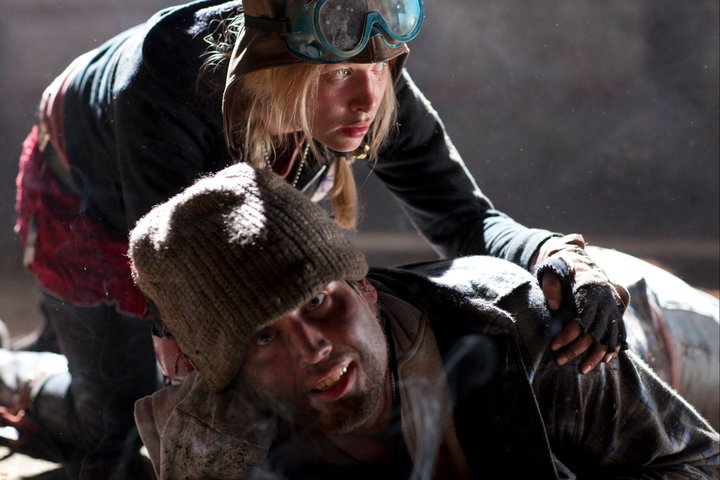
By the way, one of my favorite moments is when Sam researches the Bloodstone. How does Sam find out more about the Bloodstone? Wikipedia, of course! (Duh!) But it turns out that searching online for something mystical and said to be mythical gains the attention of the government. The next day, several men in black reach the homeless camp to hunt down Anthony and Sam, with Bettie in tow. But Anthony has a few tricks up his sleeve…

The central chase scene is well-executed and feels very intense. The special effects are seamless—there’s one slow-motion scene involving Anthony using the power of the Bloodstone to stop a pursuing car by making it float into the air, and it’s done so greatly that I wonder if Andrew McMurry of YouTube’s AndrewMFilms, with his After Effects skills, would be able to pull that off. There was a real quality put into this production, and the filmmakers obviously went all out to make this an exciting experience. For the most part, they succeed.

And it is nice to see the original owner of the Bloodstone, as well as the lives of Bettie and Sam before the events of Sleeper.

There are a few problems I have with the movie, though. For one thing, I can’t quite believe that the Bloodstone has been protected for centuries, one protector after the other. First of all, have the people before these men in black really had no avail whatsoever? And if they didn’t, wouldn’t they have just given up the search after seeing what the power of the Bloodstone can do? Other little weaknesses are the lame subtitles that appear over each new location—one of them being, “miles from nowhere” — and the unnecessary opening dream sequence that shows Bettie losing a fatally wounded Sam, obviously foreshadowing a future event.

It came as no surprise that both Sam and Anthony are dead by the end of The Thief of All Things, because of course, Bettie must be the new lone protector of the Bloodstone. But somehow, the ending of this film never really hit the right notes. It ended a little too quickly, and I could have used a little more development for Bettie, whose question of faith and sudden new responsibility have been set up for an emotional payoff that just isn’t there. Best we get is a deadly stare in Bettie’s eyes that closes the movie—To Be Continued to be sure; only the question is, to be continued in Sleeper or another story before or after Sleeper? Guess I’ll have to find out later.