Archive | February, 2013

Harry Potter and the Order of the Phoenix (2007)

20 Feb

order_phoenix_dvd_1211

Smith’s Verdict: ***

Reviewed by Tanner Smith

“Harry Potter and the Order of the Phoenix” is the fifth film in the “Harry Potter” series. It is also my least favorite in the franchise. That’s not to say I didn’t enjoy it. I am giving it three stars. But with a new Harry Potter film, you expect more than this.

“Harry Potter and the Order of the Phoenix” begins as now-15-year-old Harry Potter (Daniel Radcliffe) is sitting by himself on a swing set in a playground. He feels—as we do—that opportunities for nicer, more innocent times are gone. It’s especially so when Lord Voldemort (Ralph Fiennes) is back and looking to make himself known to Hogwarts’ world again. Nobody believes Harry saw him rise and even fought him at the end of “Harry Potter and the Goblet of Fire,” except Dumbledore (Richard Gambon). A minor problem with this film is that it can’t possibly stand on its own. There are two many references to past events—this is not a good film to start with if you’re a newcomer to the series. But that’s not exactly a problem, since this is made for regular viewers of the “Harry Potter” series.

Harry is in trouble for saving his cousin Dudley from a vicious Dementor using a Patronus spell. You see, it’s against the law to use magic outside of Hogwarts School. Harry is called to the Ministry of Magic for a hearing to see if he should be allowed to go back to Hogwarts for his fifth year. Things don’t go so well at first because most of the jury still doesn’t believe him or Dumbledore about Voldemort’s return to life. But nevertheless, Harry wins appeal from most of the jury and is allowed to return to Hogwarts.

But Voldemort is back and Harry learns that the battle lines are drawn. There is a defense group known as the Order of the Phoenix while Voldemort raises his army of Death Eaters. Harry wants to fight, but the Order won’t allow him since he’s “just a boy.” At Hogwarts, things go really bad due to the arrival of Delores Umbridge (Imelda Staunton), sent from the Ministry of Magic to put an end to this “conspiracy” and keep all students in line. She seems sweet, but she is a total nightmare that eventually costs Dumbledore his job. Then she sets her sights on Harry, who in the meantime, is gathering his own army with his friends. Harry teaches many of his friends to improve on spells to defend themselves against the dark arts, since Umbridge won’t allow them to be taught in class anymore.

Harry is still growing as a character. He even has his first kiss with the attractive Cho (Katie Leung). “How was it,” his friend asks. “Wet.” It’s not much, but it shows that these characters are more than young wizards—they’re teenagers.

The problems I had with “Harry Potter and the Order of the Phoenix” are mild, but they stop me from giving a rating higher than three stars. One is, Harry’s best friends Ron and Hermione (Rupert Grint and Emma Watson) are more like bystanders this time around—they aren’t given anything special to do, save for a few short scenes of humor. And it’s annoying when Hermione is correcting Harry for something he knows is right. That’s where young Luna Lovegood (Evanna Lynch) comes in. Another problem I had—I’m sorry, but I didn’t like Luna Lovegood. It’s a one-note-loony role that just plain annoyed me.

Also, there are many moments in the story that just felt rushed, which is odd considering the running-time length. Though, to the film’s credit, the brisk pacing is welcome.

But, in the new installments, we’ll get the unforced feel of unity with Harry, Ron, and Hermione that we should have gotten since four movies have already passed by. I don’t want them to be stooped to artificiality.

But I did like Daniel Radcliffe as Harry Potter, as I always do. Alan Rickman has more creepy moments as Professor Snape—even creepier than Fiennes’ Voldemort. I love the performance from Imelda Staunton as Umbridge, bringing menace and sweetness to the role. And I love the final half in which Harry and his friends (including the nervous Neville Longbottom from earlier films) fight against Death Eaters (including feisty, deadly Bellatrix Lestrange, played by Helena Bonham Carter) and the brief mental battle between Harry and Voldemort which shows more emotion than you’d expect. I am recommending “Harry Potter and the Order of the Phoenix,” but I have to say, I wanted more magic.

Castle in the Sky (2005)

20 Feb

snapshot20091223030317

Smith’s Verdict: ****

Reviewed by Tanner Smith

“Castle in the Sky” is an animated family film made by the sensational style of Studio Ghibli and written, directed, and supervised by Japanese animator Hayao Miyazaki. Miyazaki is responsible for great animated films such as “Princess Mononoke” and “Kiki’s Delivery Service.” “Castle in the Sky” is among his best work. It’s ingenious, exciting, and a truly fine action-adventure.

The best thing about “Castle in the Sky” is how it continues its storytelling with many twists and turns. We get from one place to another, to another, to another, and it’s all linked together so that we aren’t wondering if it could’ve gone different ways. It begins on an airship, where a girl named Sheeta (voiced for US dubbing by Anna Paquin) is being held by a man named Muska (Mark Hamill). A gang of air pirates (complete with their own personal small jets) invades the ship, seeking the crystal that Sheeta wears around her neck. Sheeta tries to hide from the pirates by hanging out a window, but she slips and falls to the ground. But a miracle occurs—because of the crystal, she falls incredibly slowly so that a boy in the village down below can catch her with ease.

The boy is named Pazu (James Van Der Beek). He’s an adventurous young man who hopes one day to save his late father’s good name by finding Laputa, a floating island said to be hidden by a thunderstorm, which his father claims to have seen. People called him crazy; Pazu wants to prove that he was right. Pazu and Sheeta befriend each other and Pazu tells Sheeta about his dream to find Laputa, which it seems has a connection with Sheeta’s crystal.

In a well-drawn, riveting action sequence, the air pirates invade the village and chase after Sheeta and Pazu on the nearby railroad tracks. You can feel the intensity coming through the screen as the chase continues. By this point, we are sucked into the story and intrigued by the execution—the animation is excellent; full of color and life.

The rest of the story is the adventures that these kids have—facing Muska who turns out to be a government agent working with the Army; encountering the air pirates and later befriending them (the bumbling pirates, led by their anxious, fed-up mother, gamely voiced by Cloris Leachman, provide most of the film’s comedy); and of course finally reaching Laputa itself and engaging in a battle over it. What do they find when they finally get there? I shouldn’t say. One of the pleasures I had with this film was that I didn’t know what was going to happen, or what I was going to find. But I can say that I wasn’t let down by the outcome. I can think of many adventure movies that run out of steam before their final act, but not “Castle in the Sky.” This is an engaging, imaginative, vigorous action-adventure from beginning to end. Indiana Jones would have been proud of these two adventurous young characters.

Old Yeller (1957)

20 Feb

Old-Yeller-pics-old-yeller-30507787-500-353

Smith’s Verdict: ***1/2

Reviewed by Tanner Smith

Walt Disney’s “Old Yeller” is not merely a movie about the friendship between a boy and his dog. While that is a basic element in the movie, there’s more to it than that. It’s a movie in which a boy takes charge and becomes a man, even if it means to endure upsetting hardships.

“Old Yeller” takes place shortly after the Civil War, centered around the Coates family on a small Texas farm. While the man of the house, Jim (Fess Parker), sets off on a cattle drive for the summer in hopes of bringing back money to support the family, his oldest son Travis (Tommy Kirk) is left to take charge, in exchange for a riding horse—“You act a man’s part, and I’ll bring you a man’s horse,” his father promises. (Although he argues what the boy needs worse is a good dog.) Travis helps his mother Katie (Dorothy McGuire) on the farm and looks after his rambunctious little brother Arliss (Kevin Corcoran), who does nothing except play in the outdoors.

A stray “yeller” (yellow) dog causes some trouble on the farm. While Travis takes a disliking towards “Old Yeller,” Katie and Arliss welcome the canine into the family. But soon enough, Yeller proves to be brave and special to have around after protecting Arliss from a bear, and standing up to whatever other animal that becomes a nuisance. Travis grows to become closer to the dog than he would have imagined.

“Old Yeller” is somewhat episodic—it features the setup in which the father tells his oldest son to take responsibility; the central story in which the family gets the dog and learns that he can be very useful and extremely loyal; and the heart wrenching final act in which everything pays off. This is an effective coming-of-age story centered around this young boy who becomes a man by taking responsibility and having to deal with great loss. It’s no secret that by the time Papa comes home, Old Yeller will have died and Travis will have to learn to move on. He gets some encouraging words from his father—it’s a very strong moment when the father tells Travis, “You can’t afford to waste the good part frettin’ about the bad. That makes it all bad.”

The scene in which Old Yeller must die is one of the most heartbreaking dog-death I’ve seen in a movie of this sort, if not the most heartbreaking. Travis already had to deal with shooting two animals that were sick with rabies—the family cow and an attacking wolf. But Yeller has been infected by the sickness by fighting off the wolf, and Katie knows that eventually Yeller will become mad and endanger the family. Travis can’t face shooting him, and so he keeps him locked up in a wooden shed to wait about a month. Eventually, he sees the awful truth. The dog that was his best friend is now gone and Travis has to perform the unpleasant task of ending his suffering. The reason this is so tragic is because Travis, now learning to become a man, has to face the ultimate responsibility, and also because we as an audience have grown to love Yeller and appreciate his and Travis’ friendship. How can you not whimper when Travis hesitates to go through with it, before ultimately doing it?

Though, for me, it started in the scene in which Travis looks into the shed and sees a completely different Yeller. I know it was supposed to happen, but I was almost as shocked and dismayed as Travis was.

But “Old Yeller” isn’t entirely a downer. The scenes featuring the family and the dog are adventurous, good-natured fun, as Yeller stands up to a stampeding mother cow and aids Travis in marking wild hogs. And there is time for humor, particularly with the occasional visits by two neighbors, Bud Searcy (Jeff York) and his daughter Elizabeth (Beverly Washburn). Searcy is the most unreliable man to ever come across. He’s a lazy bum who does nothing but eat and talk. What’s funny about him is how he says he’s left to take charge of the womenfolk and the “young’ens,” even though he constantly has Elizabeth do everything for him. For example, Katie asks Travis to pick corn for dinner, and Searcy assures her that it’s a two-man job. Pause. “Elizabeth, go along with Travis.” Hilariously lazy.

The cast members deliver first-rate performances (with one exception, but I’ll get to that). Dorothy McGuire is completely convincing and brings warmth to her role as the mother. Fess Parker has a small role, showing up at the beginning and the end, but he makes the most of it and delivers the aforementioned (memorable) speech. Jeff York is a delight, Beverly Washburn is fine as Elizabeth, and Chuck Connors has a nice brief role as a friendly passerby who gives Travis some helpful advice. But the biggest roles go to Tommy Kirk, Kevin Corcoran, and of course Spike the dog. Well first, let’s get the dog out of the way (please don’t read that the wrong way). Specially trained to perform the task of stealing scenes as the title character, Spike is completely charming. Tommy Kirk is perfectly believable as Travis, managing to create the transformation from boy to man flawlessly. But the “one exception” I mentioned earlier is Kevin Corcoran as the kid brother Arliss. I don’t say this because he isn’t convincing as a rowdy, excitable little boy, but because he is incredibly annoying. His constant screaming and yelling of every single one of his lines makes him immediately unlikable. I never really liked this little brat in most of the Disney movies he appeared in since then.

But even with Corcoran’s obnoxious performance, you can’t fault the true gem that “Old Yeller” is. It’s a neat frontier-fun movie as well as a very touching coming-of-age story. It’s sincere, good-natured, and delivers some convincing, emotionally-involving drama. It’s far from simple as some think it is. It’s a well-put-together family film with good acting and memorable scenes.

Light of Day (1987)

20 Feb

images

Smith’s Verdict: ***1/2

Reviewed by Tanner Smith

Admittedly, I thought that “Light of Day” was going to be a rock-n-roll fable about an aspiring rock band hoping to make it big. Seeing that rocker Joan Jett was one of the leads, and that the title “Light of Day” refers to her featured song (co-written by Bruce Springsteen), can you really blame me?

While that would have been an interesting film to see, and I think it would have, “Light of Day” is more than I expected. It features rock music and a rock band led by a character played by Joan Jett, but it’s really a serious drama in which problems are introduced and handled, and music seems to be the best way for the characters to compensate for them. It’s a quite effective movie, with great acting and intelligent writing.

Jett plays Patti Resnick, a rebellious young woman who sings for a rock band every night. In the meantime, her life means nothing to her. Only two things matter most to her—rock-n-roll and her six-year-old son Benji (Billy O’Sullivan). But because of her love for the music, her home is not a very healthy environment for Benji, who was born out of wedlock.

Patti and her mother (Gena Rowlands) haven’t been on good terms for a long time. The mother is a Christian woman who doesn’t approve of her daughter’s lifestyle. She resents Patti, while trying not to show it. But it comes through in the more subtle ways, such as an early scene where we’re introduced to this wedge between mother and daughter. It’s a scene in which Patti, due to the wishes of her brother Joel (Michael J. Fox) who wants to make peace between the two, goes to her mother’s birthday dinner and the situation has already been somewhat uneasy for the family, and the mother says grace at the table as her prayer slowly but surely becomes something more specific—she asks God to forgive her daughter.

Patti storms out and we see the tension that’s always present between the members of the family. The mother resents Patti’s behavior and lifestyle and is especially resentful of Patti having a child out of wedlock (though she does love the child). Patti is obsessed with rock-n-roll, but has a lot of anger that she takes out on the stage. She also finds herself wondering how her life would’ve turned out if she had had an abortion. This is one of the strongest scenes in the movie—Benji has been taken away to live with Patti’s mother for his own good, and Patti tells Joel, “You know, I could’ve had an abortion and Mom would’ve never found out.” Pause. Then she wonders what would’ve happened with her music career if she had—“I’m a good singer.” But then she states that she just wants to hit herself for thinking that way, because she does love her son.

Joel, who also performs in the band and works in a factory during the day, is the reactor to these expressed feelings (some straightforward, some subtle) by his mother and his sister. He tries to make peace between the two, but it’s not easy. He doesn’t want to risk hurting the people he loves, but he can’t really help them much either. And then Joel becomes more of a father than an uncle to little Benji, because of how he always has to make sure that he’s given proper care. He even objects to defiant Patti taking the kid on the band tour—cheap motel rooms, free beer—but Patti won’t listen. This is also quietly tragic in that Joel used to idolize Patti’s spirit.

How about the father (Jason Miller)? He’s a wimp, basically. He stands by while everyone else goes about their problems and feels it’s best not to be involved. (In the dinner scene, he stays on the couch in the living room before dinner is served, so that he doesn’t start anything beforehand.) He’s a sensitive man who should be the peacemaker in the family, but alas, it’s his son that is doing the job for him. He’s in the background quite a lot in this movie until later when he gives an insightful speech about what is going on with this family.

The family aspects are very well-handled by writer/director Paul Schrader. He effectively tells a story about a family that has fallen apart, but maybe could have a chance of reconcilement. Rock-n-roll music may be a good element in compensation for these issues, but the family elements are the backbone of the story. Things get more serious and more effective with the news that the mother is very ill with cancer and most likely not going to make it. This provides the payoff between her and Patti, with strong, effectively done bedside scenes between the two.

The acting is across-the-board solid. Michael J. Fox is very good as the quiet reactor to most of these situations and it’s heartbreaking to know he’s doing what he can, but can’t do enough. Despite given top billing in the credits, however, he isn’t the lead. That notion belongs to Joan Jett, who makes an excellent acting debut. Jett brings to her performance a great deal of depth and weight, and completely sells the film’s stronger scenes, including that scene I mentioned about the abortion, and especially the bedside scene involving her mother. This scene means everything to the film and the superb performances by her and Gena Rowlands, as the mother. This is the payoff in which the two set aside their differences and have a real talk about what has happened in their lives. This is the best scene in the movie—it’s heartbreaking, excellently-acted, well-handled, and downright effective.

There’s something else I should bring up, since there is quite a lot of rock music in “Light of Day.” The soundtrack—Patti and Joel’s band, in particular—is pretty memorable. (The title song Light of Day” is a pretty good song.)

“Light of Day” is a well-acted, well-made movie that would probably satisfy those who appreciate well-crafted family dramas, such as “Terms of Endearment” which people would probably think of. Who wouldn’t like it? Probably those who thought this was just a movie about a rock band. To be clear, “Light of Day” is a lot more than that. It was a pleasant surprise for me.

Wayne’s World (1992)

20 Feb

images

Smith’s Verdict: ****

Reviewed by Tanner Smith

Is it possible to give a movie like “Wayne’s World” a four-star rating? In my case, it is. It’s a comedy based on the Saturday Night Live sketch “Wayne’s World” featuring Mike Myers and Dana Carvey. The sketches are funny, but strangely, the movie might actually be funnier. I can watch this movie several times and still be able to laugh and smile at it. That’s a sign of a great comedy. So in that case, I am giving four stars to “Wayne’s World” and am proud of it.

Just consider this a more personal review.

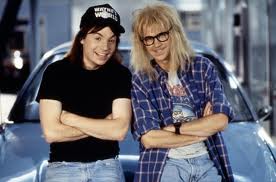
Wayne Campbell (Mike Myers) and Garth Algar (Dana Carvey) are two 20something party dudes who have their own cable access show in the basement of Wayne’s parents’ house…where Wayne still lives. On the show they usually talk about babes, guitars, and weird stuff, like the invention of a vacuum cleaner that also cuts people’s hair. The SNL sketch was always a recording of their show; the movie stretches it further than that (it has to, doesn’t it?) to show Wayne and Garth hanging out with their friends and going on a night on the town, seeking local parties.

The plot is admittedly predictable. An ad executive named Benjamin (played with inspired casting by Rob Lowe) and his producer, Russell (Kurt Fuller, very funny in a deadpan way), want to use their show to sell it to a client (Brian Doyle-Murray) who owns a video arcade chain. Benjamin offers Wayne and Garth a lot of money for doing the show, while having the client sponsor the show and clean it up a little. Things get complicated when Benjamin begins hitting on Wayne’s new girlfriend—an Asian rock singer named Cassandra (Tia Carrere). When it seems like things are going wrong for Wayne and Garth, can they be right again?

“Wayne’s World” is in the same spirit of movies like “Bill and Ted” and “Pee-Wee’s Big Adventure”—anything can happen just to get a laugh, and I mean anything. We have the guys singing along loudly to Queen’s “Bohemian Rhapsody,” we have breaking-the-fourth-wall jokes, we have the subtitle “gratuitous sex scene” when it looks like Wayne and Cassandra are about to…you know (the movie is PG-13 so no actual sex is shown on camera), we have the subtitle “Oscar clip” when Wayne makes his version of a sad speech (“I never learned to read!”), and more funny jokes. The funniest bit is a satire on product placement—in one scene, six products are brought in to get their plugs (the sequence begins when Wayne holds up a slice of Pizza Hut pizza, with the logo shown on the pizza box, and says, “Contract or no, I will not bow to any sponsor”) and it’s only that one scene where that happens. It doesn’t happen anywhere else in the entire movie.

Wayne and Garth are both likable and very funny. Mike Myers plays Wayne as a Bill Murray type of smart aleck, with a touch of Woody Allen as he addresses the camera frequently. Dana Carvey plays Garth as a paranoid technogeek whose brain may have been fried by partying too much. This makes him an awkward person to be around, unless you know him very well, like Wayne does. I love the scenes in which they hang out together—they have too much time on their hands and when they’re not partying or doing their show, they play hockey in the neighborhood street (they move the net when a car is coming) and park outside of an air field so that they can sit on the hood of their car and anticipate the noise of the oncoming airplane above. You don’t expect scenes like these in a movie like this. They have a real whimsy to them. I suppose that’s what makes it more intelligent than “Bill and Ted” or “Pee-Wee’s Big Adventure.”

Even if the plot is predictable, the jokes sure aren’t, and you’ll most likely enjoy “Wayne’s World” for its good nature, likable and funny characters. I love this movie, it’s hilarious, and I have no regrets in giving it four stars.

Harry Potter and the Goblet of Fire (2005)

19 Feb

images

Smith’s Verdict: ***1/2

Reviewed by Tanner Smith

Harry Potter may still be wide-eyed to every new magic element he observes around him, but he has gotten used to a lot of Hogwarts activity. He joins in with his friend Ron and his brothers as they chant for their favorite seeker in the famous Quidditch team (as we learn, Quidditch is a wizard-national sporting event now not just confined to Hogwarts) or when he’s learned almost every spell he can use with his wand. At age 14, he’s almost gotten used to Hogwarts School, but nothing can prepare him for what he has to encounter in the fourth “Harry Potter” film, entitled “Harry Potter and the Goblet of Fire.”

Not only is he for some unknown reason (unknown until the end of the film, anyway) chosen for the extremely dangerous Tri Wizard Tournament, but he later discovers that Lord Voldemort is on the rise. Even scarier, especially for a 14-year-old, is working up the courage to ask a girl to the Yule Ball.

It seems as though the “Harry Potter” series is getting darker and darker with each new installment. It really makes me wonder what will be in store for us in the final installment. This film ends with a setup to something even bigger. It also includes the line near the end muttered by Dumbledore, “Dark and difficult times lie ahead, Harry.” The foreshadowing is terrific.

But way before that, Harry (Daniel Radcliffe) and his best friends Ron and Hermione (Rupert Grint and Emma Watson) are in their fourth year at Hogwarts School of Witchcraft and Wizardry with only three years to go after this. Things are changing, for sure. Harry is having nightmares of Lord Voldemort (Ralph Fiennes) returning after many, many years; Ron is more nervous than usual; and Hermione is becoming a beautiful young woman (though still the intelligent bookworm). This year, there is a Tri Wizard Tournament to be held at Hogwarts, in which champion wizards from different schools (and different countries, I might add) compete for victory. Their names are drawn from the enchanted Goblet of Fire which chooses the winners to compete in the tournament. One is a tough-looking Quidditch seeker, another is a nice guy, and the other is a beauty queen—they are all 17 years old, which is a requirement for this tournament. But something weird is happening—Harry Potter’s name is drawn from the Goblet of Fire. He’s only 14 and he didn’t put his name in the goblet, but there’s nothing he can do about it.

So now he’s fighting for his life in this tournament—he fights a fire-breathing dragon, he must stay underwater for an hour to retrieve something from vicious (and ugly) merpeople, and go through a treacherous hedge maze that Jack Nicholson would have lost his mind in. He also befriends a weird new teacher who teaches defense against the dark arts (isn’t there always a new teacher in that class?)—This is Mad Eye Moody (Brendan Gleeson), a mysterious man with a robotic left eye that works as a zoom lens. But his biggest worry is finding a girl to ask to the Yule Ball. The scenes in which Harry and Ron attempt to find dates are so refreshing that it almost outshines the excellent action sequences with the dragon and the mermaids. It resembles the best of high school comedies…with young wizard crushes.

“Harry Potter and the Goblet of Fire” has finally earned a PG-13 rating in the series. The tone is darker than usual and the action is more intense. But as they were with the past three films, the action sequences are amazing—particularly the sequence in which Harry battles a dragon. The computer animation again works very well.

This is not a stand-alone film—the film reaches its final half in which Lord Voldemort makes himself seen for the first time as a whole (we only saw his face in the first film). We are not disappointed—he is pale, bald, ominous, and threatening. Ralph Fiennes makes an intriguing, terrifying villain that will make Voldemort even more so in later installments. He sets up his plotting for later installments in which Harry, Ron, and Hermione may eventually have to fight him in an epic battle. That’s one I can’t wait for. What I’m really concerned about is what will happen until that battle.

Oh, I can’t believe I almost forgot to mention another funny new character—Rita Skeeter (Miranda Richardson), the gossip columnist for the Daily Prophet who doesn’t stop until she gets her story. Richardson really makes the most of her limited role; she’s fantastic. I should also mention a nice touch at the Yule Ball—a sweet little relationship between the gentle half-giant Hagrid (Robbie Coltrane) and Madame Maxine (Frances de la Tour), who is even taller.

“Harry Potter and the Goblet of Fire” is a solid entertainment—it nicely blends fantasy with teenage comedies. The characters are growing and it will be nice to see them continue to grow until the “Harry Potter” series is over.

Edward Scissorhands (1990)

19 Feb

johnny-depp-as-edward-scissorhands-1990

Smith’s Verdict: ***

Reviewed by Tanner Smith

“Edward Scissorhands,” a weird fantasy fable by Tim Burton, has a unique and intriguing premise that begins with one gimmick, which is that the main character has scissors for hands. The premise is this: A young man named Edward was created in a mansion near a small town by a loving inventor, but the inventor died before he could finish his creation with hands. He is left “unfinished” with his scissors for hands. One day, Edward is found by a local woman, who brings him home and offers hospitality, and he becomes the talk of the town. This is an engaging premise and “Edward Scissorhands” plays it with magic realism and a real charm to it.

Johnny Depp stars as the title character, and it’s a more-than-successful creation. Sporting a fright wig, a plaintive expression, and a pure innocence within him, it is impossible not to care for Edward, played wonderfully by Depp. And as for those scissor-hands, it’s a great sight gag, even if it doesn’t make a lot of sense as a metaphor (if that’s what Burton was going for).

Edward has been living in the mansion alone ever since the death of his inventor (the fantastic Vincent Price, seen in flashbacks). His hands are the one aspect that the inventor was never able to create for him, leaving him with long, sharp razorblades. One day, he is found by the Avon saleswoman, Peg (Dianne Wiest), who feels sympathy towards this man and invites him to live at her home in the neighborhood nearby. When he’s there, he adapts to suburban life, becomes the talk of the street, impresses everybody with his skills with his hands (he can make gigantic hedge animals and give haircuts to the local women and their dogs), and also begins to fall in love with Peg’s teenage daughter Kim (Winona Ryder).

This is no ordinary neighborhood, mind you. This looks and feels like something out of a comic book or an animated sitcom. I admire the visual style that Burton shows throughout this film—every film he makes seems to turn our everyday world into something resembling a fairy tale, for example. But there is one thing that kind of bugs me. The early scenes that the strangeness of this movie’s suburban world, with the bright colored visuals (houses with bright paint colors and people dressed in practical-Technicolor, looking an awful lot like “Pee-Wee’s Big Adventure”), don’t leave us with that much wonder when we see the amazing-looking garden at the mansion—wonderful set design, with hedge animals and bright flowers. And thus, once we leave the mansion with Edward, the world just gets even stranger. That being said, I have to ask, wouldn’t it be more interesting to have Edward’s world collide with the real world? This is not the real world—this is a strange world in which the Avon lady looks at a creepy-looking mansion up on a hill and thinks there will be someone there who could use her materials, and just walks around the place and looks around for someone, saying “Avon calling.”  And some really strange people, too—the women in this weird neighborhood make “Steel Magnolias” look like a soap opera. At least the teenagers are normal enough, and react how anyone would react to a man with scissors for hands. Although, come to think of it, that means they’re less funny.

But here’s my major problem with “Edward Scissorhands” that almost kills the movie. It’s not that all the townspeople turn against Edward when they see how dangerous he can be with those scissor-hands, even if he doesn’t intend to hurt people. I get that; it’s like “Frankenstein,” which Tim Burton sort-of satirizes here. But that’s enough. Just give us the mob of local folks as a catalyst for conflict. And that brings us to the unnecessary, unwelcome addition to the villain role—Kim’s jealous, hostile, and unbelievably dull boyfriend Jim (Anthony Michael Hall). Good Lord, is this guy boring. We know that Jim is going to be jealous of Edward being in love with Kim, and know just about everything that he’s planning to do. Every time he shows up, I groan. No thought went into this character at all and it leads to a boring climax—a fight between hands and scissors.

There are enough things that “Edward Scissorhands” does right that I can marginally recommend it, despite that aforementioned boring element. I’ve already mentioned Depp’s great performance as the immensely-appealing Edward, but there’s also the sweetness that envelops around Winona Ryder. She does a really good job as Kim, who sometimes seems like the only person capable of loving Edward. The best, most touching moment in the movie is when she finds him and says, “Hold me.” Edward tries, but is too afraid of hurting her—“I can’t,” he says miserably. So, she helps him to let him hold her. That is a beautiful moment, and so is the sequence in which Edward uses his blades to scrape a giant ice block in such a way that it looks as if it’s snowing on Kim. The Danny Elfman music score in both scenes is very effective.

The first half is engaging in its weirdness of the locations and the characters, and lead to some nice sight gags and funny lines of dialogue—I love the bit in which Edward carves up some meat and offers some to one of Kim’s friends at the dinner table, and she says, “I can’t eat that—you used your hands.” I don’t even care about logic in this world, so I don’t even question how Edward is able to make shrubbery sculptures where no shrubs should ever grow. That’s just the kind of world this is. It’s a fantasy; deal with it.

There’s enough love and imagination to the making of “Edward Scissorhands” that I am recommending the movie for its strong, charming points. Sure, I hate the grudging boyfriend character and I kind of wish the ending was more about dealing with problems and accepting them, instead of resorting to an automatic fight scene. But until that point, the film is as innocent and appealing as the main character.

Throw Momma from the Train (1987)

19 Feb

ThrowMama46

Smith’s Verdict: ***

Reviewed by Tanner Smith

Not many movies inspired by other movies have the nerve to name their sources on screen, let alone have a character watch the source in a movie theater. But Danny DeVito obviously knows that and gives his character a scene in “Throw Momma from the Train”—a film that is sort of a comedic version of the Hitchcock film “Strangers on a Train”—in which he goes to a movie theater, sees that movie, and it inspires him to set up the plot.

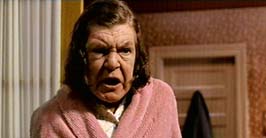
“Strangers on a Train” was about two strangers who meet on a train and one proposes a plot to commit a murder for each other. In “Throw Momma from the Train,” there are also two strangers who have people they wish were dead. Writer Larry Donner (Billy Crystal) feels anger for his wife, who has stolen his book and published it with her name. Owen Lift (DeVito), who is somewhat of a pathetic schlub, lives with his overbearing mother, who is sort of a cross between Quasimodo and the Wicked Witch of the West. He dreams of killing her, but grows spineless at every attempt.

Owen is a student in Larry’s creative writing class. When he asks Larry what he can do to improve on his writing, he tells Owen to go see an Alfred Hitchcock film for inspiration. One day, at lunch, Larry’s wife is mentioned to Larry and he responds by exclaiming, “I wish she was dead!”

Owen goes to see “Strangers on a Train,” he gets the idea of the movie, and believes that the choice of the film was a message from Larry. Larry only says he wants his wife dead, but Owen takes him seriously. He supposedly (the murder is off-screen) kills Larry’s wife and expects Larry to “return the favor” and kill his mother.

And who could blame Owen for wanting his mother dead? Momma is a monster and Larry knows that too—he has a line later in the film, “She’s not a woman—she’s the Terminator.” Anne Ramsey goes all out with this performance, and she is more than game.

DeVito is the star of this movie. He delivers a performance of a man who really needs help and we start to care for the guy. He’s a good director too—he frames certain shots in which he almost looks like a small boy; he has a tendency to make the everyday world seem somewhat surreal; and he gets the material. The best scene in the film is a sweet one—it’s a scene in which he shows Crystal his coin collection. Those aren’t coins that are really worth anything but they remind him of places his dad used to take him. That’s a very good scene, with a real amount of whimsy put to it.

There are also a couple of big laughs in this movie—one of them involves Crystal at the river trying to find an opening line for his book. And the other involves DeVito and Crystal in DeVito’s house—they’re having breakfast in the kitchen, Crystal meets Momma, and without giving too much away, there’s a frying pan involved, and the scene delivers possibly the funniest moment in the movie.

Admittedly, the whole murder situation is a little uneven. But with a few sweet scenes, some good laughs, and good performances by DeVito, Crystal, and Ramsey, this is an enjoyable, entertaining comedy.

Forgetting Sarah Marshall (2008)

19 Feb

080416-forgetting-sarah-marshall-hmed-12p.grid-6x2

Smith’s Verdict: ***1/2

Reviewed by Tanner Smith

Well, it’s time for a new lovable loser to take over the writing in the comedies coming off the Judd Apatow assembly line. First came Judd Apatow himself, writing (and directing) the romantic comedies “40-Year-Old Virgin” and “Knocked Up.” Then came Seth Rogen and his buddy Evan Goldberg, writing the teenage comedy “Superbad.” Now for the Apatow-produced romantic comedy “Forgetting Sarah Marshall,” he calls back his former “Freaks & Geeks” cast member Jason Segel and introduces a newcomer—Nicholas Stoller—to direct.

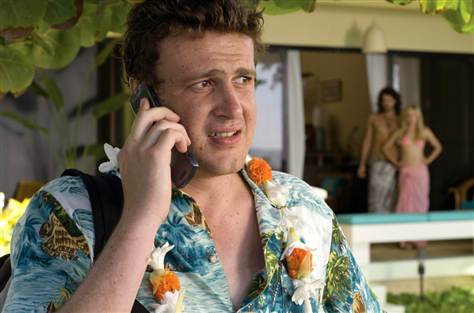
Segel not only writes this material, but also stars in it as a guy named Peter, who has a great relationship with his TV-star girlfriend Sarah Marshall (Kristen Bell) and also provides the ominous background-music “tones” for her crime show. But when Sarah comes over to his apartment, saying “I love you” in a pitiful tone, that can only mean one thing.

So Peter and Sarah are broken up and Peter is not taking it very well. To call him a wreck would be an understatement. He’s advised to take a vacation in Hawaii to take his mind off of her. But there’s a problem—Sarah is there with her new boyfriend and staying at the same hotel!

Things are about as complicated as they could possibly get. Sarah’s new boyfriend—the British rock singer Aldous Snow (Russell Brand)—is a complete weirdo, and things get really awkward when Aldous invites Peter to eat with him and Sarah at a restaurant. But soon enough, Peter finds a friend and trace of hope in the attractive hotel receptionist, Rachel (Mila Kunis). She’s beautiful, sympathizes with Peter, and lends him a supporting hand.

All of the people on the island in this movie are just hilarious and there are a handful of characters to watch and enjoy. There’s not only the zany Aldous Snow. There’s also the constantly stoned surfing instructor (played with relish by Paul Rudd), the religious newlyweds who have trouble with sex, the waiter/stalker (Jonah Hill) who tries to get Aldous to take a listen to his demo tape, and the island’s butcher. I don’t know if this counts as “on the island,” but there’s also Peter’s stepbrother whom Peter constantly stays in touch with via Skype. He’s very funny as well.

“Forgetting Sarah Marshall” has a wonderful screenplay by Segel (who, remember, also stars as Peter). He’s not afraid of making Peter into a desperate schlub of a guy, which makes for very funny moments in the first act. And for that matter, he’s also not afraid of…how do I put this? Letting it all hang out. The scene in which Sarah breaks up with Peter features quick shots of Peter’s genitals, pushing just how far the MPAA rating system could go.

Segel also gives the side characters more than enough moments to shine and the actors are game enough to give them their all. Bill Hader, as Peter’s stepbrother, delivers some of the film’s funniest one-liners while mainly on the other end of a cell phone or a computer, and his sweet-natured wife is very likable, though her role is very brief. Russell Brand is simply hysterical as Aldous Snow, who, with his long hair, lion-like face, thick British accent, and calm-yet-nutty mannerisms, is a comic treat of a character on screen. Paul Rudd is winningly silly. Jonah Hill has some great moments as he stalks Aldous while he thinks he’s being subtle about it.

The two main women are also written well and portrayed even better by the actresses. Sarah isn’t written as a complete snob (a kinder word for “bitch”). She just believes that her relationship with Peter didn’t work out and would like to try something new. She doesn’t hate Peter and we, as an audience, don’t dislike her. Kristen Bell does a nice job of portraying Sarah Marshall as having more humanity than you would expect in this sort of role. Mila Kunis (of TV’s “That ‘70s Show” fame) is absolutely delightful as Rachel—she has a great sense of comic timing, is quite fetching, and makes Rachel the kind of girl I would like to get to know in a time of crisis.

Those previous three paragraphs have gone out of their way to give praise to the written characters of “Forgetting Sarah Marshall” and how the actors portray them, but what else does the screenplay give us? Only more and more quirks to make us laugh. I couldn’t find a single weak link when it comes to the comedy in this script. What can you say about a musical about Dracula…featuring puppets? Seriously, what can you say? I couldn’t say anything. Why? Because I was constantly laughing. Oh, and I should also mention that a majority of the jokes in this movie are not merely gross-out gags…they’re just sex jokes. To be honest, I’m actually kind of relieved.

But also, like in previous Apatow comedies like “40-Year-Old Virgin” and “Knocked Up,” the mix between raunchiness and romance is kept in check; carefully fashioned and convincing. Many of the moments that feature Peter and Rachel together reminded me of the finest moments in “When Harry Met Sally.” Segel and Kunis show a great deal of chemistry, they’re convincing throughout, and their comic timing is spot-on.

“Forgetting Sarah Marshall” is a hilarious and even heartfelt movie with a funny screenplay, likable acting, and a real heart to go with the humor. And the last thing to say is that if I wind up in a predicament like Peter’s and need a vacation to take my mind off it, I hope Mila Kunis is there to help me out.

Note: I might be wrong on this one, but if the shots of Peter’s nudity had stayed on a little longer, the R rating for this movie may have been replaced with an NC-17.

The Natural (1984)

19 Feb

11-top-sports-movies---The-Natural-jpg_1349001541229_162280_ver1.0_640_480

Smith’s Verdict: ***1/2

Reviewed by Tanner Smith

I love baseball. Who doesn’t? It’s a lot of fun to play and arguably even more fun to watch (yeah, I was never that good at the game, even when it was called “whiffleball” in P.E. class). Heck, it’s America’s pastime! You could show me a football game on TV or let me play in flag-football for fun, and I wouldn’t fully understand it. No, baseball is the sport I can easily get into. I mean, I’m not saying I collect baseball cards or even memorize statistics (or else I wouldn’t be much of a movie critic, would I?), but I really adore the sport itself. So when a movie that’s centered around a baseball player comes around, of course I hope that it gets everything right.

This is where “The Natural” comes in. This movie isn’t merely artistic and wonderfully acted. It’s also amazingly accurate about the game of baseball—not just in representation of what happens on the field, but also the spirit of the game. How can you not be excited when a character hits a home run in this movie? Or when the ball is mid-air, flying somewhat gracefully? That’s the spirit of the baseball game sequences in “The Natural.”

The movie is a fable that features a natural player named Roy Hobbs. As a young man, Roy played catch with his father and carved a wooden bat out of a fallen tree, dubbing the bat “Wonderboy.” As he gets older, he gets a chance to try out for a team in Chicago and even strikes out big-league ballplayer “The Whammer” in three pitches. It’s then that people see real talent in this person. Unfortunately, those people include a deranged woman who makes it her business to kill off “the best” in every sport.

Roy (Robert Redford) survives his encounter with the woman (Barbara Hershey), but it’s 16 years in oblivion before he finally appears as a thirty-something rookie. He signs up for the New York Knights, who can’t believe he’s on the team at his age. His manager Pop (Wilford Brumley) even states cynically that players his age retire rather than begin playing. Through half the season, Roy sits on the bench, but he eventually does make it into the starting lineup on the field and shows his skills. Everyone is impressed and amazed by him and want to find out more about him, for their own reasons.

It’s within the story of “The Natural” and the sport of baseball that these themes are represented—lighter ones like redemption, and darker ones like corruption, greed, and temptation. We have the redemptive tale of a man who steps out of nowhere after a deadly experience and uses baseball as the pathway to the right track. Within the darker themes, baseball brings about the joys (and dangers) of gambling, contracts, and fame. As the story progresses, Roy comes along corruptive characters like the Knights’ owner (known as the Judge, played by Robert Prosky) who will give Roy a long-term contract if he throws the next game, a sports writer named Max Mercy (Robert Duvall) who wants to know everything about this strange natural ballplayer, a gambler named Gus Sands (Darren McGavin) who manipulates Roy’s refusal to agree to anything dishonest, and his girl Memo Paris (Kim Basinger) who tempts Roy into all of their traps.

It’s Roy Hobbs who must make the right choices to make himself into a hero. But even if we know that Roy will aim to do the right thing, we wonder ourselves if the right thing is enough. It’s because of the writing by Roger Towne and Phil Dusenberry, based on the novel by Bernard Malamud, that the tension is there and we feel it in the scenes in which Roy must figure out what to do as he discovers he has something to prove.

Roy Hobbs is a great role model for young children—he’s not perfect, but an individual that shows character and principles as he sets out to fulfill his dreams. He’s played by Robert Redford in a believable, winning performance. He’s charming, but more importantly, he’s also convincing as a baseball player.

The movie has an outstanding supporting cast—Robert Duvall, Wilford Brumley, Kim Basinger, Robert Prosky, and Darren McGavin are all solid in their roles. There are two more important roles—Richard Farnsworth, just wonderful as the faithful bench coach Red, and Glenn Close, excellent as the angel-in-disguise: Roy’s old girlfriend Iris, a passive woman who dresses in white and wears a hat that represents a halo. Notice how she’s bathed in white light at Wrigley Field at the end of the movie. (I should also note that Barbara Hershey’s mysterious character is dressed entirely in black in her scenes, like a black widow spider about to attack her prey.)

But like I said, the very best element about “The Natural” is how well it accurately portrays baseball. This movie gets the feel just right in its ballgame sequences, and the final game is involving to say the least. The outcome is one of the most satisfying in any sports-movie big-game climax. Something it didn’t need was a heroic music score by Randy Newman, but I let it slide because it sounds great.

“The Natural” is one of the best sports films I’ve ever seen—a magical tale of the human element and a fable of a destined hero. Even if some cheesy moments and a few not-so-subtle touches (see two paragraphs above) seem a little “out there,” I enjoyed every minute of it.