Archive | February, 2013

A Fish Called Wanda (1988)

24 Feb

142618__wanda_l

Smith’s Verdict: ****

Reviewed by Tanner Smith

“A Fish Called Wanda” is one of my favorite comedies—I think it’s one of the funniest, brash, offbeat movies I’ve ever seen, along with some of the Monty Python films. (Though, oddly enough, some of the Monty Python troupe takes part in this film, so there you go.) Every time I watch this movie, I laugh and laugh and laugh. But how often is it that among all the laughs and funny performances from the actors, there’s actually a highly imaginative story to go along with it? Then by definition, there’s a great movie here—good story, characters, actors, and of course, laughs.

It’s a caper story set in England and centered around a band of jewelry store robbers, consisting of the ringleader/mastermind George (Tom Georgeson), his stuttering, animal-loving friend Ken (Michael Palin), and two American recruits—Wanda (Jamie Lee Curtis) and her psychotic and quite idiotic lover Otto (Kevin Kline). They pull off the heist, but Wanda and Otto make an anonymous tip to the police. George is arrested, but not before hiding the loot. So to let himself off somewhat easily, he suggests giving away the location of the jewels to his barrister Archie Leach (John Cleese), resulting in Wanda planning to seduce Archie.

Archie Leach is a mild-mannered lawyer living an unpleasant home life with his materialistic wife (Maria Aitken) and spoiled daughter. When Wanda comes into his life, it’s a more interesting case of romance and excitement, making things more complicated since Wanda was his client’s aide, and especially because Otto is a jealous man (whom Wanda tells Archie is his brother) who constantly spies on the two of them and also takes some extreme action.

These are wonderfully nutty characters in “A Fish Called Wanda” and the actors are more than game. Everyone in the cast has his/her moment to shine while the audience is laughing out loud. Comedian John Cleese, who also wrote the screenplay and is also a “Monty Python” alum, is at his best as Archie Leach, making an appealing, unlikely hero and giving some big laughs along the way. His reactions to many of the zany, bizarre situations are hilarious. Kevin Kline is excellent as Otto, a man so deranged that he doesn’t believe himself to be deranged. This is a guy who reads Nietzsche and thus thinks he’s so intelligent, even though he misreads his style. He’s so stupid that he thinks the London Underground is a political movement. There’s also a running joke in which he’ll repeat the memorable line “Don’t call me stupid” and then go to unforgettable conditions to those who do call him “stupid” (like swing somebody from a window!).

Jamie Lee Curtis is sexy and playful as Wanda. And then there’s Michael Palin, also from “Monty Python,” having a lot of fun as Ken, a stutterer with a love for animals, particularly his pet fish (one of which is named Wanda). He’s the one who has to do away with the old lady who was a witness to the heist getaway, but constantly (and accidentally) winds up killing off her little pet dogs instead.

If you had told me that I would love a movie in which three dogs are knocked off (one of which is pounded into the cement of the street), I wouldn’t have believed you. I guess anything can be funny or maybe I’m just sick. Or hopefully, I’m not sick, because I’m sure that you would laugh at that too. Bottom line: I laughed out loud.

Most of the humor in “A Fish Called Wanda” is the nuttiness involving these zany characters and the physical comedy that occurs during most of their circumstances. I can’t give a lot of the best gags away, because that would defeat the purpose of surprise. I won’t even describe them just to make the review funny. I think I’ve explained just about enough.

“A Fish Called Wanda” is one of the funniest movies I’ve ever seen—It’s original, inspired, gamely-acted, and…it’s just funny from beginning to end.
The Great Mouse Detective (1986)

24 Feb

images

Smith’s Verdict: ***1/2

Reviewed by Tanner Smith

Well it figures that, in a Disney animated feature, when a father and daughter are having a good time, and the little daughter calls her father the “best daddy in the whole world,” it only makes it necessary for the father to suddenly be taken out of the picture. This way, she can embark on the movie’s adventure. But here’s a surprise (for a Disney animated movie)—the father isn’t dead. He’s just been kidnapped, that’s all.

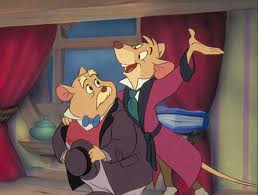
The main gimmick of Disney’s “The Great Mouse Detective,” a very well-put-together family-adventure, is that the main characters are all mice and rats living in Victorian London. It’s like a parallel world underneath our own, which makes sense considering the title character (indeed a “great mouse detective”) lives under the dwelling of Sherlock Holmes. The film draws heavily on traditional Sherlock Holmes elements—of course, for example, the main character, named Basil, is a heroic mouse who has the intelligence and personality of the famous fictional detective.

The aforementioned little girl (or mouse, whatever) witnesses her father being captured by a nasty, peg-legged bat. So with the aid of friendly Dr. Dawson, she tracks down the rodent-equivalent of Sherlock Holmes himself, Basil of Baker Street. She hopes that Basil will be able to help get her father back. While following a series of clues, Basil, Dawson, and the girl (aided by a loyal dog named Toby) set out to rescue the kidnapped parent and stop an evil scheme devised by a villainous sewer rat named Ratigan, whose plan requires the help of the father.

By the way, the father is a toymaker and Ratigan plans to use his inventiveness to create a robotic clone of the mouse Queen, so that it can trick the attendees of a royal event into thinking that Ratigan is now ruler of the land…I am aware of how dumb that sounds, but I’ll let it slide because it’s Disney-magic. The mice talk, yet Toby the dog and Ratigan’s pet cat don’t. Let them do whatever they want.

“The Great Mouse Detective” is quite the entertaining Disney film. It takes us on a wild adventure through this intriguing mouse-world and has sequence upon sequence of pure delight and mystery. It will delight kids, and also keep their parents entertained as well.

While it does feature a little mouse-world mixing with the giant human world, what “The Great Mouse Detective” is really centered around are the characters that go through it and have this adventure. The hero and villain are very enjoyable. Basil (voiced by Barrie Ingham) is a great hero to follow—he’s quick-thinking; he’s intelligent; he’s observant; he’s energetic; and he’s narcissistic yet still very likeable. You can tell that from the first moment he arrives on screen that you’re going to enjoy watching this guy (or mouse) on this film’s journey. And the villain is great. Ratigan is voiced by Vincent Price, whose sliminess is very existent in his voiceover work for this character. Ratigan is brilliant, dastardly evil, and enjoys every second of what he does. He’s enjoying what he does so much that even we as a result can’t help but enjoy it as well. The hero and villain of “The Great Mouse Detective” are very appealing, and they play off each other perfectly as two intelligent minds trying to outwit each other.

Dawson, who becomes Basil’s loyal sidekick, is also very likeable. With nervous mannerisms, a distinguished quality to himself, and a loyalty that leads to bravery as the journey continues, Dawson is an effective equivalent of Holmes’ partner Dr. Watson.

But being a Disney animated feature, the animation deserves credit, especially since this is apparently the first time Disney used computer-generated animation. What really stands out among this animation is the climax, in which Basil and Ratigan have a showdown in the clock tower. The way this sequence is animated is just so fascinating, and the way it’s put together makes for a quite intense fight scene.

“The Great Mouse Detective” constantly gets overlooked when it comes to mentioning Disney animated films, but it really is a small treasure. It may be the mouse version of the Sherlock Holmes story, but don’t let that throw you off. It’s an entertaining movie with terrific animation, interesting characters, and a good sense of fun.

Safety Not Guaranteed (2012)

24 Feb

images

Smith’s Verdict: ***1/2

Reviewed by Tanner Smith

“Safety Not Guaranteed” takes a neat idea and uses it for an independent film that starts out as cynical as its characters (and as many other smart-aleck indie films I’ve seen lately), but then turns into a pleasant, involving experience once the characters have become more involved in the mystery of the situation.

What is the situation, the neat idea? It’s a “classified” ad in a newspaper. And a most unusual one at that—it reads: “WANTED: Someone to go back in time with me. This is not a joke. You will get paid after we get back. Must bring your own weapons. I have only done this once before. SAFETY NOT GUARANTEED.”

How can you ignore an ad like that? You can’t help but be the least bit curious about the person who placed that ad in the paper. Sure, you wouldn’t actually try and track him or her down; you’d think about doing it, but you’d never actually do it. “Safety Not Guaranteed” plays that angle, as three Seattle magazine employees decide to track down and report on whoever placed that ad—is it a joke or is it for real?

The slacking reporter, named Jeff (Jake Johnson), volunteers to take this story and brings two interns with him to Ocean View, Washington. The interns are Darius (Aubrey Plaza) and Arnau (Karan Sonl). Darius is a disillusioned college grad and Arnau is an Indian-American studious biology major. They all drive down to Ocean View to do some digging, but since Jeff is more focused on hooking up with a high-school girlfriend, the interns do most of the investigative work.

Finding the guy comes off as pretty easy—Darius and Arnau spy on the post office until someone opens the Box posted in the ad. The man who placed the ad is a mid-30s grocery clerk named Kenneth (Mark Duplass). Darius has her own simple way of approaching him—by answering his ad, convincing him that she’s the right one for him to “travel back in time with,” and find out what his deal is. It turns out that Kenneth is dead serious about time travel and Darius manages to get him to trust her because she’s quirky, aggressive, challenging, and quick. And as Darius finds out more about Kenneth, she finds herself more intrigued and fascinated and just wondering, just like us, what exactly is going to happen with this time travel plan.

Who is Kenneth? Why does he want to travel through time so bad? Why does he want a partner? Can he really create a time machine? Is that what’s going on in his secretive shed? Is there really someone following him, like he says? All of these questions aren’t given simple answers. There are some answers, mind you, but director Colin Trevorrow and screenwriter Derek Connolly handles them subtly and impeccably. But more importantly, they make us care for the characters involved. A crucial example is the scene in which Kenneth reveals why he wants to travel back in time—we can easily relate to his reasons.

“Safety Not Guaranteed” starts out as an oddball road comedy with these three diverse people looking to find something unusual. But once we get into Kenneth’s characterization, whatever it may be, and further into the sweet relationship that develops between Kenneth and Darius, the movie does become a more involving, more pleasant movie that deals with its characters and their situations in a paranoid and quirky yet intriguing and investing way.

Darius becomes less of a deadpan cynic and shows moments of vulnerability that really make us care about her. The same can be said for Jeff and Arnau. Jeff, in particular, starts out as a typical unlikeable jerk, looking to hook up and also to get Arnau laid before the trip is over, until we go through a subplot involving him and his old girlfriend (Jenica Bergera). When he notices that the years haven’t been kind to her, he still enjoys being with her and realizes that beauty is in the eye of the beholder. Arnau becomes less of a stereotypical Indian-American sidekick and has his own life-changing moment as well. Actually, the whole movie could be like these three, particularly Darius—sardonic on the outside, sweet on the inside. It starts out as a grim, cynical indie flick and turns into a pleasurable story.

“Safety Not Guaranteed” can be seen as a star vehicle for Aubrey Plaza. Usually known for her deadpan-sarcastic, comic supporting roles on TV’s “Parks & Recreation,” as well as movies “Funny People” and “Scott Pilgrim vs. the World,” Plaza tries a lead role this time and succeeds. She proves a real acting talent when she’s calmed down and displays a true sense of vulnerability.

Mark Duplass, as Kenneth, hits the right notes with his performance. He’s a misfit and an oddball, but also earnest and somewhat relatable. You can tell he means everything he’s saying and just want things to go well for him. Even when it seems like he’s possibly gone off his rocker, it’s hard not to empathize with him. What should also be noted is that not once does the movie make fun of him—even in the “training montage” in which Kenneth gets Darius prepared for their trip through time, we’re still with him instead of making fun of him. He’s taking this whole thing seriously, and we have to know if he’s on the right path.

Is time travel possible in this movie? I’m not saying. Though I can tell you this—“Safety Not Guaranteed” is not about time travel. It’s about right here, right now. It’s about these characters who become people we care about and these ideas that we’re fascinated by. The end result is quite satisfying—showing little, but leaving a lot to the imagination. I did not correctly guess the ending to “Safety Not Guaranteed” and I find myself thinking about what I’d just seen. As I continue to think about this movie, I find myself liking it more and more. That is the sign of a terrific movie.

NOTE: By the way, is it a coincidence that Darius resembles MTV’s “Daria?” Just askin’.

Paranormal Activity (2009)

24 Feb

paranormal-activity-dwrks2

Smith’s Verdict: ***

Reviewed by Tanner Smith

Any horror film that forces Steven Spielberg to watch it in the daylight, rather than at night, deserves to be checked out. The story of how the extremely-low-budget independent thriller “Paranormal Activity” got its release is quite interesting—apparently, the film was shown at several film festivals for a couple of years before it was acquired by Dreamworks, who wanted to remake the film with a bigger budget. Spielberg got a DVD copy of the film and watched in his home at night, and was so scared to continue that he waited until morning light to finish it, after which he called the executives, saying, “We shouldn’t remake this—we should release it!” Paramount Pictures picked up the film and released it to the public.

“Paranormal Activity” is a welcome addition to the horror genre—maybe not a complete success, but enough clever moments and more importantly, terrifying moments. No doubt it’s a great movie to see with a crowd, with screams and laughs—it’d be very entertaining, but when you watch it alone in your house, what you have seems like a typical horror film. Not much fun is left. But still, it’s an effective chiller.

“Paranormal Activity” uses the first-person perspective used in other thrillers such as “The Blair Witch Project” and “Cloverfield.” It pretends to be “found documentary footage” and is seen only in a first-person perspective, from a video camera owned by one of the main characters. And better yet, all of the actors are unknowns, making it more effective—the actors use their real first names for their characters.

This first-person gimmick also creates atmosphere—much like how “The Blair Witch Project” created atmosphere with its first-person perspective in the middle of the woods, “Paranormal Activity” uses the same gimmick inside a seemingly normal suburban house.

Inside this house live a young couple—Katie (Katie Featherston) and Micah (Micah Sloat)—who have just moved in. They’re experiencing a haunting of some sort, so Micah decides to buy a new camera to see if he can record anything out of the ordinary, like an amateur paranormal investigator. He’s excited about this ordeal, but for Katie, this is nothing new, as she has experienced something like this in the past.

Micah films around the house during the day and also sets up a tripod in the bedroom to record them (with the help of a computer) while they sleep. And surely enough, the camera does capture some strange happenings, like a mysterious shadow or a moving door. Micah and Katie keep trying to figure stuff out—Katie even calls a psychic to come down and see what he thinks. He concludes that this spirit is a demon and it only wants Katie, and not the house.

Every night, things get creepier and more tense. It just gets worse as it goes along, and Micah is in no way making things better. He provokes the demon! I’ve seen horror movie characters do stupid things before, but…he brings out a Ouija board to try and communicate with the demon, even though he has been specifically told not to! He’s a brave guy, all right…no, he’s just an idiot. And most of his antics pay off in a way that you just want to smack him. If you don’t yell at the screen, “Get out of the house!,” you might still feel obligated to yell, “Get a clue!”

There are many scary moments in “Paranormal Activity.” As with “The Blair Witch Project,” the fear comes more from what we don’t see. When we hear something going on elsewhere, it comes out of nowhere. We hear someone—or something—walking up the stairs and it fills us with unease. And so on. There are many hints as to what’s going on throughout the movie and it gives the audience time to try and figure out exactly what’s happening. Also, just the idea of something supernatural happening in a typical suburban house at night is creepy enough. There’s something I’d like to mention too—there’s a time code at the bottom of the screen (or viewfinder, if you will) every time the camera records them sleeping. The numbers will speed up, meaning that we’re fast-forwarding through time (usually to a few hours later). When the numbers stop…you know something is going to happen, but you don’t know what. That’s a great idea.

And then there’s the ending, or rather the final image—I won’t give it away, but I guarantee it will make even horror movie fans uneasy.

This is an effective horror film, and a terrific one in that it uses its limited resources to give us something satisfying. Both lead actors are totally convincing their roles (and Katie Featherston can let out a hell of a scream, I tell you that), the setting of one house filmed with one camera is surprisingly fitting, and of course, the scares are there.

Spanglish (2004)

23 Feb

02

Smith’s Verdict: ***1/2

Reviewed by Tanner Smith

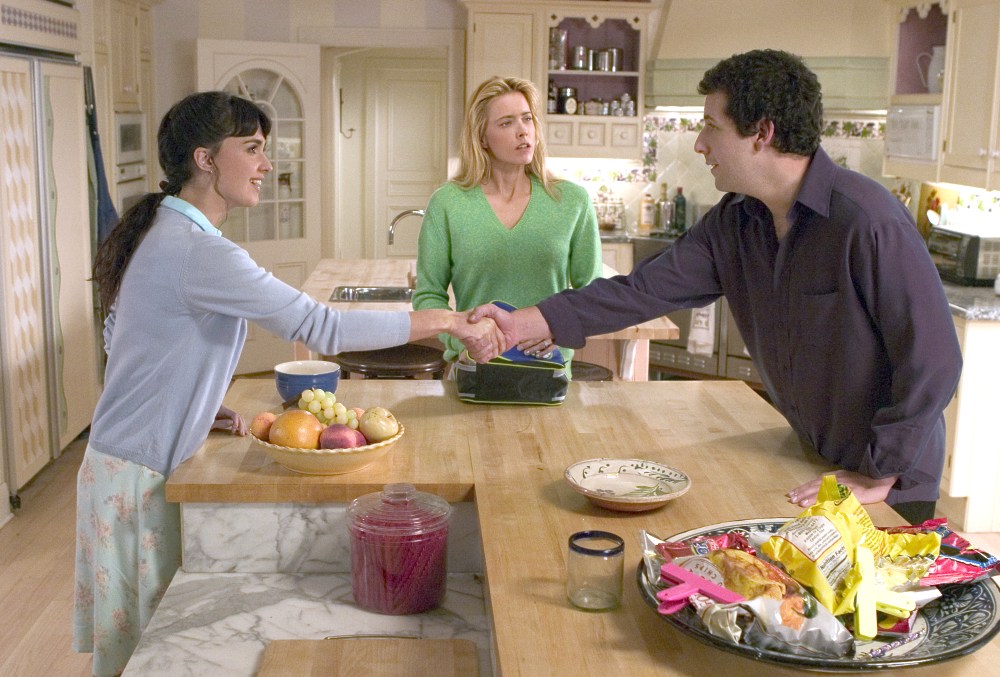
OK, what would you say if I told you that Adam Sandler starred in a movie that featured a family with a crazy member? You’d just say, “OK. So?” But what would you say if I told you that Adam Sandler does not play the crazy family member? That this movie is not a typical “Adam Sandler comedy,” but a James L. Brooks comedy-drama? “Spanglish” is that movie and it does star Adam Sandler. But Sandler plays a man who is trying to keep everything calm. His wife is played by Tea Leoni, and she isn’t just simply crazy—she shouldn’t even be living in a house with a relatively calm husband and two innocent kids. I feel sorry for those kids living in this household.

There’s a third major character in “Spanglish”—a quiet, sensitive Mexican woman named Flor (Paz Vega). Her husband has died, meaning she has to look after her daughter by herself. She leaves Mexico to live in America. To support her daughter (named Cristine), she goes to work for the Claskys, an American dysfunctional family. She is sucked into the drama that happens in this family. John (Sandler) is a chef who is named the Number One Chef in America, but really doesn’t want a lot of attention. His wife Deborah (Leoni) isn’t making life any easier for him. He is so “stark raving calm,” as Deborah puts it, and Deborah simply waves good-bye to reality as she goes cuckoo. She sounds so desperate about everything, stumbles over things, and has a bizarre sexual encounter (though this movie is rated PG-13). John and Deborah have two kids—one of which is teenaged Bernice (Sarah Steele).

Flor doesn’t speak fluent English (she only knows a few words), but she’s patient and tries her best to go along with this family. Complications arise when Deborah practically steals Flor’s daughter (who speaks fluent English) and takes her shopping. In a brilliant comic scene, Flor expresses her anger to John and asks Cristine to translate into English for her. The comic timing of Paz Vega and Shelbie Bruce (as the daughter) in that scene is just great.

A relationship builds slowly and tentatively between Flor and John. One of the movie’s finer things about it is that the relationship is so nicely developed. It doesn’t start quickly; it simply builds up to it. They spot each other on the street, say “hi” a few times at glances in the house, and have late-night chats after Flor is just learning to speak English. The chemistry between these two is convincing. Also, the relationship between Flor and Cristine as mother and daughter is handled quite nicely. I love the final scene they share together. Without giving too much away, it shows convincingly that all parents fear for their children’s futures. That scene is an excellent curtain-closer for this film, which is well-acted and powerful.

It’s nice to see Adam Sandler in this kind of relaxed performance. He’s a lot better as an actor when he isn’t manic, sadistic, or obsessive. Here, he’s restrained and gives a convincing performance as a guy who just things to be better. (After all, who doesn’t?) Tea Leoni is great at making her character not a monster, but rather an unfit parent and uptight klutz. You have to wonder if she took lessons from Adam Sandler’s previous films and brought more class to the character. Also, Paz Vega is wonderful here. One of the best things about “Spanglish” is that while she speaks Spanish (and she does speak fluent Spanish through the first hour of the film), she isn’t given English subtitles popping up on the screen for us to understand her. We don’t need subtitles. Her expressions and actions say it all. It’s a wonderful performance. Also delightful is Cloris Leachman as Deborah’s alcoholic mother. She starts out as a drunk and ends up being an actually wise person in the ways of relationships. I love the scene where she corners Deborah and warns her about what would happen if she keeps messing up.

“Spanglish” is an effective comedy-drama. This is not simply a sitcom featuring caricatures with phony problems. Real people have real problems. Relationships are complicated. Flor’s “fixing” of the family may not end the way we expect it to be. “Spanglish” is a nice movie with a terrific ensemble cast, a good script, and a good dose of comedy and drama. And after “Punch-Drunk Love,” this is further proof that Adam Sandler can handle serious roles well.

Harry Potter and the Deathly Hallows: Part 2 (2011)

23 Feb

Harry Potter and the Deathly Hallows Part 2

Smith’s Verdict: ***1/2

Reviewed by Tanner Smith

At age 11 (“Harry Potter and the Sorcerer’s Stone”), the young wizard Harry Potter and his friends Ron and Hermione spent their first year at Hogwarts School of Witchcraft and Wizardry as they encountered a giant three-headed dog, fought a troll, and played a life-size game of chess. At age 12 (“Harry Potter and the Chamber of Secrets”), they solved a deadly mystery that included mutant spiders, a dark underground chamber, and a giant snake. At age 13 (“Harry Potter and the Prisoner of Azkaban”), they were pursued by a mysterious prisoner of Azkaban (the wizard prison) who turned out to be something more. At age 14 (“Harry Potter and the Goblet of Fire”), Harry was faced by deadly challenges (including a dragon, vicious merpeople, and a treacherous hedge maze) before he witnessed the return of the evil Lord Voldemort, the former Hogwarts student who became evil and tried to overrun the wizarding world before he disappeared (but not before killing Harry’s parents). Now Voldemort is back and is slowly but surely gathering other wizards and witches to create an army to finish what he started. So at age 15 (“Harry Potter and the Order of the Phoenix”), Harry taught other students how to defend themselves, should they have to fight against Voldemort and his followers. Then at age 16 (“Harry Potter and the Half-Blood Prince”), Harry and school headmaster Dumbledore discover a way to defeat Voldemort. But Dumbledore is killed, leaving Harry, Ron, and Hermione to eventually, at age 17 (“Harry Potter and the Deathly Hallows: Part 1”), find hidden objects that contain remnants of Voldemort’s soul. Once they destroy them, Voldemort is vulnerable.

Whew! I tell you, these kids have been on more adventures than Indiana Jones.

Anyway, they’ve destroyed three of these “Horcruxes” so far, now with two more to go as Voldemort and his army grows stronger. Thus, we have the long-awaited cinematic conclusion to the beloved and successful “Harry Potter” film series, adapted from the most-beloved book series by J.K. Rowling. This is Part 2 of the seventh and final book “Harry Potter and the Deathly Hallows,” leaving this to be the eighth and final film. The result is a most satisfying conclusion to a wonderful series of films.

“Harry Potter and the Deathly Hallows: Part 2” picks up where “Part 1” left off. Voldemort has found the wand that is said to be the most powerful of them all as he seeks out Harry and sends out his army of Death Eaters to overtake Hogwarts. In the meantime, Harry, Ron, and Hermione still have to find the last two horcruxes. They locate one in a scene that’s in the spirit of the previous films’ harrowing adventure scenes (this one involving a dragon) before racing off to find themselves back at Hogwarts.

The only thing I can say about the rest of the plot is this: For those who were upset that “Part 1” may have ended abruptly (by the way, what’d you expect from a “part 1” anyway?), it’s time to watch “Part 2” and witness what we’ve all been waiting for—the final confrontation between Harry Potter and Lord Voldemort. The previous films have been building up to it and now it’s finally here. I can say that it doesn’t disappoint. It’s dark and epic, just as we wanted it to be.

Every past setup has its payoff and every character has his/her moment (I especially like how Professor McGonagall, played by Dame Maggie Smith, rolls up her sleeves) as Hogwarts becomes a battleground for the students and teachers of Hogwarts versus Voldemort and his large army Death Eaters.

Now, I can’t say exactly what the bolts shot out of each character’s wands do to whoever is hit by them. But I don’t care—they’re lethal. Isn’t that enough? I suppose so.

We get an introduction to Dumbledore’s brother Aberforth Dumbledore (Ciaran Hinds) who helps the central trio back to Hogwarts. Then, we get other sides of characters we already knew, particularly Snape (delightful deadpan Alan Rickman) who has become Voldemort’s assistant. We had our suspicions about him before we found out he was just unpleasant. Now, he’s turned over to the dark side and even killed Prof. Dumbledore (Michael Gambon) in the sixth film. Not giving anything away, we discover why Snape wasn’t so fond of Harry from the start and why…he is what he is. As for Draco Malfoy (Tom Felton), Harry’s slimy bully at Hogwarts who also became a Death Eater along with his father (Jason Isaacs) and mother, we get hints at where he’s going but we get the point nonetheless. We get a more heroic side of the once-nervous Hogwarts student Neville Longbottom (Matthew Lewis) and—I swear, I am not kidding here—an actual emotion—though brief, mind you—from Luna Lovegood (Evanna Lynch). And then there’s Voldemort (Ralph Fiennes). We know what we already knew from the previous films and that’s all the character needs in the end. Who have I left out? Well, two characters briefly seen in the first film make appearances here (but they’re very crucial)—they’re played by Warwick Davis and John Hurt. Oh, and of course, there’s Ginny Weasley (Bonnie Wright), Harry’s love interest. Well, let’s just leave it at that.

The actors—young and old—have become their roles, as is expected after seven previous films. In fact, you wonder what feature film roles the young actors Daniel Radcliffe (Harry), Rupert Grint (Ron), and Emma Watson (Hermione) will take on next. To me, they will always be Harry, Ron, and Hermione. They have become their characters in these movies, physically and emotionally. It will be interesting to see what they do next.

So what else is there to say about “Harry Potter and the Deathly Hallows: Part 2?” The pacing is brilliant (there isn’t a dull moment here), the dialogue isn’t hurried, and there are pleasant surprises for those who haven’t read the books and are fans of the films (don’t worry—those who read the books may be delighted as well). Even though the epilogue leaves an open door for a continuation, J.K. Rowling informs the public that it won’t happen. So I suppose what is left to say is…goodbye.

Like Father, Like Son (1987)

23 Feb

Like Father Like Son3

Smith’s Verdict: *

Reviewed by Tanner Smith

“Like Father, Like Son” is a comedy so desperate to get any kind of laugh just by one gimmick only. That gimmick is the same one used in “Freaky Friday,” in which parent and child switched places for a day. Well, a gimmick isn’t enough. A smart, funny screenplay was needed to lift it into the air. “Like Father, Like Son” barely makes it off the runway.

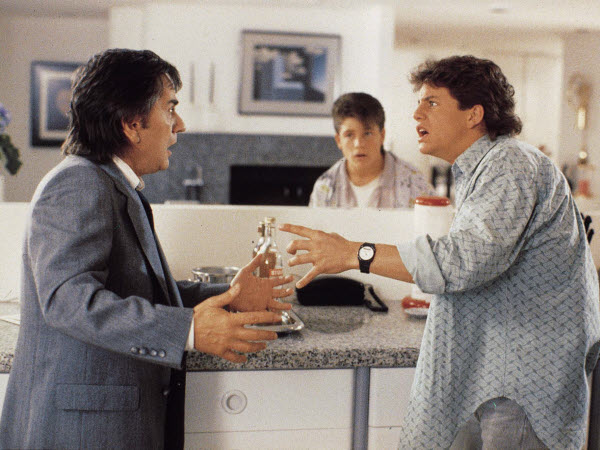
It’s a shame too, because it stars Dudley Moore, who has shown in many other comedies to be an effective British comedic actor. It also stars 1980s teen idol Kirk Cameron (best known as the smarmy teenager from the TV sitcom “Growing Pains”), who I believe is capable of a good performance when he’s not incredibly annoying (I’m not much of a “Growing Pains” fan…anymore). But these two don’t have any juicy material to work with. They play a squabbling father and son. (Where’s the mother? Never addressed.) Moore plays a doctor who wants Cameron to follow in his footsteps. (“But I’m 17,” Cameron complains, to which Moore responds, “When I was 17, I was in my second year at Oxford.”) But Cameron’s highest grade in high school biology class is a C, which won’t do well with Dad.

Cameron has a wisecracking friend nicknamed “Trigger” (played by Sean Astin in, believe it or not, a smarmier teen performance than…Kirk Cameron’s “Growing Pains” role), who has a weird uncle who came across a magic potion that can transfer minds.

Moore accidentally drinks the mind transference serum and suddenly, he and Cameron switch bodies. So, Moore is inside Cameron’s body, and vice versa. And so, until Trigger can get in contact with his uncle again and find an antidote, the father and son have to lead each other’s identities. Moore (with Cameron’s mind) goes to work in the hospital and Cameron (with Moore’s mind) goes to high school. Constant misunderstandings occur, and not one of them made me laugh. Cameron acts with a certain authority to his high school teachers; Moore behaves silly without understanding medical procedure. So what?

See if you can follow this. Apparently, if you drink the mind transference serum, you look at somebody and switch bodies with him or her. So, how would you change yourself back to normal?

Exactly! Drink the potion and look at the same person again. There’d be another switch—problem solved. See? You’re already smarter than the writers and the characters they created.

I’m serious—Moore and Cameron’s characters never consider just doing the same thing again, because the movie would be over too quickly. Also, it’s not a mind transference serum; they make it perfectly clear that it’s a “brain” transference serum. In that case, how come the brain isn’t connected to the tongue in this movie? In the first test of this potion, it is. Cameron and his friend test the potion on a cat and a dog, so that the cat has the dog’s mind and vice versa. The cat growls and barks like the dog. So then, when father and son switch places, why doesn’t Kirk Cameron speak with Dudley Moore’s British accent? Moore, with Cameron’s mind, still speaks in that accent, and Cameron, with Moore’s mind, still sounds like a Southern California teenager.

Here’s a surprise—the writing is so inept that the dog/cat joke isn’t taken advantage of. In fact, it’s never mentioned again.

This is one of those movies where all of the characters have to be total idiots to keep the story going. Why is this interesting? Why is this funny? Just because two guys switch bodies, that itself isn’t funny. You need actual jokes, characters, and a well-developed script. I didn’t care about these two clods. You could have two guys trade law files and it’d be more interesting. Dudley Moore is trying his best, as in one plot thread, he’s seduced by his boss’ wife. But Kirk Cameron doesn’t get one good moment. He’s forced to wade through the script just simply misreading things. Yes, he thinks the music at a rock concert is too loud. Where does this lead him on his date? Nowhere. Come on! There could’ve been an interesting discussion with him and the girl he was dating. But no. It’s just glanced over. It’s 1987, writers—you’re not helping with Kirk Cameron’s movie career. He could show talent; give the guy something to do.

“Like Father, Like Son” stinks all the way through. All we’re left asking ourselves after watching it is, “Were they really that cheap to not synch Moore’s voice with Cameron’s?” The premise didn’t work, I never cared, and most criminal of all for a comedy, I never laughed.

Sound of my Voice (2012)

23 Feb

sound_of_my_voice_rectangle

Smith’s Verdict: ***1/2

Reviewed by Tanner Smith

I love these science-fiction thrillers that keep the sci-fi elements in obscurity (for the most part, at least). “Sound of my Voice” is an example of this type. The basic idea is that there’s an underground cult led by a woman who claims to be from the future. So OK, you have the time-travel element that is talked about a lot in this film. Is it true or false?

And to be honest, I can’t exactly write about “Sound of my Voice” without mentioning a film that was released the same year as this—another indie film that also had to do with the possibility of time-travel, titled “Safety Not Guaranteed.” That film was more of a lighthearted, upbeat comedy-drama—the exact opposite of “Sound of my Voice,” which is grim, more mysterious, and even kind of creepy.

But it’s still as fascinating.

“Sound of my Voice” was co-written by writer-actress Brit Marling, who also co-wrote and starred in the terrific sci-fi/drama (if you will) “Another Earth.” The best thing about both films is that they use their sci-fi elements to serve the human stories that are the main focus.

The plot involves a Los Angeles couple—aspiring filmmakers Peter (Christopher Denham) and Lorna (Nicole Vicius)—as they decide to make a documentary that exposes a mysterious cult. In order to do so, they have to join the cult. On the first night, they are blindfolded and led to a basement to join cult members, dressed in white robes. And they learn the cult’s complicated secret handshake as well.

The cult’s leader, also dressed in white, is Maggie (Marling). She comes into the room, and the cult just bows down to her, as if she was their Savior. When she tells the new members her story, those who buy it sort of see why the others see her like this. She announces that she is from the year 2054 and she started this cult to prepare them for a civil war. She seems very serious about this, and her voice is quite comforting, so people will listen to her—even Peter, who at first seems cynical about all of this. Among her peculiarities—she carries an oxygen tank because she’s allergic to our air; because present-day toxins are easy for her to catch, so she eats organic food grown by one of her followers; and her methods are most unusual. For example, she gets the cult members to purge themselves by vomiting. Peter won’t do it (though he says instead that he can’t do it), and so Maggie does some pushing to get him to do it. She even manages to touch at something so personal from his past that he ultimately and successfully hurls.

By the way, if you’re wondering how Peter and Lorna are getting their footage, I forgot to mention—Peter has a hidden camera in his eyeglasses, and he also swallowed a small radio transmitter to record audio.

Anyway, who is this woman Maggie? Is she telling the truth? Is she a con artist, like Peter believes? Even he is starting to have doubts about what he thought before, which is actually starting to bring concerns from Lorna, as motivations for joining the group are starting to feel unsure.

The odd thing about “Sound of my Voice” is that Maggie’s stories of her “appearance in the present-day” and her “future-day” aren’t as convincing because time-travel is not the only explanation. She says she woke up in an apartment, with no memory and a tattoo that made her realize who she was—there’s some kind of symbol tattooed to her ankle, and the number “54,” which she “recollects” as being the sign of the traveler from 2054. And how about when the cult asks her to sing a song from the future? “We want to hear the future,” someone says. She chooses a popular song from the Cranberrys, saying it was covered by a future artist. I don’t want to give too much away, but “Sound of my Voice” has this odd tendency to keep Maggie talking about her back-story without ever declaring if it’s true.

“Sound of my Voice” has a consistently-unnerving tone as it progresses, and manages to tell an effective commentary on changing lives and beliefs or disbeliefs with tense results. It also helps to have solid characterizations to tell a more human story than you might expect. Peter is classified as a cynic to this cult’s existence, but he’s a nice guy and grade-school teacher, and honestly, who wouldn’t feel this way at first? But he also has a tragic past (his mother died on the night before his 13th birthday) that Maggie is able to play to with the “sound of her voice” (if you will) and this starts to open something in his mind. It’s almost as if he’s starting to be like the brainwashed followers she has led. Christopher Denham delivers a great performance, in a role that could have been thankless. He nails it.

Nicole Vicius is also good as the girlfriend who too is fascinated by what goes on in this cult, but she still remembers why she and Peter joined the group and is starting to question Peter’s sanity, even though he insists that he still believes it’s all a con. But it really comes down to Brit Marling, whose ethereal performance as Maggie brings so many fascinating details to wonder about with this character. She’s perfect here. (And I look forward to another one of her screenplays as well.)

The final act gets more suspenseful, as it moves into a plot development, which I won’t give away, that is both eerie and unusual. But I will say this—I mentioned that nothing is truly declared in this plot, so don’t be surprised if the ending leaves things unresolved. Like “Another Earth,” it’s an ending that leaves things open for interpretation. The mystery is still there, but there’s one little bit that they end on that brings about a whole other part of the mystery to read into. “Sound of my Voice” is an intriguing sci-fi thriller that keeps you guessing all the way through, and still has you guessing after it’s over.

The Dead Zone (1983)

23 Feb

images

Smith’s Verdict: ***1/2

Reviewed by Tanner Smith

I will admit that David Cronenberg is a gifted filmmaker and is capable of good work, but to be honest, some of his films kind of rub me the wrong way. Sure, I was shocked by the special effects in “Scanners,” but was bored by everything else. And I got into some interesting elements of “Videodrome” such as the “TV-seduction” scene, but was put off by its seemingly complicated invasion story. Really, Cronenberg’s best thriller, in my opinion, is “The Fly.” That film had fascinating, realistic-looking (albeit disgusting) makeup/effects, like most of Cronenberg’s “creature features” (if you will), and it also had characters to care about with empathize with so it made itself into a pretty strong drama—quite unusual for a horror film. I call “The Fly” one of the best films of 1986 (I have a list).

But what comes close second in Cronenberg’s thrillers for me is the film that led up to “The Fly”—it’s “The Dead Zone,” based on the Stephen King novel of the same name. But before I review it, let me state that I have not read the original novel and that this is a review of the film adaptation itself. However, if it’s faithful to the source material, I’ll be impressed. (I’ll explain why later.)

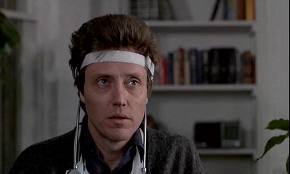
“The Dead Zone” stars Christopher Walken as Johnny Smith, a schoolteacher who is involved in a serious car accident that puts him in a coma. Five years later, he awakens and finds that everything has changed. For example, his girlfriend Sarah (Brooke Adams) is now married and has a child. But in particular, Johnny now possesses a strange ability that is either a blessing or a curse. It’s a psychic ability that allows him to learn of a person’s secrets in time, whether it’s past, present, or future, just by touching them. More people discover Johnny’s “gift” and soon, the local sheriff (Tom Skerrit) asks him to help investigate a series of murders occurring in town.

If the whole movie had been like that, with Johnny constantly using his gift to notice clues, see the future, and then change it for a new future, it’d be exciting. And there are some nicely-done eerie moments. But what makes “The Dead Zone” so good is the characterization. Once the premise has been established for a supernatural thriller, we have a good amount of serious drama and interesting, three-dimensional characters to follow. Johnny is trying to live with this new ability, but also trying to live with his new life. His job is gone, his girl has found someone else, and his life is turned upside-down. As we watch this guy go through the madness that this power and new life brings him, we keep forgetting that this is a supernatural thriller. As a result, you can buy the premise and accept “The Dead Zone” as his story.

Christopher Walken does an excellent job of portraying Johnny. He’s a confused, scared, angry individual doing what he can with his new life—whether with his companions or with his gift. Walken gets lost in the role and it’s a powerful performance. Also good are Brooke Adams as the woman that has married another man, but still loves Johnny (as a result, there’s a touch of fascinating complexity in their scenes together); Herbert Lom as a sympathetic doctor who wants to help Johnny with his gift; Tom Skerrit as the sheriff; and (possibly the best in the supporting cast) Martin Sheen, a populist politician who becomes an important role in the film’s (admittedly) very clever climax.

The story does get back on track with its story of using Johnny’s gift to change the future when it’s predicted with disaster. But then, we’ve accepted the story because we care for the characters, and what follows is very strong because of so. And if this film is faithful to the original Stephen King novel, I guess I underestimated King as a supernatural-horror writer. What I mean is, some of his stories having to do with monsters and psychic abilities have never made a whole lot of sense (sometimes, they’re intriguing; otherwise, they’re laughable). But with “The Dead Zone,” Stephen King got it right. As does director David Cronenberg, who adapted it into a fine thriller. Congratulations to both talented individuals.

Pulp Fiction (1994)

23 Feb

pulp-fiction-originall

Smith’s Verdict: ****

Reviewed by Tanner Smith

Quentin Tarantino is a filmmaker who must truly love movies. And he obviously loves making them. It’s as if someone gave him a computer and a camera, and he started right away on a script and film, aching to make a movie (much like a kid that plays with his toys). You can definitely see in “Pulp Fiction,” which he co-wrote and directed, that he wanted to get every shot and every story detail just right to create a masterpiece.

Well, he definitely succeeded there. And if he hasn’t, then he definitely didn’t bore me with “Pulp Fiction,” a movie about…basically, everything from gore to violence to sex to drugs to whatever. Tarantino couldn’t possibly bore anybody with “Pulp Fiction”—he’s too gifted a filmmaker to do so. He does many complicated things with “Pulp Fiction” and it’s amazing how he’s able to pull them all off. This movie shows us one series of characters and situations, then another series, then another, and then it almost blends them all and the movie sort of doubles back on you before it’s over. These characters live in a world of crime and danger, but also excitement and intrigue.

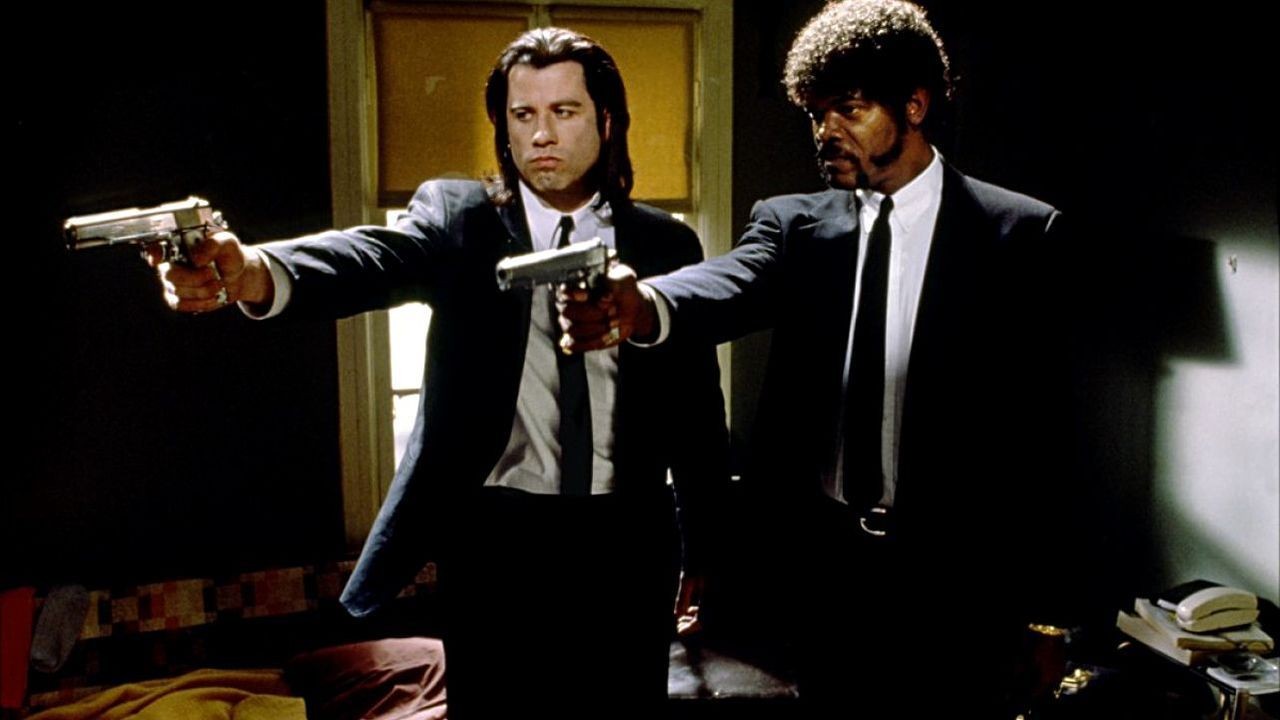
John Travolta is Vincent Vega and Samuel L. Jackson is his partner Jules. They are hit men working for a crime boss to carry out assignments that end in death for the people they are assigned to visit. But what Tarantino does is sensational—he allows these characters to talk before and during their assignments. For example, on their way to visit somebody they’re supposed to receive a mysterious briefcase from, Vega and Jules discuss why they call a Quarter Pounder with cheese in Paris a “Royale with cheese” because of their metric system. And just when it seems like action is going to happen, it’s delayed and what happens? They still talk, giving pointless conversation, but also comic timing and somewhat realism. I loved listening to these characters talk. And throughout this movie is plenty of great dialogue written by Tarantino and Roger Avery.

It’s interesting how these characters are played out. Vega doesn’t clean up after himself, probably because he doesn’t know how, but he knows plenty of people who are able to help him out, some of them involuntarily. There’s another complicated character—a boxer named Butch Coolidge (Bruce Willis) who was ordered to throw a fight, but doesn’t, so he leaves with his sweet girlfriend (Maria de Medeiros) right away. Of course she doesn’t understand why. And then there’s the watch that Butch was given which becomes an important part of Butch’s story. The story of that watch is told in a flashback through a monologue by Christopher Walken and gives the film its biggest laugh. Then there’s the outlaw couple played by Tim Roth and Amanda Plummer who also talk before robbing a restaurant in the beginning and end of the movie. And then there’s the wife of the crime boss (Uma Thurman) whom Vega is paid to take on a night of the town. This results in a wonderfully tense sequence in which Vega is forced to take her to his friend’s house after she overdoses on heroin. He has to give her an injection of adrenaline straight into her heart. His friend (Eric Stoltz) says, “You brought you here! You give her the shot!” That scene is sensationally well-written and well-crafted. I could watch that scene over and over again. And almost all of the scenes in this movie are inventive and original. Another great thing about this movie is I never knew from one point to the next what was going to happen…and then something bigger happens.

“Pulp Fiction” is a great film to watch and a great film to listen to. It’s truly a film that shows what a great filmmaker Quentin Tarantino is, and how great it came to be in the years since. I loved every minute of “Pulp Fiction.”