Archive | February, 2013

Dredd (2012)

26 Feb

Dredd_01

Smith’s Verdict: ***

Reviewed by Tanner Smith

I never considered “Judge Dredd” a household name when it comes to comic book lovers, but then again, I myself am not a comic book lover (not that there’s anything wrong with being one), so I’m not one to talk. Maybe there is a fan base out there, though I’m certain if there is, they didn’t take well to the cheesiness of the 1995 film adaptation “Judge Dredd,” starring Sylvester Stallone as the title character. That being said, this 2012 “second try” to adapt the comic book series—simply entitled “Dredd” or “Dredd 3D”—is probably the best film adaptation those people could ask for.

To put it simple, “Dredd” is a heavily-stylized, extremely-violent action film that kicks ass. It’s an insanely forceful thrill ride from start to finish, with a dose of intense violence mixed with dark comic streaks. Once the action picks up, it never lets up—in fact, by the time this movie was over, I was exhausted by what was being thrown at me.

It’s an odd thing for me to say “being thrown at me,” since I didn’t wind up seeing it in 3D. Speaking of which, I’m glad I didn’t. Forget that 3D kind of makes things unbearable in movies; even if “Dredd” did it right, I would still be suffering vertigo nonetheless. We get towering, hovering, panning shots above and below great tower heights, among many instinctual visuals done greatly by cinematographer Anthony Dod Mantle. His artistic style to “Dredd” is unbelievable and the action scenes, as a result, are suitably graphic and well-choreographed. “Dredd” is a visual treat, to say the absolute least.

But it’s also not for the faint of heart. An example of this style comes early in the film (and which makes a few reprisals here and there)—you don’t just see a bullet enter someone’s face; you see every blood drop explode outward, in slow-motion.

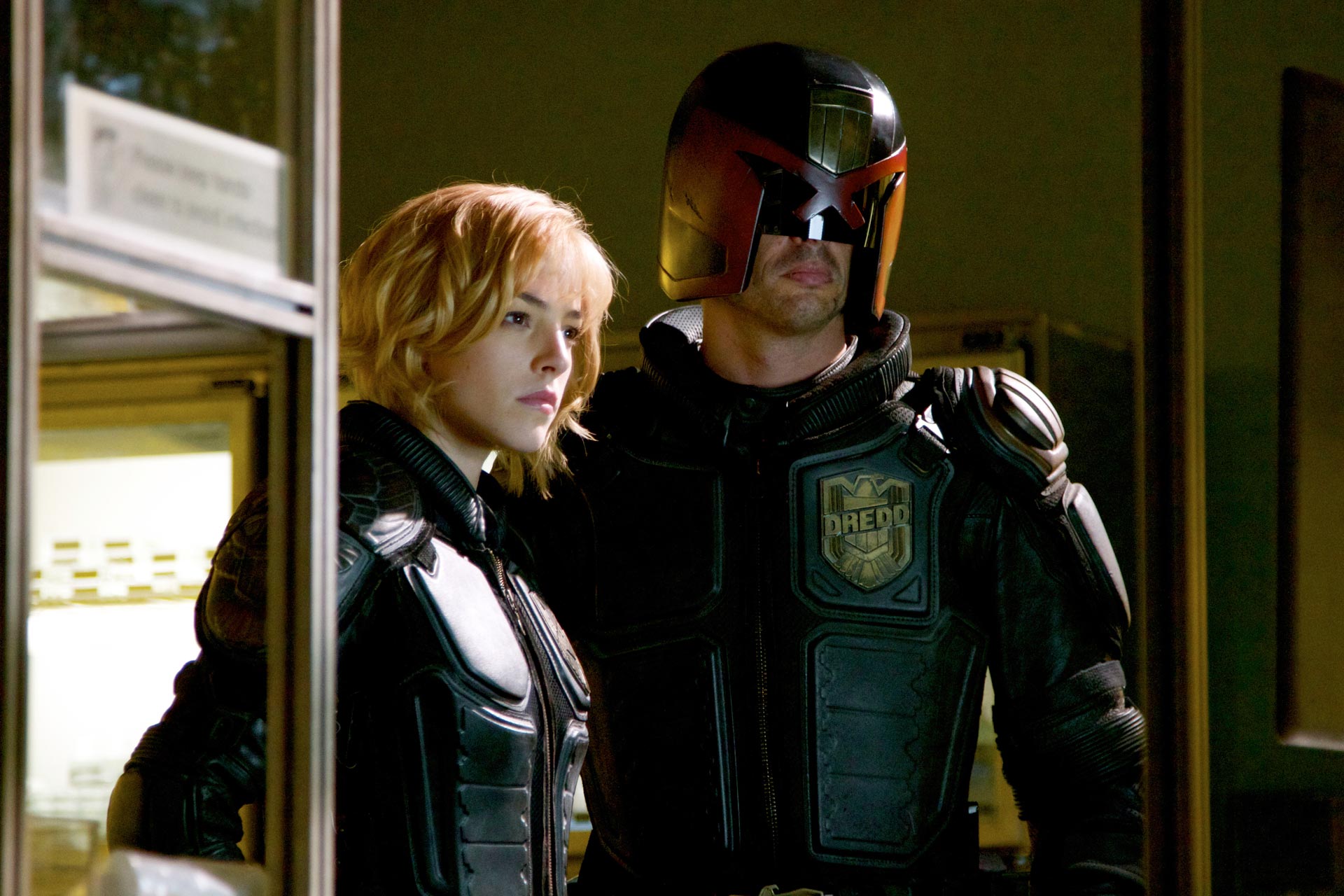
The story takes place in the future, which of course sucks. It’s always lousy in the future in the movies, isn’t it? In this “cursed Earth,” a dystopian large city, the law enforcers serve as judge, jury, and executioner all in one. The baddest of them all is Judge Dredd (Karl Urban)—with a cool uniform, a helmet that covers the top half of his face (we never see him take the thing off), and a cold, monotone voice recalling Clint Eastwood and Batman.

Karl Urban is unrecognizable as Dredd. That’s not just because we never see his face partially covered by that helmet, leaving his mouth and chin exposed, but because of his deep growl and his deadpan persona. You’d never link this man to the 2009 “Star Trek” (he played young Bones McCoy). He’s also grimly funny too, as he delivers one-liners in the most depraved situations he runs into, providing some very big laughs.

Also a lot of fun is Olivia Thirlby, best known for her indie roles as “Juno’s” best friend and the pretty high school girlfriend in “Snow Angels.” Here, she plays a blonde mop-haired psychic “mutie” (slang for “mutant” in this world—I guess stealing “muto” from “Waterworld” was too much) who becomes the rookie Judge Anderson. Thirlby displays a calm (yet somewhat ethereal) yet confident screen presence, whether it’s looking danger in the eyes or through their heads (because she has the power to enter your mind and mess with it to seek information—now that’s awesome). She’s a ton of fun and delivers some badass moments as well. She is no damsel in distress.

The real story begins as Dredd and Anderson respond to a disturbance at the 200-tower Peach Trees housing complex and interrupt a party where the latest drug is being used—a drug that allows everything in your perspective to slow down time (this is where a lot of slow-motion visual styles come into place). Facial-scarred drug-lord Ma-Ma (Lena Headey) has been killing her subjects by enforcing the drug onto them, and pushing them out the window from the top floor, making their fall seem longer than it is. Dredd and Anderson take a suspect (Wood Harris) into custody. Knowing that they will interrogate him for information, Ma-Ma forcefully arranges for the entire building to be locked down and insists that she’ll keep it this way until the Judges are caught and killed.

This sets up a series of events that lead to close calls, strikebacks, shootouts, and just about everything else you’d expect to see here. “Dredd” pulls out all the stops and then some. This film is alive with energy as Dredd and Anderson find new ways to outsmart the heavily dangerous thugs looking to shoot anything that moves. But it’s OK—the Judges have specially designed guns that have voice command and many features (automatic fire, stun, double-whammy, and more). That gives them advantages that lead to some impressive developments.

“Dredd” is violent, bloody, heavily-stylized…and it’s just so freaking cool. There’s never a dull moment, it’s visually exciting, the action is top-notch, and it’s just an intense thrill ride from beginning to end. I look forward to a sequel, and I think there will be one, seeing as how audiences are hungry for mindless entertainment. I guess I could describe “Dredd” as precisely that, but that would be considered an understatement. This movie just kicks ass.

Planes, Trains & Automobiles (1987)

26 Feb

000096_20

Smith’s Verdict: ****

Reviewed by Tanner Smith

When you team up a pair of comic actors in a movie, there’s either a danger of going over the top or not having enough chemistry on screen. But Steve Martin and John Candy are perfectly cast and are in a script that doesn’t let them down and carry the film, “Planes, Trains & Automobiles,” greatly. There is chemistry here and they never go over the top.

The film is about a road trip featuring two strangers who have to be home for Thanksgiving and will get there any way they can—planes, trains, or automobiles. Steve Martin plays Neal Page, an uptight advertising salesman trying to get from New York to Chicago. During rush hour (and two days before Thanksgiving), he has a hard time finding a cab in the city and when he finally flags one down, it is stolen (unintentionally) by Del Griffith (John Candy), a traveling shower-curtain-ring salesman. He’s also from Chicago. When the two men meet at the airport, Del feels genuinely sorry for stealing Neal’s cab. Neal tells him to forget it. But as fate would have it, Neal and Del wind up trapped in each other’s company, on the plane and off.

This leads to a night in which the two land in Wichita, Kansas, since a snowstorm has hit the O’Hare airport in Chicago. “We’d have a better chance of playing pick-up sticks with our butt cheeks than getting a flight out of here tonight,” Del tells Neal. And this also leads to a night at a motel…but their room is a single. That’s right—one bed. In one of the funniest scenes in the film, Neal and Del wake up the next morning cuddled against each other. (“Why are you holding my hand?” “Where’s your other hand?” “Between two pillows.” “Those aren’t pillows!”)

And as the film goes on, Neal and Del continue to make their way home, while Neal tries multiple times to get rid of Del. But there’s nothing that can separate them forever. In one of the best scenes in the film, they wind up renting a car and driving at night together when they don’t realize that they are going the wrong way on an expressway. This results in what is probably the only funny joke that a movie can make about a car and two oncoming trucks.

“Planes, Trains & Automobiles” is written by John Hughes, who also serves as director and producer, and it’s a pleasant surprise, considering that John Hughes specializes in teenage comedies and apparently searched for something more. So now he has “Planes, Trains & Automobiles,” a movie featuring a road trip with a great deal of character development and physical comedy. John Hughes had written a comedy about a road trip before (1983’s “Vacation”). This film is even better because the comedy is based on character and reveals heart and truth.

For example, we have the scene in which Neal snaps at Del that night in the motel in Wichita. He shows no mercy, telling Del that he doesn’t know how to tell an interesting story and that he would rather attend an insurance seminar than listen to another one of his anecdotes again. He goes on and on, as Del doesn’t show anger. His face falls; he’s genuinely sad and hurt. He realizes that he was so eager to please and has tried too hard. It’s a scene that reveals comedy and drama in the way that it reveals heart and truth. And that’s not even close to the end of the film, even though it could be the end of a short film (and feels like it, too). It’s this point in which Del wins our hearts and we enjoy watching him through the rest of the film. As for Neal, he learns about patience and slowly but surely develops a friendship with Del.

This is where the film really shines—Steve Martin and John Candy are absolutely great together and they play characters that are funny and empathetic. They’re the classic Odd Couple—one is ordinary and wound up while the other is a slob but more outgoing. But if I didn’t make it clear in the paragraph above, they don’t play caricatures. They play three-dimensional human beings.

“Planes, Trains & Automobiles” leads to the emotional payoff in the final scenes. After all we’ve seen of these two characters and been through what they’ve been through, you’d expect a great payoff. Luckily, this film has one in the way that it gives us exactly what we needed for this material.

NOTE: This film is rated R by the MPAA. Well, I’ll tell you this—fast-forward through the scene midway through the film in which Neal confronts a car rental agent played by Edie McClurg. That scene has the only times you’ll hear the F word—19 times, in fact. Omit that scene and the film is good viewing for the whole family on Thanksgiving night.

Children of Men (2006)

26 Feb

bilde

Smith’s Verdict: ****

Reviewed by Tanner Smith

“This is how the world will end…this is how the world will end…this is how the world will end…not with a bang but with a whimper.” –T.S. Eliot

That is exactly what is happening to the world in the action film “Children of Men,” a bleak, action-packed, wicked thriller that takes place in the year 2027. The Earth has become practically uninhabitable and anarchic. Natural disasters, terrorism, and war have brought the world to hell. All borders are closed permanently, which means anyone who tries to step into new territory is declared an illegal immigrant and forced to go with others to a prison where they will eventually be executed. But it gets worse—humans have become infertile. It is exceedingly rare for a woman to be pregnant. As the movie opens, a newscast informs us that the world’s youngest person (at age 18) is dead. With this knowledge, you can sense that in a few decades, the human race will become extinct. Soon, others will die until the last man on Earth will die. No one else will go on because there are no more births. That is the subtext throughout “Children of Men” and it’s a profoundly creepy one.

The movie takes place in England, where a man named Theo (Clive Owen) gets a coffee one morning and sees the newscast about the death of the youngest person on the planet. He then steps outside to wait for a bus when suddenly, the coffee house explodes! Not only is this surprising, but watch Theo’s reactions to the destruction. At first, we see him as this ignorant tough guy we see in a lot of action movies. But when the coffee house explodes, he shows off a real sense of fear—he is startled by this occurrence, as anyone would be.

Theo has his way of showing concern about this now-damaged world, but he prefers to think about being with his pot-smoking best friend Jasper (a bewigged Michael Caine, wonderfully cast), who is even more ignorant of more or less…everything. But he is soon captured by his former wife Julian (Julianne Moore) and her associate Luke (Chiwetel Ejiofor), who are part of a rebellion against the now-corrupt government (or what’s left of a government). They need Theo to help them to smuggle a young African woman named Kee (Clare-Hope Ashitey) out of the country to a place where she might be safe from everyone else. (It is said that there is a ship called The Tomorrow, which rescues and harbors said “illegal immigrants”). This woman needs to be protected because she holds the key to the future of Earth’s society. Theo doesn’t realize why Kee is so important until after a few angry run-ins with wild townspeople and the police. It turns out Kee is pregnant—the first baby to be born in 18 years. “Now you know what’s at stake here,” Luke calmly explains to Theo.

Soon, Theo and Kee are on the journey to get past the border unseen and unharmed. But of course, this is not going to be easy. They are pursued by many people (including security troops) and partake in many action sequences. But these scenes are so convincing—so well-executed—that you realize just what they’re about. You never forget what is at stake in this story. Director Alfonso Cuaron (who also directed “Harry Potter and the Prisoner of Azkaban”) has an amazing visual style and executes every action sequence well, and I love how a lot of these scenes are in a single ongoing shot. Every action scene is desperate and with purpose. Cuaron knows how to stage this kind of situation and Clive Owen captures the sense of fear and desperation. Owen is ultimately solid in this movie. He has a cool attitude, yet has a sense of vulnerability that he doesn’t show but you can tell during certain shots.

I love the way the storyline of “Children of Men” develops into something bigger than it began with. When the movie opens, we already sense the world ending because of humanity’s wasting away. Now when Kee arrives and needs to be saved, we see that the world can either remain the way it is (maybe even worse) or be preserved for a new generation. It all depends on Theo’s actions—he has his own demons with his former wife, which haunts him after her arrival.

Also, there is great cinematography. When Theo walks through a desolate London, it looks like a real place. It’s incredible, how the filmmakers were able to make this into a dark, scary place to live in (or even walk in). The settings get darker as Theo goes on this dangerous journey to the border and even through the immigrant prison. It’s all convincing.

“Children of Men” belongs in a class with “Mad Max” and “Blade Runner,” but it may be better than those two references. This is a movie that shows an even darker approach to futuristic fiction and serves as a cautionary tale. It shows a world that is indeed not ending with a bang but with a whimper.

Friends with Benefits (2011)

26 Feb

friends-with-benefits-still03

Smith’s Verdict: ***1/2

Reviewed by Tanner Smith

“Friends With Benefits” is the title of a romantic comedy featuring exactly what the title suggests—a man and woman who are friends but also sexual partners with no plans of a loving relationship. (I think Jane Lynch put it best in “The 40-Year-Old Virgin”—the easiest term is “*bleep*-buddy.”) But “Friends With Benefits,” despite its title, is not the first movie to show us this relationship. It hasn’t even been a year since “Love and Other Drugs” and “No Strings Attached” were released, featuring the same “friends with benefits” element. There really isn’t anything new in “Friends With Benefits”—it’s a romantic comedy in which the two leads start out as friends, have sex repeatedly, realize they have feelings for each other, have certain complications in dealing with those emotions, and (spoiler alert) they end up together. But that doesn’t mean it doesn’t work. In fact, I really liked “Friends With Benefits.” It uses rom-com formulas, but has fun with them in a self-referential way.

One of the reasons for the success behind “Friends With Benefits” is the pairing of Justin Timberlake and Mila Kunis as the two leads. These two are impossible to dislike—they’re appealing individually and engaging together. They’re not mismatched in the slightest, their characters are well-developed, and they never annoy the audience.

Describing the plot is somewhat pointless, but it’s probably best to mention a few things. Timberlake plays Dylan, a Los Angeles-based editor of a popular blog, who is recruited for a job in New York working for GQ Magazine. Kunis plays Jamie, a headhunter who flew Dylan there and shows him around the city. Soon, Dylan and Jamie become good friends, but are also attracted to each other physically. So they agree to become friends without romance—“No relationship,” Jamie explains, “No emotions, just sex.”

Of course, this works for a while. Of course, they start to fall for one another. Of course, they don’t know how to handle this. Of course—well, you get it, mainly. You know the formula; it’s been done before. But what makes “Friends With Benefits” worth watching is not only the convincing chemistry and charm between Justin Timberlake and Mila Kunis, but also its self-aware screenplay. There are a lot of funny lines of dialogue (mostly involving the leads picking apart some romantic comedy clichés) and some running gags (some including references to rapper-duo Kriss Kross) that work. This movie is quite funny in a dopey but consistently smart way.

The supporting cast is also game and funny. Jenna Elfman has some funny lines as Dylan’s knowing, sassy sister; Patricia Clarkson is hilarious as Jamie’s wisecracking mother; Richard Jenkins doesn’t overdo it with his character of Dylan’s father, diagnosed with Alzheimer’s disease; there are welcome cameos by Andy Samberg, Emma Stone, and the pairing of Jason Segel & Rashida Jones (whose rom-com-within-a-rom-com that the characters watch is hilarious); and there’s also a young actor named Nolan Gould who has his share of funny moments as Dylan’s aspiring magician nephew. I know I should have already mentioned Woody Harrelson as a gay sports editor who constantly comes on to Dylan, but to be honest…I never found him very funny in this. He just came across as obnoxious.

So even if “Friends With Benefits” is mostly predictable, it makes up for it with two charming lead actors, an engaging supporting cast, and a winning screenplay. It’s easy to like “Friends With Benefits” and not feel embarrassed by saying so.

Undertow (2004)

25 Feb

undertow_devonalan_jamiebell_1098413543

Smith’s Verdict: ****

Reviewed by Tanner Smith

Wow…where do I start with this movie?

“Undertow” is one of those “experimental projects” that every director goes through to make sure they can step outside of their comfort zones. Even if that wasn’t the case, “Undertow” is an amazing movie. It takes a fairly straightforward story inside a marathon of deep, personal fantasies and experimented camera shots. This movie is weird. I know that’s a strange criticism to make for a movie that I’m rating four stars, but that’s the spirit of this entire movie. It’s strange, unusual, unbelievable, unnerving, dark, unsettling, disturbing…and I loved every minute of it.

“Undertow” was directed and co-written by David Gordon Green, one of the most intriguing moviemakers I’ve ever come across. His work before this were the indie favorites “George Washington” and “All the Real Girls.” There has always been a certain quality to his films that made them special. Maybe it’s the way he lets the characters breathe and gives them room to express in just one camera shot. Maybe it’s the countryside atmosphere he’s surrounded them with. Whatever it is, he uses a lot of it in “Undertow.” In fact, he uses just about everything he can think of to make this familiar story…unfamiliar.

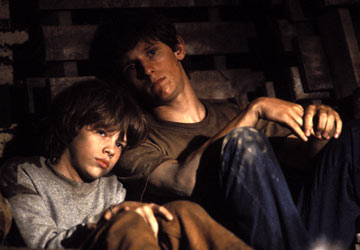
The story follows two brothers—16-year-old Chris (Jamie Bell) and 10-year-old Tim (Devon Alan). Chris is a rebel who is constantly in trouble with the law; Tim is a little weirdo who has habits of eating things like mud and paint, and also “organizing my books by the way they smell.” They live in a rural area of Georgia with their widower father John Munn (Dermot Mulroney), so out-of-the-way from society that they can’t even have friends—the only ones to celebrate Tim’s birthday are Chris and Dad.

Their lives are interrupted by John’s brother Deel (Josh Lucas), who hasn’t been in contact with his brother for years—he didn’t even know John had two sons. Deel is said to be a wild card, having been in prison for a mysterious reason. John believes Deel wants to do right from now on, so he lets him stay at the farm and work. But Deel is more sinister the more times he becomes acquainted with his two nephews, particularly Chris—there’s a scene in which he intimidates him while speeding in his nice car and saying things like, “I knew your ma first; she was my girl.”

There’s a rare gold collection said to be the gold drachmas that are good for admission across the River Styx into Hades when you die. The collection was given to John by his father, and has hidden them somewhere in the house. That’s exactly what Deel is here for—nothing more, nothing less. But after a violent incident, Chris and Tim run away from home with the gold coins, with Deel searching for them.

Chris and Tim trek along some desolate Southern landscapes and come across some very original individuals, including a young black couple who are accustomed to their rural lifestyle most comfortably and take the boys in briefly. Later, they also come across a camp for homeless people, mainly young people who have nowhere to go.

The story is somewhat similar to “The Night of the Hunter”—children go on the run from a violent man for greed, and they come across unique characters along the way—and the look of the film is as unusual. Also in mind when Green was coming up with the idea, as he said at the Toronto Film Festival, were stories by the Grimms, Mark Twain, and Robert Louis Stevenson, as well as Capote’s “In Cold Blood.” Legends and fairy tales take up a lot of the movie’s spirit and dialogue—the legend of Charon and the River Styx and that old tale about writing a wish on a piece of paper and throwing it inside a bottle into a river. There are many monologues as the boys venture through these desolate, haunting Southern landscapes that it reminds of a film made by Terrence Malick (he actually is a co-producer for the film).

What do I mean when I say David Gordon Green might be “experimenting” with “Undertow?” Consider the opening-credit sequence—there are different video filters (even negative, of all filters), pauses, slow-motion shots, and everything else that can be toyed with, all in a chase scene. As if using all of those editing tricks wasn’t enough, the chase itself is just bizarre. It introduces Chris as he breaks the window of his girlfriend’s bedroom, causing her father to chase after him. It’s a merry chase until Chris, barefoot, accidentally jumps and lands on a nearby wooden plank with a nail sticking out of it. It’s even less pretty to see as it is to hear—it’s a very painful moment. And then, Chris continues to hobble along on his way, with the board still attached to his foot.

And that’s just the beginning of the movie! Trust me; it gets just as strange, if I haven’t already made that point.

Hearing the storyline, one would get the idea that this is a chase picture. But it’s not, in the conventional sense. David Gordon Green doesn’t go for the kicks; he goes for the dread, despair, and menace of the situations—fitting, because they match the landscape.

Jamie Bell, a young British actor (from “Billy Elliot”), has no trouble perfecting his American accent nor does he have trouble making us feel sympathy for Chris. Devon Alan suits the role of Tim well. Dermot Mulroney has a reassuring presence as the boys’ father, and Josh Lucas, playing against type, is certainly menacing as Uncle Deel.

What have I left out? Only the music, I hope. The film is covered by an ominous music score by Philip Glass that gets deeper as the story continues. It’s a chilling, non-comforting score that’s perfect for the film.

There is a chance I may have left something out from “Undertow.” But if there is, you can discover for yourself exactly how unusually thrilling this film is. However, I must warn you that this is not a film that’s easy to watch. It’s the kind of “Southern Gothic” tale that leaves audiences with an uneasy feeling. I won’t lie; it left me uneasy too. “Undertow” is strange, unusual, unbelievable, unnerving, dark, unsettling, disturbing…and I loved every minute of it.

Tuff Turf (1985)

25 Feb

images

Smith’s Verdict: *1/2

Reviewed by Tanner Smith

“Tuff Turf” was supposed to be the ‘80s version of “Rebel Without a Cause” and “West Side Story” in that it features teenage hoodlums and a heavy soundtrack. In this case, it’s a confusing bunch of youngsters and an obnoxious rock soundtrack that help make “Tuff Turf” one of the worst, most unpleasant teen movies to come around in the ‘80s.

The strange thing is that it starts out all right. In fact, I really liked the opening scene in which the local teenage gang is mugging an innocent bystander when a kid on a speeding bicycle comes along and is able to foil them, and get away fast. That was inspired and amusing. I was interested in seeing where this was going.

That kid is the protagonist of the story, named Morgan (James Spader), a preppy, rebellious teenager who has moved from Connecticut to the San Fernando Valley after his father lost his business and has taken a job as a taxi driver. Morgan attends his new school, where that same gang from the other night also attends. They’re out to get him, to humiliate him. They thrash his bike. Morgan could have fought back, but he chooses not to because his family keeps telling him that he brings trouble everywhere he goes. But the gang leader’s girlfriend (Kim Richards) catches Morgan’s eye, and his charm turns her on, leading to more danger from the gang.

James Spader and Kim Richards are likable actors, but their characters continue to make one stupid decision after another, just because the plot demands it. What infuriated me about the Richards character was her bizarre motivation (if there was any sort) for choosing to marry the gang leader, after she has realized that she likes Morgan and that the gang leader has treated her like scum.

The soundtrack to the film is just terrible. I wouldn’t even mind half of the rock songs that play throughout the movie, except that they’re all pretty bad. They’re not catchy, nor are they very memorable, except for a terrible cover of the Beatles’ “Twist and Shout.”

There’s one nice scene in the middle in which Morgan, the girlfriend, and their friends (including one played by Robert Downey, Jr. who is appealing, but not used enough) sneak into a country club, and Morgan sings a pleasant song while playing the piano. After all the loud, annoying rock music that has stormed over the film, it was nice to have a quieter, more pleasant music piece.

The film descends into complete madness in the final showdown between Morgan and the gang. It’s so badly-handled, so over the top, and so sadistic that it makes the central fight in “West Side Story” look supervised. What is this movie trying to say with its ending? Violence is the easy way out? There is nothing to gain from this ending—it’s another one of those “if the villain is dead, everything will be fine” climaxes. And what’s worse—the movie laboriously tries to regain its somewhat-light tone by taking us back to a night club immediately after the final fight. Here we are again, it’s fun, we’re hanging out with Morgan and the girl who seem happy together. Then what happens? The credits roll. I have never felt so angry about an ending quite like this.

“Tuff Turf” didn’t know what it wanted to be, so I don’t know what to take more from it. I felt unclean right after I watched it. This movie needed a serious script doctor, a better editor, and much more engaging material for James Spader, who’s actually pretty good in this movie under the circumstances. “Tuff Turf” is a shallow mess.

Heaven Can Wait (1978)

25 Feb

220px-Heaven_can_wait_poster

Smith’s Verdict: ***1/2

Reviewed by Tanner Smith

How Warren Beatty, Buck Henry, and Elaine May were able to take grim material and write it into a feel-good movie like “Heaven Can Wait” is beyond me, but it works. This is a sweet, lighthearted fantasy with some good laughs and sweet moments, despite most of the material having to do with death and murder.

Let me explain—the main character has died before his time and has to go back to Earth in another person’s body, so we get a montage of events for the character to choose somebody. With each turndown, there’s a death. This should be grisly, but the way it’s executed makes it funny. And when he does find a body, there’s a subplot involving people who supposed to be his assistants (one of which is his wife) that attempt to kill him. Grisly? Possibly.

Funny? Yep.

The film stars Beatty (who also co-wrote directed, along with Henry, May, and Robert Towne) as Joe Pendleton, a backup quarterback for the Los Angeles Rams. He’s a chipper young fellow, is more than physically fit, and his team is headed for the Super Bowl. But while riding his bike through the Mulholland Drive tunnel, he collides with a truck and dies…or does he?

Joe finds himself at a way station in the afterlife with his guardian angel (Henry) and the mysterious Mr. Jordan (James Mason). Joe is told that he died, but he believes there’s been some sort of mistake. And he’s right—as it turns out, the angel was on his first assignment, guarding Joe, and mistook the outcome of the incident in the tunnel for Joe’s imminent death. So, Joe was taken before his time and would like to return back to Earth. However, his body has already been cremated and so he must find a new body (someone who is supposed to die, and this is where we get that montage I mentioned).

Joe finds himself in the body of millionaire industrialist Leo Farnsworth, who had just been poisoned by his wife Julia (Dyan Cannon) and his personal secretary Tony (Charles Grodin), who also happens to be Julia’s lover. Mr. Jordan, the angel, and we (the audience) see Joe as Joe, making it easier for us to follow his character—everyone else in the movie sees Joe as Farnsworth, making for some comedic moments of confusion for them. He’s now in charge of the company, which is confusing for him already. But once he gets the gist of it, he’s able to get through to his executives through football talk. He puts an end to the pillage that seems to come through with the company.

Eventually, Joe is able to convince his long-time friend and trainer Max (Jack Warden) who he really is. So Max can help Joe get this new body into shape so he can play for the Rams (after he buys the team), and play in the Super Bowl. Meanwhile, there’s a romance he develops with an environmental activist, played by Julie Christie. He likes her a lot, and the feeling becomes mutual—she hated Farnsworth’s policies and actions, but falls for Joe’s easygoingness.

“Heaven Can Wait” has a lot of fun with its story gimmicks, and provides a lot of laughs while keeping the audience ahead of the show. And like I said, there’s a great deal of cheerfulness that makes everything easier and more appealing.

The funniest parts of the movie revolve around Dyan Cannon and Charles Grodin, who are absolutely hilarious as the main reactors to most of the stuff going on with Farnsworth (not knowing it’s really Joe in his body). Of course they’re surprised and confused that their murder scheme didn’t work and as Cannon freaks out and screams at the top of her lungs, Grodin must calm her down, even though Cannon doesn’t want him to cover her mouth to keep her from exclaiming loudly. And of course, they must try again to murder him swiftly when Joe makes silly decisions.

Jack Warden plays the role of Max very well and has his share of good moments as well, and the same can be said for James Mason and Buck Henry as Joe’s invisible (well, visible only to him) advisors. Warren Beatty is possibly too sincere as Joe (though he is likable for us to follow him). But Julie Christie, as appealing as she is, doesn’t do enough with the nothing role of the love interest.

The ending doesn’t work well for me. It seemed too odd and also kind of contrived. I guess it’s the obligatory happy ending, but I’m just not pleased with the resolution. Without giving it away, it just didn’t do anything for me.

“Heaven Can Wait” is a fun screwball comedy mixed with afterlife-fantasy, mixed with somewhat-macabre material.

The Artist (2011)

24 Feb

video-artist-anatomy-articleLarge-v2

Smith’s Verdict: ****

Reviewed by Tanner Smith

“The Artist” may be the subject of many cynics who haven’t even seen the movie yet. There’s no point of trying to figure out why. It’s clear that people without a high outlook on film (early film, in particular) aren’t interested in seeing a silent film in black-and-white. Yes, “The Artist” is the first silent film released in cinemas since Mel Brooks’ 1976 satire “Silent Movie.” And it doesn’t just pay homage to the silent film—that would be understating it, really. It really does tell a story with emotions, movement, and music…and it happens to be presented in black-and-white, filmed in 1.33:1 ratio, and mostly without a sound or line of dialogue. Oh, there are subtitles—83 of them, if I counted them all.

“The Artist” does start out as homage to silent film, and a wonderful one at that. It starts with the lay-about opening credit cards and even begins the story in 1927 as a silent adventure film is shown within this silent film. This film within the film is wonderful on its own. It has the same energy and spirit that most adventure films back then. It stars George Valentin (Jean Dujardin), the world’s number-one silent-film star, who knows his fame and wallows in it. He seemingly has more power than the directors and producers who cast him.

After the film’s premiere, George poses for a photograph with an attractive fan—a young dancer named Peppy Miller (the radiant Berenice Bejo). Peppy decides to try acting and appears as an extra in George’s next film. But it turns out that Peppy is about to have the same amount of fame that George has. You see, silent films are making way for “talkies” (sound movies), which, for George, means his career is over. His executive producer (played by John Goodman) breaks the news that the studio is all about sound now.

George doesn’t realize what’s to become of him until he funds his own film, which ultimately flops. Peppy’s new starring role in a talkie, however, gets everyone talking (forgive the pun). She’s a star now—she’s headlining the newspapers, people are raving about her radiance, and she’s become America’s sweetheart. She stars in film after film, but George is in financial trouble, even going as far as to selling all of his possessions. He also fires his loyal chauffeur Clifton (James Cromwell), leading to a heartbreaking goodbye: “But I don’t want another job,” as a subtitle (and Cromwell’s face) states. But since George got Peppy interested in acting and is also responsible for her beauty mark above her lip (brushed upon, mind you), Peppy still cares for George and tends to him when he most needs help.

The first half of “The Artist” is lovable—I can’t tell you how much I was enjoying myself. I was laughing quite a lot (some of them came from the antics of George’s well-trained dog), but mostly, I was smiling. The orchestral music that plays throughout, composed by Ludovic Bource, is a definite tribute to music telling a story. But the music isn’t only what helps make the film come alive. If it did, I’d be criticizing the acting. But all of the actors are forced to carry their character’s emotions, use excessive body language, and make it all credible. And because the film is shot in this 4:3 ratio, it gives the actors opportunity to make use of their limited space.

Then the second half develops into something stronger, as George Valentin’s life goes down the drain. It’s telling a story. I cared about this suave, likable guy and was hoping that he can catch another break to get his life on track. All this man knows is the entertainment value he put into his work and the appropriately-named Peppy would like nothing more than to bring it back for him, while her own fame is increasing. This is all very strong and very well put together. There’s one scene in particular that really got me—it’s midway through the movie and George has realized what little he has in life anymore, so he tears apart all of his films and burns them. The music and acting bring about the sheer intensity of the scene. And that’s not the end of the film. I wouldn’t give away how everything turns out, or even if everything works out, but it’s all very fitting for the film.

True effort was put into “The Artist” to make it into something special. Everything, from the script to the execution to the acting to the music to the overall spirit, adds to the charm and whimsy of this treat of a movie—enjoyable, entertaining, and beautiful. I love this movie.

Rocky (1976)

24 Feb

rocky-1976-film-rocky-balboa-vs-apollo-creed-first-match

Smith’s Verdict: ****

Reviewed by Tanner Smith

“Rocky” is a true underdog story, inside and out. By that I mean the movie is about a novice boxer getting a shot at the title, and this involving, excellent film beat the odds and became the little film that could. It was written by Sylvester Stallone, who had many rejected screenplays, but caught the attention of United Artists with his screenplay for “Rocky,” which was mainly inspired by the 1975 Muhammad Ali-Chuck Wepner fight. Stallone set to attach himself as the star, while United Artists wanted to go with James Caan. So, the skeptical United Artists gave the production a smaller budget, around $1 million. And then when the finished film was released, it received great reviews, word-of-mouth, and ten Academy Award nominations, winning three (Best Film Editing, Best Director, and the coupe de gras—Best Picture). “Rocky” had beaten the odds.

“Rocky” is a great film that deserved all the attention it got, and the respect that it continues to get, as one of the best sports films of all time. But while “sports film” can technically by the accurate term for “Rocky,” it’s also a great portrait of a hero, and a tender love story. Either way you look at it, it’s very effective.

Rocky Balboa (Sylvester Stallone) is a small-time boxer who boxes for money to make ends meet. He lives in a small apartment in inner-city Philadelphia and works as a collector for loan shark Gazzo (Joe Spinell). Rocky could’ve been a great, well-known fighter, but blew it all away. But all that’s on his mind is winning the heart of Adrian (Talia Shire), the shy sister of his friend Paulie (Burt Young). She works at the pet shop, sold Rocky a couple of turtles and goldfish, and is amused by Rocky’s at-least-attempt at humor. But she’s painfully shy and isn’t sure about going out with Rocky.

After some harsh action by Paulie to get her out of his house, Adrian goes on a date with Rocky on Thanksgiving night. They hit it off really well as Adrian finds that Rocky is a good person and steps out of her shell to give him a chance. One of the more tender scenes in the movie is when Rocky arranges for ten minutes of ice-skating (she skates, he jogs alongside her) and talks about how his father told him to develop his body rather than his brain—Adrian says that her mother told her the opposite thing; to use your brain rather than your body. She then asks Rocky why he fights, he replies, “’Cause I can’t sing or dance.”

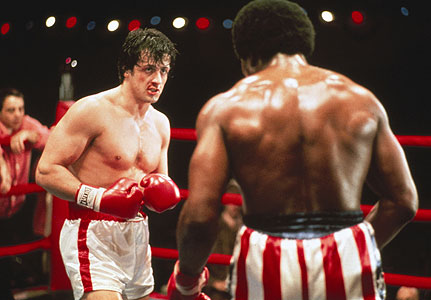
Meanwhile, world heavyweight champion fighter Apollo Creed (Carl Weathers) decides to schedule a New Year boxing event with a true underdog to go against. While looking for possible candidates, he picks Rocky only because he likes his stage name “Italian Stallion.” Rocky is asked to do it. At first, he doesn’t believe that he’s going to be the opponent of the heavyweight champion—he thinks he’s going to be a sparring partner, until he realizes that the winner of this fight gains the World Championship title. Rocky doesn’t care that much about winning, but about gaining self-respect for his future by giving the fight his all and winning Adrian’s heart. With help from boxing coach Mickey (Burgess Meredith), Rocky goes into training in preparation for the fight, while also developing his relationship with Adrian further.

The film is about using your chances to your advantage, standing by your loved ones, overcoming your regrets and lost opportunities, and pushing your potential to the best you can achieve. Now, if that makes “Rocky” sound very corny or cheesy, it’s not like that at all. Just about everything—every story element, character trait, etc.—is done right; handled delicately with a true affection for the characters, an emotionally involving feel, and many twists and turns as the film progresses. We care about the setups and payoffs involving the characters, thus making us care about the relationship and the big match. A lot of credit for that must go to Stallone for making us feel emotionally involved in everything that’s going on, and also for turning in a truly excellent performance as the hero Rocky. He’s tough and uses brawn instead of brain, but is truly a good guy with a heart of gold and hardly an ounce of cruelty. We can easily sympathize with Rocky.

The nitty-gritty look of Philadelphia helps make “Rocky” seem credible, as Rocky walks along the sidewalks at night, passing by some quirky characters who sing at the curb as well as some creeps that he, at one point, tries to keep a twelve-year-old girl from hanging around (her response—“screw you, creepo”). And the supporting characters like resentful Paulie and relentless Mickey complete the circle with blends of anger and spirit.

By the time we reach the final fight that’s been set up, it means everything. In the end, it doesn’t matter who wins and who loses—as clichéd as it is to write, it’s how it’s being played. Even if Rocky loses the fight, he gains more in life. That’s one of life’s simplest lessons that “Rocky” gets across—there’s more important things in life than winning. And it doesn’t merely rely on sports-film clichés to get that message across.

With a captivating hero and a sharp screenwriter (both the same person), nicely-portrayed supporting characters, and emotional involvement, “Rocky” is a triumph. It’s the little film that could…and ultimately did.

Do the Right Thing (1989)

24 Feb

images

Smith’s Verdict: ****

Reviewed by Tanner Smith

Spike Lee is a director that tackles controversial subjects and brings them to independent films that go beyond the usual mainstream prospects. He loves to speak valuable issues through film and brings everything he can get to the screen—even if it’s light comedy to contrast the heavier material. Lee is a prominent voice in American cinema and his third film, “Do the Right Thing” (following “She’s Gotta Have It” and “School Daze”), was the one that made him known as the risky filmmaker with the eyes and the ears.

Oddly enough, “Do the Right Thing” is also the angriest and most aggressive of Lee’s films—showing racism head-on. He shows it like it is, rarely flinches at the subject at hand, and doesn’t resort to political correctness or sermons. He tells a story—he sets up the characters and allows set-up events to play out around them.

The film takes place in a 24-hour period in the Bedford-Stuyvesant area of Brooklyn, on the proclaimed hottest day of the summer. We meet many of the neighborhood locals as they go about their daily lives. Most of them meet at Sal’s Famous Pizzeria, which has been around for about 25 years. The owner Sal (Danny Aiello) has seemingly gotten used to working in a neighborhood mostly composed of African-Americans, and believes that whites and blacks can live together in harmony, though there are some hints of racism partially present. His two sons work with him—Pino (John Turturro) and Vito (Richard Edson). While Vito is easy-going and color-blind, Pino is a hot-headed racist who mostly uses vulgarities about the black customers that come in for pizza.

We also meet other characters such as—Sal’s pizza delivery boy Mookie (Spike Lee) who is hostile and bored, but responsive when he wants to be (there are times when he offers Vito advice not to listen to Pino all the time); Da Mayor (Ossie Davis), an old gentleman whom everyone else constantly ranks out because he’s constantly drunk; Mother Sister (Ruby Dee), the strict, self-proclaimed “high-and-mighty” elderly woman that Da Mayor tries to court; and Tina (Rosie Perez), Mookie’s girlfriend who cares for their toddler son Hector. Others start up the conflict of the story—particularly Mookie’s friend Buggin Out (Giancarlo Esposito) and mild-mannered, boombox-carrying giant Radio Raheem (Bill Nunn). Buggin Out notices that the pictures all over Sal’s pizzeria wall are all of Italian celebrities, and not one “brother,” and attempts to boycott the restaurant. He gets Radio Raheem to help him and this leads to a long day that ends with the occurrence of something alarming.

The film has just been a slice-of-life picture up until this final act, in which a fight occurs, a character dies, chaos ensues, and there’s a full-scale riot.

The title comes from a quote by Malcolm X—“You’ve got to do the right thing.” Let’s look at the facts here—Malcolm X is considered a leader and one of the greatest, most influential African-American leaders in history; a character named Smiley is going around trying to sell pictures of Malcolm X, as well as Martin Luther King, Jr.; and the film is centered around racial tension in the projects. I suppose we’d like to think that racism is toning down in our society, but as Spike Lee shows in “Do the Right Thing,” it’s always going to be present and it can sometimes spin things out of control. And it can be brought back to this simple statement—because of this, everyone in this movie fails to do the right thing. What is the right thing? Who does it? The way I see it, nobody does. That’s what makes it ironic and all the more credible and disturbing. We even have a character that we have come to like performing an action that makes the violent situation even worse than it already was. (By the way, props to that, because in a more mainstream movie, I bet someone we’ve come to hate would’ve done the exact same thing.)

This is what Lee sees and that’s what he brings to the screen, while having his own understanding of what’s happening. This film is not trying to offend races—it’s not anti-white, nor is it anti-black. It just shows how misunderstanding and racial tension would/could lead to violence.

The oddest thing about the movie is actually the most interesting—amongst the angry, aggressive tone that’s felt throughout the movie, the filmmaking is so lively. The camera focuses on many images, a rocking soundtrack is present in a lot of scenes (Public Enemy’s high-powered “Fight the Power” serves as the film’s anthem, especially in the opening-credit sequence, featuring a young woman dancing in the street), the colors stand out, and just a thrilling sense of entertainment. How can you describe a film like this? It’s so angry, so aggressive (sorry for repeating myself here), and yet so damn entertaining. Also, the performances each have a high power to them—particularly Danny Aiello, Ossie Davis, John Turturro, and Spike Lee himself (he’s actually a pretty good actor).

So maybe there isn’t a solution to the racism problem in society that we can find in “Do the Right Thing,” but there’s not supposed to be. What Lee is trying to do is bring the problem to realization, if it hasn’t been realized already. This is a film that’s trying to say something and throwing all it can to make you listen. That’s a film to be duly noted, in my opinion.