Archive | February, 2013

Running on Empty (1988)

5 Feb

MSDRUON EC021

Smith’s Verdict: ****

Reviewed by Tanner Smith

Children, and even teenagers, sometimes feel like they’re being punished for crimes they didn’t commit. In the case of Danny Pope, they don’t know the half of it. Here’s this kid who has not only moved from place to place, but also changed his entire identity countless times, along with his family. He’s living in a world of secrets and hiding. He can pretend to lead a normal life, every time he moves to a different place and engages a new identity, but he never truly will. And it’s all because of his parents.

Danny has kept an enormous secret with the family. Before he was even born, his parents were radicals in the ‘60s. They blew up a napalm laboratory, nearing killing a janitor whom they didn’t know would be there. Since then, they’ve been living underground, hiding from the authorities and raising Danny and his younger brother to their same lifestyle. Every time it seems like their identities are discovered, the Pope family moves away to create new ones.

The Pope family are the central characters in the film “Running on Empty” and it tells the story of how Danny (River Phoenix), now a high school senior, would love to live a normal life, for once. He’s a gifted piano player and has finally shown his gift in this new town to his music teacher at school. With the teacher’s help, Danny gets a scholarship to the Juilliard School. But he can’t accept it, because then he would have to abandon his lifestyle and leave the family.

For Danny, this is his chance to actually become an individual. Why must he pay his parents’ mistakes? Why shouldn’t he go out and live his own life, now that he’s turning 18? For his parents, it’s a real complication. His father Arthur Pope (Judd Hirsch) is a real hard-ass who has kept the family in line for years and is not about to mess it up now. He either doesn’t understand Danny’s plight, or simply doesn’t want to understand. Then, there’s the mother Annie Pope (Christine Lahti), who has made her mistakes and barely regrets them because she did what she felt she had to do, back in the time when radical politics were hers and Arthur’s lifestyle along with others in the ‘60s. What she does care about, and what causes her heart to break, is the fact that Danny would be sacrificing his future if he stays hidden, paying for mistakes that she made. She doesn’t know if she can handle it. The big issue is that if Danny comes clean and goes to college, he can’t see his family again because he may just have the FBI following his every move—who knows?

This is all powerfully well-done and very effective in the way this family’s lives are developed and how their plight is legitimately told. We see it right away in an opening scene in which the family must leave another town—they leave their dog on the side of the road and drive away, and it feels like this isn’t the first time they’ve done this. Then there’s the situation of Danny gaining more than he did in previous lives—not only with his music and the college scholarship, but also with his first girlfriend (Martha Plimpton). She’s the daughter of the music teacher and together, they form a trusting relationship in which there are hardly any secrets, leading to the scene in which Danny finally confesses and tells her everything she wanted to know about him—how it begins: “My name isn’t Michael…It’s Danny.”

The emotional high point of the film comes during the question of whether Danny will go to the school. The film’s strongest scene features Annie arranging to meet her father (Steven Hill) for lunch—she hasn’t seen her father for years, since she disappeared from his life completely. Now she must ask him to take her son away from her so that he can live the future that she has denied herself. It’s a very heartbreaking scene.

“Running on Empty” is an extremely moving drama about choices and about consequences. It’s well-acted, especially by Christine Lahti and River Phoenix (who, despite his character’s story being told, was only given a Best Supporting Actor nomination), and well-executed, with direction by Sidney Lumet and a great screenplay by Naomi Foner. This easily could have been a throwaway melodrama made for TV, but it’s smarter than that. It’s played in a realistic way and is specific in exactly what it’s trying to convey. It’s a great film.

Cujo (1983)

4 Feb

images

Smith’s Verdict: **

Reviewed by Tanner Smith

Reportedly, Stephen King was drinking rather heavily when he wrote his novel “Cujo,” about a rabid killer dog, and apparently has no recollection of writing it. I don’t know what mood he was in when he wrote the novel, but he must’ve had it pretty bad, for him to drink so much. What other excuse would there be for Stephen King to create such an uncomfortable story? I realize the point of horror stories is to unnerve and scare, but “Cujo” goes too far by basically taking a friendly, gentle dog and turning it into a vicious killing machine. Being a dog lover myself, I speak only from a personal standpoint. And that’s pretty much how this review of the film adaptation of the same name is going to be. If you think you’re going to be annoyed by my objections, I suggest you stop reading.

I can’t necessarily knock the novel, as I haven’t read it. But I can knock the movie instead. The idea for this story is one of the cruelest for a horror story, possibly worse than a story about a psychotic killer child. It begins in a cruel way, as the lovable 200-pound St. Bernard named Cujo (what kind of name is that, anyway?) playfully chases a rabbit across a field behind his owner’s house, at the end of a dead-end road. Next thing he knows, he gets his head stuck in a small cave full of bats and actually getting himself bitten by one of them.

Cujo isn’t feeling very well and hasn’t gotten his rabies shots. As days go by, he seems to get worse and worse. And here’s one of the problems with logic in the movie—neither Cujo’s young owner nor his parents seem to notice the nasty bat bite on the poor dog’s nose. If they did, Cujo wouldn’t get rabies and we wouldn’t have a story. And surely enough, Cujo becomes rabid and vicious. He kills the man of the house, mechanic Joe Camber (Ed Lauter), and a friend (Mills Watson). This leads us to the second half of “Cujo,” in which Donna Trenton (Dee Wallace, giving the best performance in the movie) and her five-year-old son Tad (Danny Pintauro) drive out to the house, in the middle of nowhere, in a faulty Ford Pinto. Surely enough, they are trapped in the car by the newly-formed beast, because the car’s alternator dies.

This is actually the part of the movie that is admittedly suspenseful. I consider myself a sucker for movies that feature characters limited to one spot—the claustrophobia and vulnerability aspects make for effective terror. Donna and Tad are trapped for days, knowing that Cujo will somehow make his way into the car to get them. The owner is dead, the others have left, the mailman isn’t coming around anytime soon (because mail is supposed to be on hold for a while), and no one knows where they are…except Cujo. This is a convincing setup and has some tense, frightening moments. It’s just too bad we had to see this formerly cute dog transformed into a monster in order for it to come about.

What does “Cujo” really amount to? Is it telling us to make sure that our dogs have all of their shots? Well, that’s effective enough, but you’d think that that would have happened already. Basically, “Cujo” requires its characters to be idiots for all of this to happen in the first place, and even the protagonists aren’t all that bright, as Donna just continues to stand around while trying to escape, even after given enough time to see if the coast is clear.

As hard as it is to admit, the dog isn’t consistently convincing. Sometimes it’s vicious enough, but other times it just looks like a dog playing around with snarling-dog sound effects. It doesn’t matter how bad they make the dog look after it transforms into the killer dog, drenching him with blood and foam (speaking of which, I felt sorry for the dog having to go through all of that). Whatever Stephen King was thinking when he wrote “Cujo” and inspired this movie, I can only say that this deserves to be put down.

At Close Range (1986)

4 Feb

At-Close-Range-1986-Christopher-Walken-pic-7

Smith’s Verdict: ***1/2

Reviewed by Tanner Smith

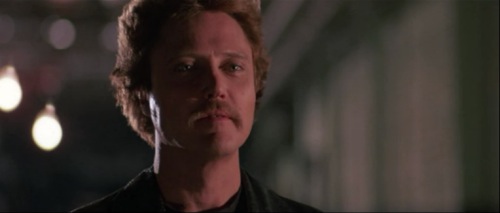
“At Close Range” tells a sad, cruel, merciless story about a boy who respects his father who would just as soon kill him in order to save himself. And as a movie, it’s violent and unforgiving, but it’s also powerfully acted and very effective. Even more shocking is that it’s based on true events that occurred in 1978.

Sean Penn stars as young Bradford Whitewood, Jr., a rebellious young misfit with little to no potential and lives in a life of untidy poverty in Tennessee with his divorced mother, grandmother, and half-brother Tommy (Christopher Penn, Sean’s real-life younger brother). Two very important people come into his life (or one of them actually back into his life). One is a neat farm girl, named Terry (Mary Stuart Masterson), whom he meets and starts hanging out with. Another is Bradford Whitewood, Sr. (Christopher Walken), his criminal father who only comes in every now and then to give money. Brad Sr. seems to be doing all right for himself, as Brad Jr. notices. Brad Jr. wants to know more about him, so he decides to live at his place with his gang of professional thieves. Brad Jr. isn’t necessarily the criminal type, but he is reckless, as we saw in an opening scene where he deals unusually and effectively with a man who cheated Tommy and a buddy of his out of a bottle of liquor. He decides he wants a taste of his father’s gang’s action, since it seems a lot more exciting than what he has now. So he rallies his own gang—Tommy and his friends (Stephen Geoffreys, Crispin Glover, and Kiefer Sutherland)—and Brad Sr. assigns them to perform easy robbery tasks for them, in order to prepare for the big stuff that they want to try sometime. But while Brad Jr. is in orbit around his father’s world, his relationship with Terry, who becomes his girlfriend, strengthens and he’s hoping Brad Sr. will “come up with some money” in order to provide a place for him and her to live. However, he finds that Brad Sr. is more than a robber, but that he’s a sick, twisted killer who kills anyone who gets in his way. Brad Jr. learns the hard way when he witnesses Brad Sr. shoot a former member of his gang in the head at close range. Then, things get more dangerous when Brad Jr.’s gang messes up on a job and are busted. Brad Sr. knows that he and his own gang will be connected to all of this, and ultimately decides to take drastic measures to save himself. This also means betraying his son, to kill him if need be.

Brad Sr. is a ruthless S.O.B. and Christopher Walken shows the dark side with intensity. This is one of Walken’s best performances in a film—he has a great ability to move between easygoingness to straight-up malice, and it really comes through in this film. Sometimes he can be a wise guy, as when he enjoys the fact that Brad Jr. idolizes him and plays around it, acting like a big shot most of the time. But when he’s mad, he can turn into a truly evil creature of a man. And he won’t care whom he has to kill to save himself.

“At Close Range” is sometimes an uneasy film to watch. It’s not pleasant or particularly charming, except for the first scenes featuring Brad Jr. and Terry (their relationship is the only sweet part of the movie). It’s very violent, especially in the final act, and seems to glamorize the lifestyles of this gang of violent criminals that Brad Jr. wants to be a part of. And when things go very wrong, the movie still doesn’t let up. But it also makes “At Close Range” an effective portrait of human nature while also delivering the much-needed subtle message against violence and gun use.

Sean Penn is excellent as Brad Jr., creating a conflicted young man caught between two worlds—the nice little world he shares with his girlfriend and the mysterious world with his father that later becomes life-threateningly violent. He’s perfectly natural and very strong in the role.

Maybe “At Close Range” isn’t the movie for you, if you don’t like violence or think this story is too much. But I think it is worth seeing for the performances by Penn and Walken. These are two of the brightest, strongest actors who deliver excellent performances.

On Golden Pond (1981)

4 Feb

images

Smith’s Verdict: ****

Reviewed by Tanner Smith

SPOILERS THROUGHOUT REVIEW

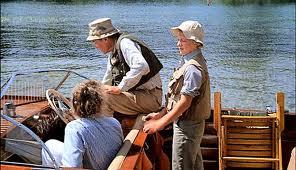
“On Golden Pond” is a collection of brilliant short segments that wraps around at the end so that the film has a linear story structure. It has a story with a beginning, middle, and end, but even between them, if it’s possible, the story has its own wraparound with the two central characters—an elderly couple who love each other to death.

The couple is Norman and Ethyl Thayer (Henry Fonda and Katharine Hepburn). They’re long-married and still share strong simple affection for each other. But Norman is feeling like he’s getting older and it seems that she’s the only thing in his life that matters anymore. That’s good enough for him, since he gripes about everything else.

Anyway, as the story opens, Norman and Ethyl arrive to their lakeside summer cottage near Golden Pond. It’s here that we see Ethyl’s free-spiritedness that apparently stays with age, and Norman’s shyness and stubbornness towards pretty much everything, even Ethyl. He knows he’s getting older and we suspect that he doesn’t see what one more summer at this old place will do to him anymore. But Ethyl assures him that he’s her “knight in shining armor” and will always be.

That’s the opening segment of the film, which could make for a short film of its own. By the time it gets to that pivotal scene, we feel like these two characters have been developed and we like them almost as much as they like each other. But this is just the setup for the real story, which begins as Normal and Ethyl’s grown-up daughter Chelsea (Henry Fonda’s real-life daughter, Jane Fonda) arrives to the cottage to celebrate Norman’s birthday. She brings along her new boyfriend Bill (Dabney Coleman) and his thirteen-year-old son Billy (Doug McKeon). And this is where the conflicts are established. We discover that Chelsea feels resentment towards her father, as Norman has never really given Chelsea her due. It’s as if he really wanted a son to bond with, or he just never really understood how to be a father.

The midway point arrives as Norman and Ethyl agree to let young Billy stay with them while Chelsea and Bill take a trip to Europe. Of course, with no TV and no “chicks” to “cruise” (he’s from San Francisco, where he and his friends “cruise chicks”), the kid acts like a brat. But with some pushing from Ethyl, Norman takes the kid fishing, and the two develop a sort-of father/son relationship together. They bond together, share communication, and trust each other. Later, Norman has learned how to be a father.

By the time Chelsea returns to pick up Billy, she notices the friendship between her father and her new stepson (she married Bill in Brussels, as it turns out), and is even more resentful because Billy is having the relationship with Norman that she never had. But maybe there’s still time for reconciliation.

When Norman and Ethyl are alone again at the cottage, the story ends with the payoff of Norman’s realized mortality. Even though it’s predictable, it’s touching nonetheless. When “On Golden Pond” is over, we feel like we’ve spent time with warm, appealing characters in a peaceful place like Golden Pond. The emotions are there and you feel good about yourself while watching this film.

The performances are first-rate. Henry Fonda and Katherine Hepburn share amazing chemistry together and share distinct characteristics that make them memorable. A lot rides on these two veteran actors and there’s nothing short of greatness for them. Jane Fonda acquits herself nicely to the role of Chelsea, Dabney Coleman shares a great scene with Henry Fonda about asking permission to sleep in the same room as Jane (the questions and reactions are just fantastic), and Doug McKeon does more than expected with the plain role of the kid—he starts out as a bratty tyke, but becomes likeable as his coming-of-age story continues.

I heard that this is the only film featuring Henry and Jane Fonda together. Maybe some of the character Chelsea’s resentment is reflected from a possible, similar relationship between these two. Whatever the case, having this father and daughter together in the film just adds to its effect.

“On Golden Pond” deals honestly with its issues of relationships, resentment, realization, and mortality, while also showing that life can be beautiful, even if things don’t go as planned. With great acting, nicely staged scenery, and a darn good screenplay, “On Golden Pond” is a real treasure of a movie.

The Iron Giant (1999)

4 Feb

tumblr_l6kz3yqDII1qzoa9f

Smith’s Verdict: ****

Reviewed by Tanner Smith

1999 brought a string of first-rate animated features, four of which in particular stood out among the rest, in my opinion. One was “Princess Mononoke,” a feature of Japanese-style animation. Another was the computer-generated “Toy Story 2.” But definitely not the least of these movies are hand-drawn animations Disney’s “Tarzan” and Warner’s “The Iron Giant.” “The Iron Giant” is the subject of this review, and it’s a wonderful movie—well-crafted, entertaining, funny, charming, witty, wonderfully-drawn, and just a joy to watch.

“The Iron Giant” mixes certain elements from science-fiction thrillers from the 1950s (such as “The Day the Earth Stood Still”) and brings to a level not unlike a “boy and his pet” story. In this case, it means that a giant metal robot man from outer space crashes down to Earth and is befriended by a young boy who vows to keep him hidden from the government and the Army. This giant robot could have been a threat to society (and we see that it can become a deadly weapon when it reacts to being fired upon, even by a toy space gun), like in the traditional sci-fi thrillers. But with help from a well-meaning little boy, he becomes a harmless being that learns as it goes along its journey on Earth. The boy describes him as Superman, in that he too has crash-landed on Earth without knowing why and using his power for good instead of evil—although, there’s another comic book character called Atomo which resembles the giant in every way except that he’s the villain instead of the hero. Will the giant continue the path of the hero?

The movie takes place in the mid-1950s, suitably enough. The hero boy’s name is Hogarth Hughes (voiced by Eli Marienthal). Hogarth lives in Rockwell, Maine, and would like to have a pet, which his mother (Jennifer Aniston) won’t allow. One night, while Mom is working late, he’s watching cheesy monster movies when his TV antenna suddenly disappears, which Hogarth suspects as the workings of “invaders from Mars.” So he goes outside to investigate, when he finds the giant robot. The robot is about fifty feet tall and can only eat metal. When it tries to eat a power station and is nearly electrocuted by the wires, Hogarth arrives in time to save him, thus beginning the friendship between the two.

“My own giant robot! I am now the luckiest kid in America!” Hogarth proudly exclaims.

The giant won’t hurt the boy, and Hogarth believes he isn’t here to hurt people. He takes it upon himself to teach him certain things, like how to speak, and also to try and keep it a secret. But unlike E.T., however, hiding a fifty-foot metal man is not going to be an easy task. This leads to many funny moments; my favorite being a scene in which the giant’s disembodied hand scampers around the house like a puppy dog as Hogarth desperately tries to get it out before his mom notices.

But as he finds somebody to trust with his secret—a beatnik junkyard-owner/artist named Dean (Harry Connick, Jr.), whose junkyard cars provide food for the giant—Hogarth also comes afoul of a sneaky, conniving, dastardly government agent named Kent Mansley (Christopher McDonald), who knows of the giant and is constantly questioning for Hogarth to find out what he knows about it.

This Kent fellow is a caricature of a G-man if I ever saw one. He doesn’t care about human nature, and even states out loud that if he doesn’t understand it, then it must be killed. He brings forth the U.S. Army to come and take out the iron giant, and doesn’t listen for a moment when Dean and Hogarth try to explain that it’s harmless if not fired upon. This is a heavy caricature of a government agent we’ve seen in other movies, but at least he knows it. And he does have a great final moment of comeuppance, which I won’t reveal.

The giant learns about friendship, the boy learns about tolerance, and everyone learns a certain expense that should or should not be made. “The Iron Giant” is a family film that teaches us all of these important lessons without ever being too preachy. And there’s a very strong anti-violence notion that comes midway through the film and continues in the final act, as the giant realizes that “guns kill” and just because the giant was possibly built for destruction doesn’t mean he has to be a weapon because as Hogarth puts it, “You are who you choose to be.”

The iron giant himself , voiced by Vin Diesel, is a lovable character. He’s well-designed and instantly appealing. This is a nice, gentle hunk of junk that we all come to care for and even feel sorry for. That’s saying something when you can make a robot lovable.

“The Iron Giant” is a delightful family film—wonderfully-crafted, nicely-animated, and surprisingly smart. It’s rare to come across a family film of this caliber, and when it comes around, it’s always welcome. I loved this movie.

Tuck Everlasting (2002)

4 Feb

images

Smith’s Verdict: ***1/2

Reviewed by Tanner Smith

“Don’t be afraid of death. Be afraid of the unlived life.”

These are the words said by Angus Tuck to Winnie Foster. Winnie is a teenager from a wealthy family who has stumbled upon the secret of the Tucks, a family living/hiding in the woods who hold the secret to eternal life. She has lived with the Tucks and fallen in love with Angus’ young son Jesse, who finally reveals the secret to her and would like to share it (eternal life, that is) with her.

As Jesse puts it, “I’m going to be 17 until the end of the world.” The Tucks didn’t choose to live this full life. They happened upon it—you see, it’s the spring in the middle of the woods that causes those who drink from it to become immortal. The Tucks were able to realize it later. And they do have their regrets. The oldest son Miles, in particular, has a tragic past and would prefer to die—but it can never happen.

Angus—the oldest in the family—tells Winnie that if she chooses to drink from the spring, she will live forever, but there will be things to miss, especially at her young age—much like Jesse, caught in limbo at more than a hundred years of age, but still in a 17-year-old body. So the choice is to live an everlasting life with the Tucks, or live a normal life with her family.

The question of immortality is the main strength of the wonderful family film “Tuck Everlasting,” based on the popular young adult novel of the same name. Maybe the term “family film” is somewhat unnecessary. Younger viewers may not think much of immortality because they already feel like they’re never going to die. But for older ones, it’s a remarkable concept. What would you choose if you were faced between a normal life and an everlasting one? What would you feel? You could say “yes” immediately, but would you think about it first? Some would, some wouldn’t. Winnie is given moments to think about a lot of things and only after does she make her decision. That’s how “Tuck Everlasting” plays out and as a result, the movie is thought-provoking and enchanting.

As it opens, Winnie (Alexis Bledel) is a teenaged rich girl who is tired of being kept inside her huge house with her overbearing parents (Victor Garber and Amy Irving) and wishes for something more in life. She runs away from home, into the woods, where she meets Jesse (Jonathan Jackson) at the spring. Jesse warns her to go away, but Winnie is stubborn and doesn’t leave that easily. It’s then that Miles (Scott Bairstow) comes along, sees her as a threat, grabs her, and takes her back to the Tuck home. Winnie is treated like a prisoner at first, to be sure she doesn’t go back and tell people where they are. But Winnie knows nothing of their true origins at the time, and opens up to their lifestyle.

A romance develops between Winnie and Jesse, and it’s developed nicely. It’s not cloying or forced—it’s sweet and innocent. By the time Winnie must make her choice, you genuinely wonder what will happen for them. Will Winnie stay with Jesse or will she leave him, knowing he’ll outlive her? There’s weight added to the question of immortality.

The Tucks are well-developed and have their own shadows and advantages. Angus and Mae (William Hurt and Sissy Spacek), the parents, are stuck in middle-aged bodies, but remain lively. Miles, stuck in the prime of his life, is the most tragic of the family, with a past revealed later that makes him more like a zombie stuck in a lifelike state without ever dying. Jesse is more like Peter Pan—never growing old, never dying, and forever young.

As if the choice of normality and eternity wasn’t enough, there’s a rising action featuring another character crucial to the story—a mysterious Man in a Yellow Suit (Ben Kingsley) who knows the Tucks’ secret and is determined to expose it. And of course, there’s the conflict of Winnie’s parents intent on finding their daughter, also risking the Tucks’ hideaway. These elements may be necessary, but they almost make the final act of the story seem somewhat overstuffed, with all the right payoffs.

But that’s a minor quibble, mind you. Ben Kingsley is suitably menacing in the role and the determination of the parents wanting their daughter back is realistic enough. However, Winnie’s important choice is the element that should address the most concern, in my opinion.

“Tuck Everlasting” is a wonderful film—one that makes you wonder, and provokes thoughts such as, “If you live forever, what do you live for?” That’s at the center of the movie and it’s very engaging.

21 Jump Street (2012)

3 Feb

21-Jump-street-21-jump-street-2012-26466089-1280-853

Smith’s Verdict: ***

Reviewed by Tanner Smith

Remember in the buddy-cop movie-spoof “The Other Guys” when Will Ferrell and Mark Wahlberg are blown out of proportion after an explosion nearby? Remember how Will Ferrell complained, “How do they walk away in movies without flinching when it explodes behind them?! There’s no way! The movie industry is completely irresponsible for the way they portray explosions!” So sue me—I didn’t laugh at that. The picking-out of the clichés in action movies (though mainly in horror movies as well) has itself become a tired cliché. Quite odd that I’m criticizing what the screenplay was criticizing because it criticized them too much. It was fresh before, like the original clichés themselves. But nowadays, whenever a movie tries to do that, it doesn’t quite work and I wind up saying, “Weak.”

That is why within the supposed-clever satire of the big-screen adaptation of the late-1980s/early-1990s TV show “21 Jump Street,” there was a scene that really made me smile—it involves a police chief moving the movie’s central characters, two misfit cops, to a place that was tried before in the late-1980s and returning to business because “originality is gone and no one has any good ideas.” (It’s sad to admit that I’m paraphrasing; I should’ve written the line down in my phone immediately after I heard it.) It’s no secret that that line is a direct reference to the movie itself. The movie is based on a popular show called “21 Jump Street” that ran from 1987 to 1991. Now for early 2012, Hollywood executives must have thought it’d be great to greenlight if it was a very loose adaptation—not a drama like the original show, but a mashup of screwball comedy. I’m not saying I had a problem with that—I was quite interested when I heard that this new version of “21 Jump Street” was taking the more comedic approach. But that’s mainly because—and I’m just going to come out and say it—I never really liked the show. Even though a lot of people are fond of it and it jump-started its star Johnny Depp’s high-profile acting career, I just felt that the show itself was pretty bland. (But to be fair, I’ve only seen the first few episodes on DVD—maybe the show got better, but I don’t know.)

But anyway, back to the review of the movie. “21 Jump Street” has about as many tongue-in-cheek approaches to certain buddy-cop movie clichés that you would expect, and its satire is about as subtle as “The Simpsons,” but I must say I got more stupid laughs from this movie than I did with “The Other Guys.” “21 Jump Street” does pick out the clichés and isn’t afraid to do so. As a result of a merrily vulgar screenplay, there are jokes that don’t work, but luckily, most jokes that do. And more importantly, I laughed. That is the purpose of a comedy, and I did laugh quite a lot during this big-screen version of “21 Jump Street.”

“21 Jump Street” stars Jonah Hill and Channing Tatum as cops Schmidt and Jenko. In high school, they were complete opposites—Schmidt was a shy nerd; Jenko was a dumb jock. But seven years later, they meet again at police academy and become good buddies, despite their differing personalities. Schmidt and Jenko expect chases and explosions to come into their lives, but as of now, they’re stuck riding on bicycles for park patrol. A bust goes wrong—Schmidt is too nervous to fire his gun, and when they finally catch a suspect, the arrest isn’t precise because Jenko doesn’t remember the Miranda Rights. (Apparently, you have the right to be an attorney.) Schmidt and Jenko are then sent to an undercover unit called “21 Jump Street” (you know, the project that is starting over again because “nobody has any good ideas anymore”), where they’re assigned by their new captain (Ice Cube, consistently funny as the angry boss) to investigate a dangerous new drug being sold at a high school. This means they’ll have to infiltrate the school, masquerading not just as brothers…but as high school students.

These two 20-something-year-old guys make look to old to be in high school (and that’s brought up in the movie sometimes, too), but let’s face it—they’re able to keep their dignity in sense of appearance, which is more than I can say for Johnny Depp, who in the first episode of the original show had to dress like an 80s punk. At least these guys, in this day and age, can dress casually and fit in. Anyway, Schmidt is supposed to be the nerd in AP Chemistry and band class, while Jenko is supposed to be in drama class, but due to a mixup on their part, the roles are reversed. This leads to some pretty funny situations where these guys, posing as teenagers, are in the wrong place at the wrong time, and just attempting to wing it.

This is a preposterous premise, but to me, it’s fun to see an adult go back to high school in a comedy under these certain circumstances—I guess that’s why I liked “17 Again.” I don’t know why I like this gimmick, seeing as how I’m just a couple years out of high school, and wouldn’t dream of going back myself (not yet, anyway), but it does show promise for a comedy. In this movie, Schmidt and Jenko throw their responsibilities as police officers away just to find the right ways to fit in—they throw a party at Schmidt’s parents’ house, Schmidt tries out for the school musical with a popular girl (Brie Larson, with a sweet smile), and the two guys even, in one of the funniest scenes in the movie, are forced to take the new drug that’s being dealt at the school, just to prove to the smooth dealer (Dave Franco, smooth but kind of weak villain) that they’re not “narcs.” One of the more appealing subplots involves Jenko as he falls in with a trio of nerdy outcasts, who are good kids and resourceful enough to help with the bust. This is also one of those movie high schools where authority figures are either clueless or invisible. There doesn’t seem to be much control in this school—the principal is only seen in a couple of scenes. There’s a chemistry teacher (Ellie Kemper) who takes a sexual interest in Jenko, a drama teacher (Chris Parnell) in his own world, and a gym teacher (Rob Riggle), who’s about as dumb as they come. Am I crazy or does that make Schmidt and Jenko, these misfit odd-couple cops, the more mature people in the school?

There are a few things in “21 Jump Street” that don’t work. A few satirical lines don’t reach the pinnacle for good laughs, the addition of Schmidt’s parents who still treat Schmidt like a little boy doesn’t work to its full potential, and the chases and explosions, when they do come, aren’t as funny, save for a few effective tongue-in-cheek approaches. But there are more laughs to be had when it focuses on the two guys as they continue their way back into high school. And there’s also a hint of sweetness in this friendship between Schmidt and Jenko. As played by Jonah Hill and Channing Tatum, they click well together and form an authentic friendship among the ridiculousness of the script.

It’s a funny thing about Jonah Hill’s career. In his first few roles, he’s been known to be an obnoxious presence that you either accept as a character or just want to shut up. I think, since the comedy “Get Him to the Greek” in 2010, Hill has found a way to relax on-screen and connect with the audience (and still be funny) without having to scream every other line in anger. That served him well in the indie comedy-drama “Cyrus” and especially well in the sports drama “Moneyball,” which garnered him an Oscar nomination. Now, after the dreary return to obnoxiousness in “The Sitter,” he’s relaxed (and slimmed down, as well) for “21 Jump Street” while still being likable and pretty funny.

Channing Tatum hasn’t shown a lot of promise in movies—he usually comes off as pretty stiff. But now, people have found a simple solution—put the guy in a comedy! Tatum is hilarious in this movie. His approach to everything he doesn’t understand and yet has to follow through with gets a laugh just by his attitude. Tatum is willing to try something new here, and as a result, he’s charismatic and pretty funny. Put him in more comedies.

The final action climax is where the movie almost lost me, but there are still enough gags and satirical references to get me through it, complete with a fun payoff for a setup having to do with a chemistry experiment.

“21 Jump Street” is a nice surprise, given where it was thought of. I guess someone really did run out of ideas and decided to borrow the premise from a popular TV show and bring it to the big screen. Well, if you’re going a different approach, be sure to have a lot of fun with it.

Hot Rod (2007)

3 Feb

hot-rod-2007

Smith’s Verdict: ***

Reviewed by Tanner Smith

I’m a huge fan of the SNL Digital Shorts and the three guys who make them—Andy Samberg, Jorma Taccona, and Akiva Schaffer. Their “Lazy Sunday” and “In A Box” creations are some of the funniest videos I’ve ever seen. Even with its occasional racy material, these videos are so upbeat, positive, and just so darn funny. Even their stupidest gags get laughs.

So with me being a huge fan of these guys—who call themselves The Lonely Island—you can imagine how hyped I was when I found out about a movie created by them. Well, they did, and it’s an energetic, cheerfully funny little movie called “Hot Rod.”

It’s a pure “family affair”—Andy Samberg is the film’s star, Jorma Taccone is a supporting character, and Akiva Schaffer is the film’s director. Samberg stars as Rod Kimble, a novice stuntman who doesn’t go a day with nearly killing himself with a crazy stunt. As the movie opens, he attempts to jump a trailer when the takeoff ramp falls apart and Rod falls straight over. But it’s OK—he’s fine. So he can do practically the same thing every day. He never gives up and his failures don’t discourage him. He knows that he will become a great, infamous daredevil (“infamous” for the right reasons, of course).

Oh, and he also sports a fake mustache during each of his stunts, because he thinks it makes him look professional.

Rod is also trying to earn respect from his jerk of a stepfather—Frank (Ian McShane). Every now and then, Rod and Frank engage in a duel (with Rhodesian fighting sticks and throwing stars) to which Frank always wins. But now, it is learned that Frank is dying due to a heart condition. If he dies, Rod will never have gained his respect. So what’s his plan? Raise 50 thousand dollars to pay for Frank’s life-saving heart operation and make him healthy enough so that he can beat him to death! How’s he going to do it? Jump 15 buses, he explains to his crew—his nerdy but loyal stepbrother Kevin (Taccone) and the less ambitious Dave (SNL’s Bill Hader) and Rico (Danny McBride). Rico responds by saying, “Come on, Rod. That’s nearly as much as Evel Knievel jumped.” Well, it’s actually one more than Evel Knievel jumped.

As you can tell, the story is all over the place. It gets crazier during its progression, with Rod raising money to fund the big jump by engaging in stunts like being blown up, set on fire, and even acting as a human piñata. But this is one of the reasons it’s so funny—the zanier the story gets in a lowbrow comedy such as this, the better. And it’s also funny because it’s sincere. It never becomes mean-spirited or condescending in the slightest. It’s just telling a lighthearted story about a likable ne’er-do-well racing to succeed in the most improbable situations—not only with the stunts and the big jump that he must conquer in order to raise enough money to save his stepfather (just so he can beat the crap out of him), but also with attempting to score with the pretty young woman next door named Denise (Isla Fisher) who joins the crew because she likes Rod’s determination. But unfortunately, she has an obnoxious jerk of a boyfriend—played by Will Arnett, who kind of overdoes it with his performance, but I’ll take it—who drives a Corvette, constantly looks down on Rod, and even at one point leaves his girlfriend on a date so he can punch an old buddy in the groin. (By the way, I love his line to Rod and Denise when he leaves—“Don’t you two go falling in love while I’m gone.”) Will Rod get the girl away from this jerk?

Of course he will.

And there’s just a ton of flat-out funny gags scattered throughout “Hot Rod.” This mess of a movie got even bigger laughs out of me in a theater than the overrated Will Ferrell sports-comedy “Talladega Nights.” In just about every scene of this movie, there’s a new gag. Some of them are failures (the enunciating of the word “whiskey” bit shown in the film’s trailers gets a bit old before it finishes), but like with comedies such as “Airplane,” where there’s a gag just about every minute, you wait for the next one to come along and make you laugh. While there are a few gags that didn’t work, many others made me laugh out loud. A few examples—I won’t give away all of them to make the review funnier—include a theoretical discussion about whether or not a taco would beat a grilled cheese sandwich in a fight, a nasty sight gag involving Bill Hader’s Dave in a slight injury due to an acid trip, and (undoubtedly the biggest laugh of the movie) a parody of the punch-dancing scene in “Footloose” that results in the longest, funniest fall in movie history (I will say no more about that—watch the movie; you’ll laugh your ass off).

Andy Samberg has a likable comic presence and makes Rod instantly sympathetic. His goofiness is enough for good laughs as well—he’s as capable as Jim Carrey and Eddie Murphy when it comes to comic actors in comedic leading roles. Jorma Taccone, Bill Hader, and Danny McBride have a lot of great moments to share as Rod’s three-man working crew. And give Sissy Spacek credit for playing her role as Rod’s mother completely straight.

“Hot Rod” is a modest, very funny movie that not only makes me excited for the next Lonely Island video, but mostly for the next Lonely Island movie. Let’s hope these three get a new movie idea together very soon.

The Adventures of Tintin (2011)

3 Feb

images

Smith’s Verdict: ***1/2

Reviewed by Tanner Smith

“The Adventures of Tintin” is a welcome callback to exciting adventure films for families to enjoy, and also, its opening credit sequence is a callback to those wonderful animated opening-credit sequences that are the perfect ways of letting us know what we’re in for (remember the exciting animated opening-credit sequence in “Honey, I Shrunk the Kids,” for example). While the actual movie is done in motion-capture computer animation, the opening-credit sequence in “The Adventures of Tintin” is back to the traditional hand-drawn animated style (with help from computers).

By the way, since we’re on the subject of credits, have you noticed that these opening-credit sequences are very rare? Usually, movies will show what should be the opening credits at the end, as if we‘re supposed to be surprised by who directed it or wrote it. (To be fair, I know movies just show the title at the opening to get the movie going.) Some movies that do have credits at the opening just show them during the opening scene, as if the editors don’t care how the credits are shown. But with opening credits, you can really get your audience invested in what they’re about to see. While the credits appear, have some creative visuals and have some exciting music. I was glad to see that kind of sequence in a movie again, and here it is in “The Adventures of Tintin.”

“The Adventures of Tintin” is based on Herge’s classic comic books from long ago, and is also director Steven Spielberg’s first animated feature—and in 3D, no less. It’s an imaginative, exciting adventure that features some stunning action sequences and keeps the journey lively as it goes along. Spielberg must have been studying his Indiana Jones guide to remember what makes adventures exciting to execute.

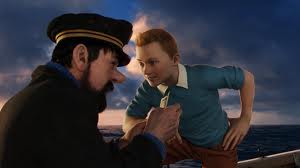
Tintin (Jamie Bell) is a young, lively investigative reporter that apparently has been all over the world, as things in his apartment suggests (I must admit I’ve never read the original comic books), solving many mysteries and making them into stories for the newspaper. He has a loyal dog named Snowy, who is very gifted and possibly even smarter than Tintin. Sometimes on the same cases as him are two bumbling police detectives named Thompson and Thomason (Simon Pegg and Nick Frost, showing great comic relief)…they’re not particularly reliable because they’re so dim.

Tintin purchases a model ship called the Unicorn and believes that there’s something special about it, since the mysterious Sakharine (Daniel Craig) is trying to get his hands on it. Tintin does find a very important clue hidden inside the ship and later meets up with the rarely-sober Captain Haddock (Andy Serkis). Haddock’s seafaring ancestors have hidden a treasure long ago, which Sakharine and his crew are seeking. So the race is on to find many clues that lead to the treasure’s location.

“The Adventures of Tintin” uses entire motion-capture style animation. It’s when an entire movie is digitally animated after live actors perform their roles, in black box theater, with sensors all over their bodies. With this animation, you can do whatever you want. In “The Polar Express” and “A Christmas Carol,” in particular, this style of animation was really taken advantage of because with this technology, you can really play around with atmosphere and create some sensational energetic scenes.

Take a chase scene late in the movie, where Tintin and Haddock are after an important clue in Morocco, and the bad guys are seeking possession of it as well. There is one shot that lasts for about five minutes as the chase continues—the shot swipes from spot to spot and goes all around the place, further intensifying the action. That’s a marvelous visual shot, and it shows just how far this motion-capture computer animation can be pushed.

There are other sensational action sequences in the movie—Tintin, Snowy, and Haddock must escape from the villains on their ship after being captured; they hijack a small plane and must learn to land it, and fast; and there’s also a flashback involving the back story of the life-sized Unicorn that seems pretty heavy. These scenes are exciting and well-crafted.

The human characters in this movie certainly look better than the other characters used in other motion-capture movies. Tintin does look very human, but I must ask, why do the other characters resemble the doll-like figures in “Monster House?” They either have big heads or big noses, but then again, I don’t care—at least the eyes aren’t too big or too small to be creepy. There is one exception, aside from Tintin and that is the villain Sakharine.

By the way, I must ask, was it the animators’ intention to make Sakharine resemble director Spielberg?

The performers/voice-actors are well-chosen. Jamie Bell gives Tintin an appealing, intense curiosity and carefully avoids steering into blandness. Andy Serkis is wonderful as the constantly-drinking Haddock, who is Tintin’s sole human ally and provides some great comic moments while on this crazy adventure. I’m not really surprised—Serkis is probably considered the king of motion-capture. Remember, this is the man who played Gollum in the “Lord of the Rings” movies and Caesar in “Rise of the Planet of the Apes.”

With the right blend of humor and action, and a first-rate technical look to the film, “The Adventures of Tintin” is an ambitious, well-crafted adventure movie. I hope there’s a sequel so these new Spielberg adventures can continue; especially since I doubt people will be expecting “Indiana Jones 5” pretty soon. It has a lot of energy and enough potential to become a film series.

Cocoon (1985)

3 Feb

Cocoon1985-01

Smith’s Verdict: ***1/2

Reviewed by Tanner Smith

“Cocoon” is another modern-day science-fiction tale in which advanced aliens from outer space visit Earth with no plans to destroy us, but just to visit us. But these aliens in “Cocoon” are easy to communicate with, simply because they could easily pass off as human. Sure, their true form is pure light, but when they put their latex rubber body suits on, they just seem like rich tourists who have their own business to tend to. They could easily pass as human!

Character actor Brian Dennehy plays Walter, the leader of the group of Antareans, as they’re called, who come to Earth on a mission. He and three of his friends (one of them played by Tahnee Welch, Raquel’s daughter) rent a boat from a young broke skipper named Jack (Steve Guttenberg) to go out into the ocean, dive deep underwater, and retrieve many cocoons of their friends that were left behind on the previous mission decades (maybe even centuries) ago.

You see, it’s said that on their planet, there’s no such thing as sickness or death and so none of the Antareans have experienced the sadness of such. And if the cocoons are taken back to the planet, those inside will be free again. In the meantime, the cocoons that are already found are being kept in the swimming pool near a retirement home, where three senior citizens (Don Ameche, Wilford Brumley, and Hume Cronyn) are tired of their boring lives and take joy in trespassing over at the pool for a little fun. But now, with the strange stones at the bottom of the pool, the pool has become a fountain of youth for them. They feel young again and are suddenly joyful of their lives.

With Walter’s permission, the three men bring their wives (Maureen Stapleton, Jessica Tandy, Gwen Verdon) to the amazing discovery and they all get second chances in being young. They go for nights on the town and even tick off others at the home.

All of this is pure delight. Just about every character is either interesting or enjoyable to watch. We have the scenes with the three guys, who are all wonderful, especially Wilford Brumley who always has a twinkle in his eye that reminds us of a kind grandfather we either had or wish to have had. (Actually, I didn’t know that he wasn’t even at age 50 when this movie was filmed!) Then, we have the scenes with the aliens who just want their friends back and when things go wrong midway through the film, there’s a shocking look of revelation on Brian Dennehy’s face that brings his character full-circle. There’s also a sweet relationship between Guttenberg and Welch and one bizarre scene in which Welch shows Guttenberg her planet’s way of sharing affection with one another.

What I didn’t like about “Cocoon” was its ending. As everyone is invited to stay with the Antareans on their planet, we get a race, a chase, a child in the mix, confused orderlies and police, and a spaceship—just a typical, average Spielbergian ending that wasn’t like anything we’ve seen up until that point.

But everything else in “Cocoon” is just wonderfully entertaining, with great acting and a real feel of whimsy. It’s just a wonder as to why director Ron Howard wanted to end this wonderful film with a climax?