Archive | February, 2013

The Outsiders (1983)

7 Feb

283965_1251572218752_295_300

Smith’s Verdict: **1/2

Reviewed by Tanner Smith

“The Outsiders” is a film based on a best-selling young adult novel written by S.E. Hinton, who specializes in teenagers as complex characters (also read “Tex”). Francis Ford Coppola made this beloved book (beloved particularly by junior high and high school students) into a film at the request of a junior high English class who all signed a letter, asking Coppola to adapt this book. The result is a mixed bag.

The narrator is a fourteen-year-old “greaser” named Ponyboy Curtis (C. Thomas Howell) whose friends are all greasers. Greasers are the social outcasts on the north side of Tulsa, Oklahoma—most of which are hoods and they all have greasy hair. “Socs” (pronounced “soeshes”) are the rich kids from the south side of town—most of which have fun jumping greasers. There’s a conflict among them and occasionally, they throw rumbles to fight each other.

Ponyboy is basically a nice, smart kid—he reads books, keeps his mouth shut, and tries to stay out of trouble. His best friend is Johnny Cade (Ralph Macchio), a scared sixteen-year-old greaser who was beat up terribly by a soc long ago. Both wind up in a nasty situation after Ponyboy and Johnny pick up a couple of soc girls and their boyfriends catch them. This results in the murder of one of the boyfriends (committed by Johnny, who wouldn’t hurt a fly before) and the scared kids are forced to run away.

There are many characters among the greasers. There’s Two Bit (Emilio Estevez), a likable scalawag who has his fair share of screen time. There are Ponyboy’s older brothers Darrel (Patrick Swayze) and Sodapop (Rob Lowe). And last but certainly not least, there’s Dallas Winston (Matt Dillon), the rebel without a cause. Dallas helps Ponyboy and Johnny hide out after the murder.

All of the actors are great in their roles—the central trio of Howell, Dillon, and Macchio are convincing. But the problem comes with the story and development. The story is not particularly convincing and most of the characters aren’t developed properly. I didn’t really buy the conflict between the greasers and the socs. And some of the greasers who are in the film’s advertising don’t even have time to breathe—they just appear briefly. I bought the friendship between Ponyboy and Johnny, but not so much of the relationships with Ponyboy and his brothers. Here’s another thing wrong with the movie—Ponyboy talks about his brothers a lot more than he talks with them to the point where he just seems like annoying exposition. Sodapop just seems invisible throughout the movie. And then, there’s the plot thread in which Ponyboy is possibly going to be taken away from Darrel and Sodapop and must go to juvenile court for running away. That element is dropped and never spoken of again. It didn’t matter much because I didn’t care much about the brothers anyway.

I also didn’t like the music composed by Carmine Coppola. It’s all over the map here and, along with Francis Ford Coppola’s direction, seems like “The Outsiders” is trying this generation’s “Gone with the Wind.” I wouldn’t mind so much if it wasn’t distracting.

So I can’t recommend “The Outsiders” mainly because of its execution. I like Ponyboy, Johnny, Dallas, and Two Bit. I like Coppola’s direction. I love the book—the original making of this film was to cover the whole novel, which tells the story better. Apparently, Warner Bros. thought it’d be too long for the young audience’s interest and asked for the film to be cut from nearly two hours to an hour and a half, which isn’t enough time to tell this story. I’ll just quote Roger Ebert and argue that a good film isn’t long enough. And I’ll also say that “The Outsiders” needed more material to be a better movie.
50/50 (2011)

7 Feb

50-50-movie-images-seth-rogen-joseph-gordon-levitt-01

Smith’s Verdict: ****

Reviewed by Tanner Smith

When a movie is made in which cancer is the central conflict, it’s so easy to go overboard with the movie’s dramatic elements. And it’s hard to feel anything for the cancer patient when the movie is trying so hard to make the audience weep that it just becomes corny. But “50/50” managed to beat that problem and is, in my opinion, one of the very best films of 2011.

The film stars Joseph Gordon-Levitt as a young man named Adam Lerner who learns that he has a rare form of spinal cancer and the chances for survival are 50/50. He feels his life turning upside down, as he didn’t expect to be expected to die so young. He breaks the news to the people in his life, who react in different ways. He first tells his girlfriend Rachael (Bryce Dallas Howard), who guarantees to stand by him and look out for him. Then he tells Kyle (Seth Rogen), his vulgar but loyal best friend who wants to keep Adam’s spirits up even though sometimes he can go too far when it comes to parties. And then he tells his mother (Angelica Huston), who constantly calls to check on him and already has to care for her husband who has Alzheimer’s disease.

During chemotherapy, he befriends two other cancer patients (Philip Baker Hall and Matt Frewer) who are constantly stoned with medical marijuana and “weed macaroons.” He also gets a therapist—a pretty, naïve, innocent 24-year-old named Katherine (Anna Kendrick) whose new patient is her third.

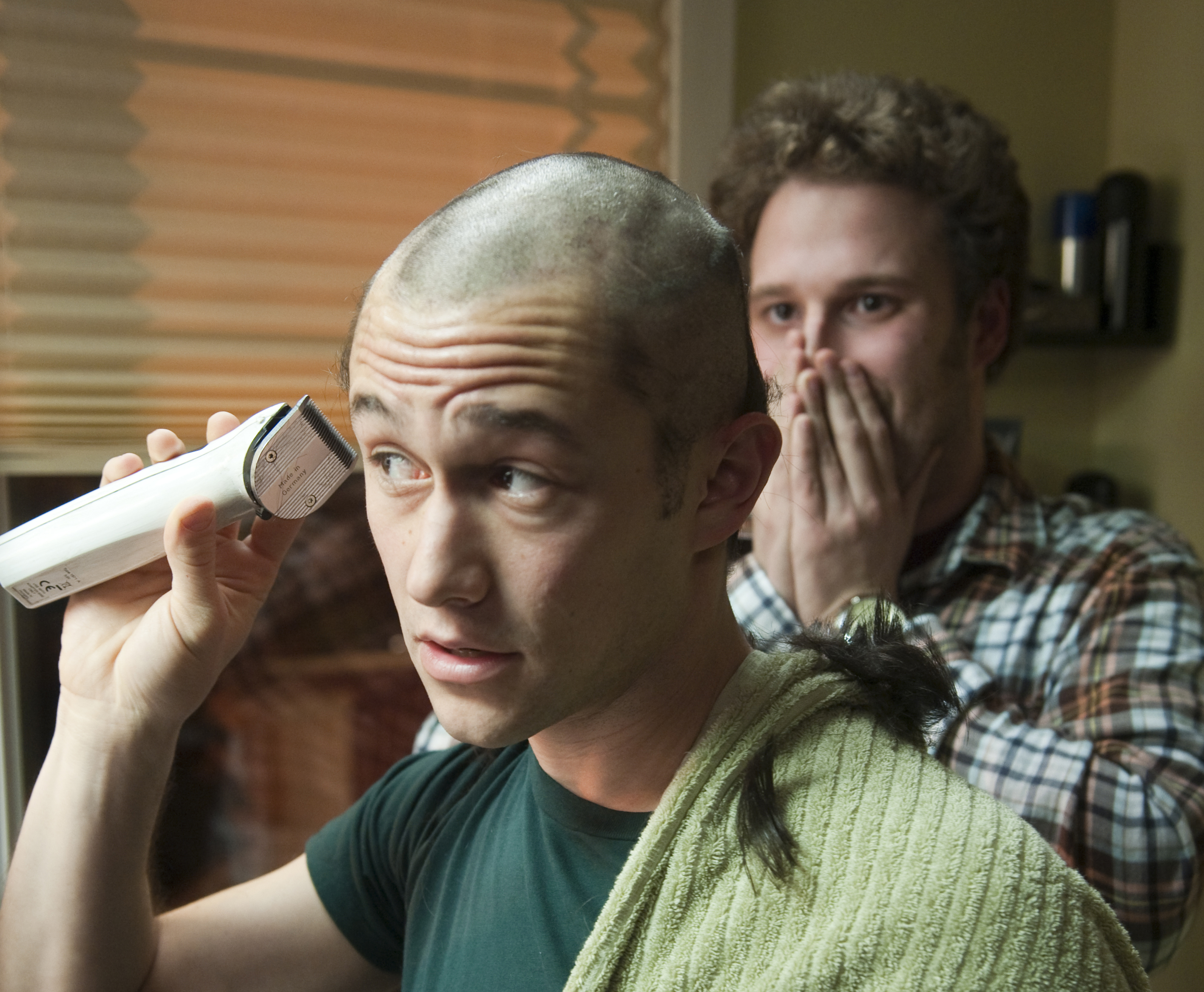
The screenplay for “50/50” by Will Reiser, a comedy writer, is loosely based on his life, as he had spinal cancer like the main character of this movie. Mostly, he writes from past experience about dealing with this disease, and delivers well-written scenes that feature how Adam deals with his cancer and how his friends react around him. But more importantly, he adds another key ingredient to making “50/50” work—comic relief. Observe the naïve behavior of the Kendrick character in her first scene, and then keep watching and listening to the dialogue in the following scenes that feature her. They’re both funny and endearing. And then there’s the improvised-in-character scene as Adam shaves his head as Kyle watches in confusion and something close to fright. And then you have Seth Rogen, who specializes in playing the goofy, profane, vulgar best friend in many other movies. Rogen is Reiser’s friend in reality and his role is essentially based on how he dealt with his friend’s cancer. Reiser and Rogen take Rogen’s usual characteristics that people have seen in other movies and just when you think it’s starting to wear thin on us, the story moves on to something else for a while before coming back to him. Don’t get me wrong—Rogen is pretty funny in most of his scenes, but when a lot of other situations in the movie are to be taken seriously, only sometimes he seems out of place. But then, Rogen’s character becomes even more endearing when we get to his payoff in the final act of the story. It’s handled in a very effective way. The drama and comedy in “50/50” blend wonderfully.

The actors in “50/50” are all wonderful as well. Joseph Gordon-Levitt, one of the best young actors in recent memory (he was also fantastic in 2009’s “(500) Days of Summer”), as Adam is so winning and endearing that when the time came for his final surgery, I was almost as worried about what his outcome would be as he and his family and friends were. There’s one scene in particular that is just heartbreaking—it’s when he finally snaps and lets out all of his anger on the night before his surgery. I sure hope he gets an Oscar nomination for this performance. Seth Rogen, like I said, is more than a smartass best friend. Angelica Huston avoids the cliché of overbearing mother and makes her character more three-dimensional than she starts out with when she hears the news. Philip Baker Hall and Matt Frewer steal their scenes together. And then there’s Anna Kendrick, the Oscar-nominated actress from “Up in the Air” and who was also in the “Twilight” movies. She always has a charming screen presence and makes her character likable, always. I will watch her in any movie, even if it’s just a brief appearance. Many reviews of this movie have complaints against the Bryce Dallas Howard character because of her actions as the movie progresses. I have no complaints because even if what she did was a wrong move, I believe she did learn her lesson and actually sympathetic towards her in her final scene.

With great acting and a great screenplay, “50/50” is a movie dealing with cancer in a touching but also funny way. It reminds us that when faced with a situation like this, there are only two ways to get through it—with tears or with amusement. This is one of the best films of 2011.

Real Genius (1985)

6 Feb

RealGenius1985anamorphicWSDVDRip-1

Smith’s Verdict: ***1/2

Reviewed by Tanner Smith

“Real Genius”—you know, some films just have accurate titles. In a decade where a lot of society’s movies are about teenagers (that decade would be the 1980s), “Real Genius” is one of the real good ones. It’s a surprise too—this film was released in 1985 and was one of three movies about teenagers and their science projects. The other two such films were “Weird Science” and “My Science Project,” two lousy teenage comedies. “Real Genius” is a real treat, however—it’s very funny and well put together.

The film’s central teenage characters are college students who are not quite the sex-crazed goons you would find in lesser teen movies. The protagonists in this movie are actually well-developed, likable three-dimensional characters who don’t always play by the rules, but there are teenagers like that around. They are Mitch (Gabe Jarret), a 15-year-old boy genius who is the youngest person to be accepted at Pacific Tech, and Chris (Val Kilmer), another young brain who has spent four years at the school and is about to graduate. Mitch and Chris are two of the students chosen to work on a laser experiment. But little do they know that they are being used by Professor Jerry Hathaway (William Atherton), who wants to use the experiment—if it gets finished—to sell it to a military as a weapon.

But in the meantime, Chris is a class-A prankster who uses his genius to set up all sorts of things to make life on campus less boring. For example, he turns the dorm hall into an ice-skating rink, and he turns the lecture hall into a swimming pool. He tells Mitch that he used to be just like him—nervous and socially awkward—until he learned how to relax. Now he feels like it’s his duty to take Mitch out of his shell and teach him to have fun. “Real Genius” is most fun when it comes to showing Chris’ antics. There’s another scene in which Chris and Mitch get revenge on an uptight nerd named Kent, who is also Professor Hathaway’s fink and Mitch’s bully, by disassembling his car and reassembling it in his own dorm room. Brilliant and…dare I say, ingenious.

There are two other quirky characters are crucial to the movie. One is a scruffy-bearded strange man named Laszlo (Jonathan Gries) who used to be the top brain on campus until he cracked and is now living in the steam tunnels below the school (the way in is through Chris and Mitch’s closet, which makes things awkward at first). The other is a hyperactive girl named Jordan (Michelle Meyrink). She never sleeps and is the kind of girl who would run into the men’s restroom to show Mitch a sweater that she made for him. She and Mitch share a cute relationship together. Chris, Mitch, Laszlo, Jordan, and another genius nicknamed “Ick” (he helped Chris with the ice in the dorm) discover about Professor Hathaway’s plan later in the film and decide to strike back.

“Real Genius” is packed with characters and jokes. It is well-written with a real integrity and intelligence (although some jokey lines of dialogue using the word “penis” get old). The writers know that teenagers can have the freedom to be themselves—not just slobs or sex-crazed maniacs or idiots. They’re funny enough being geniuses in this film. That’s a pleasure among many pleasures that lie within “Real Genius.”

The Fly (1986)

6 Feb

images

Smith’s Verdict: ****

Reviewed by Tanner Smith

David Cronenberg’s “The Fly” is a perfect example of the “experiment-gone-wrong” movie. It’s when a mad scientist wants to create a device that will change the way humanity sees things and something goes terribly wrong, and the direst consequences occur. That’s always one of the enjoyable of stories to be told in movies, and “The Fly,” a re-imagination of the 1958 sci-fi thriller of the same name (but a different story), is one of the best. It’s one of those horror movies in which we get to know the characters first and know the important setups to the oncoming rules of the gimmicks, so that when the terror happens, it amounts to something.

It begins as scientist Seth Brundle (Jeff Goldblum) meets a pretty journalist named Veronica (Geena Davis) and wants to impress her. So he puts it bluntly, starting out by saying that he has an invention that will change the world as we know it. Being a curious mind, Veronica accompanies Seth to his home. Seth wastes no time in impressing her—he shows her a pair of “telepods” connected together by cable and run by computer. He explains to Veronica that it’s a sort of “teleportation” device, which can move something from one telepod to another. It works great on items, such as a stocking that’s used as a test…but it turns living things inside out. (There’s a really gruesome scene in which Seth tests the machine on a baboon, and we actually see the outcome.)

One of the interesting elements of “The Fly” is that the science seems believable. That’s rare for a movie like this—usually, you roll your eyes at the very idea of certain experiments. But not here—I believed in this experiment, whether it could work or not.

Anyway, Seth figures out the problem with the invention, tests it another baboon with success, and then finally decides to try it on himself. However, something unexpected happens during the process. A housefly has made its way into the telepod with Seth and he makes it out, but with certain side effects. He suddenly has a great amount of energy and increased strength. However, that’s just the beginning and it may seem positive…but things are about to get a whole lot worse.

Seth is no longer Seth. He’s slowly but surely turning into a man-sized fly—or “Brundlefly,” as he describes himself. Ugliness starts to emerge and, thanks to first-rate makeup and effects, only looks worse and worse every time we see him again. Also, Seth’s nature is reversed, letting the menacing insect side take over what little of Seth is left. What’s Veronica to do? She wants to help him, but she’s ultimately powerless to do anything for him.

Too many of these mad-scientist movies are focused on ideas, but not so much with characters. Of course, there are exceptions, like “Frankenstein.” Now, here’s “The Fly,” in which we get to know and care for the two central characters played by Jeff Goldblum and Geena Davis. Goldblum’s Seth is a socially awkward but excited and likable character who gets his enthusiasm from his continuing experiment and his relationship with Davis’ Veronica, a curious reporter who gets way more than she bargained for. Goldblum gets lost in the role—it has to do with the way his eyes get wider whenever he gets excited or when he casually tries to explain certain elements of this new experiment. He plays it like he sees it. The result is a powerful performance. Davis is very good too, and she and Goldblum show great chemistry together.

The character development and interaction is arguably the most important aspect of “The Fly.” We care about these people, we fear for them, and we hope that somehow things will turn out all right for them. There’s a particularly strong scene in which we see Seth probably as bad as he’ll get before his human side is completely gone—the line “I’ll hurt you if you stay” (Seth saying it to Veronica) is chilling because of everything that led up to it.

The makeup and creature effects, created by Chris Walas, are horrifyingly excellent. I mentioned that Seth looks worse and worse every time we see him again, and I wasn’t exaggerating. The work done on making Jeff Goldblum look nearly human before transforming into a horrific insect-beast is consistently effective—creepy and sometimes even hard to watch, but remember, this isn’t a geek-show. The effects don’t make the movie—they’re there to serve the story.

There are troubling scenes in “The Fly,” but it’s a great film with terror that actually amounts to something with two well-developed, likable characters to feel for. And for people out there who search for new ways of changing the world as we know it, just be sure you know what you’re doing.

Oh yeah, I almost forgot—Be afraid. Be very afraid.

Fatal Attraction (1987)

6 Feb

52179.6a00d83451b05569e2013480acb22a970c-800wi

Smith’s Verdict: ***1/2

Reviewed by Tanner Smith

What “Fatal Attraction” is trying to get across is very simple—don’t cheat on your spouse. Even when you think there’s a way out of a one-night stand or an affair, don’t take the chance that it will turn against you and threaten the lifestyle of your family. In “Fatal Attraction,” family man Dan Gallagher (Michael Douglas) has a one-night love affair with another woman and wants to end it the morning after. But the woman won’t let it end, no matter what…

This would be the premise for a broad comedy, but “Fatal Attraction” is a thriller—and an effective one, at that. It shows the consequences that occur not only when a married man cheats on his wife, but also with the wrong woman.

The film’s opening scenes feature the life of successful, happily married lawyer Dan Gallagher, his wife Beth (Anne Archer), and adorable six-year-old daughter Ellen. While Beth and Ellen are out of town for the weekend, Dan meets Alex Forrest (Glenn Close), an editor for a publishing company. They have dinner together, Alex seems like an intelligent, passive woman, and she and Dan wind up having a passionate affair that very night. Alex assures Dan that it would’ve only been a simple thing, a fling to be forgotten about later, and Dan falls for it.

Big mistake. Dan leaves the next morning, hoping to forget all about this and go back to his normal life. But Alex doesn’t let it go—she wants to further the relationship and clings to Dan. Dan tries to let it down easy on her that they should never have a relationship together…only to have Alex attempt suicide. And it gets worse—it turns out that Alex is pregnant with Dan’s baby.

Or is she? We’re never quite sure of this. But what we do know is that Alex is obsessive and undoubtedly insane. Dan wants nothing to do with her, but Alex keeps coming and coming, threatening the lifestyle of Dan and his family. Dan tells Alex to leave him alone, to which Alex replies “I’m not going to be ignored, Dan!”

This is one crazy lady. And the odd thing is that she starts out seemingly normal. It’s this affair with Dan that sets her on edge, and the fact that she can’t have him enrages her. Her rage continues to grow every day and her obsessiveness takes her over to the point of violence. Who is at fault for all of this? Is it Dan, for falling into this affair with a woman other than his wife, and then hoping to forget about it immediately? Is it Alex, for leading him on in the first place? You can read much into this.

Dan is a likable guy, despite what he does. He’s just trying to do right by his wife, whom he still loves. He’s smart too—when things turn ugly, he follows advice that many characters in thrillers seem to neglect. He calls the police to see about a restraining order. He even tells his wife about the affair, later in the movie. Understandably, Beth doesn’t take this very well—especially not when Dan tells her that Alex is pregnant. There’s great family drama in occurrence in “Fatal Attraction,” particularly in the scenes in which Dan is trying to fix everything to keep his wife and daughter from any harm.

Michael Douglas and Glenn Close do great jobs at portraying these characters, and Anne Archer is effective as Dan’s wife Beth.

Some critics, including Roger Ebert, were bothered by the film’s ending, in which Alex officially loses it and attempts to slash Beth before Dan can try and stop her. This has been likened as a “Friday the 13th” style ending, and to be honest, the only time I made this distinction is with the brief fake-out after it seems that Alex is finally dead. Of course not; she comes back for one cheap scare. The climax itself worked for me; it’s effective in showing how far Alex was pushed in her mental obsessiveness. But that cheap scare at the end didn’t work at all. It did indeed make it seem like a slasher film. Mostly though, “Fatal Attraction” is a terrific psychological thriller. The acting is great, the dilemmas are legitimately tense, and it’s executed with convincing realism

Road Trip (2000)

6 Feb

4fdea77cb18fc

Smith’s Verdict: ***

Reviewed by Tanner Smith

In 1978’s “National Lampoon’s Animal House,” Tim Matheson uttered the words “road trip” and that led to a very funny sequence while the Deltas are on a road trip. “Road Trip” seems like an extended play on that sequence—it makes sense, considering that the executive producer is Ivan Reitman, who produced the former. The result for “Road Trip” is somewhat uneven but mostly very funny and, in its own way, kind of sweet.

The main character is Josh (Breckin Meyer), a student of the University of Ithaca. He has a long-distance relationship with Tiffany (Rachel Blanchard), who goes to the University of Austin. They call each other every day and Josh sends videotapes of himself to her. But lately, Tiffany doesn’t call Josh back. This upsets Josh, who thinks that Tiffany may be cheating on him. It also drives him to give in to the seductiveness of the attractive Beth (Amy Smart), who has a crush on Josh and is being stalked by the nerdy teaching assistant Jacob (Anthony Rapp). They have sex after Josh bids on her at a girl auction held at a party, while being videotaped by Josh’s camcorder. But the next day, Tiffany finally returns Josh’s calls and says that she went through a mourning period due to her grandfather’s death. But wait. It gets worse—the sex video is accidentally mailed to Tiffany (one of Josh’s roommates mixed it with Josh’s “I miss you” tape, which he meant to send). Josh has three days to get from Ithaca to Austin before Tiffany comes back to school and sees the tape. Josh is joined by three friends (Seann William Scott, D.J. Qualls, Paulo Costanzo) on…what else, a road trip.

Of course, it’s not whether or not characters in road-trip movies make it to their destination that’s important. It’s what happens on the way. A lot happens on this road trip—their car explodes after jumping a huge ditch, they steal a bus, they spend the night in an African-American fraternity house, and more that I can’t give away. Some of the jokes are hit and miss, but there are more laughs. There is also a great deal of raunchiness—a diner cook makes French toast in such a nasty way that you might not want to try it again, there is a lot of nudity, sexual references, and sperm donations (in the most unusual way). You could call this the first follow-up to “American Pie,” which redefined the genre of teen sex comedies. (Oddly enough, Seann William Scott, who played Stifler in “American Pie,” plays a big-mouth best friend here.) Oh, and I almost forgot to mention the subplot involving MTV’s Tom Green as a seven-year student at Ithaca who tries to feed a mouse to a snake and terrorizing it until the moment of “fury.” That’s funny, too. And also a subplot involving D.J. Qualls’ hard-as-nails father (played by Fred Ward) who believes his son is kidnapped and waves a gun at anyone who doesn’t answer questions. A lot happens in “Road Trip” and even if all of it doesn’t mesh well, you still have a good time.

The real show-stoppers of “Road Trip” are D.J. Qualls and (sue me) Tom Green. D.J. Qualls is brilliant as the nerdy, cowardly college student who is afraid of his father and has a redeeming point on this road trip. Observe his performance and notice how flawless he is at playing this character. And as for Tom Green as the film’s narrator—this is probably the only time I’ve found him amusing. Then again, he tones down his persona here. All in all, I did like the characters and laugh a lot, so I recommend “Road Trip” while saying it could have been better.

Red Dragon (2002)

5 Feb

images-1

Smith’s Verdict: ***1/2

Reviewed by Tanner Smith

“Red Dragon” begins with an unnerving shot of an audience at a concert hall. The reason it’s unnerving is because of the one person we recognize before the camera pushes in on him. There’s a subtle lighting on that shot that isn’t too flashy so that we recognize right away who the guy is, but it just comes naturally. We can see that it’s Hannibal Lector, the infamous, cannibalistic psychiatrist/serial killer played by Anthony Hopkins in the role that won him an Oscar in 1991’s “The Silence of the Lambs.” Seeing Lector among people, wearing a suit, is unnerving even of itself, but his emotion of disgust when he studies the one flutist playing the wrong notes is even more so.

That may be because we realize who this man is and understand that “Red Dragon” is actually a prequel to “The Silence of the Lambs.” And it’s also because the director Brett Ratner has a way of showing things as they are and yet keeping an eye for important things, like the best directors of thrillers. It’s surprising that Ratner’s previous work was directing the “Rush Hour” movies.

But anyway, what follows that first scene is something even more disturbing when you’ve studied Lector in “Silence of the Lambs”—Lector is hosting a dinner party. You heard that right—a dinner party. I don’t even want to know what he serves to his dinner guests, but they seem to enjoy it. I don’t even want to think about it.

What follows isn’t as terrifying as its great opening, but it’s still pretty suspenseful. “Red Dragon” is actually a well-put-together, gripping thriller. That comes as a surprise, because while it’s an adaptation of Thomas Harris’ novel of the same name, it’s also a remake of the stylized 1986 thriller “Manhunter,” by Michael Mann. I loved the original film, and that’s why I was surprised to like this remake (or more accurately, re-adaptation) just as much. Sure, it doesn’t have the same amount of style, but not all movies can be the same.

“Red Dragon” follows an FBI Special Agent named Will Graham, who has a gift for deduction (he’s like a modern day Sherlock Holmes). He goes to Lector’s house the same night as the party and tells him, as his psychiatrist, that he’s found an extra clue in the latest killings—body parts are missing from the bodies, like livers and hearts. Soon enough, he realizes that Lector is a cannibal and he’s responsible for the killings. Graham is able to capture him, but after he nearly dies.

Several years later, Will goes into retirement is called back from his family life into the field to track down a new sick serial killer dubbed “The Tooth Fairy.” After finding some clues, Will realizes to know a serial killer is to capture one, so he goes to the prison where Lector is being held to ask Lector if he knows anything about the Tooth Fairy or if he would know what his next move would be, as a psychopath. It’s psychiatry and psychopath mixed in one, just as Lector showed in the previous film. He’ll give his answers only after he’ll share his delusions of the human mind.

These scenes are different from Lector’s talks with Jodie Foster’s Clarice Starling in “Silence of the Lambs” in two ways. The first way is, Will is too smart to fall for Lector’s delusions. In “Silence of the Lambs,” Clarice pays attention and looks on with frightened awe. But in “Red Dragon,” Will takes none of that. He’ll just get the answers he needs and get the hell out of there. And the second is that there’s a constant battle of wits between Lector and Will. While in “Silence of the Lambs,” Lector grew to care for Clarice (you have your version, I have mine), Lector hates Will in “Red Dragon.” He knows that Will isn’t interested in Lector’s off-subject rambles and is still steamed that Will found a way to get him in this prison, and that stretches to the point that he actually finds a way from inside his cell to tell the Tooth Fairy where Will’s family lives. There’s a great deal of tension between these two.

Edward Norton plays the intelligent, insightful Will Graham and sells the role. Norton has a powerful screen presence shown in countless other movies and he makes a great hero for this sort of movie.

As for the Tooth Fairy, he’s played by Ralph Fiennes in a chillingly good performance. He plays the Tooth Fairy as a tortured soul fighting his emotions the way Gollum fights his double personality. One moment, the Tooth Fairy (or Francis Dolarhyde, as he’s known at his job) is a frightened man tortured by his abusive past. The other moment, he’s a twisted killer who kills as part of his own transformation from a coward to a conqueror. Whatever part of him that’s still human is kept alive by a blind woman (played by Emily Watson) who feels compassion for him.

Anthony Hopkins is still spot-on as Hannibal “The Cannibal” Lector, the role that won him an Oscar, this fascinating character that has room for more back-story to be told. He’s a psycho, but he’s charismatic and shares his views of the human mind with exact pronunciation and a sense of irony in his wit.

There are other characters in “Red Dragon,” like Will’s wife (Mary-Louise Parker), Will’s boss (Harvey Keitel), and memorably, the reprehensible tabloid reporter (Philip Seymour Hoffmann) who finds out more than he should know and ultimately becomes the Tooth Fairy’s latest victim. What’s engaging about “Red Dragon” is that it takes its time to develop its characters while keeping the gore at a more minimum level than you might expect. There is suspense, intelligence in Will’s way of figuring all of these things out, and Norton has a mighty screen presence that balances out Lector and the Tooth Fairy.

“Red Dragon” is a smart thriller with sharp direction, great acting, and a real sense of tension, not to mention a great, memorable music score by Danny Elfman. It’s an appropriate prequel to “The Silence of the Lambs” and well-drawn-out remake to “Manhunter” and captures the right amount of menace compared to each.

Manhunter (1986)

5 Feb

images

Smith’s Verdict: ***1/2

Reviewed by Tanner Smith

I get the feeling that Thomas Harris really gets what it means to set up a gripping murder mystery. In his books “Red Dragon” and “The Silence of the Lambs,” Harris creates memorable, three-dimensional characters and brings them on some of the more original mysteries of identifying some of the more original serial killers. For movies to be adapted from these works, it’s important to capture the same sense of suspense, intrigue, and danger. It helps to have an artistic look as well. With “Manhunter,” writer-director Michael Mann brings the novel “Red Dragon” to life and delivers a gritty, tense, stylish thriller with a talented cast and a gripping mystery.

For starters, it has an intriguing main character for us to follow, played with an intense, mesmerizing performance by William Petersen. Petersen plays an FBI agent named Will Graham, a brilliant mind that can enter the mindset of a killer and read into how he acted. But after a breakdown after catching an equally brilliant serial killer, Dr. Hannibal Lecktor (Brian Cox), he went into retirement. But now, he’s called back to help his former FBI superior Jack Crawford (Dennis Farina, in a strong performance) in a new case—a serial killer known as the Tooth Fairy because of the bite-marks on his victims.

In one of the more disturbing early scenes, we see Graham as he investigates one of the murders. As he thinks everything through, you feel a great sense of unease because you feel like he is actually thinking like a sick killer himself. He isn’t merely having an epiphany—it’s almost as if he’s thinking of what he would have done if he committed the murder. This makes him an effective anti-hero—always wavering between good and evil, if you will. You know he’s not of a fully stable mind.

The killer, the Tooth Fairy, is Francis Dolarhyde (Tom Noonan), an odd person who works at a photo lab where he strikes a relationship with a blind woman, Reba (Joan Allen). We meet him later in the film, when he’s torturing a jackass journalist (Stephen Lang) who printed an article about him that he certainly didn’t agree with. In one of the creepiest scenes in the movie, the journalist is strapped to a wheelchair and has no choice but to tolerate the killer as he goes about his idea of changing into a Red Dragon (inspired by the William Blake paintings). How he does away with the journalist is especially unnerving. And then when you see how he works, and his interaction with Reba who doesn’t know who he really is and likes the way he speaks, it becomes clear that Reba will become the next victim, unless Will can find the killer and save her.

You could say that because you don’t know all that much about the killer and his relationship with Reba is somewhat rushed, then it just seems like another killing for him. While I can agree with the second part (I did want to see more of the Reba character beforehand), I think that of the first part, that you don’t know much about him, just makes him a more chilling villain. You don’t know what he’s thinking, but you know that something can put him on edge anytime and he can kill people. It’s more unnerving when you don’t know much about the killer. You know his motives, you know he’s up to no good, and Tom Noonan delivers a great sense of terror within strangeness.

There’s another killer in this movie—Dr. Hannibal Lecktor, whom was captured and locked away by Graham. Now, Graham requires Lecktor’s insight and assistance in helping him capture the killer, by using his sick mind to figure the Tooth Fairy’s move. Lecktor enjoys playing mind games with Graham, since he believes that they are “just alike,” as they are brilliant minds on the edge of destruction. On top of that, secretly, Lecktor is grudging against Graham and actually figures a way from inside his cell to get to him and his family.

“Manhunter” also allows us to see Graham with his family. The scenes in which his wife (Kim Griest) and his son (David Seaman) are effective because it gives Graham something to live for and something to protect. We care about them and hope nothing bad happens to them, and so we root for Graham to solve the case and catch the killer. In particular, the scene in which Graham talks about his son about why he was sent to the psychiatric hospital ward is very strong with the right element of tenderness.

The story unfolds quite smoothly and we’re involved all the way through, but I wish that the movie would end on something more than a climax featuring a violent showdown between Graham and the killer when they finally meet and try to kill one another. I was hoping for a more psychological element to take over since these two have been developed as mentally-unstable minds, one more than the other. But instead, it’s just a standard climax. Fortunately, it doesn’t shoot the movie in the foot, because of everything that has happened before.

The actors deliver excellent performances. William Petersen, as I’ve said, is mesmerizing as the hero Will Graham, seeking redemption by stopping the actions of a sick mind. Tom Noonan is a chilling villain, Brian Cox is a slimy catch-you-off-guard mad intellectual, Dennis Farina is an intense superior, Stephen Lang is a memorable jackass reporter, Joan Allen makes the most of her scenes, and Kim Griest and David Seaman do good jobs as Graham’s family. The characters are memorable and actors portraying them do great jobs.

The visuals in the film stand out—blank walls, long beaches, and colorful palette make the most of scenes—and while admittedly some of them get a little tiresome after a while, they still stay in your mind. Technical detail is given the appropriate attention in “Manhunter.” And while that doesn’t make it necessarily subtle, it’s still effectively chilling enough. “Manhunter” is a disturbing but active thriller that keeps you invested from beginning to end.

Flatliners (1990)

5 Feb

flatliners

Smith’s Verdict: ***

Reviewed by Tanner Smith

“Flatliners” is a thriller that asks the question, “What happens to us when we die?” According to the main character in the film, no one can know for sure…unless someone dies and then lives to tell about the afterlife experience. But how is that possible? Well, for the characters in “Flatliners,” it’s possible. As for me, I’m not sure if the method would work, but I personally wouldn’t try it out either.

Let me explain—the movie is about a group of medical students who one-by-one stop each other’s heartbeats, to die. Before too long, the others revive the person. So that person will have come back from the dead to live to explain what was happened.

Being medical students, these people have been taught to play God to their patients. It’s Nelson (Kiefer Sutherland) who has the idea to look God in the eye with this little experiment. He enlists the help of Rachel (Julia Roberts), Labraccio (Kevin Bacon), Joe (William Baldwin), and Steckle (Oliver Platt) to sneak into the school after hours with medical equipment, in order to lower his heart rate, die, and have the others revive him by emergency measures. This experiment is dangerous, and would result in both death and expulsion…but it works. Nelson has come back from the afterlife, convincing the others to try it out themselves. Thus tampering with God’s plans for them.

This is an intriguing concept for a movie and it has a top-notch cast, as well as a unique, incredible style to it, from director Joel Schumacher. Also, the idea behind the afterlife’s plans after their experiment is quite something indeed. You know how when you nearly escape death and your life flashes before your eyes? In “Flatliners,” when the characters kill themselves and then are revived again, their biggest sins and fears (mainly to do with guilt) are brought back along with them. They haunt them to no end—for example, William Baldwin’s character is known for his one-night stands and secretly videotaping sexual intercourse; now whenever he looks through a camera or to a TV, he sees those same women, asking “How could you do this to me?” or saying, “I trusted you.” They conclude that the solution is to face them instead of run away from them. This is the movie’s way of saying that you should have your emotions in check before you die. That’s very clever.

This is when “Flatliners” stops becoming an adventure and a thriller and turns into drama. But while I got into Kevin Bacon’s story, and Kiefer Sutherland’s story becomes the central conflict, I feel like William Baldwin’s story had no satisfying turn and Julia Roberts’ entire story is handled so heavily that I felt like I was watching an afterlife-themed soap opera. (Oliver Platt doesn’t “flatline,” which he gladly mentions.)

There’s one thriller aspect that annoyed me, and it had to do with the “flatlining.” Actually, it’s not necessarily the flatlining; it’s the reviving. The first time you see it is kind of suspenseful, but when you have to see it a few more times, suspense is long gone and the scenes desperately try to hammer in the tension to little prevail. I was also annoyed by the competition among the characters based on who can stay dead the longest.

“Flatliners” works as a thriller, and works fine as a drama (though like I said, that’s mainly coming from Sutherland and Bacon’s separate story arcs, which are the strong points). Is there a tunnel with a bright light leading to heaven after you die? I don’t doubt it. Just don’t ask me to undergo this sort of therapy to find out.

Election (1999)

5 Feb

top20jerks-election-590x350

Smith’s Verdict: ***1/2

Reviewed by Tanner Smith

“Election” is one of those movies that is even better the second viewing. I saw it once and wasn’t all that impressed. Then days later, I saw it again and was ultimately surprised by how much this film really is. This is a sharp, smart satire about high school with more to it as well. It’s about a high school teacher who is not perfect and gets himself in a weird situation during the student body election. And I have to ask, how often do teachers get as much good treatment as teenagers in even the best teen movies? Let alone a satire of teen movies?

We not only get one narrator, but four different narrators telling their sides of the story in this movie. One is that teacher I mentioned above. His name is Jim McAllister (Matthew Broderick). He gets involved with his students some of the time and is deeply dedicated to his work.

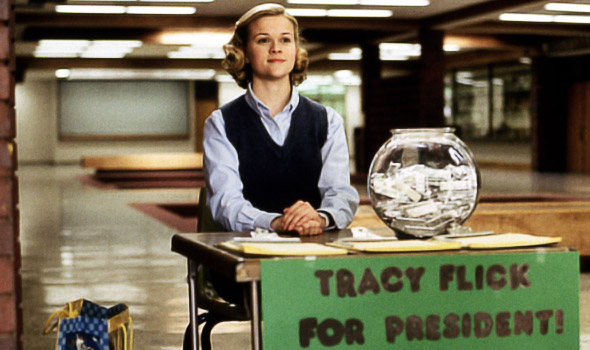
But there is another main character that really gets our attention—a student named Tracy Flick (Reese Witherspoon). To say she’s an overachiever is an understatement. She doesn’t just conquer all; she waves goodbye as she moves from regular student to obsessive, perfect student. She always has her hand up in class, leaving the teacher wishing someone else would raise a hand. She is always perky, neat, seemingly good-natured, and so-called “perfect.” But in truth, she’s a snobby wench. Her overachieving personality and unpopularity to her peers may remind the audience of a female politician. Mr. McAllister doesn’t like Tracy. She was involved as a “victim” in a sex affair that involved McAllister’s best friend, who was also a teacher. And now, she’s running unopposed for class president.

McAllister will not have this, so he decides to encourage another student to run for president against Tracy. His choice is one of the more popular and most sincere students named Paul Metzler (a third narrator played by Chris Klein). Paul was upset because of his broken leg that will not allow him to play football again and now, McAllister brightens his spirits up a little bit and convinces him to make a difference as student body president. Tracy is appalled. She will not stand for this. But what’s worse? Paul’s adopted sister Tammy (Jessica Campbell, the fourth and final narrator) is an angry lesbian whose former lover left her for Paul. So she decides to run for president as revenge.

This leads to a great scene in the gym, in which the whole school watches as the candidates give their speeches. Tracy’s speech is delivered with as much pep as possible, Paul is completely honest but his delivery is monotone, and then everyone is surprised by Tammy’s speech, simply saying that she doesn’t care about any of this and calls it a “pathetic charade.” That gets a huge round of applause from everybody except the other candidates and the teachers because…let’s face it, the students are bored by this “pathetic charade.” I know I was (and I’m sorry for saying so). That’s a great scene.

We follow all of these characters on their sides of the storyline. Mostly, we stay with McAllister. One of the darker sides of the story doesn’t even take place on school grounds. He begins to have an affair with the wife of his original best friend, who was thrown out of the house. It’s totally wrong and he’s just as bad as his friend was with Tracy. But he goes through with it and later, his life and career is all downhill. One of the strangest things about this movie is just how frank it is about sex. We get one too many bizarre sex scenes, one of which features McAllister imagining he’s having sex with Tracy (!). That frankness is a bit uneven and loses the film its fourth star from me.

But the other stuff is great. It’s all nicely directed and well-written by Alexander Payne. There are some big laughs, some touching moments, and despite everything, McAllister is someone to care about. The acting is solid here. Matthew Broderick has come back to high school after movies in the 1980s, such as “WarGames” and “Ferris Bueller’s Day Off,” where he played a high school student in each. As a teacher, he seems strangely more comfortable here than in anything else he was in recently. Chris Klein is likable as the jock that really wants to make a difference in school. He doesn’t play Paul as the stereotypical jerk who gets the hot cheerleader friend and puts everybody down. He’s just a nice guy who is completely honest about his campaign. Jessica Campbell is very good as the budding lesbian who can’t take it anymore. But it’s really Reese Witherspoon who really should have gotten an Oscar nomination for this performance as the overachieving Tracy Flick. She is absolutely fantastic here. Watch the scene in which she tries to fix her banner in the school hallway, which winds up destroyed, and watch how she reacts to one little thing becoming a mess. The way she reacts to her imperfect deeds is an absolute classic. Oh, and she thinks she knows how everything works in the world. Well, she doesn’t but she thinks she does.

We’ve all known students like Tracy, Paul, and Tammy, so we care what happens to them. Because of this, we actually care what will be the outcome of the election. They are well-developed and not just comic foils for a terrific script but real people.

There are laughs in “Election,” but this is a dark comedy, so you get the kinds of laughs you would expect about the frankness of sex I tried to explain about above. The ending is a bit overlong but it makes up for the perfect touch of irony that is developed. Director/co-writer Alexander Payne doesn’t go for the cheap laughs or cheap shots or even cardboard characters—he just wants to tell a story. “Election” is a satire that is bright, alive, sharp, funny, and endearing.