Archive | February, 2013

Die Hard (1988)

8 Feb

John-McClaneDie-Hard-1988Before-he-started-talking-to-chairs-Clint-Eastwood’s-Dirty-Harry-was-the-epitome-of-the-trigger-happy-catchphrase-cop.-Yet-out-of-his-legacy-crawled-John-McClane-–-bloodied-bruised-and-probably-we-650x438

Smith’s Verdict: ***1/2

Reviewed by Tanner Smith

One can praise “Die Hard” for its slam-bang action sequences and its two great performances of two very interesting characters. That’s exactly what I am doing—solid three-and-a-half star rating based on those elements. The action scenes are half routine and half original, so when you put them both together, they’re amazing. And then you have the star of the picture—the hero in action who will go through many lengths to accomplish the impossible. A masterstroke here is that the character is believable as he goes through one situation after another—he’s a New York cop named John McClane who visits a 30-story building in Los Angeles and winds up fighting twelve terrorists who have taken over the whole building and are holding many people (including his wife) hostage. The odds are against John McClane here and as the movie’s poster puts it well, that’s just the way he likes it.

That’s one of the two very interesting characters I mentioned already. The other is the villain. Of course, all of the best action movies have compelling villains and Hans Gruber, the leader of the terrorists, is one of the absolute best. This is a man who is well-dressed, has a neatly-trimmed beard, and is not your typical out-of-control maniac—he’s a somewhat well-behaved German intellectual who has his own delusions of authority. He would like to get his way because he believes this is the right thing to do. He doesn’t call himself a terrorist, though not much is said in the defense of his hired team of gunmen who really are maniacs out for blood. Actually, Hans believes he is superior to these misfits, but seeing as how they are packed with machine guns and explosives, it’s probably smart not to say that to them.

Hans has taken control of the Nakatomi building with a controlled plan of robbing millions of dollars in negotiable bonds from the building vault. The terrorists hold party guests hostage on the party floor, but they overlook John McClane who was invited by his almost-divorced wife, now taken hostage. John hides in one of the higher floors of the building and becomes a one-man army against these terrorists. He sneaks around, gets information, finds a way to inform the police (and the FBI become involved later), and fights as many of the terrorists as they come.

All of this is a ton of fun! The action is very impressive, the stunt work is excellent, and the special effects are first-rate. There are shootouts, chases, close calls, and explosives being thrown down an elevator shaft. But more importantly, the action scenes are never boring. For one reason, it’s because of its technicalities. For another reason, the pacing is excellent. Director John McTiernan has paced this movie very well. And for another, it’s because Bruce Willis, as John, makes a great hero. He has a charming personality with wit and priceless one-liners to burst—we definitely know that when the action stops (and it does, so the action doesn’t go forever). And he has an everyman quality—Willis is so great at making John believable. We root for him as he takes down these terrorists and he holds our attention throughout.

In between the action is Alan Rickman as Hans Gruber—mostly, he stands by and makes sure that the plan is not altered. He has his men go after the “fly in the ointment” while he makes sure everything is still under control and negotiates with the police and the FBI, who are mostly as ignorant as can be. We know that Hans is no ordinary terrorist. This is a man who wants to get things done and doesn’t want time to mess around, like the wild animals he sends after John.

Despite all I’ve said, I am not giving “Die Hard” four stars. I apologize, but there is one character who didn’t really work. When you have good supporting performances by Bonnie Bedelia as John’s wife, Reginald VelJohnson as the cop who communicates with John via radio, and William Atherton as a slimy news reporter, there is one really dull character that just doesn’t work. That character is the police chief, played by Paul Gleason. This guy has no purpose in this movie except to say one stupid thing after another. This character is unnecessary and annoying and he almost made me give the movie three stars instead of three-and-a-half.

Put him aside and you have a nearly-perfect action movie. “Die Hard” is fast-paced, well-shot (great camerawork by Jan de Bont), wonderfully-acted, and intensely action-packed. I really enjoyed it and if the movie had put away that character of the police chief, I would’ve loved it even more.
Say Anything (1989)

8 Feb

say-anything-1040cs022412

Smith’s Verdict: ****

Reviewed by Tanner Smith

In the 1980s, movies featuring teenagers were just as popular then as they are now. But they were very rarely given a good name. There would be sleazy teenage sex movies and deplorable slasher movies. Every once in a while in the ‘80s, there would be welcome exceptions—teen movies that feature solid writing and good development for their teenage characters, like “Lucas,” “Tex,” “Risky Business,” “The Breakfast Club,” and “Permanent Record,” among others. Then near the decade’s end, “Say Anything” came along and made itself known as what is not only a great teen romance movie, but possibly the best of its kind. It’s treated intelligently with well-developed, likable characters, credible situations, and well-drawn relationships that are emotionally involving. At times it’s funny, other times time it’s touching, and mostly it’s engaging.

“Say Anything” stars John Cusack as Lloyd Dobler, a recent high school graduate. Lloyd has no future plans as of yet, because there’s nothing out there that catches his interests except kickboxing. He tells one of his teachers that he’s looking for “something great, you know—a dare-to-be-great situation.” He’s a real optimistic guy and has his hopes up when he decides to ask out the class valedictorian Diane Court, said to be “a brain trapped in the body of a game show hostess.” True, Diane Court (Ione Skye) is very smart and very beautiful, and most people wouldn’t see her and average Lloyd together. But Lloyd gives it a shot and calls her up—I love the bit in which Lloyd dials her phone number and checks himself in the mirror before pressing the last digit.

At first, Diane doesn’t answer the phone—her father (John Mahoney) does. Lloyd asks him to have her call him when she gets a chance, and his tone of voice gives the assumption that Lloyd isn’t the only guy that’s called for Diane. “Is this the guy with the Mustang,” he asks. “Why don’t you just leave a message—that’s usually how it works,” he says. Lloyd repeatedly tells him his phone number. Then he hangs up the phone, shrugs it off, and quickly goes back to reading his magazine. But Diane does call Lloyd back and Lloyd asks her to a graduation party. At first, Diane tries to let it down easy, but changes her mind when Lloyd makes her laugh.

Diane is someone who needed a good laugh, as a lot of things are going on in her life. As she confides with her caring father, she’s scared for her future even though things seem to be going great for her. Really, her father is more excited for her than she is. What she needs is someone outside of her father to socialize with. She realized while making her valedictorian speech that no one at school actually knew her—they knew of her. She wishes she didn’t take any summer school courses. And so, when Diane agrees to go to the party with Lloyd, she’s able to finally mingle with her peers. And not only that—even though she and Lloyd have very little in common, she finds that she genuinely likes him.

The relationship between Lloyd and Diane is sweet and believable, but another key relationship is between Diane and her father James. It’s a trusting, confiding relationship between the two; Diane feels she can say anything to him. But when Diane wins a scholarship at a school in England, James is more excited for it than Diane is. Diane is scared for the future, but the father just wants her to deal with it. Then, Lloyd comes along and as their relationship grows, the father becomes skeptical since Lloyd has no real plans for the future except “to spend as much time as possible with your daughter.”

James is written with more intelligence than one would expect from a parent in a teen movie. He has his own problems too, and there’s a pivotal subplot involving a pair of tax collectors that turns his world upside-down. Mostly though, he’s Diane’s confidant. And he tries to keep his daughter close to him as they usually are, but the screenplay doesn’t turn him into a device to try and keep Lloyd and Diane apart. (Though, there is a time when they do separate, but for believable reasons.) And when he does get angry, he respects his daughter enough to listen to what she has to say, leading to one of the best scenes in the movie, as Diane tells James what happened between her and Lloyd on one of their dates. The scene cut away from when it looked like Lloyd and Diane were about to have sex, right to when Diane comes home the next morning—the way she describes to her father what exactly happened is a smart, well-written moment. It’s very rare in a teen movie that a teenager has this kind of relationship with his or her parent(s).

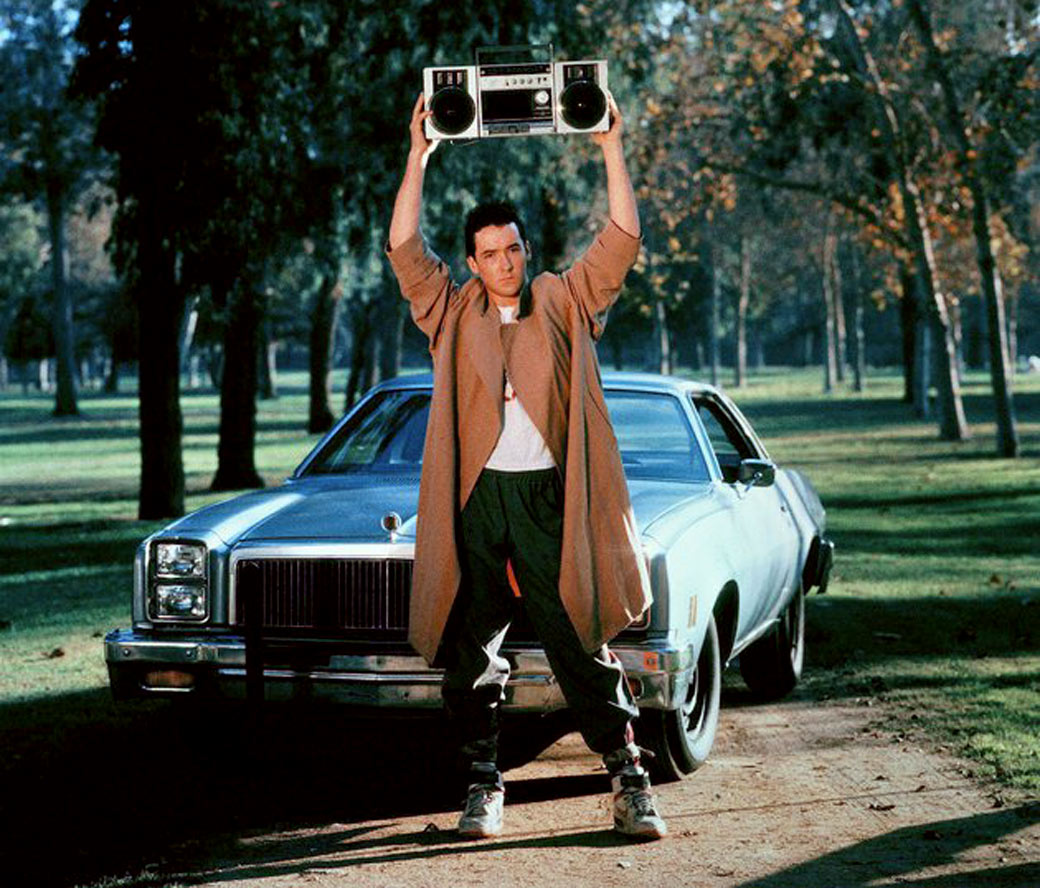
This is a great screenplay by Cameron Crowe (who also directed the film). All three central characters—Lloyd, Diane, and James—are well drawn out and easily identifiable. Every one of their situations seems believable, thus making it all effective. Aside from the great scenes I mentioned before, there are many other great ones—Diane’s amusing first talk with Lloyd, Lloyd’s best friend Corey (Lili Taylor) using her guitar at a party to get over a breakup, Lloyd meeting up with some guys at a gas station after he and Diane break up (they think they know a lot about women, even though they hang out with each other on Saturday night), and who could forget the later scene featuring Lloyd as he stands in front of Diane’s house and holds a boombox over his head, playing Peter Gabriel’s “In Your Eyes” in an attempt to win Diane’s heart again.

I love this exchange between Lloyd and Diane when Lloyd takes Diane home the morning after their first date. Diane says she’ll call him tomorrow. Lloyd: Today is tomorrow. (beat) Diane: I’ll call you later, then.

John Cusack is perfectly cast as Lloyd Dobler. He’s immediately likable and so sincere in his performance that it’s so hard not to feel for him. He has a great deal of optimism, humanity, and self-respect to believe that he deserves the prettiest and smartest girl in the class, and we’re hoping for the best. (There’s no surprise that the film’s poster features the tagline, “To know Lloyd Dobler is to love him.”) Ione Skye is wonderful and totally convincing as Diane Court—a better performance than her role in the 1987 teen drama “River’s Edge.” Both actors share great chemistry together. John Mahoney does great work, making James into a three-dimensional father character. Llil Taylor and Amy Brooks as Lloyd’s friends, and Joan Cusack as Lloyd’s older sister whom he lives with, fill supporting roles effectively.

“Say Anything” is such a treasure. It’s very human, very believable, always pleasant, extremely-well-written, and wonderfully-acted. It features a teen romance, but to be honest, it’s not necessarily a “teen movie.” This is a movie for all people—it’s a movie about relationships and trust. It doesn’t condescend to romantic comedy clichés—it tells it like it is. The result is a wonderful movie that I can’t imagine anyone not enjoying.

28 Days Later (2003) – 28 Weeks Later (2007)

8 Feb

28-weeks-later

Smith’s Verdict: ***

Reviewed by Tanner Smith

Somehow, I always had a feeling that those darn animal-rights activists would find some way to cause chaos, let alone practically the end of the world. In the opening scene to the horror film “28 Days Later,” a misguided group of British animal liberation activists break into a Cambridge laboratory and free a caged chimp, despite the helpless scientist stating the animals are infected with a dangerous, mysterious, extremely contagious virus dubbed “rage.” The contaminated chimp violently mauls one of the activists, who then turns on the other, and this is the beginning of the end.

Those pesky animal-rights people. They think they know best, but they certainly don’t know better than to go against someone exclaiming, “They’re infected with rage! They’re contagious!”

28 days later, the virus has spread even further. Jim (Cillian Murphy) awakens in an empty, abandoned hospital after a comatose state that started before the disaster. Confused and unnerved, he wanders the streets of London and finds that it’s completely deserted and trashed. Then he is attacked by one of the “infected” people and saved by other survivors who inform him of what has happened and what the “infected” have become—they are wild, aggressive, raging, bloodthirsty beasts with not a sense of human left in them at all. Apparently, all it takes is a bite and a drop of blood to transform you within 10-20 seconds.

Jim and another survivor, Selena (Naomie Harris), encounter two other survivors—a middle-aged man named Frank (Brendan Gleeson) and his young daughter Hannah (Megan Burns). They come across a radio broadcast from the Military that claims a group of soldiers are in a “safe zone” which keeps the secret to curing the infection. So, they all set out to find them.

“28 Days Later” is a gripping thriller with memorable visuals (such as Jim walking down the empty, isolated streets of London) and a surprisingly convincing dilemma. The way these infected “zombies” (for lack of a better word) come about is effectively complex, and all the more frightening. And these beasts are pure rage with only two things on their minds—flesh and blood. They’re very fast, unlike most zombies, and worse yet, they travel in packs. It’s one thing to have one or two zombies charging after you, but an army? That’s always fearsome.

Although, I have to wonder—if they travel in packs, then why don’t they attack each other? Wouldn’t they be hungry enough if no healthy people are around?

Even if “28 Days Later” were just about this infection and these zombies, it would have been a successful horror film. But this movie focuses more on its characters than you would expect from a film of this genre. You grow to like them as you get to know them, and you root for them to survive the infection, the zombies, and whatever comes next. And also, the film becomes more of a tale about human nature, once the characters find the military base where they think they’ll be safe. There’s something more here than what seems to be, and you have to wonder who can really be trusted in this changed world. Questions of evolution, the future, and the right to kill are brought up as well as, “Who’s human and who’s the beast?” That’s a question that science-fiction writers love to try and handle and we have it in “28 Days Later.” It’s predictable, but effective all the same.

“28 Days Later” is a great thrill ride. I was invested from beginning to end, and a lot of credit for that has to go to the director Danny Boyle. He shoots on video to give the film its gritty, almost documentary-like feel (and also because it’s probably more affordable). The camera-shaking element helps as well to keep the tension going in scenes such as when the heroes are trapped in a dark tunnel, and having to change a tire on their car quickly before the zombies catch up with them. The tension is present, as are the shocks that ensue.

Jim, Selena, Frank, and Hannah are all well-developed characters and they’re well-acted by Cillian Murphy, Naomie Harris, Brendan Gleeson, and Megan Burns. All four actors do credible jobs, but more importantly, it’s the writing of these people that must be recognized. Writer Alex Garland remembers that a key essential element to a successful thriller/action picture/horror film is that you care for the characters as much as anything else.

Sure, the allegories can be very obvious, some questions needed some answers, and the ending is kind of a cheat in some way, but for the most part, “28 Days Later” is a scary, intelligent thriller that even gives something as ridiculous as “zombies” a good name.

——————————————————————————————————————

11later600.1a

Smith’s Verdict: ***1/2

Reviewed by Tanner Smith

Who should be feared more? The contaminated zombies that want nothing more than to eat anyone they can catch up to? Or the government that orders a Code Red; to end the problem by picking off everybody to make sure this doesn’t leave the area? In the case of “28 Weeks Later,” both sides are equally threatening. They each bring about a certain single trait—one side contains merely rage; the other side knows less about human nature than they think they do. Both of them bring certain death.

Several months after the contagion that infected about half of the human race (turning them into rage-filled, bloodthirsty zombies—a word that is never used, for better or worse), the infected have died out and Britain is now under quarantine, as US forces have taken over. Settlers are brought in to repopulate the area. These include two kids—Andy (Mackintosh Muggleton) and Tammy (Imogen Poots)—who had been on a school trip to Spain during the catastrophic outbreak. They’ve come home to their father, Don (Robert Carlyle), who now has to explain to them what happened to their mother, Alice (Catherine McCormack). In an unbelievable act of cowardice, Don abandoned his wife during a zombie attack to save his own life. (We see that in the film’s gripping, intense opening sequence—later, Don just tells the kids there was nothing he could do to help.)

Andy and Tammy sneak out of the Green Zone to their old house to pick up a few things, where they discover their mother; still alive, symptom-free, and catatonic. The military goes in to pick up the kids and also brings back Alice to a biohazard room to see if she has the Rage Virus.

I won’t be giving anything away by saying that Alice is in fact infected and that the contagion is going to start all over again, because if that didn’t happen, we wouldn’t have a second half. The first half is mainly for setup and character development. Aside from Don, Andy, and Tammy, we’re also introduced to Doyle (Jeremy Renner), a sniper whose conscience makes his job difficult; Scarlet (Rose Byrne), a medical officer; and Flynn (Harold Perrineau), a reluctant chopper pilot.

Then the second half arrives, and “28 Weeks Later” really kicks into gear with one long, action-packed, intense thrill ride as the virus becomes active again and the military are given one basic order—Code Red. Everyone is a target as Scarlet, Doyle, and the two kids are on the run from the soldiers and the newly-infected zombies.

The second half of “28 Weeks Later” is phenomenally thrilling and even terrifying, the further it continues. It doesn’t let up. The action scenes are superbly handled; they’re very effective and keep audiences on the edge of their seats. There are three key sequences that are equally exhilarating—one is the first sniper attack in which Doyle’s conscience gets the better of him once he sees young Andy running for his life among a mixed crowd of infected and normal, frightened people; one has the characters trapped in an abandoned car by advancing soldiers, nerve gas, and the attacking zombies; and another is seen in night vision as the characters try to keep track of each other, and you just know that one of the infected is going to show up soon, and that feeling alone gets you shaken up. “28 Weeks Later” delivers one hell of a ride.

Who is man and who is beast? That’s the allegory that all science-fiction writers love to use in some or most of their stories, and when it works, it’s very effective, as is the case with “28 Weeks Later.” It’s intense, thrilling, and scary. This isn’t for the faint of heart, but after watching this movie, you’ll be glad the nearest person is still human.

Superman IV: The Quest for Peace (1987)

7 Feb

superman-iv-still-121

Smith’s Verdict: Half-a-star

Reviewed by Tanner Smith

The only reason I choose to give “Superman IV: The Quest for Peace” a half-star rating instead of a dreaded zero-star rating is because the movie is good-natured and real little kids may find some enjoyment out of it. For everyone else, and especially for those who enjoyed the first “Superman” movie (I also enjoyed the second one and found the third one to be dull as dishwater), it’s a waste of time and a mystery that needs to be solved. That mystery is, who thought a fourth entry in this big franchise would have a script this lame and effects so terrible?

The story is this: with the Cold War getting everyone paranoid, a grade-school kid writes a letter to Superman. The letter asks that he do something about the nuclear weapons in the world. So what does Superman do? He announces to the world that he will destroy them all.

And everyone’s OK with this? No one’s arguing with him?

Anyway, Superman (Christopher Reeve) destroys every nuclear missile by launching them into the sun, burning them up. This gives an opportunity for archvillain Lex Luthor (Gene Hackman), with his annoying “tubular” nephew (Jon Cryer) in tow, to send a missile with a strand of Superman’s hair attached into the sun so…(sigh) Nuclear Man can be born and be ordered to destroy Superman. Nuclear Man is a Dolph Lundgren type who has the same powers as Superman and this should lead to some interesting action sequences, right? Not even close to exciting—just bad filmmaking.

This is the fourth film in the franchise and I ask the question: Wouldn’t the effects have advanced over time? How bad are the effects? Consider the first “Superman,” which had the tagline, “You’ll believe a man can fly.” Did we see any wires? No. Did we notice a green-screen effect at times? Yes, not so distracting. Now, consider “Superman IV: The Quest for Peace.” The wires on the flying characters are visible, black curtains are seen instead of a space background when a scene is set on the moon, and I won’t even mention the bridge-effect. Also, the film suffers from bad editing to hide most of the effects.

Meanwhile in the story, there’s a subplot involving a love triangle between Superman’s secret identity—the nervous Clark Kent—and Lois Lane (Margot Kidder) and the daughter of the paper’s new editor (Mariel Hemingway). This leads to a scene in which one woman needs to be with Superman and another with Clark at the same time.

Christopher Reeve and Gene Hackman do what they can with their reprising roles. But Margot Kidder seems mostly gone through the movie, Mariel Hemingway should have known that a character with a line like “all men like me; I’m rich” isn’t interesting, and Jon Cryer deserves a slap in the face—he’s annoying all the time.

I could also argue that the production team of Golan-Globus is responsible for most of the film’s failings, but I don’t feel like writing another word about this terrible movie.

Buried (2010)

7 Feb

wwu9988fmvwb90rqbw87

Smith’s Verdict: ***1/2

Reviewed by Tanner Smith

When I die, I’ll have made sure that my body is cremated. I wouldn’t want a burial. This may sound a little ridiculous, but after hearing about certain miracles that (how do I put this, exactly?) bring people back from the dead. If I’m one of those people, then I would be buried alive, and I shudder to even think about others buried alive. But like I said, that’s probably a rarity. Though still, I’d prefer to be cremated.

It’s a truly frightening concept, being buried alive. There you are, in a dark cramped coffin. Underground. Barely any oxygen. A real sense of claustrophobia. You can scream…no one can hear you. All of that is covered in the film “Buried,” which is about a man who is kidnapped and placed in a wooden casket underneath the desert. It’s an engagingly gripping thriller.

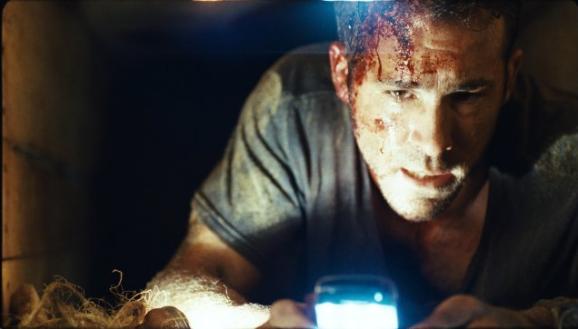
Ryan Reynolds stars in a convincing, effective performance as Paul Conroy, a truck driver working in Iraq. As the movie opens, he awakens in the casket with only a Zippo lighter, a cell phone, a flashlight, and a pencil. The last thing he remembers is his convoy being attacked and his fellow drivers being shot at. While inside his own possible grave and knowing that there is no way out from inside, he realizes that he’s been captured and held for ransom by his attackers. The terrorists order him to ask the US embassy for five million dollars.

While all this is going on, Paul desperately calls many people for help—the police, the FBI, the hostage crisis handlers, his wife, everybody. It becomes very irritating when those are really supposed to help keep asking all sorts of idiotic questions and wasting what little time there is while Paul is down there. In fact, I don’t even know who’s more the villain—the terrorists or the people who are supposed to help him.

Probably the very best thing about “Buried” (and the most amazing) is that its story follows through only inside that coffin. Throughout the film’s 95-minute running time, we stay entirely with Paul. There are no flashbacks, no scenes that take place on the other side of the phone calls, and nothing even above ground. Perhaps that’s not the most amazing part—the most amazing part is that the film keeps the viewer’s attention and interest. There’s a great deal of atmosphere and mood, told right away by the opening scene.

That opening scene comes after an old-school credits sequence that, along with a heavy orchestral score, promises something massive. The first shot after that is complete darkness, followed a few seconds later by light breathing, some thumps, and finally a lighter igniting to show the fear in the main character’s eyes.

But “Buried” also probably wouldn’t be as effective without Ryan Reynolds’ performance. That’s an odd thing to say, because I don’t consider myself a fan of his. Reynolds’ comedic work does nothing for me—he seems too bland and uncharismatic. But in this serious, dark role, he’s perfect. He brings about every right emotion, he’s absolutely credible, and is easy company for 95 minutes. Since we spend our time in the coffin, the other characters in this film are mainly voiceover roles, played by actors Stephen Tobolowsky, Samantha Mathis, and Erik Palladino.

The more claustrophobic you are, the less “Buried” is going to appeal to you. But this is an unforgettable, impactful thriller that gives me more reason as to why I would prefer to be cremated.

Smokey and the Bandit (1977)

7 Feb

smokey_and_the_bandit_1977_685x385

Smith’s Verdict: ***1/2

Reviewed by Tanner Smith

“Smokey and the Bandit” starts slow, but ends fast. It’s the strangest thing—it’s a movie that I wanted to just move along at first, but as it ended, I wanted to see more. It happened after about twenty minutes in that I started to really enjoy myself. Actually, I can tell you the moment it happened. It happened when Sally Field appeared on screen and joined the adventure of Burt Reynolds’ “Bandit” (as he’s known by his CB radio handle) and Jerry Reed’s “Snowman” as they go on an urgent trip to haul a truckload of Coors beer from Texas to Georgia.

To be sure, I was enjoying the company of Reynolds and Reed, who have a nice comic rapport with each other as they kid with around in their introductory scenes together. What I wasn’t enjoying was the way the bet for the beer was set up, by rich Big Enos and Little Enos (annoying), and I also wasn’t looking forward to how it would all turn out since Bandit and Snowman got the beer with no trouble at all and only fifteen minutes into the movie. I was hoping something would bring the movie to life—hard to believe I could ask for that, since Bandit is driving a cool-looking black Trans Am, but I need more than a car to get me interested. I’m not driving the car, and Reynolds and Reed communicating by CB radio (Reed drives the truck full of beer) could get boring. That’s how I felt while watching this movie.

But thankfully, director Hal Needham apparently knew someone like me would feel this way. So instead of a mere “getaway show,” he brings along three things to make “Smokey and the Bandit” into something fun.

The first is the character of Carrie, played by Sally Field. She’s an excited young woman who joins Bandit after hitching a ride with him, while wearing a wedding dress. She ran away from a wedding and wants something new. What she gets is Bandit’s exciting reckless-driving. What Bandit finds (and what we find) is a terrific gal. She’s attentive, fun, excitable, and so darn cute. She even gets her own CB handle—“Frog.” (“’Cause you hop around like one,” Bandit explains. “And I’d like to jump you.”) And as Sally Field plays her, she brings the heroic side of the movie to life. She’s very funny as she shouts for joy over Bandit’s driving and attempts to explain her background to this charming person she just met (while Bandit has his CB radio on for Snowman to listen to her ramblings). I loved watching her.

The second is the villain—a Texas Mountie with the handle of “Smokey Bear.” He could have been just a boring, one-dimensional caricature. Well, as played by Jackie Gleason, Smokey has two of those things right—“one-dimensional” and “caricature”—but never “boring.” In fact, Gleason is absolutely hilarious as this overweight lawman who chases Bandit along the trail and doesn’t give up for anything. He doesn’t care if he’s far out of his jurisdiction. He just wants to find Bandit and nab him. He’ll shout if he doesn’t get what he wants and takes it out on his idiot son, Junior (whom “Frog” was about to marry), even going as far as to say “There is no way that you could come from my loins.”

The third is the staging of each scene that follows as those two characters are introduced. As Smokey chases Bandit from place to place, the chases are well-staged, well-shot, and most importantly, fun to watch. Pretty much every way Bandit can evade Smokey is put on display here. They’re to the point where I found myself actually involved and I was proud of the movie for bringing me to this after a slow opening.

So what if there’s no feel for Bandit and Snowman to deliver the beer to Big and Little Enos on time? Let these folks drive, let Field keep talking, let Gleason keep chasing after Bandit like Wile E. Coyote, let Reed get beat up by some tough guys at a bar so he can gain revenge by running over their motorcycles in his truck (I love that scene). Once “Smokey and the Bandit” gets going, it really gets going. And as I said, when it was over, I wanted it to keep going.

I love you, Sally Field. I really love you.

Alive (1993)

7 Feb

fears-alive-590x350

Smith’s Verdict: ***1/2

Reviewed by Tanner Smith

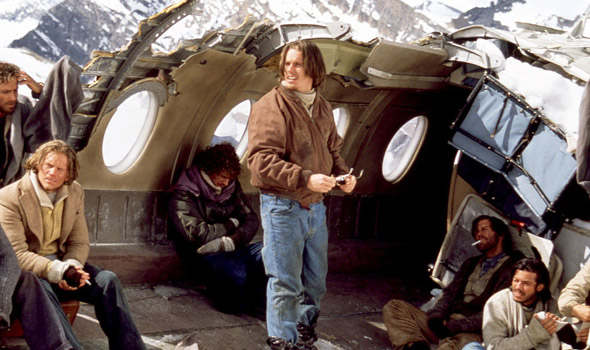
“Alive” is based on the true story from 1972 of a chartered plane carrying friends, families, and members of a Uruguayan rugby team that crash-landed in the Andes. For a little more than two months, before they were finally rescued, the survivors struggled to survive the cold and also resorted to cannibalism, eating parts of the dead, to keep from starvation. The story was made into a best-selling novel by Piers Paul Read, and has been adapted into the uplifting drama “Alive.”

“Alive” opens with one of the most frightening, convincing plane crash sequences you’ll see in a movie. It’s perfectly executed and captures the intense fear of being on a falling plane. It starts out just unnervingly, as the plane goes through some turbulence, but then it gets crazier and more terrifying as the plane surely is crashing down. It’s unforgettable, as sights such as seats with people still in them being hurled outward through a gaping hole where the back cabin used to be. At that point, we’re hooked and wondering what’s going to happen next.

The survivors are stuck on a mountain slope in the Andes and they do what they can to stay alive until a rescue team comes for them. They ration what little food they have, use seat covers as blankets, go inside the fuselage at night and curl up next to each other to stay warm. But with the continual freezing weather, food running out, and a rescue that has been called off, they realize they must do whatever they can to survive, even if that means eating the flesh off of their dead.

The subject of cannibalism is horrid and “Alive” doesn’t shy away from the horrific reality of the situation. It confronts it realistically. The characters talk about it with credible unease and tension. Some are even afraid to say the word “cannibal,” and when one does, it makes the situation even more uneasy. When one does eat, no one asks how it tastes, so no one says what it tastes like—someone eats for the first time and then leans his head down in disgust and holds out the cutting tool used to slice some meat and says quickly, “Someone take this.” When they’re all used to it, though, they manage to crack a few awkward jokes, like “If you eat me, be sure to clean your plate.” This is all done genuinely, with the characters reacting with authentic horror at the situation and then trying to relieve the tension.

“Alive” is something of a “triumph of the human spirit,” as an ordinary group of people is pushed to their limits to survive an extreme situation. The film has a bright look, an uplifting tone, and constant talk about religion and God that make “Alive” more of an inspirational survival tale than a dark thriller confronting the horror of cannibalism. This is why the true event is sometimes remarked as “the Miracle of the Andes.”

One problem I have with “Alive” is that with a large group of people as the film’s central characters, only a few of them can have enough screen time to be considered independent while the others just blend into the film. The only actors I can think of that have a significant amount of screen time are Ethan Hawke as reckless Nando; Vincent Spano as take-charge Antonio; Josh Hamilton as reasonable Cannessa; Bruce Ramsay as optimistic Carlitos; and Kevin Braznahan as pessimistic Roy. Another problem I have with “Alive” is the ending. This is supposed to be the big dramatic payoff, but it just felt sort of rushed and looked over without really gathering a lot of much-needed weight.

But for the most part, “Alive” is very much indeed alive. It’s well-crafted, well-acted, and quite effective. Instead of becoming a mere adventure story, and the final half does venture into that territory (though respectively), “Alive” becomes a more visionary tale about survival and experience that works.

Dracula (1931)

7 Feb

vlcsnap-2011-10-23-17h48m58s209

Smith’s Verdict: ***

Reviewed by Tanner Smith

“Dracula” remains one of the most notable titles in horror movie history, as well as a common spot in the most influential “talkies” of the 1930s. But despite its reputation, does it still hold up? Well, the answer would be “no.” This movie has not aged well—it’s campy, hokey, and really dated. By today’s standards, it’s not very scary and you really can’t take a lot of it seriously. It’s a lesser movie that a lot of people make it out to be. Watch it again, and you’ll probably see what I mean. But “Dracula” is still an entertaining watch. It’s atmospheric, has its share of memorable moments, and features an entertaining villain in Bela Lugosi’s Count Dracula, a vampire. For these reasons, I can recommend the film…slightly.

What do I mean by atmospheric? Look at the scene in the beginning of the film when a British real estate agent named Renfield (Dwight Frye) visits the dark and decaying Castle Dracula, high in the mountains of Transylvania. Look at the inside of this castle and just how decrepit it is. You totally buy this as Dracula’s castle. (Though, why are there armadillos in Transylvania?) It’s here where Renfield meets the sinister Count Dracula who stands on top of the stairs, hears a wolf howl, and states, “Listen to them—children of the night. What music they make.” Yes, this was the 1930s—subtlety in villain characters weren’t exactly a staple in horror movies. But I don’t care—it’s an iconic line for a good reason. Anyway, Renfield quickly falls under Dracula’s spell and becomes his assistant as he helps transport him to England. But upon arriving, Renfield is committed to an insane asylum because he has completely changed from sane and nervous to maniacal and ranting. He also eats flies and spiders.

Meanwhile, Dracula roams the village and seeks new victims to feed upon. He bites a woman on the neck and she becomes a vampire. But his next pick, Mina (Helen Chandler), is more of a challenge, since she’s constantly protected by her boorish fiancé John Harker (David Manners), her father (Herbert Bunston), and clever Professor Abraham Van Helsing (Edward Van Sloan). Van Helsing is the only one who believes in vampires and also delivers the line that hits a strong note in the screenplay—“The strength of a vampire is that no one will ever believe in them.” He soon becomes a threat to Dracula, since he knows how to stop him.

It’s so good to see most of the vampire trademarks in this movie. You can pretty much count them off and smile whenever they’re mentioned or shown. There’s the coffin for the vampires to sleep in during the day (because they only come out at night), the bites on victims’ necks, the setting of the castle in Transylvania, Dracula’s hypnotic eyes, the crucifixes that (for some reason) seems to harm vampires, the giant bat form of Dracula, Dracula not casting a reflection in a mirror, a wide-eyed, crazy assistant, and of course Dracula’s long black cape. It’s nice to see them all in one movie, and I enjoyed singling them out. \

If there’s one very important element to consider from “Dracula,” it’s Bela Legosi. His distinctive accent, calm manner, and huge eyes can make for a realistic vampire. Aside from Legosi, however, the only two actors who stand out in the cast are Edward Von Sloan who’s a hoot as the wily Van Helsing and Dwight Frye as the manic Renfield. Everyone else is either bland or unconvincing.

The film is anticlimactic. From everything Van Helsing states about handling the situation of saving Mina and killing Van Helsing, it’s a huge disappointment. It’s much ado about nothing, as most of it is taken place off-screen, it’s not exciting in the slightest, and the whole final act is let down already by its neverending, calm orchestra background music score.

“Dracula” may not be the classic that it’s been said to be, as it has many flaws. But it is still an entertaining watch.

The Impossible (2012)

7 Feb

the-impossible_2012-4-1200x800

Smith’s Verdict: ****

Reviewed by Tanner Smith

Knowing what “The Impossible” was about, a feeling of nervousness overwhelmed me and yet a feeling of fascination followed it. The fascination came from the notion that this movie would set up many things that would pay off later after a harrowing journey. The first few minutes feature the central characters—a family of five—enjoying their vacation time at a resort beach in Thailand. They’re solidly developed and feel like a real loving family. But then when there’s a shot of the family looking at the peaceful-looking beach at sunset, a feeling of horror took hold of me because I knew that this was to be a huge amount of irony for what will happen very soon. And surely enough, the next day, they’re enjoying the day after Christmas; the kids are playing in the pool with their father; the mother is reading a book on a beach chair. And then there’s an ominous wind…

Describing it like that would make “The Impossible” seem like a clichéd disaster movie, but there’s something about the way director Juan Antonio Bayona sees these scenes that make them convincing and unnerving. The audience is seeing this movie because of what is going to happen to them and for them, and thus seeing these opening scenes play themselves out as peacefully as possible works in the film’s advantage as an element of suspense.

“The Impossible” tells the story of this family as they endure one of the worst natural disasters in the world—the 2004 tsunami that devastated the Pacific Basin. You would think after Clint Eastwood’s 2010 film “Hereafter,” there couldn’t be another film to portray the outcome of its survivors. Well, “Hereafter” relied on a character’s psychic connection as a need for redemption in that case. Here, it’s pure hope—hope that all your close friends and family members are still alive after a disaster that claimed the lives of millions. That’s the case here, with this central family in “The Impossible.” They’re based on a real family—though their nationality has been changed from Spanish to British for international appeal. This is the story of how they were separated from each other and struggled to survive in the catastrophe’s aftermath to be reunited.

But first, a word about the tsunami sequence. My mouth was open the entire time at how phenomenally brilliant the special effects were, and how masterful the scene was executed. I could barely breathe—you read that right; I could barely breathe. I felt like I was there with the characters just struggling to stay afloat as the water rushed through the village. This was a brilliantly-executed sequence—one of the most terrifying disaster scenes I’ve ever experienced in a movie theater.

Maria Bennett (Naomi Watts) and her oldest son, 12-year-old Lucas (Tom Holland), are separated from Henry Bennett (Ewan McGregor) and the two younger sons, Simon and Thomas (Oaklee Pendergast and Samuel Joslin), as they struggle through the aftermath (floodwaters and mud) to seek help.

A good portion of the movie is seen through the eyes of young Lucas, who has to learn to grow up fast. His mother is badly injured with punctures to her right leg and chest, and so he must help her to keep going. But he also feels the worst for his father and two little brothers, so his mother has to keep hope alive for him. Lucas and Maria do find refuge at a hospital, where many of the tsunami survivors are being treated. It’s then that Lucas is asked to seek patients’ family members who may be around the hospital somewhere. And it’s here that hope comes for Lucas—if they’re alive, then maybe his father and brothers are too. This makes “The Impossible” an effective coming-of-age tale as well as an effective disaster movie.

Extreme devastation; a paradise turned into a wasteland; many people dead; separation from loved ones; not knowing who’s dead or alive. All of these elements are ongoing in “The Impossible” and they’re all powerfully portrayed. The fear and despair that come with these characters are existent. You really get a sense of what they’re all going through, and sincerely hope for the best (although, those who know the true story of this family already know the outcome).

The performances from the principal actors are spot-on. Naomi Watts has the most physically-challenging role, since her character is mostly confined to a hospital bed as she’s in critical condition. Her Oscar nomination for her work is well-deserved. Ewan McGregor, as her husband, is powerful as well. Of the three child actors, Tom Holland, as Lucas, is just brilliant in his feature debut. He has Lucas’ emotions down to a T and delivers the complexity of a little kid looking to live through this crazy situation.

I don’t want to say too much about “The Impossible,” especially for the sake of those who don’t know the story of this family. I didn’t know, when I saw this movie. I think the less you know, the more emotionally involved you are with the story’s execution. From the beginning to the middle to the end, I was absorbed by “The Impossible.” If you’re looking for a disaster movie in the style of Michael Bay or Roland Emmerich, then just keep looking. “The Impossible” is not escapist entertainment. It’s much more complicated than that.

The Outsiders: The Complete Novel

7 Feb

Curtis_Brothers_Talking

Smith’s Verdict: ****

Reviewed by Tanner Smith

I gave 1983’s “The Outsiders” a negative but affectionate review, saying that it needs more material to be a better movie. Well, fans of the movie, who were also fans of the novel it was based on, wrote many letters to the director Francis Ford Coppola and they all asked the same question as to why the film wasn’t more like the book. And now, in 2005, there is a much better version of “The Outsiders” with twenty minutes of deleted scenes. It’s called “The Outsiders: The Complete Novel” because it covers more of the original novel. It also makes the story more clear, gives room for the characters to develop, and gives the thought of why in the world didn’t Warner Bros. release this film in the first place?

I love this movie. It reminds me so much of why I love reading the book in the first place. It’s touching, powerful, and a much better film than its original cut. I am even going to give it four stars. I think it deserves that rating.

In a never-before-seen opening scene, the hero Ponyboy Curtis, a fourteen-year-old greaser who lives on the wrong side of the tracks, is jumped by the socs, a gang of rowdy rich kids from the other side of town. His older brothers and buddies come to his rescue. This is great—we are given proper introductions to all of the “greaser” characters and we get a sense of the relationship between Ponyboy (C. Thomas Howell) and his brothers Darrel and Sodapop (Patrick Swayze and Rob Lowe). With other additional footage, the characters are given room to develop into people we care about. One character in particular who given special treatment is Sodapop. His added scenes—especially one in which he breaks down at the end—remind us that Rob Lowe is a very good actor for dramatic situations, not just deadpan comic effect.

Ponyboy and his buddies—tough, mean Dallas (Matt Dillon) and scared, sensitive Johnny Cade (Ralph Macchio)—are hunting for action one night at the local drive-in. While there, Dallas tries, very rudely, to pick up a soc girl named Cherry Valance (Diane Lane). She tells him to go away and then she unexpectedly picks up Ponyboy and Johnny, knowing very well who they are (she tells them, “I’ve met people like Dallas Winston; you two don’t look mean”). Her friend Marcia is picked up by Ponyboy and Johnny’s friend Two Bit (Emilio Estevez), the jokester of the greasers who loves Mickey Mouse cartoons. But soon, there’s trouble. The girls’ boyfriends spot them with the greasers which leads to them hunting Ponyboy and Johnny, finding them alone later that night. While drunk, they come very close to drowning Ponyboy in a fountain and one of them—Cherry’s boyfriend Bob (Leif Garrett)—is murdered by Johnny. This leads to Ponyboy and Johnny being aided by Dallas to figure out what to do about this situation. They hide out in a church for a week, then they become heroes for saving children in a fire, then they return home to resolve issues with the socs.

There are more touches to this director’s cut that really make this film special. The story is better developed, the characters are more complex, and that music from the original film is gone—thank God (I hated that music in the first place). This is a much more faithful adaptation to the beloved book by S.E. Hinton.

Watching this new cut, it’s fun to see all of these actors before they made their big career moves. Matt Dillon is fantastic as Dallas, the rebel without a cause—it’s fun seeing him here and in “Tex” and “Rumble Fish” (all of which were film adaptations of S.E. Hinton novels) as this tough teenager with a lot to do and say. Ralph Macchio (yes, the Karate Kid) is very good as Johnny—he’s just that kid you want to see good things happen to, despite his murderous deed. Patrick Swayze, Rob Lowe, Diane Lane, Emilio Estevez, and Tom Cruise (yes, Tom Cruise) are all great in their roles. What really surprised me was that C. Thomas Howell, playing the narrator of the film, didn’t go on to bigger and better things like his co-stars. Howell is wonderful here—he gives a convincing, complicated performance as this nice, scared kid who is smart and thoughtful. Since this movie, he’s played pretty much the same character until his career bomb, “Soul Man,” in 1986.

“The Outsiders: The Complete Novel” is a much better film than Warner Bros. thought it to be in 1983 and I loved it.