Archive | February, 2013

Chronicle (2012)

10 Feb

Dane-DeHaan-in-Chronicle-2012-Movie-Image1

Smith’s Verdict: ***1/2

Reviewed by Tanner Smith

“Chronicle” mixes a superhero origin story with a teenage coming-of-age drama and presents it in a first-person perspective. If that doesn’t sound like an ambitious project, I don’t know what does. “Chronicle” is a well-made movie, and it was thoroughly entertaining. Just when I thought I was getting tired of the first-person perspective (I’ve seen it in “Blair Witch Project,” “Cloverfield,” “District 9,” every episode of “The Office,” and don’t get me started on the “Paranormal Activity” series), “Chronicle” sneaked up on me. I say this because I avoided the trailers and TV spots for this movie and knew hardly anything of the plot, except that it was played as if it was actually documented and there was a poster that looked like a kid was giving a thundercloud the middle finger. I wasn’t anxious to see this movie, but I did the immature thing and gave in to peer pressure. What I saw was a film that has a lot more on its mind than you might expect.

The film’s story is seen through a video camera, though not just the main character’s camera. Sometimes, we see through a v-logger’s camera, and other times, we see through surveillance cameras or any camera that comes into the scene. The film stars a high school senior named Andrew (Dane DeHaan), who is shy, awkward, and standoffish. Girls ignore him, jerks pick on him, and he only has one friend—his popular cousin Matt (Alex Russell). Also, his mother is dying and he’s the constant punching bag of an abusive father who drinks a lot. Andrew has bought a video camera and documents his home life and his high school, though really that makes him even more awkward.

Matt brings Andrew to a rave party, where they and another kid—Steve (Michael B. Jordan), the big man on campus running for class president—stumble across a hole in the ground nearby. It’s circular, seems to tunnel underground, and gets deeper and deeper as the three boys explore.

Now, would you step into something like that? I didn’t think so.

But they do, and Andrew brings along his camera. They come across a strange object, which, because it glows, may give the possibility that it’s alien. The boys are exposed to a kind of force that destroys Andrew’s camera. But luckily, Andrew buys a new camera and we see that a few days have gone by and the boys suddenly possess powers of the mind. They throw baseballs at each other’s chests so they can stop them in mid-air before they get hit. They build a tower out of their Legos without touching them. They start a leaf blower to lift up cheerleaders’ skirts. They play pranks in a department store (like bringing a teddy bear to life in front of a little girl). They can even move themselves up in the air!

They have a lot of fun with their new talents and behave like teenagers while fiddling with them because…they are teenagers. But these kids have no adult mentors (as most superhero stories do) to tell them how to use their powers responsibly. However, Matt decides to lay down some rules after Andrew’s irresponsibility nearly kills someone. This is the start of the dark, disturbing plot thread that follows Andrew’s tortured personal life to something really dangerous. Later in the movie, after being humiliated at a party, he addresses to the camera that he’s evolved into something better than he was and the way he feels about hurting a person leaves him with the same lack of remorse after killing a bug. He thinks of it as natural selection.

The first half of “Chronicle” is the most fun part of the movie. It has fun with these kids experimenting with these new powers and gaining more from them, such as when they realize they can soar through the air together. There are a lot of laughs, particularly with the one-liners the kids spew and the constant mishaps that occur when first testing their powers. My favorite scene is when Andrew and Steve perform at a talent show, showing off their powers, pretending to perform magic tricks, and wowing everyone in the process. But then the movie develops into something more deep and dark that comes mainly from Andrew’s slowly but surely loss of innocence. One tragedy leads to certain danger and that leads to a total mental breakdown. With someone of his abilities, that can’t be good.

“Chronicle” may be inconsistent that way—different second half in contrast to the second—but the second half is admittedly very strong. It shows Andrew’s problems in a convincing way and when you think about it, there are moments in the first half that do lead to what Andrew could be capable of. I remember Andrew always learning his powers faster than Matt and Steve can because he focuses the hardest, and when he records himself with his camera (while moving the camera in the air and letting it hover in his bedroom), he ponders. Now we’re aware what he was thinking about doing all along. We see some of his home life when he’s not fooling around with his friends, and it is enough to show the pain he goes through, what with his ailing mother and his jerk of a father.

Give credit to the director—newcomer Josh Trank—and the writer—also-newcomer Matt Landis, John Landis’s son—for making these kids seem like actual teenagers and behaving like they would behave if they were suddenly telekinetic. I believed these young actors were living their characters and I felt their excitement. But I suppose that could also be because of the first-person perspective, seeing things through the video camera’s point of view. And to keep things from being repetitive, “Chronicle” beat the problem by showing things through the view of other cameras, particularly the camera belonging to a cute blogger named Casey (Ashley Hinshaw), whom Matt has a bit of a crush on. This works especially well in a conversation scene—we first see through Casey’s camera to see Matt talking (while he has Andrew’s camera), then through the other camera to see Casey as she talks. And using other cameras for perspective works especially well in the film’s explosive climax in which Andrew completely loses his sanity and lets out all of his rage onto public property and unlucky people.

So, from goofing around comes deep trouble. But isn’t that what would happen if a troubled teenager really did gain mind powers and decide not to use them responsibly? Not that it could happen, but what if? That’s why the first-person perspective tells this story—to give a great kind of “what-if” tale. What have I left out of this review? Only the effects. The special effects used to make objects float and make the kids fly are downright first-rate. They look extremely convincing and make the production values even more impressive. To wrap this up, even if “Chronicle” switches gears, it has a lot of fun before doing so.


20,000 Leagues Under the Sea (1954)

10 Feb

images

Smith’s Verdict: ****

Reviewed by Tanner Smith

One of the great things about the late Walt Disney’s movies is that they’re suitable for all audiences. Disney has a reputation of being an important member of the family-movie circuit, as well as the richest. But that’s just it—they key word in that phrase is “family” movie, not “kid’s” movie. These are good-hearted movies for children and adults. If Disney’s animated movies, such as “Pinocchio,” can show that, then his live-action films certainly could. One that comes to mind is the 1954 film adaptation of Jules Verne’s “20,000 Leagues Under the Sea.”

“20,000 Leagues Under the Sea” is a delightful adventure movie—exciting, mysterious, thrilling, and when it needs to be, insightful. It’s great for kids, but also for adults, who I think arguably, might enjoy it more. It knows how to tell a story, it’s thought provoking, and visually thrilling.

It begins as something unknown continues to sink ships all over the ocean. Professor Arronax (Paul Lukas) has been invited to board an expedition to search for the supposed “monster.” But after an encounter with the thing, the Professor, his meek but loyal assistant Conseil (Peter Lorre), and sailor Ned Land (Kirk Douglas) are left shipwrecked, and they swim to find that the monster is not a monster at all. It is, in fact, a fully functional submarine.

The submarine is an amazing discovery for its time, and is captained by the megalomaniacal Captain Nemo (James Mason), a genius with a skill for invention, a hunger for freedom, and a grudge against humanity. Because he has read the Professor’s work and feels there’s more he can show him, he agrees to take him and his two companions aboard. The Professor is fascinated by Nemo’s invention(s) and free world, and unnerved by his resentment for society. Ned, however, would like nothing more than to escape.

Everything around the submarine is a visual treat. Showing how the contraption works and all of the neat little gadgets around it makes it interesting to watch. I feel that everything in this movie’s budget went into this submarine and it shows. And it’s captained by a particularly interesting character—Captain Nemo is one of the great villains in literature and is no exception in the movies, based on the performance by James Mason. Nemo is constantly wavering between insanity and intelligence, and has his own views of society that forces him to create a deadly crusade across the seven seas. James Mason is brilliant as Nemo—he makes us hate him one minute, and then care for him the next.

There are plenty of fun action sequences. Three come to mind—the first is, the shark attack underwater, as Ned and Conseil go hunting underwater (sporting diving suits and helmets) and attempt to steal buried treasure when they come across trouble; the second is, a chase by a cannibal tribe on a remote island which ends with another clever invention by Nemo; and last but definitely least is, a battle with a giant squid. Great creature effects are put into that last sequence, like giant tentacles wrapping around the crew, and the pacing is perfect as Ned attempts to break out of his prison room in order to save the day, making this a brilliantly formed action sequence.

Kirk Douglas is likable as the rambunctious scalawag Ned Land, who becomes the unlikely hero only after trying multiple times to escape. Paul Lukas does a nice job as the intellectual who is slowly descending to Nemo’s level, and Peter Lorre is fun as the meek one caught in the middle of all this.

There are also some nice light-hearted moments to go with the dark material, such as when Ned plays a catchy fun tune called “Whale of a Tale” on guitar, or when Nemo’s pet seal who apparently prefers cigars over seafood—though to be fair, I think those cigars were made of seaweed, since the food on that ship is entirely made of creatures from the sea. Would you believe that the supposed “cream” is actually milk from a giant sperm whale?

“20,000 Leagues Under the Sea” is a timeless classic in not only the Disney live-action group, but also the action-adventure genre. It provides characters to root for, a villain that can be both sympathetic and intimidating, great visual sets, sensational sequences, and a well-moving story.

Side Effects (2013)

10 Feb

Rooney-Mara

Smith’s Verdict: ***

Reviewed by Tanner Smith

“Side Effects,” director Steven Soderbergh’s final film (yeah, we’ll see about that), has so many twists and turns in its story and development that it’s hard not to think of one of the late Alfred Hitchcock’s thrillers. It’s said that Hitchcock always loved to “play his audiences like a piano” with his films and here, it seems that Soderbergh wanted to do the same thing. To review a movie like this is difficult because I’m hesitant about giving away certain details of the story, even in the beginning. It’s like a movie that Hitchcock would have warned critics not to give away the beginning (“Psycho,” for example).

And I have to be honest—it worked for me. I didn’t watch a single trailer for “Side Effects” nor did I read any other reviews beforehand. (I only noticed the film’s poster, and I was to see either this or “Identity Thief” this weekend.)

“Side Effects” has twist upon twist upon twist, bringing a solid, gripping thriller from one of our best directors.

I have an obligation to at least say a little bit about the story. As the movie opens, we’re introduced to 28-year-old Emily Taylor (Rooney Mara), who is waiting for her husband Martin (Channing Tatum) to be released from a four-year prison sentence (on what charge, I might have missed). As if in a trance, Emily drives her car into a parking garage wall and nearly kills herself. This begins a series of therapy sessions with Dr. Jonathan Banks (Jude Law), who prescribes her a series of antidepressant medications (even though Banks is undoubtedly more interested in drug studies than properly helping his patients). The drugs work, as Emily begins to gain her normal life with Martin again. However, a certain side effect has Emily sleepwalking, and this leads to tragedy…

Period. That’s all I’m going to write about the plot for “Side Effects.” What the tragedy means, what it leads to, and everything that follows further deserves to be experienced. The less you know, the better. But this is a smart film that doesn’t go for the usual elements you’d expect from a modern thriller.

Rooney Mara, playing Emily, is given her first leading role since her Oscar-nominated turn in “The Girl with the Dragon Tattoo.” In the difficult role of a woman fighting depression and confusion, she’s great in this movie. Jude Law, as Dr. Banks, handles his role with great conviction—it’s his finest performance in quite a while. Channing Tatum is a reliable screen presence as Emily’s husband, and Vinessa Shaw is convincing as Banks’ wife who can’t quite handle her husband’s obsessiveness and anger after the aforementioned tragedy occurs (I still refuse to talk). Catherine Zeta-Jones portrays Emily’s previous therapist whom Banks visits for advice about Emily’s conditions, and unfortunately, she’s miscast here. She doesn’t do a terrible job, but she just seems too…obvious.

Not everything about “Side Effects” works. While you can follow the story fine, there are little details I wish were extended—that’s just my personal preference. And the certain twist that sets up the final act of the movie, while I never saw it coming, is a little too much for me to buy.

It’s been reported that “Side Effects” is Steven Soderbergh’s final theatrical feature. Apparently, Soderbergh has said that he wanted to try something new, with TV for example. Maybe he goes and comes back to film, or maybe he likes where his new career will lead him. But one can hope that “Side Effects” does not turn out to be his final film, because this is a director who clearly knows how to make movies and tell stories in a most unpredictable way. If the former is true, and this is his last film, “Side Effects” is a decent way to go. It’s a neat thriller made by a damn good director.

A Hero Ain’t Nothin’ but a Sandwich (1978)

9 Feb

741952659693

Smith’s Verdict: ****

Reviewed by Tanner Smith

What’s more disturbing about drug use is that some people are the ones we least suspect of using. Take Benjie: He’s 13 years old. He lives in the Watts ghetto with his caring mother, stepfather, and grandmother. He’s a bright junior high school student. He’s happy just hanging out with his friends.

Now he’s a heroin addict. He was introduced to the stuff by one of his buddies, and loves the high so much that he frequently buys from the local drug dealer.

Benjie is the focus of “A Hero Ain’t Nothin’ but a Sandwich,” a tough, well-acted, gritty family drama about a confused boy caught in a world of drug addiction. He keeps saying he isn’t hooked—he is.

The situation gets worse, and Benjie is eventually sent to a drug rehabilitation center when everyone finds out about him. In one of the most bizarre sequences in the movie, we see in photo slides Benjie coping with rehab—in between is a painfully effective scene in which Benjie is confronted by an encounter group and tearfully opens up to them.

That leads to the second half of the movie, as Benjie deals with rehabilitation, starting over, deeper temptation, and his relationship with his stepfather.

The most interesting part of “A Hero Ain’t Nothin’ but a Sandwich” is the relationship between Benjie and his stepfather. The stepfather is not written as a monster to act as reason for Benjie to use drugs in the first place. Instead, he tries to be the best father Benjie can be, but Benjie constantly shuts him out when he’s there for him. Benjie tells his best friend that he does this because he’s afraid that if he winds up loving him like a father, then he’ll be sad if this new father leaves, like his old father. When the stepfather—named Butler—finds out about Benjie’s new hobby, he’s very strict and sometimes goes out of line, but tries to do the right thing by him. And when things get really nasty, he seems to be the only person Benjie can depend on. But the problem is, he can get to his wit’s end with the kid.

Those scenes make “A Hero Ain’t Nothin’ but a Sandwich” more of a movie about family values and trust rather than merely a story of tragedy involving young people and drugs (though it is that, as well).

The acting is great, especially seen in the scenes involving Paul Winfield as Butler and Larry B. Scott as Benjie. Paul Winfield is excellent as Butler—he creates a character that is tough and persuasive as he tries to be a hero figure as a surrogate father for a disillusioned teenager. Larry B. Scott turns in a believable performance as a kid who has high spirits but whose ambitions turn low. Cicely Tyson as Benjie’s mother, Helen Martin as Benjie’s grandmother, and Kevin Hooks as the drug dealer named “Tiger” are also solid.

What surprised me about “A Hero Ain’t Nothin’ but a Sandwich” was how honest it was. In fact, at times, it’s hard to watch. But that means it’s working. Just about every scene in this movie is so authentic that at times it is frightening. It’s an effective tale about how pride, trust, and respect can be taken away by drugs, and about how coping and willing with withdrawal can gain them back.

The People Under the Stairs (1991)

9 Feb

images

Smith’s Verdict: ***

Reviewed by Tanner Smith

For a movie director that mostly does horror films, Wes Craven seems like a smart person. His films are not necessarily masterpieces except to many horror fans, but you can see what he shoots for and you have admire him for that. He adds terror and suspense to artistry and imagination. That was the case for “A Nightmare on Elm Street” and “The Serpent and the Rainbow”—“The People under the Stairs” is one of his more satisfying films, in my opinion. It’s a scary, well-acted horror movie with a good deal of imagination.

The main feature is a house full of gruesome surprises, ghoulish children in the basement, passageways in the walls, and a couple, only known as Man and Woman, that are psychotic, delusional, insane, grownup monsters. The people under the stairs in the basement, as the title refers to, are children that they stole as babies and punished very severely when they “heard too much, saw too much, or said too much.” They have stooped to cannibalism after being locked up downstairs for many years—they’re given flashlights to see their ways around and are given dead human meat—don’t laugh—to eat. But the people under the stairs are not the real monsters here—the Man and Woman are not to be messed around with. Anyone who breaks into the house or visits the house to look around (like police or salesmen) wind up murdered by the couple…and then eaten by the people under the stairs. There is no compromising with this couple—they will kill you mercilessly.

And what’s even scarier? They act like it’s their lives’ duty to “punish” people. After they murder mostly-innocent visitors, they say, “May they burn in hell.” They have their own insane delusions of religion and feel like they are supposed to act like this. Also, they have fun while doing this. The Man and Woman are jolly killers, if you can believe this. The Man, especially, is the one who yells at runaways trapped in the house, “Gonna kill yooouuu!!!” At one point, he dances around near the Woman and chants “I got him” multiple times, leaving the Woman to stand not amused and tell him in a firm, clear voice, “Prove it.”

Played by Everett McGill and Wendy Robie, the performances and personalities of the Man and Woman are so over-the-top that even when you shouldn’t, you laugh at certain moments. At the same time, you are frightened because of their behavior. They kill, they sic their bloodthirsty Rottweiler on those who are loose in the house, and they lock up and abuse their teenage daughter Alice (A.J. Langer) very severely, but not as bad as the people under the stairs. (Still, it’s pretty bad.) Alice is a terrified young girl who would like to get out of this house, away from this crazy couple. But nobody ever gets out of this house—the doors are all locked (the front door even gives an electric shock) and the windows are all unbreakable. Inside the house, there are many passageways from inside the walls that Alice’s friend Roach, one of the people under the stairs who has escaped the basement and is being hunted by the Man frequently. The house is like an amusement park haunted house with many surprises around every corner and secret ways to get through many areas.

The passageways come in handy for the young hero of the film—a thirteen-year-old Ghetto kid nicknamed “Fool” (Brandon Adams) who helps his older sister’s boyfriend Leroy (Ving Rhames) break into the house to retrieve a hidden gold coin collection to cover Fool’s family’s apartment rent (one little flaw with this plan is that the Man and the Woman are the landlords to begin with, but oh well). Leroy is killed by the couple and Fool is forced to fight for his life—he makes friends with Alice who gives him some help, he is chased by the Rottweiler, he is menaced by the people under the stairs, and does battle with the Man and Woman throughout the film. This kid has so many tricks up his sleeve in the way he outsmarts these evil adults that this could be an R-rated “Home Alone.” It is very violent and gruesome and frightening—this is not for small children. The R rating is well-deserved.

I mentioned that “The People under the Stairs” was one of Wes Craven’s most satisfying films, and it is impressive. The house is a fun house of horrors, Brandon Adams is a likable resourceful hero, Everett McGill and Wendy Robie are a frightening couple, A.J. Langer is suitably sweet and scared as Alice, and there are genuinely frightening moments. I was cheering for Fool all along, I wanted him to escape this madhouse, and this is quite odd because when you have a child in jeopardy, it seems like a cheap move for suspense. But with the craziness of the villains, it almost seems like all bets are off. It’s this bravery (and again, imagination with the story and sets) that earns “The People under the Stairs” a recommendation from me.

The Runaways (2010)

9 Feb

images

Smith’s Verdict: ***

Reviewed by Tanner Smith

“The Runaways” is a biopic about the all-girl rock band started by Joan Jett, whom we know as the punk rock female singer from Joan Jett and the Blackhearts mainly. For those who have little to no knowledge of The Runaways, her start in the music business, “The Runaways” tells that story with its own touches. The result is a good biopic—not a great biopic. It is well-made but standard in its storytelling. What makes it special—in fact, what makes most biopics special—are the performances from the actors who portray the historical figures the movie bases them on.

The movie opens as a young woman—guitarist Joan Jett, played by Kristen Stewart—and her friend—drummer Sandy West (Stella Maeve)—approach a music agent named Kim Fowley (Michael Shannon). Joan tells Kim that she wants him to manage an all-girl rock band with her as the lead guitarist. Kim hears them play and believes they have potential, so he tells them to be tougher and more energetic in their music performances. He brings The Runaways together and helps bring along the rest of the group—including guitarist Lila Ford (Scout Taylor-Compton), bassist Robin (Alia Shawkat, the rebellious teenage girl in “Arrested Development”), and fifteen-year-old singer Cherie Currie (Dakota Fanning). They are young and ready to rock. But Kim knows getting them known to the public isn’t going to be easy, so he continues to push them harder during practice.

Cherie Currie could be considered the main protagonist of the story. We see her living with her sister and mother (a wannabe actress who always shouts “Places everyone” when getting her daughters’ attention) in a rural home. In an opening scene, Cherie dons a lot of makeup and lip-synchs David Bowie in a talent show, where she is booed off the stage.

What’s most fun about “The Runaways” is the creation of The Runaways’ popular songs such as “Cherry Bomb.” The music is one of the best things in the movie. When the band is on the stage, “The Runaways” rocks along with it. But that’s not the only thing that gives it its strength. Performances from the lead actors make this worth watching. Kristen Stewart is excellent as Joan Jett, with the short brunette hair and attitude that mixes asking for trouble with sincerity. Dakota Fanning is very good as Cherie Currie—I think this is her first role in which she doesn’t play a little girl, but a young woman. The scene-stealer here is Michael Shannon—his character of Kim is a creep and proud of it. He is not likable but he seems very real. What didn’t quite work was some of the elements in the storytelling, such as the relationship between Joan and Cherie. Also, the melodrama in which Cherie’s family misses her is a bit uneven, though Cherie’s relationship with her sister is pleasant enough. Maybe a few scenes with Joan Jett’s home life would’ve made the movie earn a three-and-a-half star rating. What did work, aside from the music and the performances, was Cherie’s descending into the world of drugs and sex, after the band makes it big in Japan. That was convincing enough.

Like I said, “The Runaways” is not a great biopic—it’s a good one and I’m giving it three stars. I just wish the screenplay went further ahead with the band and the relationships. Luckily, they have the performances and the music to compensate for the script’s weaknesses.

Charlie and the Chocolate Factory (2005)

9 Feb

images

Smith’s Verdict: ***

Reviewed by Tanner Smith

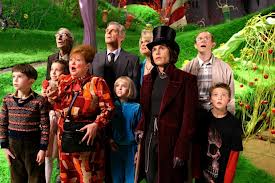
“Charlie and the Chocolate Factory” is a film adaptation of the well-known Roald Dahl children’s book of the same name, as well as a remake of the well-known 1971 children’s classic, entitled “Willy Wonka & the Chocolate Factory.” It’s also an easy movie to review—everything in this movie works except for Willy Wonka, the magical tour guide who was a huge part of the magic in the original 1971 film. While Gene Wilder played him as welcoming, winning, magical, though maybe somewhat deranged, Johnny Depp, playing Wonka in this new version, is just…awkward. Depp plays him all over the place, but there is just no sense of magic with the way he portrays Willy Wonka. He’s not charismatic; he’s uncomfortable and creepy. Wonka is supposed to tour five kids into his wondrous chocolate factory. I’m just glad the parents are there with the kids before the crazy stuff happens to them (more on that later)—especially since their tour guide is a…weirdo.

That’s not to say Gene Wilder’s Willy Wonka in the original wasn’t weird, but at least that was part of his edge. Sure, he was mysterious, but he could be kind when he needed to be and fun to be around. Johnny Depp’s Willy Wonka is not only annoying, but also somewhat psychotic in the way that his motives are never quite clear.

But strangely, even if Johnny Depp’s performance doesn’t work, there are many more elements of “Charlie and the Chocolate Factory” that do. They help me give the movie a mild recommendation.

“Charlie and the Chocolate Factory” centers around a little boy named Charlie Bucket (Freddie Highmore, who previously co-starred with Depp in “Finding Neverland”) whose family is so poor that they have cabbage for dinner every night, all four grandparents sleep and live in the same bed, and there’s a large hole in the ceiling of Charlie’s upstairs bedroom, open to cold weather. Oh, and the house is slanted. He lives in the town where Willy Wonka’s chocolate factory is located—as the story goes, no one goes in and no one comes out. But what goes on in that factory? Who’s working there?

Well, it turns out that five children will get the chance to find out the answers to those questions if they find golden tickets inside Wonka chocolate bars. The first four kids who find it each have serious character flaws—one never stops eating, one is rich, bratty, and spoiled, one is overly obsessed with winning (even chewing a piece of gum for three months for a world record), and one is obsessed with video games and TV. Charlie gets the last ticket, though not without suspense.

That’s the first half-hour of the movie, and then all five kids, each bringing a legal guardian (Charlie brings his feisty Grandpa Joe), arrive at the factory, only to be welcomed by the strange Willy Wonka who will serve as their tour guide. When he first arrives, he’s reading his greeting from cue cards and acts uncomfortable when the kids say “hi” to him. Kind of rude for someone who sends out tickets inviting people to visit inside his top-secret factory.

It turns out the factory is a dream come true. There’s a room that is like a candy wonderland—it’s a meadow made entirely out of sweets. Everything is edible, even the grass and river (which is made entirely out of chocolate and churned by a waterfall). The inventing room is full of strange inventions and neat little tricks all around. There are squirrels that are specially trained to test walnuts. And even more strange, wonderful stuff is seen. “Why is everything here completely pointless,” one of the kids rudely asks. Charlie calmly replies, “Candy doesn’t have to have a point. That’s why it’s candy.” Truer words couldn’t be spoken about this place.

Charlie is a good kid—honest, sincere, nice, and true to his heart. But the other four kids’ flaws get the better of them in this factory. With each stop, one of these kids gets a comeuppance. The fat kid drinks from the chocolate river and winds up in the filtration system after falling in—he shouldn’t have been greedy. The other kids suffer worse fates they had coming due to their flaws, but they still make it out alive so they can learn from their experiences. So the message is as clear, as in the original version—be kind and patient, and one day you’ll be rewarded. That’s how Charlie wins the big prize at the end, which I won’t spoil in this review, if you haven’t seen the original version already.

“Charlie and the Chocolate Factory” was directed by Tim Burton, who specializes in weirdness/quirkiness. As is the case with most of his movies, the movie looks incredible. Even before we go inside Willy Wonka’s chocolate factory, the everyday modern world is neat in the way the settings/surroundings are exaggerated to look like an illustrated fairy tale. The outside of the factory seen from behind a large gate, the young protagonist’s slanted little house, even the candy stores—all of these locations/sets are fun to look at. And that’s just the first thirty minutes of the movie. Inside the factory, later, we get more visual treats. The candy room is a pure delight. Everything looks edible, and you really want to just fly into the screen and join the experience. The chocolate river, in particular, looks especially realistic. And there are more visual treats as the movie (and factory tour) goes along.

The story gets deeper with Wonka’s back-story—how Wonka became who he is now and why he apparently has a “parent” complex. We never even saw a back-story in the original version. That’s because we didn’t need one—the character was already as interesting as he could be without being the main focus of the story, which is Charlie. However, while it may not be necessary, there needs to be at least some saving grace from Johnny Depp’s awkward performance.

And I’m sorry, I keep coming back to how uncharismatic this Willy Wonka is. What’s really surprising is that Johnny Depp playing the role sounds like it would be great. This should have been the high point of the movie, or at least one of them. But I have no idea what he’s doing with this performance. How can you not think of Michael Jackson crossed with Marilyn Manson when watching him? That’s not a welcome combination, and I don’t care who I’m talking to with this review.

But like I said, everything else in the movie works. The movie looks great, the story is well-executed, and the other actors do competent jobs. Freddie Highmore is likable and sweet as Charlie, David Kelly is wonderful as Grandpa Joe, and the other four kids—Julia Winter, AnnaSophia Robb, Jordan Fry, and Philip Wiegratz—are good comic actors.

OH! I cannot believe I forgot to mention something else I liked in this movie—the Oompa-Loompas, the race of strange, little men (all of which played by Deep Roy) who are the workers of the factory. Whenever one of the kids gets into trouble in the factory, there they are to sing songs about their fate. Their musical numbers come out of nowhere and are as weird and fun as the singing waiters in “The Polar Express.” These sequences are very delightful.

“Charlie and the Chocolate Factory” is a nice fantasy film, despite Johnny Depp’s awkward performance. Just about everything else in this movie works well and are enough for me to rate it three stars. I gave the original film four stars, and that was made more than thirty years before this one. At least that version had a more charismatic tour guide for the chocolate factory.

Scent of a Woman (1992)

9 Feb

images

Smith’s Verdict: ****

Reviewed by Tanner Smith

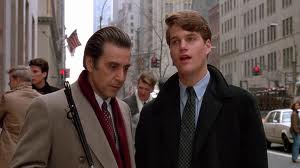
In “Scent of a Woman,” Charlie Simms (Chris O’Donnell) is a shy Boston prep-school student who needs a good role model in his life. His mother and stepfather live in Oregon, and he and his stepfather don’t see eye-to-eye. And he’s not the most popular kid in a school where most of his classmates are spoiled by their wealthy fathers. Some of those classmates have pulled a prank on the headmaster, damaging his new Jaguar. Charlie knows who did it, but won’t snitch. However, if he doesn’t, he’ll be expelled. So, a disciplinary hearing is scheduled after Thanksgiving break to determine Charlie’s scholastic future.

Enter Lt. Col. Frank Slade (Al Pacino), a lonely, blind veteran. He’s an embittered man with two things that keep his spirit alive—his sense of humor and his romanticism. Charlie is working over the Thanksgiving weekend as his aide and companion. When he first meets him for an interview, Slade takes joy in making him feel as miserable as he feels. He uses sarcasm, anger, and abrasiveness to further confuse and slightly frighten Charlie.

In that first scene you see Slade, you get the feeling he enjoys doing this, as if his interviewees are his “victims.” And it’s probably not the best way for the audience to be introduced to this character, because he is so coarse that he comes so close to being a turnoff for the movie. But as performed by Pacino and written by Bo Goldman, the character gradually becomes more fascinating as the role and movie progresses. We can see why he acts this way and also why he isn’t such a miserable old fart.

“Scent of a Woman” takes these two characters, and their own stories, and brings them into a story that uses the reliable coming-of-age formula in which a young man is counseled by an older man who has lived through a lot and has a thing or two to teach his new pupil. In that case, these two characters seem just right for each other.

Anyway, it turns out Charlie gets the job of housesitting and looking after Slade. Charlie agrees to put up with more of Slade’s insults, mainly for the money. However, Slade has other plans in mind. Slade ropes Charlie into a trip to New York City to have a good time. Charlie tries to get away, as he is uncertain of whatever’s going to happen this weekend (and Slade has many tricks up his sleeve), and on top of that, he’s got the hearing to think about. But he has to do his job and keep Slade out of trouble…even though Slade is stubborn to keep making trouble.

Slade is blind, but he sees himself as a ladies’ man and tries to let Charlie in on his ideas about women. Slade sees women as the most exotic and beautiful creatures on Earth, and even believes he can tell a lot about a woman by her scent—hair color, eye color, perfume, etc. And while his ideas may seem old-fashioned (and being in the military most of his life, he has never really known a woman very well), Charlie can’t argue with him…especially after his charm works with an attractive young woman, Donna (Gabrielle Anwar), with whom, in one of the movie’s best scenes, he shares a tango. Slade and Charlie meet Donna at a hotel ballroom, and during conversation, Slade is finally able to convince her to tango with him.

Charlie doesn’t trust every of Slade’s actions, especially when Slade drinks heavily. He’s constantly on guard whenever Slade has something in mind that he neglects to let Charlie in on beforehand. Sure, riding in a limo and staying at a suite at the Waldorf-Astoria is nice, but Slade has already mentioned that he’s going to enjoy everything New York has to offer before committing suicide. What can Charlie do except respond politely to keep Slade from being more extreme, until he can find some way to stop him if he’s serious about killing himself?

Al Pacino was not going to let this film go down. He knows a lot rides on this character of Col. Slade, and I wouldn’t be surprised if he forced himself to give the “performance-of-a-lifetime” for this role. Because “Scent of a Woman” rides mostly on his performance, the character, and the central relationship between Slade and Charlie, Pacino’s effectiveness is all the more welcome, to say the least. He delivers a great portrayal of a man who has a vindictive outlook on life with a few ways of making things interesting for him. And who can deliver a hearty “hoo-ah” every now and then better than him?

Chris O’Donnell is solid as Charlie, playing a nice kid to sympathize with. Most of the story is seen through his eyes.

This complicated relationship these two characters share—in that one is going to learn something from the other—is executed brilliantly. It’s believable and doesn’t go for the easy way through. The “easy way” would be for these two to befriend each other early on, but “Scent of a Woman” has them keep their distances, so that Slade is doing his thing and Charlie is staying on guard. And then when it comes to the tense moments when they need to help each other, you feel what each person is going through and sense how it all came to this.

Everything leads to the final act, in which Charlie’s scholastic future is on the line. Charlie is pushed into telling what he knows about the school prank, and there may or may not be a way out of this with his honor intact. It’s amazing how, without giving much away, everything that was set up before seems to come together for this.

“Scent of a Woman” is often criticized for its running-time length of two hours and 37 minutes. I don’t care about how long it had to be. It was as long as its storyline needed it to be. In fact, I could watch this go on for another half-hour, if given another plot element. As most film critics say it, no great movie is too long. And “Scent of a Woman” doesn’t feel as long as it would seem.

I think “Scent of a Woman” is a damn good movie. The performances are brilliant, the writing is intelligent, the music score by Thomas Newman is excellent, every setup has its payoff, and the whole film has a skillful and intriguing feel. What else can I say but…hoo-ah!

The Karate Kid (1984)

8 Feb

karate-kid1

Smith’s Verdict: ****

Reviewed by Tanner Smith

Any subject matter can be done well. In the case for “The Karate Kid,” it’s an underdog story that is done very well. This movie could be considered as a “younger Rocky,” since it’s from the same director—John G. Alvidsen—and has the same basic premise of a character—younger this time—preparing for a big fight at the end. But it’s not fair to make that comparison because this movie stands out on its own. This is a much better film than you’d expect when you hear the title of the film—it’s touching, fun, well-acted, and well-made.

Ralph Macchio plays the protagonist—sixteen-year-old Daniel Larusso. He and his mother (Randee Heller) move from Newark, New Jersey to Reseda, California and Daniel isn’t as excited as his mother. (“This is the end of the line,” the mother says as they arrive at their new home. “You’re tellin’ me,” Daniel sullenly says under his breath.) Then he meets a beautiful blonde girl named Ali (Elisabeth Shue) and they hit it off nicely. But that angers her ex-boyfriend Johnny (William Zabka), a blond hunky jerk with a black belt in karate. He beats the stuffing out of Daniel, who tries to fight back but he’s only studied karate at the YMCA in Jersey; this kid is from Southern California and takes karate at the dojo near the drug store.

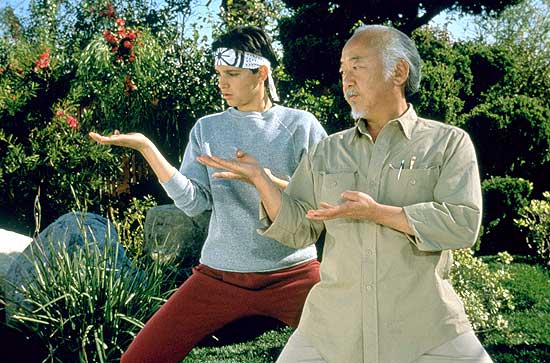
Daniel is menaced and beaten more and more as days go by—he considers checking out the karate place, but the problem is the instructor is a sadistic Army vet who believes in “no mercy.” Daniel is amazed to discover that Mr. Miyagi (Pat Morita), the Japanese handyman at the apartment building he lives in, knows a great deal about karate as he takes down Johnny and the bullies one night. Mr. Miyagi offers to teach Daniel karate in preparation for a karate tournament, in which Daniel must beat Johnny and the other Cobra Kai students in order to gain respect. His methods are not promising—Miyagi has Daniel wash his car, paint the fence, paint the house, and sand the deck. Daniel thinks he’s doing manual labor, but it turns out there’s a method here.

This is great—it’s smart writing here. And while Miyagi still teaches Daniel karate, there’s a nice friendship between the two. It seems fresh and original—this is a wonderful student/teacher relationship. They understand each other and feel like they’re each other’s best friends in quite a while. Actually, there are more relationships within characters and they all work fine. The romance between Daniel and Ali is nicely handled and then there’s the relationship between Daniel and his mother. All of these relationships are credibly handled and acted. There hardly seems to be a moment of acting. It all seems natural.

And that’s a wonderful thing about this movie—the filmmakers know what to do to make a movie with martial arts as a central theme. They think of the story and characters before they think of the martial arts. Too many kung-fu or karate movies would care less—not “The Karate Kid.”

Ralph Macchio is a natural actor and extremely likable as Daniel. He has a wit, but knows when to shut up and pay attention. He’s nervous, but good at hiding it. That makes him a likable main character to follow. Pat Morita is wonderful as Mr. Miyagi. In reality, Morita is a Japanese-American, but in the movie, he plays a different person (of course, that’s acting) by playing a Japanese import with a struggle for English. On top of that, the character is a true original—a breath of fresh air for the “wise old man” character. He has a sense of humor and knows a convincing lot about karate, but he also has his tragic past to try and forget. Morita is great here. The supporting cast is strong as well. Elisabeth Shue is beautiful, sweet, and likable. Randee Heller portrays a tough mom character, enthusiastic and with a street-smart personality. William Zabka is suitably slimy. And then there’s Martin Kove as the psycho karate instructor—“ruthless” is an understatement description of his character. He makes this character so villainous that it’s so over-the-top…but it’s so darn memorable and fun to watch.

Just like “Rocky,” “The Karate Kid” ends with a fight climax, in which Daniel must finally fight the bullies after learning everything he was taught by Mr. Miyagi and putting it to use. These fight climaxes seem almost obligatory, but this one is well-handled and it actually means something because we feel like we know the characters and buy into their relationships with each other. The heart is with “The Karate Kid’s” story and characters, and unlike most underdog stories, it’s about something.

Full Metal Jacket (1987)

8 Feb

images

Smith’s Verdict: ****

Reviewed by Tanner Smith

The opening sequence of Stanley Kubrick’s war film “Full Metal Jacket” features young Army recruits getting their heads shaven in time for training camp. The expressions on each of their faces represent misery…but they haven’t experienced anything yet.

That’s one of many amazing, complex touches added to this story set during the Vietnam War. It’s the story of the descent into madness that war can bring. “Full Metal Jacket” is not a warm, heavy-handed movie about the Vietnam War, but a traumatic, blunt tale about war itself.

But what more could you expect with this kind of complexity from the great director Stanley Kubrick? This is a director who goes out of his way to make sure not one shot rings false or forced, to the extent of filming more takes than any other director (or actors to be directed) could imagine. Kubrick makes sure to capture every little detail on screen, positioning the cameras right where he needs them so we can feel what he captures.

Kubrick’s favorite close-up shot to use in each of his movies—a character has his chin down, but his eyes straight up at the camera. In “Full Metal Jacket,” that close-up is focused on Pvt. Leonard “Gomer Pyle” Lawrence, a chubby misfit who is the subject of humiliation at basic training on Parris Island and is about to be pushed over the edge.

Kubrick’s favorite camera movement—the Steadycam. This comes in handy almost throughout the entire movie, particularly in sequences that feature the drill sergeant on Parris Island instructing the marine grunts, and sequences in the final half that feature heavy war action in Vietnam.

Those are all essential to the tension that “Full Metal Jacket” brings—first to training camp, then to war.

The first 45 minutes of “Full Metal Jacket” are just brilliant, as we see the marine grunts undergoing basic training. Sometimes, it’s funny, but it’s mostly brutal, mainly because of the grunts’ instructor (R. Lee Ermey) making their lives hell when not giving speeches about the great Marine marksmen, which include Lee Harvey Oswald. Especially vulnerable is “Pvt. Pyle” (Vince D’Onofrio) who starts out as a complete loser not cut out for all of this. I’ll never forget the unbroken shot in which the other men thrash the poor guy at night in bed. That pummeling opens his eyes to what’s around him and causes him to slowly but surely give in to the madness.

That’s the first half of “Full Metal Jacket” and it’s pure Kubrick—irony, harshness, terror, and art. It’s so good that it comes close to overshadowing the rest of the movie, which takes place in Vietnam, following another Marine nicknamed “Pvt. Joker” who was the squad leader on Parris Island. Now he’s a journalist who doesn’t take the War seriously (he wears a peace symbol while wearing a hat that has “BORN TO KILL” written on it). Joker goes out into the wild to do a story on a platoon, just to relieve himself from boredom in De Nang, and gets more than he expected.

But even the second half is well put together and pretty strong. It’s also where “Full Metal Jacket” comes full circle—from basic training to real warfare. It shows how war affects these characters and in a key scene, we see the startled but joyful nature of these soldiers.

The Vietnam sequences were shot on stages and outdoor sets in England, and they look so realistic that, with the cinematography and no-nonsense acting, it feels like a documentary is being shot instead of a war narrative (that’s even more convincing when a news camera crew comes in to interview the soldiers—“We’re getting killed for these people, and they don’t even appreciate it. They think it’s a big joke,” one of them declares). This is one of the best-looking war movies I’ve ever seen.

The acting is excellent, particularly from Vince D’Onofrio and R. Lee Ermey in the first half of the movie. Matthew Modine, as Joker, takes a little getting used to, with the constant joking despite knowing where he is. But as the movie progresses, he does become more of a character than a “joker” and Modine shows how surprisingly solid he is at playing him. The other actors—which include Adam Baldwin, Arliss Howard, Dorian Harewood, and Kevyn Major Howard—seem so real, they help make the movie feel like a documentary. Kubrick has directed them well, as he always does (though I can imagine the hard work they must have been put through).

“Full Metal Jacket” makes Oliver Stone’s war drama “Platoon” look like a bedtime story. While that film was about embracing the soldier within, this film digs deeper into the terrors of the Vietnam War and the insanity that was brought about. It’s a harrowing, tensely-built story that is not for the faint of heart.