Archive | February, 2013

Pleasantville (1998)

12 Feb

images

Smith’s Verdict: ****

Reviewed by Tanner Smith

“Pleasantville” is a wonderful fantasy that is funny, great-looking, effective, well-acted, and very clever. First, it parodies those old TV black-and-white sitcoms, such as “Father Knows Best” and “Leave it to Beaver,” then it gets even better as it continues with its own sitcom plot and transforms into a strong story with a message of the power of change.

“Pleasantville” is the name of a TV black-and-white sitcom that features the same happy family we’ve seen in those other old sitcoms. They live in a small town called “Pleasantville.” Every day is the same—father comes home from work and yells in a pleasant tone, “Honey, I’m home!” Dinner is always on the table when Father comes home. (Making dinner is all Mother does, apparently.) The kids are pleasant too. In fact, everyone around them is pleasant and happy.

‘90s teenager David (Tobey Maguire) watches the reruns of “Pleasantville” and knows the show very well. We’d think that teenagers wouldn’t be interested in a show like that, but David feels left out of place in the 1990s and is more at home in the dream world of “Pleasantville.” His sister Jennifer (Reese Witherspoon), however, is right at home here—she’s popular and has experience with sex. One night, while their mother squabbles with their divorced father, David and Jennifer fight over the remote control for the TV, which breaks. To the “rescue” is a mysterious, friendly TV repairman (Don Knotts), who supplies them with a new remote that will “put you through the screen.” They click it and find themselves magically transported into the black-and-white world of Pleasantville. Horrified by her complexion, Jennifer exclaims, “Look at me! I’m pasty!”

So far so good—the idea of having modern-day teenagers in a wholesome, pleasant 1950s TV world is clever. The script has fun with the kids learning about this new world—everyone sticks to the script; no one does anything different; every breakfast is no choice of pancakes, eggs, sausage, bacon, and a ham steak; the basketball team never misses a single shot, no matter where they aim; the books in the library are blank; nothing burns (the firemen only rescue cats from trees); everyone sleeps in twin beds; and there is nothing outside of Pleasantville (the school history class is only about Main Street and Elm Street and it begins where it ended again). No one has ever even heard of sex. David has seen all of the episodes, and so he knows this world well. Jennifer, on the other hand, finds this world mysterious and creepy. “We’re stuck in Nerdville!,“ she exclaims.

David and Jennifer attempt to cope with this world until the TV repairman feels pleasant enough to send them back home. Their names are now Bud and Mary Sue, their parents’ names are Betty and George Parker (Joan Allen and William H. Macy), and Bud works at the soda shop with Mr. Johnson (Jeff Daniels). But any change can alter this universe and who knows what’ll happen? And there are changes, starting when Jennifer goes on a date with the cool guy in school and gives him his first sexual experience. That’s when things start to spread around town, and things and people slowly turn into Technicolor.

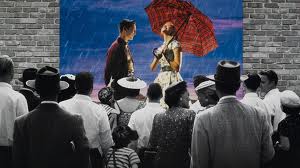
I mentioned at the beginning of this review that “Pleasantville” is great-looking and I wasn’t exaggerating. Almost every shot from that point on is amazing to look at because writer/producer/director Gary Ross and his cinematographer John Lindley use special effects to show a black-and-white world mixed with characters in color. Some of them are still in black-and-white so they interact with the ones in color. How does it happen? As it turns out, whenever anyone in this pleasant world experiences any change of any kind, they turn color and the world becomes more like ours. One of the very best scenes involving this technique is the scene in which Betty, now turned color, is assisted by David to put grey makeup on her face. That scene is very well done. Also, there are bits where things in color are reflected onto the black-and-white characters, like a fire and the moonlight over a river. I was absolutely bedazzled by the effects in this film.

People are ready for change, and the more serious subject of the film are the questions they ask of who they are, what is their purpose, what will happen next—questions they’ve never thought about before. Mr. Johnson becomes interested in art and Betty does something for herself for once. But George is distraught—he’s used to getting dinner on the table when he comes home and distraught when he comes home and the house is empty. His routine is ruined. Finally, the Mayor (the late J.T. Walsh, in his last performance) announces to the remaining “true” citizens of Pleasantville, “Something is happening to our town.” He’s right.

Even David and Jennifer have the ability to change. For example, Jennifer is less interested in keeping her sexual reputation, and wondering what else there is to do. She even starts to take up reading (although, she has to wait until the words appear back in the library books).

The writing is fantastic. The directing is great. Credit Gary Ross for making this movie like it is. In lesser hands, the movie would’ve been as bland as the show it lampoons. Ross delivers the goods here.

The performances are terrific. Tobey Maguire and Reese Witherspoon are good and convincing as the bewildered teenagers. William H. Macy is delightfully deadpan as the father, Joan Allen is fantastic as the mother, and Jeff Daniels is also good and funny as Mr. Johnson.

“Pleasantville” is also thought-provoking. It’s a magical piece of work that allows us to think about who we are and why we’re here. Can we, as individuals, make differences? I loved every moment of “Pleasantville”—it’s a clever, well-written, great-looking, solidly-acted, fantastic, satirical, fun feel-good movie. (Good Lord, is that enough adjectives?)

The Good Son (1993)

12 Feb

images

Smith’s Verdict: **

Reviewed by Tanner Smith

“The Good Son” is a thriller that features a good nephew, but not a good son. But as the parents see it, it’s the nephew that concerns them more than the son, whose deeds are surprisingly unnoticed by them. Of course, he seems like the sweet innocent kid that the parents would like to think they’ve raised him to be. But instead, the boy—named Henry—is a diabolical little demon that makes his cousin Mark’s life a living hell while also causing great harm to family members, innocent bystanders, and a dog.

As if poor Mark didn’t have enough to go through already. He’s already lost his mother after making a promise that he wouldn’t let her die. His father leaves him in his time of need at his brother’s house on an island in Maine for a couple of weeks so that on his business trip, he’ll have enough money for them both to be set for life. Mark gets along well with his aunt and uncle, and their two children—one of whom, of course, is the little demon spawn named Henry. Henry and Mark become good friends and hang out around the island. But later on, Mark has his suspicions of Henry’s true nature as Henry kills a dog with an invention he made that shoots nails and screws. He becomes even more convinced that the kid is sick when he throws a man-size dummy on a highway, causing multiple cars to crash into each other.

Henry’s sole explanation as to why he’s this way is revealed only to Mark, as he tells Mark that he was as scared as he was before he found ways to get away with doing certain things. But those “certain things” wind up harming innocent people. Wouldn’t it be more interesting if the screenplay had been written so that another part of Henry’s influence was watching violent action movies? Wouldn’t it make a more effective, chilling message if movie violence were the cause of the development for a child’s sociopathic mind?

But no—Henry is just plain evil at a shockingly young age, and I suppose that’s enough reason for us as a movie audience to be frightened by him. Henry is played by Macaulay Culkin, the sweet, charming kid from the family hit movie “Home Alone.” He’s playing against type in “The Good Son,” but sometimes it works, and other times it doesn’t. In the first half of the movie, he does very well at keeping the balance between guilt and innocence. He just seems like the kid whom everyone his age would like to be friends with, but he still gives hints about his true nature that would fool them. The development that leads Mark to really see his true nature is handled effectively as well. Mark befriends Henry, they hang out together, Mark is suspicious of him after a while, and then he sees something that really convinces him that Henry is not a “good son.” But the problem is that Culkin isn’t convincing when playing sinister. He speaks in a monotone voice and with a deep, twisted philosophy that a James Bond villain would have—only to Mark, of course. Where did he learn to talk like this? His parents are good-natured, he doesn’t watch TV, and he’s already stated that he doesn’t read comic books. This can’t be natural, but to be fair, I think this has more to do with the writing rather than Culkin himself.

Culkin does seem like an innocent child whom you wouldn’t suspect of any wrongdoing, so that gives him an edge. And when Mark tries to tell people about the boy’s psychotic antics, no one believes them. They don’t want to—they want to believe that Henry is the good little boy that he only pretends to be. And soon, it is Mark they all come to fear. But here’s the main problem with “The Good Son”—with his sophisticated speech that I’ve already mentioned, Henry doesn’t seem much like a kid. No kid talks the way he does. And it’s hard to believe that later in the movie, the parents and even a child psychologist can’t tell that this little robot is lying.

The script has many problems like that. One in particular is with that scene in which Henry and Mark watch the cars pile up after the dummy falls onto the street. We see a brief news report about the incident, but the dummy is never mentioned. Neither are the two kids who were in plain sight on the bridge above. There’s another moment in the middle of the movie that is inexcusable. It’s when Henry takes his little sister (played by Culkin’s real-life sister Quinn) to go ice-skating on a frozen pond and then pushes her onto some thin ice, which she falls through. Get this—she falls through the thin ice and yet her rescuers walk on it fine…and use an axe to break through it and save the girl! What conveniently thin ice.

Elijah Wood, as Mark, gives the film’s best performance. He’s the kind of kid that Henry’s parents see Henry as, and Wood has a natural screen presence that doesn’t bore us or make us want him to go away. It’s so hard not to feel sorry for Mark in this truly messed-up situation.

The ending is the more suspenseful piece of filmmaking to be found here. It involves the two boys and Henry’s mother (Wendy Crewson) on top of a cliff. Without giving too much away, it leads to a masterful climax. But then immediately following it is the film’s final line, which is completely unnecessary and kind of sick, the way it asks about the mother’s choices. To sum up “The Good Son” is like this—Elijah Wood’s performance is effective, the setup is good, the photography is lovely (the way it captures the island as if it were a painting), and the climax is suspenseful; but the writing is devoid of substance and reality. And the question that it all comes down to is, “Do we really want to see Macaulay Culkin in an R-rated movie about a young killer?”

Disney’s The Kid (2000)

12 Feb

images

Smith’s Verdict: ***

Reviewed by Tanner Smith

Adding the name “Disney” to the title of your movie must mean that families will automatically rush to the theater for some good, solid family entertainment from the Magic Kingdom. But you could call “Disney’s The Kid” just “The Kid” and it wouldn’t make much difference. Either way, this is a nice little movie that’s good for the family. It has its comic moments that entertain the kids, but it also has thankfully mature moments for the adults. It’s an involving, sweet, innocent family film—a feel-good story that Disney has been known for—and not just a kids’ movie, despite it having the “Disney” name in the very title.

The story is centered around hard-edged image consultant Russ Duritz (Bruce Willis). He focuses on his own image, while consulting the image of others—mostly celebrities and politicians. He gives brash-but-somewhat-helpful advice to his clients about omitting “self-pity” and also gives enough insults to everyone he meets, so that they all call him “jerk.” Not a day goes by without someone calling him “Jerk” either behind his back or right at his face. He alienates himself from family, he tyrannizes his personal assistant Janet (Lily Tomlin), and is even dismissive to his co-worker Amy (the always-delightful Emily Mortimer) who could be his girlfriend if he wasn’t such a “jerk.”

A few days before his 40th birthday, something strange happens. He’s visited by a little boy—a chubby lively kid named Rusty (Spencer Breslin). But this isn’t just any kid. As they both realize, Rusty is really Russ, at age eight. Somehow, Rusty has traveled forward in time to meet his 40-year-old self. Rusty is not so thrilled at his future self’s occupation—he doesn’t have a family, nor a dog, and has a job that just isn’t very exciting. “I grow up to be a loser,” the kid grimly states.

You can tell where this is going—Russ is going to realize through this kid what led him to become a loser and, with help from his past, is going to learn how he can become a better person. Now, I’m sure kids won’t appreciate this story very much, but they’ll still have the kid to identity with and the occasional slapstick humor that comes long (most of it is tame). The adults will get more out of it—this is their fantasy of revisiting their past. Yeah, the plot gets a little corny as it goes along, with story elements that seem added on for further drama, such as the subplots involving Russ’ on-again/off-again relationship with Amy and the heavy deal with Rusty being told that his mother is going to die from cancer. But most of the material does work, and leads to good lightly comic moments (most of which playing with Russ and Rusty’s relations with each other, or the question as to why the moon sometimes look orange), as well as effective dramatic scenes.

The acting helps give the movie its credibility. Bruce Willis is an effective leading man and shows dimensions far from being a deadpan, wisecracking beatnik (a role he’s usually known for). He shares terrific moments with Spencer Breslin, who is very appealing as Rusty the kid. Of the supporting cast, Emily Mortimer is always a delight to watch, Lily Tomlin is quite droll as Russ’ bored assistant, Chi McBride has a nice moment as a boxer/client who teaches bullied Rusty how to fight, and even the appealing Jean Smart, who has the least amount of screen time, has some wonderful moments as a Southern newscaster, who is one of Russ’ clients and gives him helpful advice about dealing with his own past.

“Disney’s The Kid” nearly ends with the message that learning to fight leads to a successful life. And I’m glad it didn’t go that route, because that seems to be the staple for movie messages in a lot of movies; particularly action films. It seems like it’s going to go that way, in a scene in which Rusty uses his new fighting skills on school bullies. But then we get to the satisfactory happy ending in which Russ and Rusty realize the true meaning and ambition of their lives, and Russ realizes that if he can’t change his own life by having his past self deal with his present self, then maybe the best is yet to come.

The River Wild (1994)

11 Feb

River-Wild-cast

Smith’s Verdict: ***1/2

Reviewed by Tanner Smith

“The River Wild” is predictable. I’ll admit that. You can guess more-or-less where the film’s story is going to go. But that doesn’t make it a bad movie. Actually, I think it’s a terrific action-thriller. It has top-notch acting; it features a fully-realized main character played with more than the right amount of gusto by Meryl Streep than it deserves; it’s shot wonderfully in the great outdoors, the Salmon River in Idaho; and it has its share of tense moments. I enjoyed watching “The River Wild.”

So what do I mean by predictable? Well, here’s the setup:

Meryl Streep plays Gail, a former river guide and rafting expert who decides to take her son Roarke (Joseph Mazzello) on a whitewater rafting journey for his birthday. Her husband Tom (David Strathairn) is a workaholic architect who is reluctant to go on this trip. But he shows up at the last minute, though he is more concerned with getting work done than enjoying the outdoor life and spending time with his family. Gail knows the territory well, and even once braved the challenge known as the Gauntlet, which is said to be the most dangerous set of rapids. (She tells her family that one person was killed and another was paralyzed for life.) Also on the river are Wade (Kevin Bacon) and Terry (John C. Reilly), who are not so experienced in this sort of thing and have lost their guide. They meet Gail and family who decide to let them come along and join them. Roarke is able to befriend them because Wade seems like a nice guy. But the further they go downstream, the more distrust Gail and Tom feel towards Wade and Terry. And things get more ominous when Wade shows Roarke a loaded gun, and Tom plans to confront Wade…

So from reading that setup, you might have already guessed where this is going. Wade and Terry are on the run; they know that Gail knows the river, so she can help them escape; they make their true presence known, as they’re midway through; Gail, Tom, and Roarke are held hostage; and the way Wade and Terry want to go is through the Gauntlet. I was almost about to give a “SPOILER ALERT” for this review, but what’s the point?

The plot is thin and predictable as they come.

But there’s more than enough to make up for that. First and foremost is the fine acting by the cast. They aren’t caricatures or one-note figures thrown in for marketable reasons; they’re well-developed characters played by great actors. Meryl Streep is wonderful as to be expected, and is really the backbone of this movie. She’s physically fit, which is something you rarely see in her other roles, and she plays the character as smart and as tough as we would like to see in this role. Streep captures Gail’s energy and terror perfectly. She has the makings of a strong female action hero.

Kevin Bacon is well-cast as the ruthless Wade, delivering an effective mix of menace and charm. David Strathairn is convincing as an uptight workaholic suddenly pushed to his limits. John C. Reilly is good as Wade’s sidekick whose hesitance, especially when the group is shooting the rapids, makes for some comedic moments.

“The River Wild” also has top-notch production values important to the film’s success. The cinematography is outstanding and the suitable music score is effective assistance. The climax of the film, in which the group inevitably race down the aforementioned dangerous Gauntlet, is exhilarating. Watch this movie on a big screen—you might feel like you’re experiencing this with the characters.

I’m not going to lie—I think that maybe “The River Wild” would have been more effective if it was just about this woman bringing her family to see the beautiful river before it’s “polluted,” and trying to settle things with her distant husband along the way. (And just drop the whole thing about the two guys and the thriller aspects.) That would have been an interesting family drama, and there could have been a lot played off from that.

But while reviewing for “The River Wild” for it is rather than what it isn’t, I still think it’s an effective thriller. Is it familiar? Yes. But it’s also well-executed and delivers the goods.

Free Willy (1993)

11 Feb

images

Smith’s Verdict: ***

Reviewed by Tanner Smith

The pre-production meeting for “Free Willy” probably went like this:

Quick! We need a family film with a save-the-whales message to give the kids! How do we do it?

What do you mean, “How do we do it?” Why don’t we just make a documentary about the danger that whales face?

Because A) Documentaries don’t make money unless they’re narrated by Morgan Freeman, and nobody will know how cool his voice is until next year when “Shawshank Redemption” is released! And B) Come on, we’re Warner Bros. Family Entertainment now. Let’s make a sweet, charming family-adventure…and make money off of it!

OK, OK, I gotcha. So how about this—we tell the traditional story of a boy and his dog. People eat this stuff up—we’ve had a boy and his dog, a boy and his raccoon, and a boy and his alien. Why not have the whale be boy’s best friend?

Hm, that could work. But we need a certain thing to make sure that people are going to see it…maybe a pop star to sing the theme song!

Michael Jackson?

THAT’S IT!

Yes, “Free Willy” tells the usually reliable boy-and-his-animal story, only it’s an unusual relationship between a young street kid and a killer whale. And while that does seem out there (and sometimes it is) “Free Willy” is innocent and charming enough to make for a winning family entertainment.

Jesse (Jason James Richter) is a young boy living on the streets after being abandoned by his mother and escaping from an orphanage. When he is caught spraying graffiti at an aquatic theme park, he is forced as part of his probation to clean up the mess he made. The main attraction at the park is an orca named Willy, with whom Jesse strikes up an unusual friendship. Soon enough, he finds that Willy is able to respond to the sound of his harmonica. He’s even able to train Willy to do certain tricks that the whale’s trainer Rae (Lori Petty) hasn’t been able to do, and so he’s hired as a co-worker.

Jesse lives with a pair of foster parents (Michael Madsen and Jayne Atkinson), who are both patient and loving towards Jesse. But Jesse doesn’t take to his new home very well, and rebels by giving insults and sneaking out at night. Jesse just doesn’t comfortable with these because he would rather be with his own mother, who would just as soon not want him around. This is how he relates to Willy, who was taken away from his family in the nearby ocean. Both Jesse and the whale are homeless and maybe unable to make the best of their surroundings.

There are not many surprises in this movie—just look at the poster, trailer, or DVD cover and you know how the movie is going to end. And it relies on many clichés and formulas, although while some of these are acceptable because they still work, it’s pretty easy to make fun of the rest of them. The most particular of these elements is the villainous park owners, played by Michael Ironside and Richie Riehle. How can you not laugh when Ironside (who I suppose always has to play the villain) states out loud that they’re both about “making money?”

And while whales are undeniably beautiful creatures (which the movie reminds you right from the beginning, in an opening sequence that stretches out the action of whales jumping), Willy (played by “Keiko”) is probably the least interesting element of the movie, because he’s mostly seen as a big blob for Jesse to interact with, and I can barely see the whale’s eyes to connect with him myself.

And by the way, is it me or does Willy understand English? There are moments in which he nods for “yes” and shakes his head” for “no.”

But despite that, “Free Willy” is a solid family film, mainly because of its dramatic elements with Jesse trying to cope with his foster parents. It also works with how Jesse is able to redeem himself by changing from delinquent to hero, because of having this friendship with Willy whom he wants to help out. This is a gentle movie about a young boy discovering himself, and the relationship between Jesse and his foster parents ring true.

The acting is one of the strongest assets of the movie. Jason James Richter is naturally winning as Jesse—if his performance didn’t work, the whole film might fall apart. Lori Petty is strong as reliable, helpful Rae; August Schellenberg is quite solid as Haida-native handyman Randolph who knows a thing or two about orcas; and Michael Madsen as the foster father Glen is excellent, portraying a three-dimensional individual as he tries patiently to give Jesse a good home while also trying to relate to him. Also good is Mykelti Williamson as Dwight, Jesse’s social worker.

The whale effects are outstanding. Sometimes they would use a real whale (Keiko), but other times, the filmmakers would use animatronic whales. To be honest, I could never tell the difference between which whale was real and which whale was mechanical.

“Free Willy” has its heart in the right place, and the “save-the-whales” message is quite clear, but not so over-the-top that adults will be groaning in annoyance. It’s shot nice, the special effects are convincing, the actors are good, and as I said, the family-drama aspects are well-developed. It’s a charming film.

NOTE: Yes, as I mentioned above, Michael Jackson sings the film’s theme song, “Will You Be There.” It’s a touching song, and this was back when MJ was still king of pop and so if he told people to see this movie, they would. And that’s mainly why this movie was a box-office hit.

Star Trek: The Motion Picture (1979)

11 Feb

star-trek-the-motion-picture

Smith’s Verdict: **

Reviewed by Tanner Smith

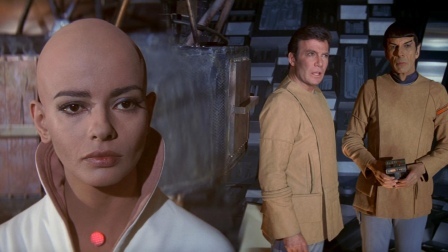
“Star Trek,” the TV series created by Gene Roddenberry, is a delight. It’s a great mixture of neat science fiction, creative ideas, and memorable characters. No one would ever link it to something like “Star Wars,” which is about nonstop sci-fi action and thrills. With “Star Trek,” the characters and story always came first. It’s not about tense action and stunning visuals. And what “Star Trek” is certainly not is an out-of-body experience, like Stanley Kubrick’s great sci-fi epic “2001: A Space Odyssey.”

Unfortunately, when world-renowned director Robert Wise decided to direct a first film adaptation of the series, he thought to bring to appeal to the “2001” or “Star Wars” crowd, since elements of each film are noticeable. When you put them both together, it kind of distracts from the notion that you’re watching a “Star Trek” movie, and the first one, at that. Even though it has its moments that feel like a “Star Trek” union, the film has a lot of moments that make the film as a whole into a grand space opera. At times, it’s thought-provoking and visually impressive, but mostly, it’s a bore. It has a slow pace and doesn’t even try to give us a rousing adventure, let alone that “Star Trek” lighthearted character interaction that was the best part of the show.

Instead, we have long (and I mean LONG) sequences in which we’re supposed to marvel at something. They are long, slow, and undoubtedly supposed to create for us a visual marvel and an out-of-body experience. The tone of this film is all wrong. Those memorable characters, including Admiral Kirk, Mr. Spock, Dr. McCoy, and such, are trapped in a “2001” wannabe, and are not at home here.

I can’t fault the technical aspects of “Star Trek: The Motion Picture”—the visuals are outstanding, the special effects are top-notch, and the Jerry Goldsmith music score that pulses throughout this movie has a haunting feel. And in keeping in spirit with “Star Trek,” there are some clever ideas here. In particular, the central conflict—a space anomaly known as V’ger—is pretty interesting as it makes its way with destruction, and Kirk and crew have to find it and face it. Actually, once we get to the reality of V’ger, the movie finally starts to feel like a “Star Trek” story some of the time. The origin of V’ger produces some food for thought.

But when you have to stare at the visuals and listen to that music score for minutes at a time, you care less and wonder why anyone thought to create “Star Trek: The Motion Picture” with this sort of treatment. The result is a sometimes-intriguing but mostly-sleep-inducing mess that results in an out-of-body experience into dreamland. Those expecting a “2001” kind of movie is obviously not a “Star Trek” fan; those expecting a “Star Wars” type of movie is going to be disappointed; and those expecting a “Star Trek” movie will be disheartened.

Jack (1996)

11 Feb

427

Smith’s Verdict: **
Reviewed by Tanner Smith

“Jack” is a movie about a little boy trapped in an older man’s body. However, it’s not through a magical occurrence, like in “Big,” but through a rare medical condition that causes a kid’s cells to accelerate four times the normal rate. At age 10, he looks like a full-grown 40-year-old man. That’s the setup for “Jack” and it’s a nice one that could have resulted in an engaging drama. But as it is, it’s one of the clumsiest lost opportunities I’ve seen. While there are a few cute moments in the movie, there are many moments that are unnecessary, others that are uncomfortable, and worst of all, moments that are uncomfortably unnecessary.

Robin Williams is admittedly an ideal casting choice for the title role of Jack, the little boy in a grown man’s body. I guess that’s because Williams, a comic known for his goofy antics, never seems to have grown up. He’s like a live-action cartoon that only takes time to relax when held in check. It’d make sense that he portray the role in this movie.

The movie begins with Jack’s birth. He’s fully-developed after a two-month pregnancy and it turns out that he has an unusual internal clock. He will age four times as fast as a normal person. Ten years later, Jack has been mostly kept in the house by his loving parents (Diane Lane and Brian Kerwin) as other kids his age stare at his bedroom window, thinking he’s a “freak.” His home-school teacher Mr. Woodruff (Bill Cosby) thinks it’s time for Jack to go to public school, but Mom is scared that Jack will never fit in with the other kids, since he’ll be the only one in the fifth grade that shaves.

They of course decide to give Jack a chance to see how well he adjusts to school. At first, he’s picked on by the other students and has a miserable first day. But the next day, the other kids discover that he’s a good basketball center and can also help them out with other favors, like picking up a “Penthouse” magazine without any sort of ID. “I just don’t shave for a day so I look like I’m 50,” Jack explains. He has a new best friend in a kid named Louie (Adam Zolotin), who invites him join in with his treehouse club.

The low point of the movie is a subplot involving Louie’s trampy mother, played by Fran Drescher. Jack meets her while posing as the school principal as a favor to Louie. In that scene, it’s uncomfortable with the misunderstandings, as Drescher’s character doesn’t know that Williams’ character isn’t a grown man and is yet flirting with him. Robin Williams doesn’t really play the scene as a 10-year-old would, it seems more like lines from failed versions of his standup. And Fran Drescher is as irritating as you imagine she’d be outside of TV. That’s not the end of her character, however. There’s an entire sequence that lasts about twenty minutes that features him meeting up with her in a bar where she works as a waitress. There’s more uneasy flirtation going on, more misunderstandings, and of course, a bar fight. This sequence doesn’t have anything to do with the rest of the movie. Take it (and Fran Drescher) out of the movie, and you wouldn’t miss a thing.

There’s also a great deal of awkwardness in a scene in which Jack attempts to ask his pretty fifth grade teacher Mrs. Marquez (Jennifer Lopez) to the school dance. How am I supposed to feel during that scene? Am I supposed to laugh, because Jack looks like a grown man when we know he isn’t and he’s asking out his cute school teacher? Is this a dramatic moment? I wasn’t sure of it.

I think the movie might have been more effective if it focused on Jack’s mortality. There are moments when you think they’re going to dig deeper into it (there’s a deep moment in which Jack is asked what he wants to be when he grows up—“Alive”), but there’s never a big dramatic payoff.  When the movie was over, I didn’t feel anything or learn anything. I mainly saw pointless moments and forced comedy with obvious payoffs. It’s like they thought why look more into Jack’s internal clock when there’s a bar fight to commence? Or why go further into the kids’ introduction to “Penthouse” when their treehouse can collapse? And of course, we have Robin Williams in a classroom asked to take a seat in a small wooden desk—let’s break it! Then let’s do it again! See, while they’re thinking that, I’m thinking, “Really? This was directed by the great Francis Ford Coppola?”

Francis Ford Coppola, I imagine, wants to try something new with his films, like every filmmaker should. So, one shouldn’t be necessarily surprised to see his name attached to a director’s credit in “Jack.” However, it’s necessary to surprised to see his name because of how inept the movie is. It has some cute moments (such as when Jack is sharing his Gummi Bears with his teacher, or Jack is hanging out with his friends, and a rare few others) as well as moments of appropriate drama (like that “Alive” moment I mentioned, as well as Mr. Woodruff’s speech about why Jack is so special), but as a whole, “Jack” isn’t what we expect from a great director like Coppola, and doesn’t even come close.

Ruthless People (1986)

11 Feb

images

Smith’s Verdict: ***1/2

Reviewed by Tanner Smith

If I had to pick my favorite Danny DeVito role, it would probably be rich businessman Sam Stone in “Ruthless People.” DeVito plays the villain that you love to hate—a man so ruthless that he would even cheer at the thought of his own wife dead. In fact, that’s what he’s talking about in the very first scene of “Ruthless People”—he’s telling his mistress Carol (Anita Morris) that he’s planning to swiftly do away with his annoying wife Barbara (Bette Midler). We find out that Sam married her just for her money, and if he kills her, he’ll gain her late father’s inheritance.

This is a vile man. He’s selfish, shallow, and ruthless. But he’s so earnest and passionate in his schemes and purposes that you can’t help but admire DeVito for making this villainous character so entertaining.

“Ruthless People” has the comic premise of Sam’s wife actually being kidnapped before Sam has a chance to do her in (he planned to fill her with chloroform and hurl her off a cliff). He gets a call from the kidnappers who threaten to kill her if he doesn’t pay the ransom. Watch his face as he listens to every detail and knows that his wife could be killed if he doesn’t meet their demands—this is his dream come true! He’s not supposed to tell the police; he tells the police and the story hits the news. He’s told to pay the ransom; he doesn’t.

But the kidnappers, as it turns out, are inane at their title. They’re actually a nice suburban couple (Judge Reinhold and Helen Slater) who kidnap Sam’s wife Barbara for reasons of ruthlessness. Reinhold’s Ken decides that they both need to be ruthless to succeed in this world, and holds a grudge against Sam for stealing spandex designs from his wife Sandy (Slater) and passing them off as his own, and becoming very rich because of them. Now they want their share and hold Barbara hostage until Sam pays the ransom…. Yeah, that’s not gonna happen.

This is a simple idea of a nagging wife being kidnapped and her husband doesn’t want her back. It’s stretched out into a very funny comedy with charismatic acting and a sharp screenplay brough to life by the three-man directing team of Jim Abrahams, David Zucker, and Jerry Zucker—the same guys who made “Airplane.” This script is full of funny jokes and does a good job of making the story be as complicated as it can with this premise, just barely going over-the-top with its conclusion (a standard car chase). I don’t want to give away most of the gags, because that takes away the elements of surprise in this movie.

Bette Midler’s Barbara has a great share of screen time, and I’m sorry I forgot to talk about her. Midler is hilarious in this movie, making her character as stubborn as possible while being held by these two nice losers. She starts out as a shouting whiner (which I know you’d expect, since we first see her in a bag and her mouth is gagged), and then delights in teasing her captors, sometimes intimidating them by saying she’s going to turn them in later, and driving them crazy. Later on, though, she does soften up and even befriends Sandy, and she delivers the funniest line in the movie when she realizes that the ransom number has decreased. I won’t write what it is; just see the movie. Trust me—it’s worth it.

An amusing subplot involves Sam’s mistress Carol as she attempts to blackmail Sam by having him give her all the money, or else she turns him in for killing Barbara. But due to a series of hilarious misunderstandings, she and her buffoonish lover (Bill Pullman, hilarious) find themselves in many unsuccessful attempts to do so. That is all I am going to say about that. Period.

One failing in “Ruthless People,” besides the conclusion, is that there is no dueling confrontation between DeVito and Midler. We only see them together once, to deliver a weak punchline to the story, and I would have liked to see them really have it out with each other.

With some big laughs, game performances, and a very funny screenplay by Dale Launer, “Ruthless People” is a goofy, hilarious movie about…ruthless people. They’re ruthless, but they’re likable and memorable. DeVito is a joy to watch as the lovable villain, Midler is suitably stubborn, Reinhold and Slater are pretending to be ruthless but are truthfully nice enough for us to like them, and Morris and Pullman are hilariously idiotic. They help make “Ruthless People” a very funny movie.

The Incredible Shrinking Man (1957)

10 Feb

images

Smith’s Verdict: ****

Reviewed by Tanner Smith

The 1957 science-fiction film “The Incredible Shrinking Man,” written by Richard Matheson (based on his novel), takes the idea of an ordinary person exploring an alien planet, and brings it closer to home. This is a story in which a man is continuing to shrink with each passing day until he is so small that his own home becomes a whole new, treacherous world for him. It’s a clever idea, executed wonderfully (and effectively) in “The Incredible Shrinking Man,” with a great sense of danger and adventure, as well as some nicely-done special effects.

It begins as Scott Carey (Grant Williams) and his wife Louise (Randy Stuart) are on vacation at sea when Scott is enveloped in a radioactive mist. Since then, his clothes don’t fit, he’s losing weight, and worst of all, he’s losing height. Every day, he keeps getting smaller. Several weeks later, he is the size of a small boy as he becomes famous (and known as the Incredible Shrinking Man), while the doctors are searching for a cure.

The first half is mainly about how Scott and Louise deal with this strange phenomenon surrounding Scott, and it’s exceedingly well-done. You really feel the pain that each of them are going through, with Scott being regarded as a freak and Louise feeling helpless to him. It’s acted with a great deal of conviction, given the material—the best example is when the camera is focused on the back of an armchair while Louise and Scott’s brother Charlie (Paul Langton) are talking; the revealing shot of the diminutive Scott, sitting in the armchair, is most effective not because of the effect, but because of the blank expression of Grant Williams’ face. The melancholic situation becomes even clearer.

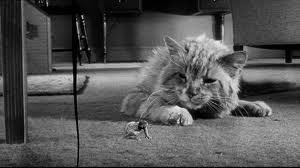
Then, we reach the second half of “The Incredible Shrinking Man,” which transforms the film into an adventure story. Scott is now small enough to live in a dollhouse and Louise walking about the house becomes too much for him to handle. Then, when Louise leaves the house for a little while, something unexpected happens. The family housecat comes into the house and attacks Scott, chasing him about the house until he reaches the cellar, where he is accidentally and ultimately trapped. Louise comes back to believe that the cat has eaten Scott and so no one is going to come down to the cellar looking for him, leaving Scott to endure the new world he has brought himself into.

The film is advertised with the tagline, “A Fascinating Adventure Into the Unknown!” I would have to agree. Scott is inside the cellar, he can’t climb the stairs, he calls for help but no one can hear him, and the floor expands like a vast wasteland. He gets water from a leaking boiler (drops are the sizes of golf balls), he now lives in a matchbox, he has to get food from a mouse trap and high atop a cabinet that towers over him, and he is menaced by a tarantula loose in the cellar. It’s a treacherous new world that is of course Scott’s from a different scale.

The giant sets are (forgive the pun) largely convincing and really make you believe that there is a tiny man in a giant world. And the suspense of the second half, as Scott braves this unknown land, really comes through. The adventure keeps building and building as it goes along, with Scott scaling the walls, crossing a Grand Canyon-type of pit, and eventually doing battle with the spider.

Throughout the movie, we get a close look at Scott’s psyche, so that we understand his plight and sympathize with him. Much of this element is further improved in the final few minutes, as Scott is coming to terms with the idea that he will shrink into nothing…or will he? The film ends with an inner monologue (one of the best acting monologues, in my opinion), in which Scott now accepts his fate and looks forward to an adventure in an even smaller realm and beyond. He believes that no matter how small he will get, he will never become nothing and will still matter in the universe, thus ending his fears of future shrinking. This is not, nor has it ever been, a standard miniature-adventure story. There’s a psychological element to it that makes it special—exploring power and acceptance. That ending is just fantastic. I’m pleasantly surprised that the writers really had it in them to do this instead of taking the easy way out.

Let Me In (2010)

10 Feb

LET ME IN

Smith’s Verdict: ****

Reviewed by Tanner Smith

This was not supposed to happen—I was not supposed to receive much from a remake of a great movie that came out almost two years after the original. I was a big fan of the original Swedish film “Let the Right One In” and so, I had my doubts about this American remake entitled “Let Me In,” directed by Matt Reeves, whose previous directorial effort was 2008’s “Cloverfield.” This new movie is faithful to the original, but a few changes have been made to make it even more effective. Those who saw the original film and see this new one will know the changes I’m talking about. But I was far from offended. I think these changes helped the story a lot. For example, the motives of the adult “father” to the vampire girl (for those who haven’t seen or heard of the original, I’ll get to the vampire part soon) are explained more clearly…but also in a subtle way. In the original film, I didn’t quite understand the relationship of the little vampire girl and her adult guardian who could be her father but then again could not be. There are a couple of scenes in this remake that explain it a bit more and then there is one shot that sums everything up—it involves a picture, that’s all I will say. I was satisfied by this subtle explanation—in fact, I was satisfied by a lot of elements in “Let Me In.”

The storyline remains the same in “Let Me In.” Owen (Kodi Smit-McPhee, the talented young actor from “The Road”) is a twelve-year-old, lonely boy who is severely bullied by sadistic bullies at school. When he is alone, he repeats the bullies’ dialogue as he stabs a tree multiple times. This brings the attention of a mysterious girl that just moved in the apartment next door to him—her name is Abby (played by Chloe Grace Moretz, “Kick-Ass”) and she is a vampire. She lives with a middle-aged man (reliable character actor Richard Jenkins) who is believed to be her “father” but maybe something more, as we see in a few key scenes. Owen and Abby become great friends and their relationship is dangerous because Owen doesn’t know that Abby is a vampire—he doesn’t know that The Father kills for blood in order to feed Abby. But Abby would never let anything happen to Owen and she gives him the strength that he needs.

I was intrigued by the relationship of these two twelve-year-old kids in the original film and I am just as intrigued here. Unlike the relationship between Bella and Edward Cullen in the Twilight Saga, this is a relationship that actually feels real and risky—there is no sex in this movie, but there are sensuous moments in which Abby goes into Owen’s bed while naked (no nudity is shown) and other moments when Owen and Abby share warm hugs when they realize they need each other. This relationship never states that dating a vampire is fun and games—it could be dangerous.

These two kids live in a dangerous world where bad things can and will happen. I mentioned the bullies’ sadistic behavior. These kids are more brutal than the kids in the original film and that’s quite an accomplishment indeed—we get many nasty scenes of the bullies’ terrible behavior. They pull his underwear up so tight that he wets himself, the leader of the bullies strikes him hard across the face with a pointer stick, and they try to push him into a hole in an icy pond. But that’s Owen’s problem. Abby’s problem is that she needs blood to eat in order to survive. This leaves opportunity for horror elements—The Father is killing innocent people and draining them of their blood to put it into a jug. There’s one scene that is absolutely incredible—I’m not going to give much away, but it involves The Father’s latest victim of murder in a car. The outcome of this scene is the best movie car wreck I’ve seen in a long, long time, seen through an unmoving POV shot inside the car! This is an absolutely fantastic shot. There are many other shots that are great, but that’s because director Matt Reeves drops his “Cloverfield” style of directing (camera shaking for intensity) and focuses on what is most important in the shots. He even goes as far as keeping Owen’s stressed, divorced mother (Cara Buono) out of focus throughout her scenes. He knows it’s more important to capture Owen’s expressions in these scenes, and we can hear Mom’s suffering in her voice when she talks to Dad on the phone. This is one of the best-looking movies of 2010; wonderfully well-made.

This movie is set in 1983, which leaves many Reagan-era touches, such as Ms. Pac Man and songs by Blue Oyster Cult. Most notably are the haunting references to the candy Now and Later, as well as Reagan’s television speeches about good and evil. Suitably, there is a character known only as The Detective (Elias Koteas) who goes through town investigating the murders, believing it to be the work of “Satanists.” A word about the new character of The Detective—I do admit that the town-adult subplots in the original film seemed unnecessary with a somewhat weak payoff. If you recall the original, you recall the woman who is turned into a vampire and the husband who is investigating what is happening when his friends are murdered. The latter is transformed into The Detective for “Let Me In” and we only see him (and the woman, of course) when we absolutely need to.

Aside from how great-looking and well-developed the story is in “Let Me In,” what will really draw the most attention are the excellent performances from the actors. Kodi Smit-McPhee, who was very effective as the little boy in a damaged world in “The Road,” is a boy in a world that may as well be damaged. We believe in Owen, we care for him, and we want things to go well for him. This is a kid we definitely don’t want bad things to happen to. Even more effective about his performance is his reaction shots—when he’s not talking, he listens and learns important things about this situation. In the first most effective terrifying moment in the final half, we feel his fear. Also very strong is Chloe Grace Moretz as Abby. Moretz gave “Kick-Ass” its energy (and controversy, I know) and in “Let Me In,” she plays an even more complicated character and pulls it off. Richard Jenkins, who doesn’t have much dialogue, lets us know what he’s thinking with just his expressions and the intensity in his murders.

To me, “Let Me In” is one of the best movies of 2010. It’s definitely the best remake of the year—a step or two above the remake of “The Karate Kid,” which I liked. Yes, we’ve seen vampire romance many times before and we have the original film, but “Let Me In” is a lot better than you might expect. For one thing, it doesn’t treat this relationship with sexuality but with the loneliness of childhood as these kids are on the brink of adolescence. Don’t be expecting a “vampire movie” if you see this movie. Expect something a lot more.

NOTE: I should also mention that there are some genuinely terrifying moments in “Let Me In,” the two most effective come in the film’s final half. I won’t go into the first one, but I will say this about the second one—if you’ve seen the original film, you know there is a swimming pool scene. If you were terrified of that scene in the original, there is a chance you will breathe heavily and recoil in your seat in the theater…I did.