Archive | January, 2013

Cellular (2004)

25 Jan

Chris-Evans-in-Cellular-2004-Movie-Image

Smith’s Verdict: ***

Reviewed by Tanner Smith

When rushed for time, either going to a certain location or staying at a certain spot, it’s the journey that matters the most in the case of constructing an action-thriller. Examples include “Speed,” which had the concept of a bus that will explode if traveling below 50mph, and “Phone Booth,” which had the concept of a man held by a sniper to remain inside a phone booth lest he get shot. It’s always the high-concept gimmicky-setups that interest people in seeing the film and it takes skill on the filmmakers’ part to keep it on its toes in order to keep the audience on the edge of their seats. That is why despite how dated “Cellular” might be with its central portable technology, which has been through constant upgrades (and is still increasing in new developments), the film still holds up as a tense, adrenaline-filled thrill ride.

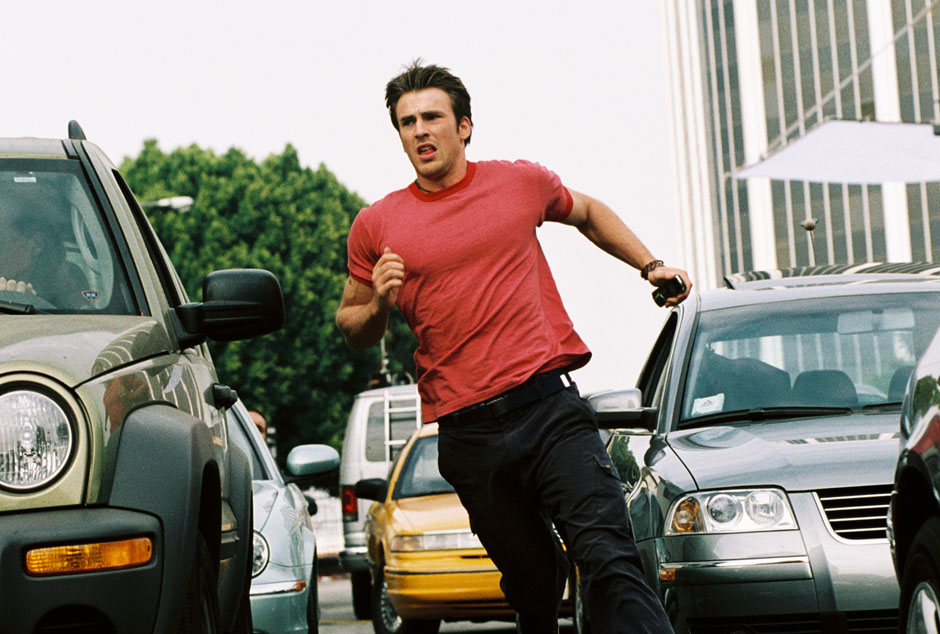
“Cellular” practically opens by showcasing its 2004 “new, edgy improvements in technology.” As people walk about the boardwalk in Los Angeles, they’re admiring their new cellphones, amazed that they can take pictures of chicks in bikinis and send them to other people’s phones. (Ah, the good old days when we were impressed.) But once that’s out of the way, the story for “Cellular” kicks in. We meet our hero—a hunky surfer-type named Ryan (Chris Evans)—who is walking about the beach with his even-less-ambitious buddy (Eric Christian Olsen) and trying to make amends with his ex-girlfriend (Jessica Biel). But soon enough, his cellphone rings. He answers it and it’s the desperate call for help from a schoolteacher who has been kidnapped. The teacher, Jessica Martin (Kim Basinger), has been kidnapped by corrupt cops, led by Greer (Jason Statham), who know that her husband has stumbled upon one of their operations. She doesn’t know what they want, and believes they have the wrong family. Convinced that they’ll kill her once they get what they want, she manages to use a smashed phone (by touching a couple wires together) to make a random call and see if she can get some help. And so, Ryan winds up on the other end of the line, and while he doesn’t quite believe her, her desperate pleas keep him from hanging up. So he agrees to take his phone to the police and have her talk to them about the situation. But when a cop named Mooney (William H. Macy) listens to Jessica’s story, he’s interrupted and distracted, leaving Ryan to take charge of the rescue and thus thrusting him into a race to save the day.

Ryan must keep Jessica on the phone, or else he’ll lose her and be of no help in rescuing her. (Jessica’s phone doesn’t dial normally.) This of course sets off the inevitable series of events that get in the way. Just about every cellphone cliché you can think of comes into play here. Signals get crossed, the battery is dying, the signal is poor, other calls come in at the wrong times, etc. “Cellular” stays alive by thinking of new ways in creating obstacles that get in the way of Ryan, forcing him to outwit and maneuver every which way, all while he has to make Jessica’s husband and child aren’t kidnapped as well, and following different clues that lead to her and the bad guys. But things get even more complicated once Greer learns that Ryan is involved, and also when Mooney discovers some things about the situation he knows very little about that doesn’t hold water, leading him to do his own investigation.

There are chases (both foot and car), drawn fire, fistfights, and other elements that make “Cellular” a regular action-packed thrill ride. It’s never boring, and it even takes a few rest stops, most of which include Mooney as he is planning out his and wife’s new “day spa,” but different circumstances force him into investigating the central situation. Unfortunately, this also leaves room open for exposition. All of this builds up to an over-the-top (albeit inevitable) climax in which Ryan and Mooney join in ultimately saving the day. At an hour-and-a-half of running time, “Cellular” is an enjoyable, entertaining movie that packs many thrills by using clever gimmicks in its action sequences. It’s nicely developed, action-packed, and it doesn’t matter if your phone now is different than phones back then. If your phone has new apps, the situation can still be the same. Stop laughing and enjoy the movie.
Innerspace (1987)

25 Jan

images

Smith’s Verdict: ***

Reviewed by Tanner Smith

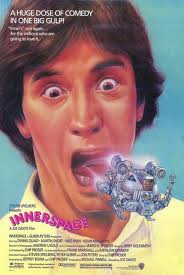
“Innerspace” is a movie full of ideas—perhaps too many ideas that don’t work entirely. But still, there are enough intriguingly silly ideas that are executed well and acted with enough game that I’m recommending the movie as absurd fun.

It’s a blend of science fiction, comedy, thriller, action, and romance that begins with a crazy idea: test pilot Tuck Pendleton (Dennis Quaid) has volunteered for a secret government experiment that involves a miniaturization device and a capsule suited for it. The experiment would cause surgeons to operate on patients from inside them. To test it out, Tuck is supposed to be miniaturized to about the size of a molecule (by estimation, at least) so that he’ll be injected into the bloodstream of a lab rabbit.

It works, and Tuck (and the capsule) is placed inside a syringe. But there’s a problem—high-tech thieves send their hit men to break in and steal the technology from the experiment. One of the scientists run off with the syringe holding Tuck and as he’s shot and killed by one of the hit men, he uses his final action to inject Tuck and the capsule into a random passerby—a grocery clerk named Jack Putter (Martin Short). As we see in introductory scenes, Jack is nervous enough. How’s he going to take the news that someone is inside him?

Tuck wades through Jack’s bloodstream and discovers soon enough that he’s inside a stranger. He uses a little gizmo to stick to one of Jack’s eyes in order to see from a screen inside the capsule exactly what Jack sees, and he also uses a communications system to talk to Jack from inside. Jack at first thinks he’s hearing things—“I’m possessed!” Jack exclaims—but eventually comes to grips with the situation and decides to help Tuck out.

If you’re following this, you’re a smart reader. But believe me—things get even stranger.

That’s mostly what’s part of the fun. There’s a limit to how long Tuck can stay inside the capsule before his oxygen runs out; the villains get closer and closer, and must be outwitted each time; the villain’s new hit man enters into the scene—a bizarre character named The Cowboy (Robert Picardo); and soon, Tuck’s former girlfriend Lydia (Meg Ryan) gets involved.

Oh, but that’s not all. Jack develops a crush on Lydia and constantly forgets that Tuck—Lydia’s former boyfriend—is still around, much closer than he thinks, to say the least.

The plot goes all over the place in “Innerspace.” Most of it is fun, and directed with a sense of silly amusement by Joe Dante (director of “Gremlins”), but you kind of wonder what would happen if the editing was tighter (the movie’s running time is 120 minutes). And there are a few holes that are kind of hard to overlook—there’s a “face-change” that is difficult to explain, and Tuck is as small as the molecules in the liquor that Jack drinks for him but it doesn’t look or seem that way. At the same time, there’s a lot to like in “Innerspace.” Not just the chances the story takes, but also the special effects and the acting.

There are many wonderful visual scenes in which Tuck travels through Jack’s bloodstream. It looks remarkable and surprisingly realistic. The computer-animated effects here are definite first-rate. Though, I would’ve liked to see Tuck fight some white-blood cells or antibodies. No such luck here, but he does eventually have to fight off a hit man who’s been miniaturized and place inside the body to get to him. Oh, and there’s also a sequence involving the heart that’s probably the best sequence in the movie. It looks realistic, as the effects involving Tuck’s capsule were combined with actual footage of a beating heart. “That’s a hell of a pump you got there,” Tuck tells Jack.

Dennis Quaid’s character of Tuck could’ve been a bore, as he spends most of his time confined to the capsule. But with his personality and constant one-liners, it feels like he’s still here. Quaid plays a hero who can’t move while Martin Short plays a nerd who wasn’t expected to be the hero. Quaid and Short have nice moments in developing their friendship.

Martin Short, the manic “SNL” alum, is wonderful in this movie. He’s extremely likable, very funny without being too manic, and is fun to watch throughout this movie. It’s hard not to like this guy.

The love story in “Innerspace” is surprisingly nicely done, and Meg Ryan makes a fun, plucky woman put into the confusion of everything. How would she handle the news that her old boyfriend is inside this nerdy guy she’s just met?

“Innerspace” is completely ambitious. It may have worn me out, and the scenes with the thieves aren’t as interesting as the relationships between Tuck, Jack, and Lydia (with the exception of the Cowboy’s scenes, which are manic), but it still provided a good time for me with its intriguing special effects, good acting, and constant use of story twists.

Mission: Impossible–Ghost Protocol (2011)

25 Jan

mission-impossible-ghost-protocol-tom-cruise-brad-bird-burj-khalifa-dubai

Smith’s Verdict: ***1/2

Reviewed by Tanner Smith

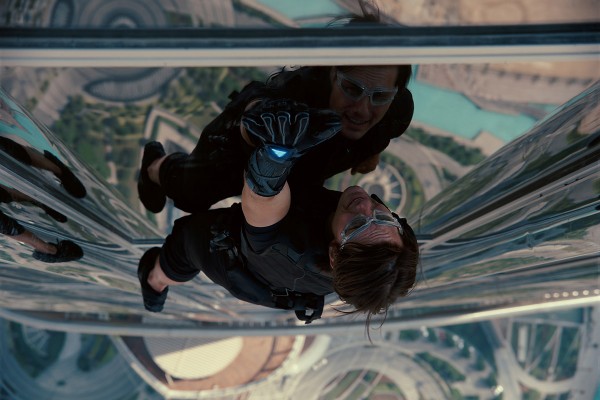
There’s no doubt about it—the best action sequence in the fourth “Mission: Impossible” movie (subtitled “Ghost Protocol”) is the one in which Tom Cruise’s Ethan Hunt has to scale a skyscraper. But not just any skyscraper—the Burj Khalifa in Dubal. The world’s tallest building. Ethan has to scale the glass windows from the outside, more than a hundred stories up. He’s equipped with special gloves that stick to a surface, which of course malfunction so that Ethan can hang on for dear life.

Why doesn’t anyone else do this? Simon Pegg’s Benji’s reponse is simple: “I’m on the computer.” Jeremy Renner’s Brandt’s response: “I’m…the helper.” And Ethan is…well, he’s the hero. He was going to scale that tower no matter what. What floor does he have to stop at? 130.

Pulling off a sequence like this is tricky enough, but then I found out this piece of information—apparently, Tom Cruise did his own stunts. Wait…what?

OK, maybe some heavy wirework was involved or there were unseen footholds around, but Tom Cruise reportedly insisted on performing his own stunts. I simply can’t believe it. There’s a shot where we actually pan out from Cruise scaling the building to where we get a full shot of the place, and I simply can’t believe that anybody would really try this. But apparently, Cruise isn’t CGI in these shots and we really are looking at him. This either means that Cruise is very brave or very stupid.

Either way, this whole sequence is impactful. I have an underlying fear of heights and seeing this on the big screen gave me vertigo. It’s that impressive.

This may be the standout, but there are other terrific action sequences in “Mission: Impossible—Ghost Protocol,” an exciting thriller that comes along like the lost James Bond picture. We have it all—stunts, chases, explosions, neat gadgetry, a megalomaniac villain with a thuggish henchman, and wall-to-wall action. It’s a lot of fun and easily the best entry in the “Mission: Impossible” franchise, proving that sometimes the fourth entry can be the charmer (see “Live Free or Die Hard” or “Star Trek IV”—just please don’t see “Superman IV” or “Batman and Robin”).

OK, maybe the story is a bit muddled and somewhat confusing in that certain things are left unsaid, but there are still some kick-ass action sequences to turn this into a thrill ride to make us care for it. It begins with a prison break, as Impossible Mission Force (IMF) need Ethan back to take care of something big. Ethan is stuck in a Russian prison, so agents Benji and Jane (Paula Patton) break him out in a nicely-done opening scene. The team is hunting down the international terrorist Hendricks (Michael Nyqvist), a genius who is looking to gain control of nuclear weapons. He must be stopped before he succeeds in unleashing nuclear war—he believes that the way to gain world peace is to start over, from the rubble.

Hendricks and his brutish sidekick Wistrom (Samuli Edelmann) blow up the Kremlin and frame IMF, forcing “ghost protocol.” But Ethan, Benji, Jane, and analyst Brandt are still carrying out the mission.

Aside from the skyscraper scene, there are some neatly-staged sequences in the movie. Of course, a lot of these aren’t plausible, but they are thrilling. There’s one in particular that comes in the final half of the movie where the team is in Mombai, and Brandt jumps into a ventilating shaft somewhere. I guess he wears a steel belt so that Benji can keep him safe in the shaft via a mobile magnet. Of course, there are close calls in that sequence as well, as you’d predict. But close calls are what make action scenes all the more exciting.

I liked the four central cast members. They do appealing work and I was interested in following them because they were entertaining. Tom Cruise is on hand for action as he always is in these movies (although you have to wonder, in those sequences where he’s running like mad, if he’s going crazy). Jeremy Renner is apparently stepping in for Cruise in a fifth “Mission: Impossible” movie; he’ll have earned his position as a new lead. (I forgot to mention that his character Brandt isn’t just an analyst—he has field agent training.) Simon Pegg has nice moments providing comic relief. I hate to actually have to type this in a review, but…Paula Patton is hot! And she gets some neat girl-on-girl action in a fight scene between her character and a sexy female assassin played by French actress Lea Seydoux.

This is the live-action film debut of the great animation director Brad Bird (“The Iron Giant,” “The Incredibles,” “Ratatouille”) and it proves to be a spectacular one. “Mission: Impossible—Ghost Protocol” is alive and entertaining with nifty action sequences and an exciting feel.

And the next best thing I can say about the skyscraper scene is this: I wish I had seen it on IMAX…or maybe I don’t. Like I said, I have a fear of heights.

October Sky (1999)

25 Jan

octobersky

Smith’s Verdict: ***1/2

Reviewed by Tanner Smith

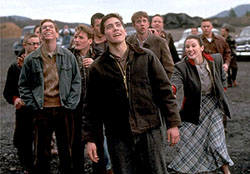
“October Sky” has the feel a smart feel-good sports drama, mostly in the notion in that it’s not just about the sport, but about life’s ambitions and relationships. (“Hoosiers” was a great example of showing that.) But if you don’t care that much for athletics, then “October Sky” is even better for you. The “sport” in this movie is rocket-building, which doesn’t make very exciting competition. But that’s OK, because the rocket stuff isn’t competitive in the slightest. The characters in “October Sky” do what they do because they love doing it and they want to share it with people once they get it right, and hope that the people they love will approve of their goals.

“October Sky” is based on a novel by Homer Hickam and relates to the true story of Homer and his three friends who were experimenting with rocketry when they were high school teenagers in the autumn of 1957, when the Russian satellite Sputnik was first launched. Seventeen-year-old Homer (Jake Gyllenhaal) lives in small coal mining town Coalwood, West Virginia. On the night Sputnik is seen soaring over Coalwood, Homer is amazed by the sight that man has put right up there in space, so much so that he decides he’s going to build a rocket.

His first attempt is not a successful one—it’s a flashlight with a fuse that of course explodes, and blows up part of Homer’s fence. So, Homer—who is a bright student, but science and math are his weak subjects—enlists the help of science nerd Quentin (Chris Owen) to help him and his two friends Roy Lee (William Lee Scott) and O’Dell (Chad Lindberg) build their own homemade rockets. Their first rocket together isn’t as successful as they imagined—they launch it, all right, but it makes its way through town, nearly hurting someone. So the boys make their own launching post eight miles outside of the coal mine and spend their days together making more rockets, hoping at least one of them will them will soar.

On Homer’s side is an encouraging, supportive teacher, Miss Riley (Laura Dern), and his mother (Natalie Canerday) is fine with this new hobby as long as Homer doesn’t blow himself up. But Homer’s father John (Chris Cooper), who runs the mine, doesn’t believe in Homer’s dream. He thinks of it as foolish and believes he should just get his head out of the clouds and down into the mine to work. This is a town that feels like a dirty prison and the only ones that get out of here are those who get college sports scholarships. The rest are stuck to work and mine coal. And so John believes that conducting these rocket experiments, entering and winning the national science fair, and hoping to get into college is just a waste of effort, and doesn’t want Homer to even try it.

And this is where the real tension of “October Sky” lies—not merely with the boys trying to create a successful rocket, although you do really hope that they do. It’s with Homer having different dreams than his father. And his father is not a bad person—he does what he does (confiscating the rocket equipment, forbidding Homer to use it near company property) because he’s doing what he believes is best for his son. He thinks his son just needs to face reality. And he makes sacrifices at work—he looks out for his fellow workers, fights for their jobs, and when we first see him, he even saves a life. He wants Homer to follow in his footsteps. So what we have is a legitimate realistic movie confrontation between a boy and his father—not the one-dimensional arguing that you see in most movies that have this element. It’s characterized on both sides of the confrontation and played very convincingly.

The stuff with Homer and his friends building the rockets has its own whimsy and entertainment value without getting tedious (although you can sometimes predict which rocket is going to explode, during a montage, and that gets kind of old). The boys are excited about doing this, and we’re excited for them. And when they finally get one up there (and good timing too, because everyone in town is watching) midway through the movie, it’s a glorious, joyful moment.

Of course, there must be a central conflict that nearly makes Homer change his mind about what he’s doing and it’s a pretty substantial one. It starts after Homer and friends have made their first successful launch—a forest fire is said to be caused by one of the boys’ faulty rockets and so they’re forbidden to continue with their experiments again. Actually, that’s somewhat obvious, but then John injures an eye in an emergency down in the mine and has time off for recovery. Taking his place is Homer, who learns the responsibilities his father had to go through and ponders about whether he should work down there full-time. But Miss Riley convinces Homer that he should do what he dreams of doing, and that also gets Homer thinking.

This leads to Homer and his friends rejoining to work on rockets again and enter the national science fair, but first they have to figure out, using trigonometry that they learned during all of this, whether or not it was their rocket that started that fire.

“October Sky” is a wonderful movie that has deep values within it. It has a real go-for-it, feel-good spirit in the sequences with the boys making their rockets, and a real connection between a father and son that comes rare in the movies. It’s helped by intelligent writing and more-than-capable acting by Jake Gyllenhaal who gives a winning performance as Homer, Chris Cooper who is excellent and three-dimensional as John, Laura Dern as encouraging Miss Riley, Natalie Canerday as Homer’s loving mother, and Chris Owen, William Lee Scott, and Chad Lindberg as the three friends (Scott, in particular, has some pretty funny moments, even though his fake Southern accent is somewhat forcibly thick).

I will not forget “October Sky” any time soon. It’s a delightful movie that deserves to be seen by everybody. Forget that it’s a mainstream movie that doesn’t feature tired action or forced melodrama, and enjoy it for what it is—a nicely-done, well-acted, free-spirited movie that is likely to satisfy even the most stubborn of audience members.

NOTE: Here’s a fun fact I came across—“October Sky” is actually an anagram for “Rocket Boys,” the title of the autobiography this movie is based upon.

Something Wild (1986)

25 Jan

images

Smith’s Verdict: ***1/2

Reviewed by Tanner Smith

“Something Wild” is one of the more accurate titles for a comedy. It’s about a wild woman, a not-too-wild businessman, a wild series of events, and wild encounters. It gets even wilder as it continues and only lets up in a more conventional final act, but doesn’t hurt the movie so much. It’s too interesting to be brought down.

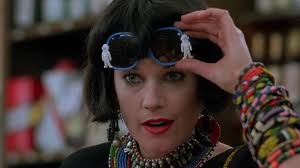
The movie gets to the plot immediately. As it opens, a conventional businessman, named Charlie Driggs (Jeff Daniels), meets an interesting, sexy woman named Lulu (Melanie Griffith). She asks him out to lunch, even if Charlie might be married. But Charlie is easily stimulated by her boldness and comes along anyway. It’s when he gets into her car that he realizes that Lulu is a wild child. She practically kidnaps Charlie and they do whatever she wants to do, and he enjoys her free-spirited, impulsive recklessness. She is that person to bring spark into Charlie’s life and he goes along with whatever she has in mind.

They rent a hotel room, have wild sex, and while he’s handcuffed to the bed, she dials his boss’ number and forces him to talk, because after all, he’s supposed to be at the office. He has to make some sort of excuse, right?

Things get even wilder from there. It involves spending a lot of money, going from hotel to hotel, continuous sex, and soon enough, leading to meeting Lulu’s mother, as Lulu introduces Charlie as her husband. That’s how fast she is; she has a creative imagination and thinks on the fly, all while leaving Charlie to experience it as it goes. (“Lulu,” by the way, is not her real name. It’s the name she chose for the week.)

Charlie and Lulu drive from New York to Tallahassee to attend Lulu’s high-school reunion, still pulling the “husband” card on Charlie to impress her former classmates. They have a fun time (and there’s a brilliant comic scene in which the two dance to a cover of David Bowie’s “Fame”), but they both run into the last people they wanted to meet. For Charlie, it’s his co-worker, an accountant from the office who knows the real deal about Charlie and could either aid him or make things worse. And for Lulu, it’s her ex-husband Ray (Ray Liotta), who was just released from prison (or did he escape?) and came to the reunion to see Lulu again. She’s not interested, but he sticks to the two and soon enough takes them captive in the same way Lulu took Charlie. Charlie is looking for more fun and excitement, but Ray is far too wild to hang around with. He has crime-related ideas to act upon, gets the two involved, and Charlie realizes he must fight for Lulu and for his own life.

The first half of “Something Wild” is mesmerizing. It takes the ordinary everyday world into a bizarre play-land for just about anything to happen at any time. We never see any of the tricks coming; they’re bestowed upon us as they go. They’re random, inventive, and unpredictable. You have to wonder if director Jonathan Demme can keep it going…and it turns out he can keep the spontaneity for so long that the movie descends into a more conventional route, as Ray continues to stalk Charlie and Lulu with vengeance on his mind. This of course must lead to an ultimate showdown—a climactic fight between Charlie and Ray. We pretty much know what’s going to happen at this point, so the tension that was brought upon the impulsiveness and eroticism of the earlier and middle sequences is somewhat reduced.

The actors carry the movie with incredible timing, appeal, and believability. Melanie Griffith has to convince us that her character is a wild child, and has no problem pulling that off. Jeff Daniels is likable and has that look in his eye that says that he wants something, but doesn’t quite know how to get it. That’s where Griffith comes in. The two share great chemistry on-screen, as well as suitable sexual tension. Ray Liotta, showing up midway through the movie, is absolutely compelling as the jealous ex-husband. He has that similar look in his eye, but resorts to higher measures to get what he wants. He is convincing in being able to get Charlie to trust him—this is a guy you’d like to go partying with before realizing that he’s a little too much into the act, more so than you are.

“Something Wild” is indeed something wild. It’s one of those inventive comedies in which the characters and the plot are consistent in that they’re just as surprised to continue as we are. Everything is thought through and seems spontaneous for us to laugh and be invested, and the actors are game for the material. Even if it goes more for a standard climax, it has a lot of fun leading up to it.

Stand by Me (1986)

24 Jan

365647730_640

Smith’s Verdict: ****

Reviewed by Tanner Smith

In a series of novellas called “Different Seasons” by Stephen King, the third (of four) novella—entitled “The Body”—uses the segment “Fall from Innocence,” meaning in all of our lives there is a time that changes our lives forever. Coming-of-age stories are the tales that showcase a character (or characters) going through important events in their lives. In “The Body,” the event for four pre-teenage boys is the journey to find a dead body and become famous for turning it in. They find the body, but they really find each other and learn some valuable life lessons. Despite being written by Stephen King, it isn’t a horror story. In fact, one of King’s strengths in his horror stories is the strong friendships that develop between the characters. This is simply a story of one of those friendships with no macabre elements (save for the sight of a corpse); just simple life lessons.

The novella is closely adapted into the film “Stand by Me.” You can put the praise onto the nostalgia aspects of the story, the convincing portrayals of these four compelling young characters by four excellent young actors, its honest look at their journey (psychologically, as well), or all of the above. Either way, “Stand by Me” is a wonderful movie. It’s one of the best teenage coming-of-age films I’ve ever seen. It’s fun, it’s touching, it’s believable, well-acted, well-executed, and when it needs to be, very funny. It’s the third outing for Rob Reiner as a director, after the success of “This is Spinal Tap” and “The Sure Thing.” His impressive streak continued with “Stand by Me.” Reiner knows the subject material by heart and, with an excellent screenplay by Ray Gideon and Bruce A. Evans, brings delight to the screen in telling this story.

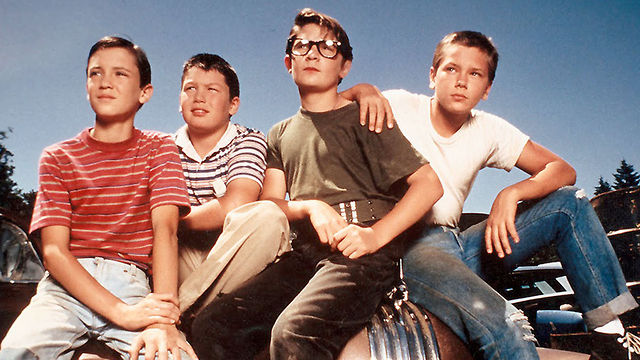
Unlike most coming-of-age stories, this one takes place in just a couple of days, rather than a couple weeks, months, or even years. That’s how long it takes for these small-town Oregon treehouse boys to walk along the railroad tracks to find the dead body of a missing kid. It begins as pudgy, wimpy Vern Tessio (Jerry O’Connell) arrives to the treehouse to tell his friends—Gordie Lachance (Wil Wheaton), Chris Chambers (River Phoenix), and Teddy Duchamp (Corey Feldman)—his knowledge of where it can be found. They decide to trek after it, turn it to the authorities, and become famous.

Where do I start with the effective drama in this movie?

Each of these boys have their own demons, as we learn through the journey. Gordie—who serves as the narrator of the story, voiced as an adult by Richard Dreyfuss—is haunted by the thought that his parents believe his late older brother—the “favorite son” (played in flashbacks by John Cusack)—was the wrong one that died. (He even has a nightmare in which his father states, “It should’ve been you.”) Chris comes from a family who doesn’t love him, has a reputation of being a bad seed like his brother “Eyeball” (Bradley Gregg), and just wants a fresh start, but feels trapped by his hometown. Teddy’s mentally unstable father, who wound up in a mental hospital, abused Teddy and no one ever lets him forget it. Vern is a coward, always afraid of trying anything new. Each of these elements are brought up and confronted along the way. They realize the good things they have in life—one is each other, and the other is their own abilities. In particular, Gordie is a creative storyteller and Chris is loyal and mostly takes the peaceful route. This is all told in a convincing, well-written, well-acted way that makes for one great scene after another. The most touching scene is when Chris finally breaks down and tells Gordie, his best friend for life, about the time he really felt let down.

The boys’ friendship is in danger of being torn apart. This is first brought up when Chris tells Gordie that he’ll be separated from him and the others, because he’ll achieve at a higher rank than them. Gordie doesn’t want that to happen, but it’s inevitable. Since Chris doesn’t want to drag Gordie down, he doesn’t want to fight it—he wants Gordie to use his gift of writing to succeed in life. No one’s friendship is the same as when they were 12 years old, but at the time, there’s nothing stronger than that bond.

Then once the kids find the body, they’re faced with their own mortality once it turns out that the town bullies, led by knife-wielding Ace (Kiefer Sutherland), show up and decide to claim it for themselves. It’s then that they realize what’s more important, what’s at stake.

This is great stuff! It’s all told in a very effective way and makes us believe in every detail these characters go through. But the movie isn’t so dramatic that it will turn people off—there is a lot of comic relief in many inventive scenes of comedy and adventure. In the latter category, we have the actual trek itself. The boys get attacked by a junkyard dog, which turns out to show as a real difference between fantasy and reality (it turns out to be a harmless-looking Golden Retriever); they go through leech-invested waters in the middle of the forest; and in the most exciting scene, they cross a railroad bridge and nearly get run down by an oncoming train. As for comedy, the best segment comes during the boys’ campout—it’s the story told by Gordie to the others about a tormented overweight boy who gets his revenge at a pie-eating contest, in the most disgusting and hilarious way. It works as comedy and as a concept of a disregarded child, giving come-uppance to his tormentors.

The comedy, drama, and adventure go great together, and the performances by Wil Wheaton, River Phoenix, Corey Feldman, and Jerry O’Connell are spot-on. They capture their personalities distinctively and memorably and make for great company to spend an hour-and-a-half with.

I love this movie. I love it so much that I’m sincerely hoping I’m not leaving anything out in this review. Sometimes, I want to hurry along a review and finish it. But with really great movies such as this one, I hope there’s nothing I’ve missed that needs to be brought up. I love “Stand by Me” that much.

Waterworld (1995)

24 Jan

screenshot-med-01

Smith’s Verdict: ***

Reviewed by Tanner Smith

The most expensive movie ever made at its time, 1995’s “Waterworld” is known as one of the all-time bombs—up there with productions like “Heaven’s Gate” that didn’t even come close to making its money back. That doesn’t necessarily mean it’s one of the all-time worst movies. Actually, it’s a pretty decent action flick with nicely-handled sequences and great sets that give atmosphere.

Though, with the label of “most expensive movie,” it’s easy to see why people were disappointed by the outcome of the production. Even disappointing to me, actually—for a movie of this budget, perhaps being merely “decent” is a disappointment. But you take what you can get.

“Waterworld” takes place in the distant future, as we see a change in the opening Universal logo with the polar ice caps melting, and a brief narration stating that most of the world is covered with water. Thus, we have Waterworld, a place filled with drifters, terrorists, and falling civilizations—all survivors now living on manmade boats, one large ship, and large docks. No land in sight. Freshwater and dirt are now valuable trading. People and brotherhood aren’t what matter to the survivors anymore.

Kevin Costner stars as Mariner, a drifter who lives on his own, sailing on a boat of his creation. He trades for some dirt and sells it in a civilization made up on a big floating “atoll.” However, upon closer inspection, the people there see that he’s a mutant—he has gills and webbed feet. But while the people want him executed, a barmaid named Helen (Jeanne Tripplehorn) and her adopted daughter Enola (Tina Majorino) believe he has seen Dryland, assuming from most of the materials he has traded. So they join him on a journey to get there. However, a terrorist group called the Smokers, led by one-eyed, nasty Deacon (Dennis Hopper), is after Enola (quite an unusual name—it’s “alone” spelt backward) because she has markings tattooed on her back that might actually be directions to Dryland (though no one can decipher them).

“Waterworld” has some intriguing ideas. As we see in the beginning of the film, we see how Mariner is able to stay hydrated and healthy—he processes his own urine, drinks it, gargles, and spits on his little lime tree. That’s very clever. We also see many of the technical aspects of this world—there are a lot of shots focused on how many gadgets work. I love the focus on the mechanics in this world.

But there are some pretty dumb moments with “Waterworld” as well. For example, why would the people on the atoll try and kill Mariner after finding out about his mutation, when HE WAS JUST ABOUT TO LEAVE? What did they have to worry about? And also, why is there a prejudice against people with gills in this world? With some experimentation, couldn’t there be some problems solved around this man who can breathe underwater, in a world that is maybe entirely covered in water? Nothing is made clear of this. There are also moments involving stunts involving jetskis in which the movie looks like a TV spot for Seaworld.

The action sequences are mostly well-staged, particularly the Smokers’ attack on the atoll as Mariner, Helen, and Enola must escape. Even if the stuff with the jetskis looks commercial-like, there is some impressive stuntwork there. I also really liked the final sequence in which Mariner must storm the Smokers’ ship in order to rescue Enola from Deacon’s clutches (and hammy speeches).

Kevin Costner is probably not the best choice to play this part—as the anti-hero, Costner doesn’t particularly come across with as much energy as Mel Gibson with his “Mad Max” movies, nor does he have the goofy one-liners that Schwarzenegger could deliver. Sometimes, he’s just kind of a bore. But as an unsmiling action hero, he’s mostly effective. He does have his share of badass moments. Dennis Hopper, as the villainous Deacon, is deliciously over the top and also serves as weirdly effective comic relief. Jeanne Tripplehorn is fine and Tina Majorino, while kind of annoying at first, gets better as the role progresses.

“Waterworld” has its problems, but has its action and sets to make up for them. This may be one of the bigger bombs in the past thirty years, but it’s far from one of the worst movies in the past thirty years. It’s just decent.

The Secret of NIMH (1982)

24 Jan

000015_16

Smith’s Verdict: ***1/2

Reviewed by Tanner Smith

Don Bluth’s animated movie “The Secret of NIMH” recalls the joy of some of the earlier Disney features. In fact, I think Walt Disney himself would’ve been impressed by the chances this animated movie takes and how unusually thought-provoking it is.

If you think the NIMH in the title is the acronym for the National Institute of Mental Health, you’re right. We learn that a group of NIMH laboratory rats and mice were injected with a secret serum that made them smarter. They could read, reason, and became so smart that they escaped from the lab and made their own secret home and society in the backyard of a farmhouse. They were able to create lights, electricity, and other mystical elements that the movie doesn’t explain, but to be fair, I’m not sure the altered rats themselves can explain them either.

That’s the secret of NIMH that the title suggests, discovered by the story’s heroine on her own adventure. This is Mrs. Brisby (voiced by Elizabeth Hartman), a field mouse/widowed mother who has a deeper connection to the rats of NIMH than she thinks.

Mrs. Brisby is an unusual leading character for a movie like this. Usually, it’s the plucky young children (like Brisby’s own children) who go out and embark on the incredible journey (in fact, in most Disney movies, parents end up either dead or separated). But not here—Mrs. Brisby also isn’t a wisecracking action hero that races to save the day. She’s a concerned mother with a real bravery to her that forces her to go out and do what she does in order to protect her family. She’s kind and likable, and serves as an appealing heroine.

Mrs. Brisby’s ill child is sick of pneumonia, as a mouse named Mr. Ages (Arthur Malet) declares, and must stay in bed for about three weeks. But “moving day” is approaching fast, meaning that a tractor will come along and plow the field. Mrs. Brisby can’t take her child away from home and risk him dying, so she must venture into the farm for answers.

After an encounter with a visionary, intimidating Great Owl (John Carradine), Mrs. Brisby finds the home of the NIMH rats, meets their wise old leader Nicodemus (Derek Jacobi), discovers their secret, and enlists their help to move her home to safe location. At the same time, the rats are trapped with the ethical dilemma of whether or not to keep stealing supplies from the humans or to move out into the wilderness to set up a new society for themselves.

For that matter, what is needed for the rats of NIMH to continue to survive together? Is it discovery? Is it science? Is it logic? Is it intelligence? Maybe it’s all of those choices. This helps make “The Secret of NIMH” into a deeper social commentary. What all do we need to survive in this world, when you really think about it?

“The Secret of NIMH” has a complicated but intriguing story that is distracted only by the unnecessary antics of an annoying talking crow named Jeremy (Dom DeLuise). Kids may enjoy this character, as he is constantly mumbling nervously and acting clumsily, but he really did nothing for me. He doesn’t really have a payoff either—he doesn’t wind up helping to save the day (he returns too late)—so the only reason he’s there is so Mrs. Brisby can ask him to look after her children while she’s gone, and the kids tie him up and torture him.

The animation from Don Bluth and his followers is nicely done. Body language is expressed for the characters, the animals range from cute to frightening, the backgrounds are interesting, and the settings are good-looking. There’s a real sense of depth here.

“The Secret of NIMH” moves at a brisk pace, is delightfully drawn, and carefully constructed. It’s a well-done family film that will entertain adults as well as kids, because they can probably see more than just cute little mice and an inviting look. They can see something deeper within the story.

Young Sherlock Holmes (1985)

24 Jan

Ysh_poster

Smith’s Verdict: ***

Reviewed by Tanner Smith

“Young Sherlock Holmes” imagines what it would be like if Sir Arthur Conan Doyle’s notorious detective characters Sherlock Holmes and Dr. Watson met as young men. And even if the screenplay calls for young Holmes and young Watson to embark on an adventure of Spielberg proportions not necessarily worthy of the Doyle tales (indeed, Steven Spielberg was one of the film’s producers), it’s a pretty entertaining watch.

The introduction of young Holmes and young Watson is wonderful—a real treat. Young Watson is the new-boy-at-school in every sense—he’s near-sighted and slightly round. His first encounter with a fellow student is a young genius named Holmes. Just as Watson is about to introduce himself, Holmes stops him, saying “Let me.” After an awkward pause, Holmes, without stuttering, states proudly, “Your name is James Watson, you’re from the North of England, your father is a doctor, you’ve spent a considerable amount of leisure time writing, and you have a particular fondness for custard tarts. Am I correct?” He was right about everything except that Watson’s name is John. Watson asks how he did that, to which Holmes responds that it was clear, elementary deduction from a close look at his belongings.

“The name tag on your mattress reads J. Watson. I selected the most common name that belongs with ‘J’—James. John would have been my second choice.”

The boarding school that Holmes and Watson attend is in the great tradition of English locations used in fiction, in which a great sense of unconventionality is always visible. In particular, living in the school, is a retired old professor, Dr. Waxflatter (Nigel Stock). He has many bizarre, clever, wonderful inventions in his workplace. His latest is a contraption much like a one-man pedaling airplane—however, his many tests have proven unsuccessful.

And let’s not forget that nosy dark-cloaked figure that stalks the grounds and uses a blowpipe to shoot special thorns into his victims. The thorns are dipped in a solution that causes those exposed to it to experience frightening hallucinations. The victims seem to be killing themselves to escape their drug-induced nightmares—these include a gargoyle that comes alive and attacks; a coat hanger that turns into snakes; and the most impressive (although definitely underused) special effect, a stained-glass-window knight that jumps off the window and walks toward the victim. (For you trivia buffs out there—That knight is the first entirely computer-generated character to be released in a feature film.)

When Waxflatter falls victim to the hallucinations, Holmes and Watson are left important clues. Holmes is determined to get to the bottom of this foul play, as he, Watson, and Holmes’ girlfriend Elizabeth race to solve the mystery.

What they find, I’ll admit, is not worthy of Holmes and Watson. It’s a secret Egyptian religious cult that partakes in human sacrifice of young female virgins, inside an underground pyramid. Just call this “Young Sherlock Holmes and the Temple of Doom” and you get the idea. (Fittingly enough, in some countries, this film is entitled “Pyramid of Fear.”)

“Young Sherlock Holmes” is essentially Doyle mixed with Spielberg, and it does more justice to Spielberg than it does to Doyle. But there are many Doyle elements to enjoy—such as the references to the Holmes/Watson elements we know of (Holmes’ pipe, his cloak, his violin-playing, etc.). The characters of young Holmes and young Watson are portrayed and written convincingly in the great spirit of Doyle, and played wonderfully by Nicholas Rowe as the charismatic young genius and Alan Cox as the loyal Watson. They’re effective so that Holmes purists won’t be offended.

There’s one element that fans will notice doesn’t fit into this Holmes story and that’s the character of Elizabeth (Sophie Ward), a beautiful young woman who lives at the school and serves as Holmes’ love interest. She’s beautiful, nice, and attentive; but you can tell where the character is going so that no woman will ever touch Holmes’ heart again, hence his bachelor lifestyle. However, to her credit, if anyone were to be the only woman for Holmes, it would have to be Elizabeth.

Even if the special effects don’t belong in a Holmes story, they’re still fun, and so is this movie. “Young Sherlock Holmes” gives us interesting heroes to root for, an engaging mystery for us to follow, and more-than-capable execution from director Barry Levinson, writer Chris Columbus, and cinematographer Stephen Goldblatt.

The Stepfather (1987)

23 Jan

500full

Smith’s Verdict: ***

Reviewed by Tanner Smith

“It’s like I have Ward Cleaver for a dad.”

In the low-budget thriller “The Stepfather,” teenager Stephanie Blake doesn’t know the half of it when she delivers that simile about her new stepfather. This new man in hers and her mother’s life seems like the perfect family man, or he just wants the perfect family. It seems like he wants his family to be like those in “Father Knows Best.” But there’s something we know that Stephanie and her mother don’t. The stepfather Jerry is undoubtedly an unstable, sick mind. As we see in a creepy, gripping opening scene, this man has murdered his family (we don’t see the murders, but we do see the bodies in the living room), changed his appearance (shaved his beard and wears contact lenses), and went off to find a new family. One year later, he has changed his identity and remarried Susan Blake (Shelley Hack) to come across, possibly yet again, as an ideal family man. Susan falls for it, but daughter Stephanie (Jill Schoelen) sees right through him—she complains to her mother, “It’s not even our house anymore—it’s his.”

The stepfather goes through the notions of an ideal family man, fooling everybody in the neighborhood. He hosts dinner parties with his real-estate clients, gives Stephanie a puppy as a present, and even calls her Pumpkin, which creeps her out even more. Stephanie’s therapist (Charles Lanyer) thinks she’s just having trouble adjusting to having a stepfather to replace her deceased father, and her acting up in school—and getting expelled—doesn’t make her any more credible. But she knows that something is wrong with this man.

“The Stepfather” has its share of effectively disturbing moments—the most memorable is that opening scene I described. Just as tense is the scene in which Stephanie comes across the stepfather having a mental breakdown before immediately snapping back into character when he sees her. But it also has one other, very important thing going for it, and that is the performance by Terry O’Quinn as the stepfather. O’Quinn is great in the role—chilling, subtle, and even strangely likable at some points. He’s convincing as a psychopath who acts as a normal person but has an unbalanced mind that resorts him to murder when everything goes wrong. The tension is always there when he’s on screen.

Not particularly strong is the subplot involving the brother of his latest victim trying to track down the killer, by using a newspaper reporter and a police detective to try and track him down. It’s not particularly interesting and pretty distracting, compared to the family aspects and tension.

What really satisfied me about the film was that the characters weren’t necessarily idiots to figure this guy out, especially when the film shows the audience right from the start. I feel like this man could fool anybody; of course, that includes Susan. And Stephanie does her own detective work. She has a sure plan to figure him out, which backfires, making her feel like she was wrong about him. This helps raise the tension level.

“The Stepfather” isn’t like the usual slasher films you come across. Sure, it does have a rising action that comes down to a climactic confrontation between the psychotic killer and his family, and you could use that for the climax for any other film of this sort. But what makes “The Stepfather” special is the characterization and performance of the title character, its successful scary moments and haunting feel, and a sharp script by Donald Westlake. It’s an effective thriller.